I was looking up a link for someone and rediscovered the video today showing how to make tough and durable sandals from discarded tires. This style is well-known in Southeast Asia, particularly in poorer areas.
If you are interested in sandal-making, you can hardly go wrong with this design if you have access to old tires. I suggest watching the video if only for the remarkably sharp knife this maker is using. Using tire material is a little heavy but will truly last a lifetime. The straps fit purely by friction so they are continuously adjustable while the waterproofness of the material makes them perfect for the wetlands and jungle.
I understand this style was created in the 1940s when old tires became abundant and some creative shoemaker had a Eureka moment. There is also a short write-up on this style on the always interesting Huarache Blog if you are seeking more information about this shoe.
Another step toward self-sufficiency and off-grid knowledge for the Mayhem Shoe Collective.
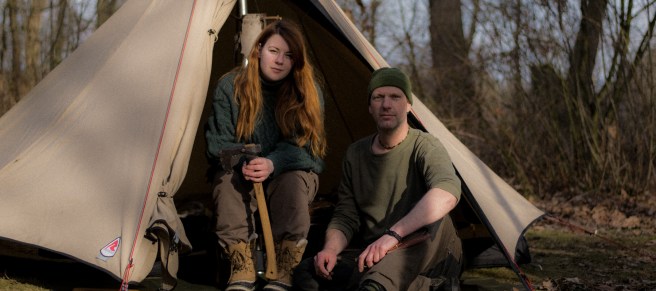
From one of my new favorite blogs Running With Sheep. Johan and Sanne are a couple of remarkable outdoors – bushcraft – survival enthusiasts with more than a touch of philosophy thrown in.
Their most recent project shows how to convert a run-of-the-mill thrift store find into a functional pack basket. From what I can tell, they are adept leather workers so their skill shows in this project. Re-using found objects is an excellent way to economize both money and time, especially if it is something outside your skill set or craft specialty.
Pack baskets are light and strong and a perfect choice for hauling anything from food to dirt. Prehistoric people used them for everything, and the solid structure makes them useful even when not carried on the back (most of the time).
If you can cut a few straight lines, do some minimal sewing, and hammer a rivet, this project is for you. For the complete post, head over to Running With Sheep to learn more. I suspect you’ll want to stay a while and catch up on their other posts as well.
Learning a thing or two from the past…Part 1, 21st century Westerners are not the first to minimalize.
How much stuff do we really need to lug through life?
“The things you own end up owning you.” Chuck Palahniuk, Fight Club
There’s a lot of recent talk about Minimalism as a social movement and this fits well with my personal philosophy and my interests in preindustrial technology and survival. Not long ago, minimalism was mostly associated with artists, aesthetes, wanderers, mystics, and philosophers. That is to say, the fringe element, outsiders, and weirdos. These things come in cycles and I think, as a backlash against generations of sell-out philosophy and the creation of a professional consumer class, many people are reaching for something new.
We come to learn that everything old is new again.
I’ve been pondering history and prehistory on a full-time professional basis for several decades now. As hard to believe as it may be, I even get paid a salary to do it. One of my professional interests involves the tools, tool-kits, and strategies for surviving that various people have come up with for dealing with the world. As a sometimes primitive skills-survival instructor and full-time frugalist I think it important to not reinvent a lifeway when we have millennia of ancestors who dealt with most of the same issues we do today.
A San bushman demonstrating fire-making. Ostrich egg canteen in the foreground. These people probably resemble our ancestral way of life and have very few possessions, even in their harsh environment.
For most humans, for most of our history, owning too much stuff has never really been an issue. We had what we needed and either made what we needed or did without the things we didn’t have. It brings a smile to my face to know that more than 2,500 years ago, various thinkers people in China, India, Greece, and the Middle East were contemplating the nature and evils of acquiring stuff; some were even writing about it. That’s not to say that I have immediate plans to become a wandering mendicant like a medieval friar (as appealing as that might sound to some) but I do have an interest in lightening my material load and some very specific goals for the coming year.
Medieval European mendicants represented by a pilgrim and a friar.
My foundation as a minimalist (and I may not be very good at it)-
I have been thinking about what stuff a person needs to survive since I was a teenager who enjoyed backpacking and travel. Like virtually every young boy, I had grand ideas of escaping the family and traveling unhindered across the world. My family weren’t exactly readers but I devoured Jack London and Mark Twain stories as a kid. I loved the extensive and well-thought out gear lists provided in the Boy Scout Handbook, the Explorer’s Handbook, and the Philmont Guides. I read Larry Dean Olsen’s great book of Outdoor Survival Skills and Colin Fletcher’s The Complete Walker again and again. I read about the mountain men of the fur trade, and always, took note of what they carried or didn’t seem to need. I would copy lists into a notebook and revise them while sitting in some boring high school class, making my own lists of what I have, what I need, and what I want. This thinking encouraged me to work and save money to buy a better knife, backpack, or camping stove. I was probably the only kid I knew who wanted, and got, a file and whetstone for Christmas one year (my grandpa was good that way). My friends and I spent our teens and early twenties hiking and camping year round, mostly in the woods of the Ozarks in southern Missouri testing our mettle at that time in life time when all teenagers know they are invincible. Some of us even made it to Europe, Asia, Africa, and beyond.
A few of the many books I ended up possessing on a quest toward fewer possessions.
In a modern sense of survivalist, many people look to the military or the loonies of the social media. Often, military service is the time when young men and women are introduced to such things for the first and only time in their lives. Realistically however, the military itself acknowledges it’s shortcomings on a personal basis as (with the exception of a few special operations units) its entire system is dependent on lengthy and complex supply lines, support chains, and de-emphasis of the individual and personal decision making. Military survival is generally approached as a means of keeping alive until help arrives. Great for fighting a war, but not always so good when you are turned loose into the world. This sort of survival strays from our point here anyway.
More (and less) to come soon.
* here are a few links to modern Minimalists of various ilks and philosophical merit. A journey through these links will hint at the breadth and depth of people on different paths but moving in the same direction.
My fishing kit is coming together and I added another hook and leader last night.
The left hook and gorge are made from deer cannon bone (metacarpal) and the right is whitetail deer antler. The antler hooks are proving to be tougher and less likely to snap under tension. The leaders here are yucca and stronger than I would have thought. Hopefully, we can test them out sometime very soon.
I study the technology of prehistory. Because of this, I believe strongly in the benefits of experiential archaeology. It gives perspective on a very deep level. We can walk in the shoes of our ancestors, so to speak. I say experiential here not experimental and I’m glad to hear this word coming into the dialog of other primitive technology people. While not trying to dwell on the words themselves, it is an important distinction. Experimental generally implies the ability to replicate an actual experiment (i.e., testing a hypothesis to see what you find).
Experimental pottery; gathering materials, construction, paint, and firing. Click the image to see more about this project.
True experiments are things like:
Can a tree be cut down using an exact replica of a prehistoric axe?
Is it possible to move a ten ton stone over long distances using only the technology and manpower available in the Neolithic?
Can fire be made by rubbing sticks together?
Will a Medieval arrow penetrate 14 gauge armor plate?
You certainly gain the experience through these experiments but you are also testing something specific with something like a yes or no answer. Experimental archaeology can create some popular misconceptions as well. Just because something could be done, doesn’t mean that prehistoric people must have done it that way.
Replicated woven sandals as found on the Southern High Plains and throughout the greater Southwest. Produced from narrow-leaf yucca (by Stacey Bennett).
Experiential archaeology integrates this and everything else learned along the way. E.g., How comfortable are these shoes, is there more or less back pain using a tump line on a pack, what kind of wear can be expected on arrow fletchings over time? This allows us to ask even more questions and have a fuller knowledge of ancient peoples.
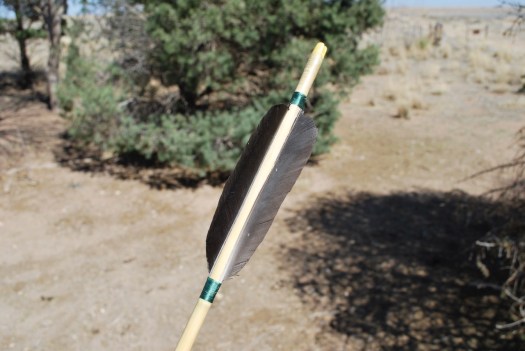
Testing silk lashed goose feather fletching. Clicking the image links to bamboo arrow making.
I really enjoy the various directions replication takes the maker. Learning the finer points of cutting and scraping with stone flakes or abraders, working with antler and wood, creating glues and mastics, and developing an appropriate paint or sealer as on the spear thrower below.
Upper Paleolithic-style spear thrower. Image links to the “how to” for making this thrower.
Whatever you do and whenever you learn, it’s all good.
There are so many good reasons to have a home garden, even in the city.
Starting fresh in a new place means we’re in for some work this spring. Although I suspect that many things have grown in this yard in the last century, other than the small plot I turned over last year, we have mostly lawn. Even our lame little herb and tomato plot yielded some great results. Our worst pests are definitely squirrels, with birds and raccoons running a close second. The seed catalogs are in, orders are being placed soon, and preparations are ready to begin.
With the risk of sounding like a nonconformist, I really feel that every creative act minimalizes our interaction in a consumer economy, is a small personal victory. Our war is a personal one now. Planting food, mending clothes, buying local (or not buying at all) is a triumph of the will. Knowing where our food comes from is a good beginning on a path to a better life.
For many Americans, simply planning and making a great meal from scratch feels like a success; and it is. It just takes small steps and eventually, these skills and habits become second nature. Your food is better, your health will improve, and you will have an invaluable skill. Teach your children well.
And finally, food preservation is the next logical step. With refrigeration as the norm in the industrial world, we should take a little time to ponder what happens when the power goes out. Hurricanes, tornadoes, earthquakes, or acts of terrorism are all very real things, even if we don’t feel them every day. There is a thin line of convenience that can be quickly swept away and a little preparedness goes a long way. One great start is the Ball Canning Jar Company’s Blue Book. It has been around for over 100 years and has helped people preserve food without much experience and at a low cost. Even though there some initial monetary outlay, remember that most everything is re-usable.
A good reference like this keeps you healthy and safe. The modern, up-to-date version is readily available at nearly any retailer who sells cookbooks.
If you haven’t grown your own food, or you haven’t in a while, consider making this your year for better food.
Winter is here. For some of you it is here with real gusto. Growing up in Missouri and being sent out to ‘play’ no matter what the weather or who was around I learned a lot about how to entertain myself. Snowfall in the Mississippi valley could be heavy and wet throughout the winter and was a great medium for construction snowmen, fortresses, and quinzhees. Of course, we didn’t know such an exotic word at the time but we did learn good tricks and techniques for safety later in the Boy Scouts.
Image from Boy’s Life magazine. Click for a short “how to.”
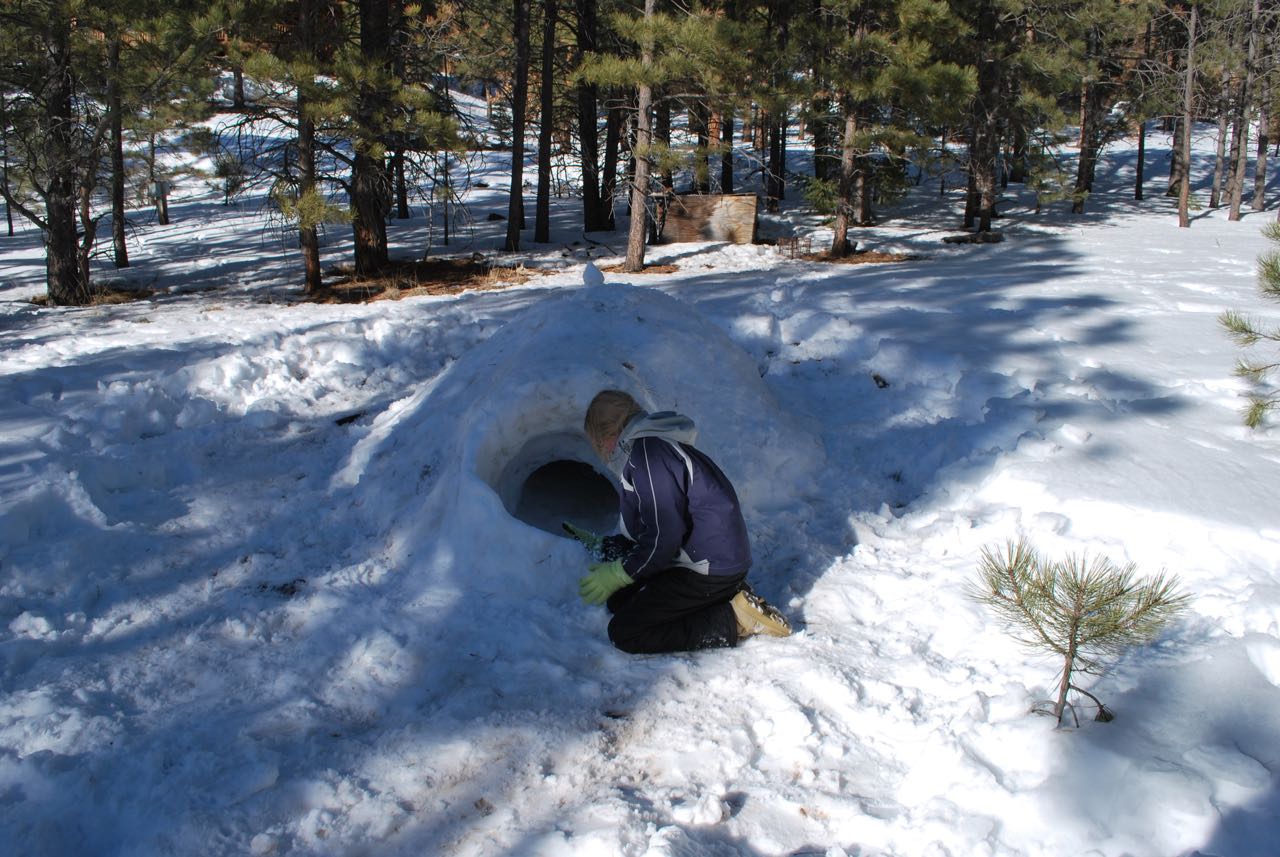
I’m certain there are no photos of the sometimes elaborate, and often not so elaborate, snow shelters my friends and I built as kids (I don’t think parents played outside with kids in my era). I was reminded that we had our own photos of one built with my daughter several years back. We were staying with a friend in the Sangre de Cristo mountains for the holiday at about 8,000 ft AMSL (ca. 2,500 meters). The snow was perfect and wet so we couldn’t pass up the chance for a little shelter building. “Teachable moments” surround us every day. It’s up to us to take advantage of them.
Working on the wind wall. If you look closely, you can see the miniature chimney and rain shield on top.
The snow wasn’t deep and we weren’t intending to spend the night inside so it was kept pretty small for ease of construction.
View into the vestibule. The opening was kept narrow for warmth.
It was a chance to talk about safety, collapse, and fresh air exchange. Valuable information for later in life. Ours faced south.
The dog was, of course, a great help, mostly chasing snowballs.Testing out the fit.
It was definitely kid-sized but an adult could squeeze in more-or-less comfortably for a while. The dog was not enamored with the confining space.
Enjoying the evening by the warmth of a candle.
It was just another fun day, experimenting with the gifts that nature provided, and passing on knowledge to the next generation of wilderness lovers.
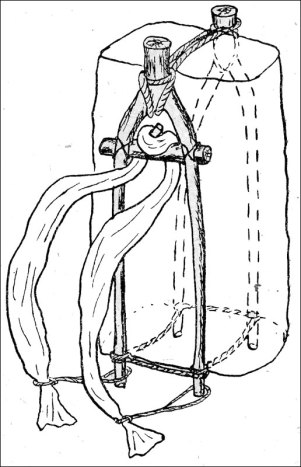
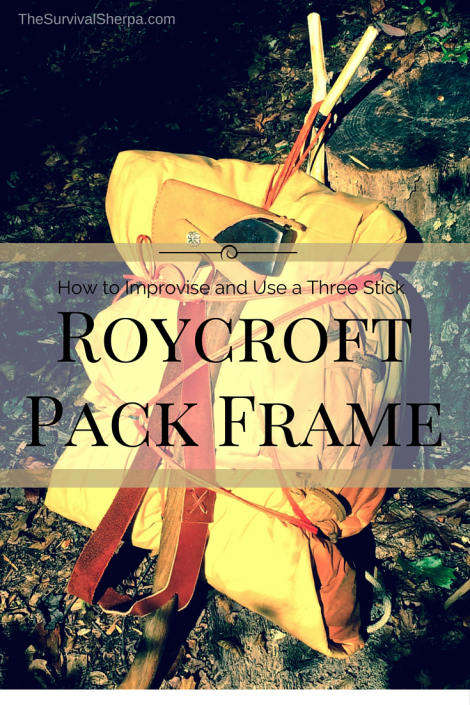
Thanks to Survival Sherpa for posting this look at making a pack frame. Making a quick, three stick pack frame is a valuable bit of knowledge. How serendipitous that this came up (seems to be a lot of convergent thinking around my world lately) as I am beginning to tweak my own wooden pack frame for some experimental travel. And while we’re on the subject here’s a link to a broad look at pack frames from around the world on Markus Kittner’s fine web page.
Have a look at Survival Sherpa by clicking the link below.
I study the technology of prehistory. Because of this, I believe strongly in the benefits of experiential archaeology. It gives perspective on a very deep level. We can walk in the shoes of our ancestors, so to speak.
Replicated woven sandals as found on the Southern High Plains and throughout the greater Southwest. Produced from narrow-leaf yucca.
A fun and relatively tame primitive technology event for a good price located in southwest Missouri put on by good friends of mine. Here’s some information from their website:
This unique event has two parts – a free knap-in/native arts-crafts show starting Thursday, with top-notch knappers, artists, and crafters from a 20-state area making and selling their work. In the Workshop Area starting Friday, a pool of some of the area’s finest instructors offer workshops on various wilderness skills and crafts. You can learn the survival skills of our ancestors, and in many classes, take home a completed project.
Overnight camping and vendor-knapper setup – $5/night, a limited number of electric sites available on a first-come basis – $15/night. If you arrive before Wednesday, leave camping fee in the deposit box, Wednesday and after, please pay at the Registration Booth. Food Concession provided by the Dade County Historical Society.
Admission to the Workshop Area – $60/day or $150/3 days:
Get your hands on it, and learn with some of the finest primitive skills instructors in the midwest!
Below is a partial list of workshops available – the list may change to to instructor availability, check registration for an updated schedule.
Friction Fire
Flintknapping
Flute-making
Basketry and Pottery
Deadfall Traps
Pine Pitch and Hide Glue
Pump Drills
Bow and Arrow Construction
Atlatl Construction
Bone Tools
Tracking and Trailing
Primitive First Aid
Bowls & Containers
Knife Sharpening
Primitive Cooking
Braintan Buckskin Hide Tanning
Buckskin and/or Cattail Moccasins
Cordage & Netting
Shelter
Rivercane Blowguns
Edible, Medical Useful Plant Identification
Edible Insects and much more!
HEAD OVER TO THEIR WEBSITE FOR MORE INFORMATION, MAPS, ETC.









 Preindustrial Craftsmanship