Terrapin, a New Caravan Design From Casual Turtle

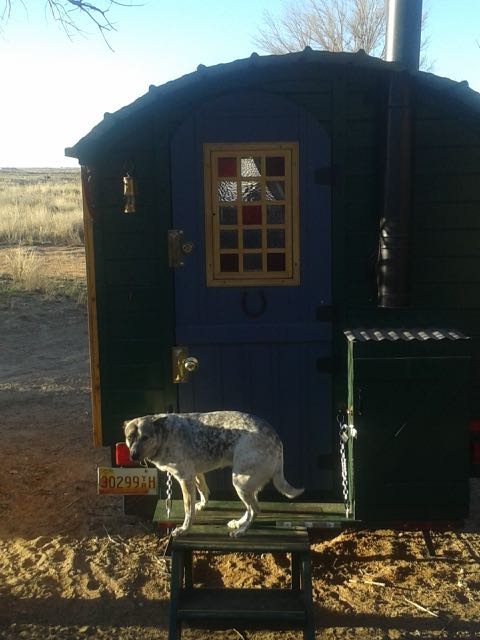
aThere’s a new edition to the fleet of designs coming from Peter Pavlowich at Casual Turtle Campers.  The unique, curved roof lines really make his work stand out in the crowd and I’m glad to see it again in his newest model.  For me, this design melds the aesthetics of the early motor caravans with modern tastes.

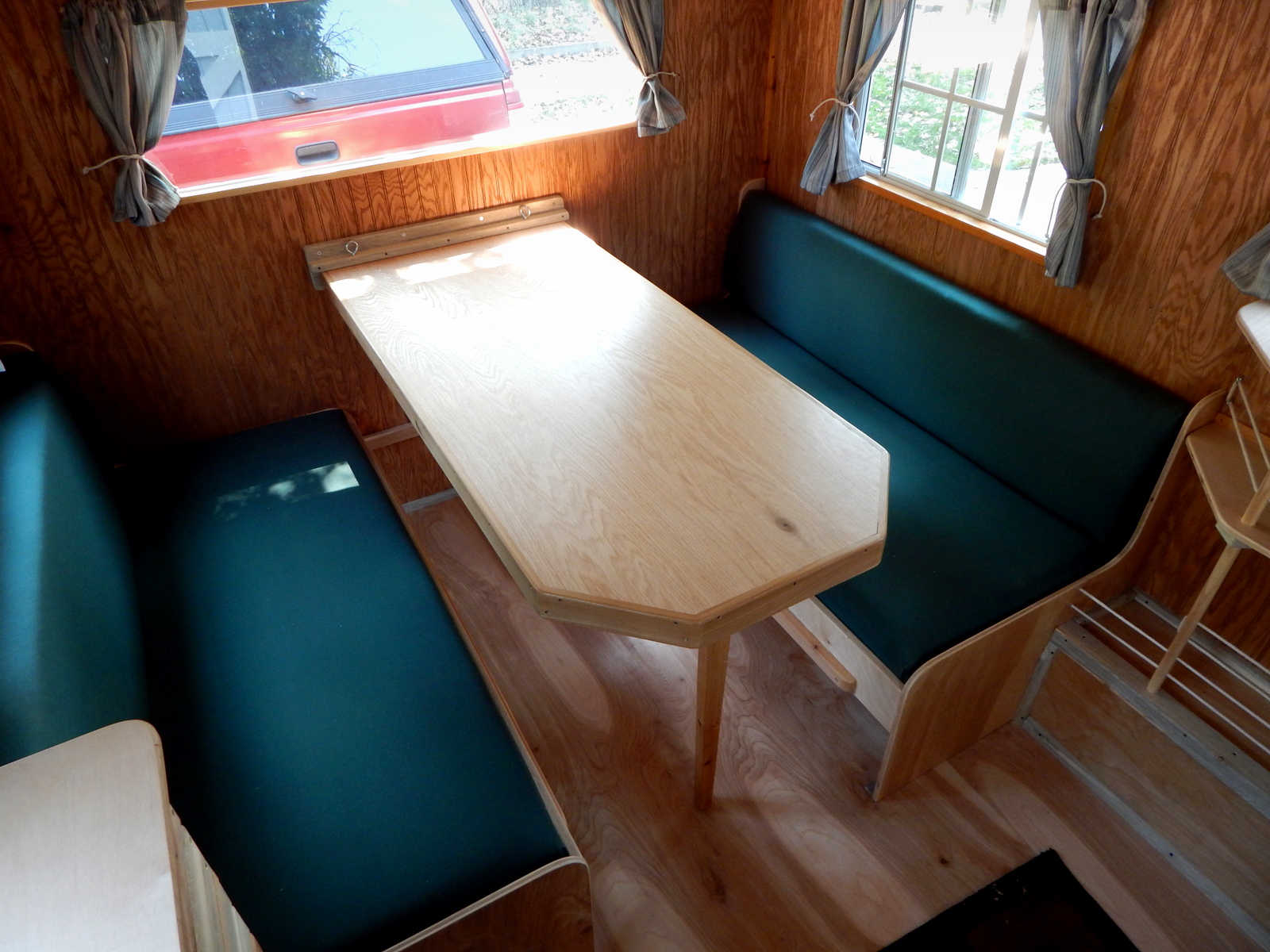
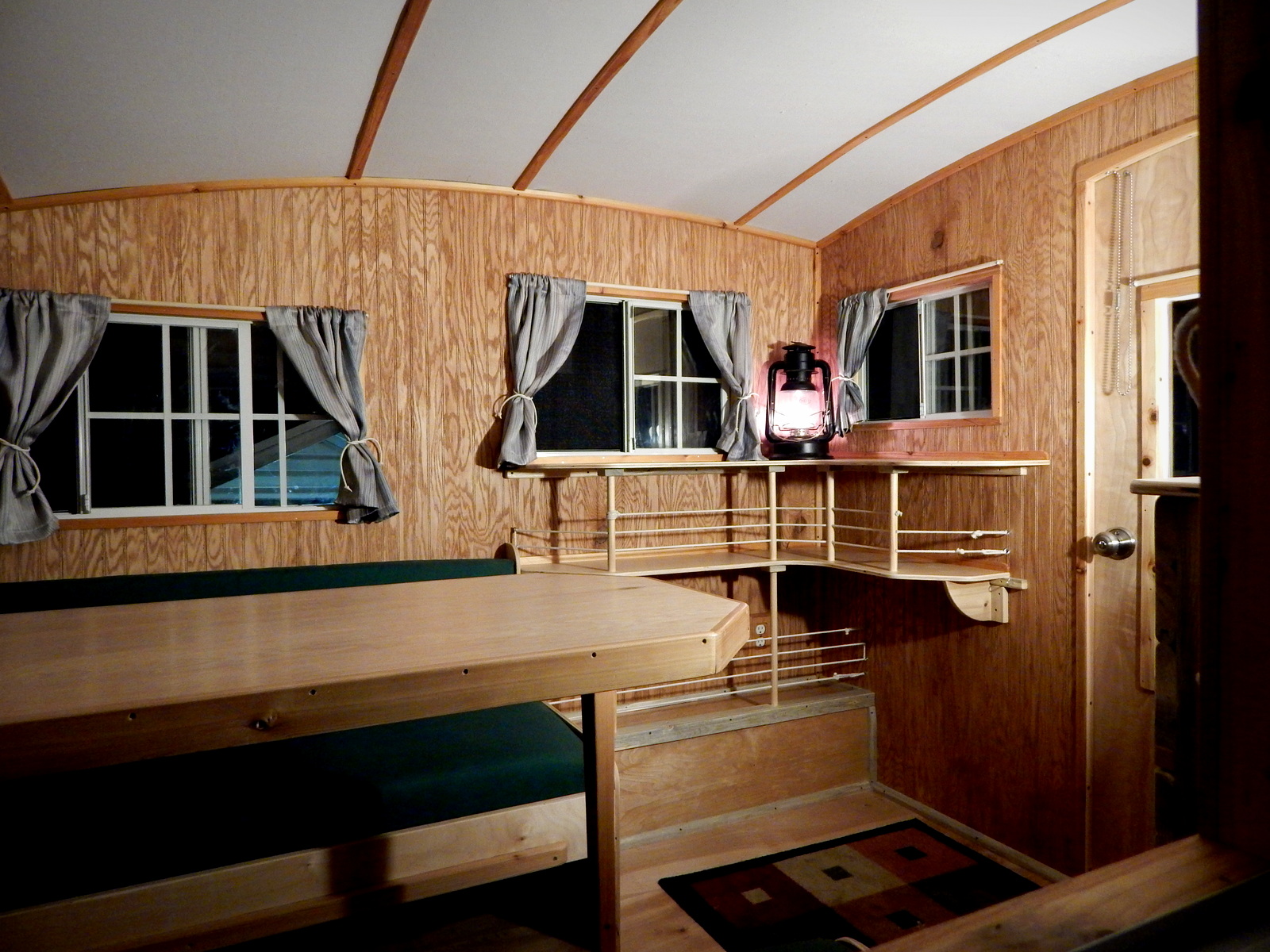
1-DSCN0332It’s a simple cabin design with a convertible table top bed setup that looks like it will work great for one or two people and answers all the basic needs of shelter on the go.
a.JPG_6I heard from Peter (the owner and builder of Casual Turtle) last week and I think he can describe it best:

“Hey George-I thought I’d pass along a few shots of a recent build.  This one was for a gentleman here in Colorado – the model I call the Terrapin.  We went with a pretty full interior arrangement on this one.  He opted for no painted surfaces (which I usually do), so we incorporated several different species on the cabin’s interior – oak, birch, cedar, and beetle-killed ponderosa pine – so it wasn’t a one-tone wood overload.   It weighed in at 1,300 lbs, max headroom around 5’9″, and it goes down the highway just great.”

eIt’s compact, lightweight, and is filled with windows to enjoy the great outdoors in any weather.  It would be great to see this after the new owner settles in, decorates it to his personal taste, and gives it a “lived-in” look after a few thousand miles.

c

“Casual Turtle Campers was founded on the belief that wood is good, small can be comfortable, and that there is still room for simplicity in this increasingly complex world. “

l k jI enjoy the simplicity of this design.  It reminds me a bit of the “canned ham” campers of the 1950s and is not overly complicated by cabinetry and appliances.  The wood exterior fits in with the natural world in a way that shiny, white aluminum could never do, making it seem more at home in the woods than in the RV park.  This would make a perfect base camp for hunting, fishing, or just gazing at the mountains.

oHere’s a little about Peter and his company from his web page:

“The idea for Casual Turtle Campers was conceived by Peter Pavlowich in the summer of 2010. On a road trip to Colorado, he noticed an abundance of truck campers but a profound lack of variety or style.  As a Wood Construction and Design graduate from the University of Idaho, he believed he could design and build a simple and attractive alternative to the big, heavy, white boxes that he seemed to see everywhere. Over the next few years, Peter slowly and methodically brought together ideas and drew up plans for what would eventually become the designs for Casual Turtle Campers.

He very happily lives in Fort Collins, Colorado with his wife, Lindsey, and their dog/shop foreman, Moxie.  We love when people stop by – just get in touch!”

Have a look at this and his other work by clicking the link below. Tell him I sent you!  It’s not really worth anything but tell him anyway.  GTC.

CasualTurtleLogo

b

“I had to go alone…a kind of casual turtle carrying his house on his back.” -John Steinbeck, from Travels With Charley.
A Story of Growing Up in a Sheep Wagon

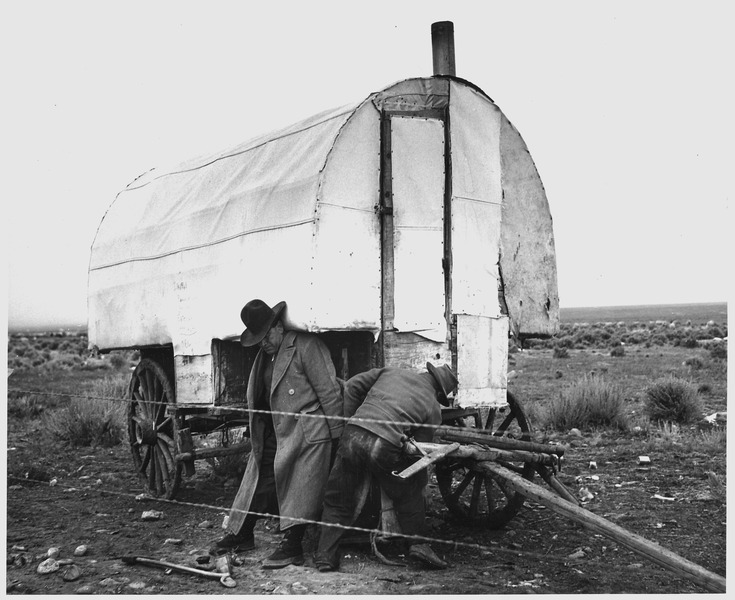
Greasing the axles of a sheep camp n Taos County, New Mexico ca. 1941.
Greasing the axles of a sheep camp in Taos County, New Mexico ca. 1941.

“Victor Croley grew up with a sheepherder father, his family of six lived happily in a wagon like this, entertained by the outdoors and a fiddle.”

Victor Croley describes growing up in a nomadic family of six with a sheepherder wagon for home and how years down the road he felt the urge to build a wagon of his own.
Mother Earth News, May/June 1970

Here is great story I read years ago about being raised in a family of six in a sheep camp measuring about 7 x 8′! (I think that’s the floor space).  I recently relocated the article in Mother Earth News.

Croley’s Wagon.
Schematic of a typical sheep camp.

Here’s an excerpt:

“The canvas-covered sheep wagon was roughly about seven feet wide by eight feet long. On the front end a door opened out of the middle and you stepped down onto the wagon tongue and thence to the ground. From the inside looking out, the stove was on the left of the door. On the right was a small wash stand with several wooden drawers for storage of linens, towels and socks. A bucket of water and washbasin were on the oil cloth covered top and a small mirror hung above the basin for shaving. Soap, toothbrush, razor and essentials rested on top of the stand when in location or were stowed in a drawer when moving.”

Download the print article here: CroleysSheepCamp.

New and Improved

That’s the idea at least.  I have been diligently working to re-write the Vardo building pages in such a way as to make them a little more instructive.  The benefit of hindsight has allowed me to address issues that seem to be common questions.  I kept the comments in place (I hope) as they provide a lot of information and discussion from over the years.  Over the next few days I intend to keep adding photos.  Please feel free to comment, question, or point out any obvious typos or other errors.

overviewClick the preview image to go the the first page of the re-write.  More pages will be published as I get the images and text in place.  Also I would deeply appreciate it if readers could share this in appropriate media with links back to the blog.

Cheers! ~GTC

Home is Where the Hearth Is

…and the Vardo Will be Close by.

20150329_073652
Somebody hates to be left out.

Some important facts about caravan living before the ultra-modern RVs came along that may help people understand some of the choices I have made about my own wagon:

atHome
At the most basic level, life revolves around food and shelter.
  • The caravan is the hub around which camp is built, but most “living” actually takes place outside in the wide world.  Sometimes this means tents or other temporary structures provide added protection from the elements.  Prior to the second world war, caravan Travellers in Europe often slept outdoors, under the caravan when necessary while the kids were corralled inside.  This makes a lot a sense as adults stay up later, and kids can wander off.
  • Cooking is done outdoors, over a fire.  The stove, when there is one, is for heat and drying.  The hearth is the focus of family life, just as it has been for a million years.  That is where people congregate, music and stories happen there, and it is provides comfort and cheer.
Hearth and home has a real meaning.
  • There is no water closet or toilet inside the caravan.  That is considered by connoisseurs to be repugnant in such a small space.  Needing to defecate in such a small space is a modern, and to some, a filthy idea.  However, this is one of the most common criticisms I hear about mine or other traditional wagons; seemingly from folks with little travel or camping experience.
J. Lequesca's sheep graze in Jordan Valley, Oregon.
J. Lequesca’s sheep graze in Jordan Valley, Oregon.
  • A consistent anthropological observation about nomads is the strict rules of hygiene and cleanliness.  Working and wandering outdoors can be a dirty business so strict rules are adhered to.  Some of these reach the level of taboos and can be traced back over at least a thousand years.  Living on the road can make one appreciate this need.Family

    Family
    A happy family from the road.
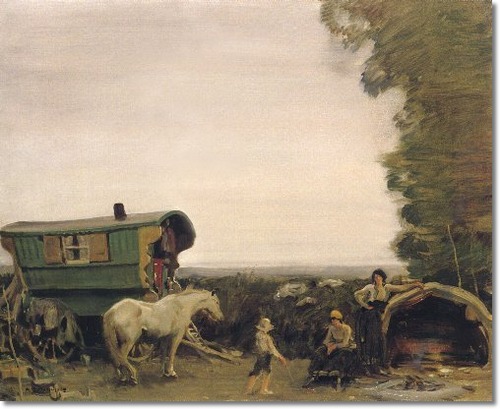
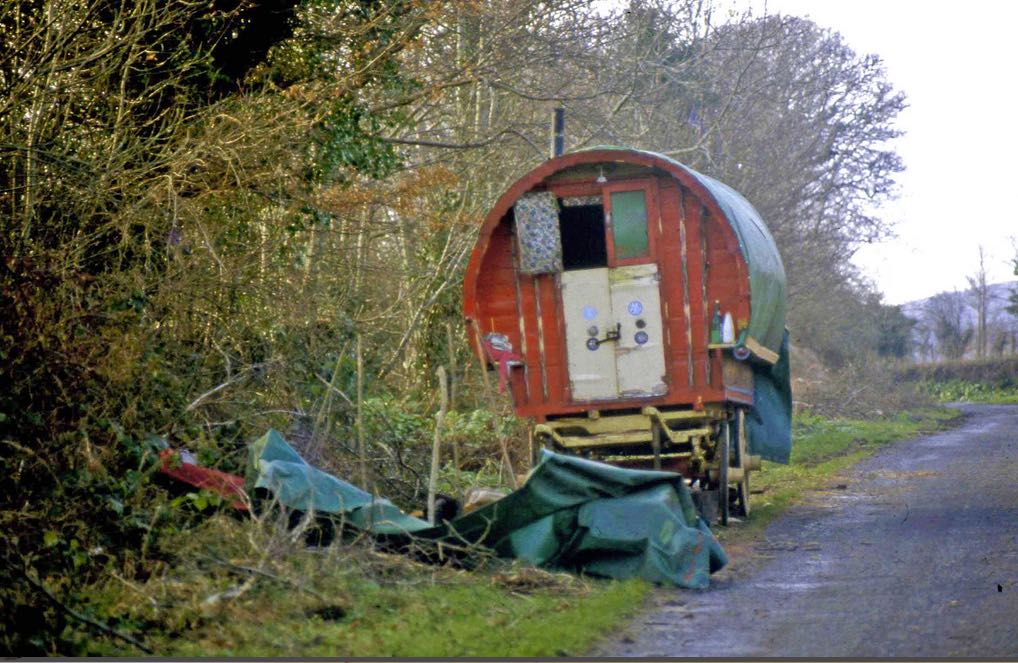
  • The fancy wagons of 19th century Britain are the exception, not the rule.  Functional but sometimes homely carts and wagons have likely served as the home base for nomads of various types since 500 B.C. or before.  They came to their peak of perfection in Britain in the 19th century before morphing into the RVs we see today.
TravellerinSWengland
A Traveller in southwest England. This simple accommodation is much cheaper and more readily built from cheap or found materials than the fancy production models.

Then as today, a conscientious traveller uses a fire pan to prevent scorching the earth by the roadside.  Mine is an old plow disk.

And finally, above are a few examples of outside extensions added to late 19th century caravans across Britain exhibiting the functionality of canvas to extend the living space in less-than-perfect weather.

Caravanroadside
You never quite know where the day might end.


The Tiny House Movement

Here’s a redux from a conversation held last year.

George Crawford's avatarPreindustrial Craftsmanship

Here’s a recent conversation I had, as best I can recall, of creating disappointment and maybe using the wrong words when describing the Vardo.

A woman in a grocery store parking lot jogs up to the vardo while I’m making a sandwich shouting, “Oh my gosh!  That is so cool!  Wow! Is that a Tiny House like on TV? Can I have a look inside?”

“Yes, of course.  You can look inside.”  So far, it’s progressing just like a hundred other conversations I’ve had over the years.

“Is it like the little TV houses? You know, like on that show?”

“I don’t know the show but it’s actually a little camping caravan.”

“It’s not a Tiny House?  Oh, never mind then,” turning on her heel she walked away without a backward glance.  Then to another gentleman walking towards us she shouts, “It’s nothing.  It’s not like the Tiny House Show”…

View original post 292 more words

Five Years and 20,000 Miles Later…

The vardo known as the Snail turned five years old a few months ago and shortly after, crossed the 20,000 mile mark.  It’s just an arbitrary number, I know, but it feels like a milestone in our lifelong journey.  Changes have been made, details reconsidered, and minor additions have created a cozy little living space.  We now know how to use the space when traveling, eating, sleeping, or just hanging out.  The dog thinks of it as home and recognizes the signs when we’re preparing for a trip.

DSC_0082
Heading out.

This is a bit of a sentimental recapitulation of some high points so far.

There are many little wagons that are much more artistic than mine but I have been lucky and have received awards from both Popular Mechanics and the good people at Maker’s Faire.  While at the Faire, the wagon was staged for viewing, allowing visitors to walk through and ask questions.  Thousands of people came inside and checked it out.

The north woods of Idaho, 2014.

Life has slowed down for the Snail but we still take it out regularly and it makes a safe and comfortable home on the road.  In case you missed it, here’s a quick overview of the construction.

Heading out on the road.

Taking a break.
Taking a break.
Packed and ready to go.

I hope to show a few of the recent updates and changes to the living space in the next few days.  Thanks for following.