My fishing kit is coming together and I added another hook and leader last night.
The left hook and gorge are made from deer cannon bone (metacarpal) and the right is whitetail deer antler. The antler hooks are proving to be tougher and less likely to snap under tension. The leaders here are yucca and stronger than I would have thought. Hopefully, we can test them out sometime very soon.
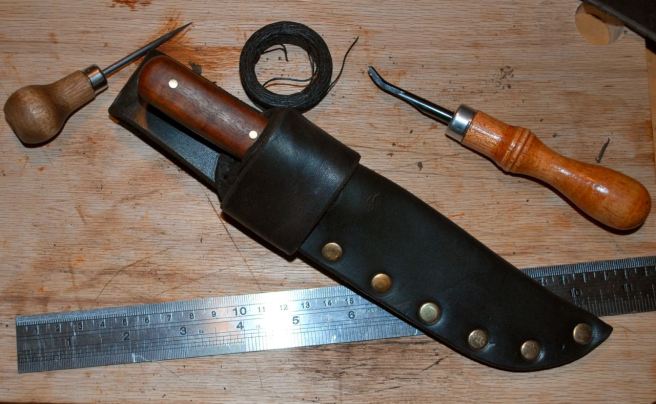
I realize this isn’t the most exiting project of the year but a necessary one nonetheless. My knife sheath for the “regular” camp knife was a sloppily done remake of the original. The knife maker did an excellent job on the knife itself but the sheath wasn’t up to the standard of this fine tool.
No surprisingly, I have quite a lot of leather around for small projects like this so after some searching I chose a very thick and solid, wax stuffed leather that was batch dyed a very dark brown. For durability I decided to rivet this sheath with brass which makes for fairly quick work as well. The only real issue is getting the fit just right; tight enough to hold upside down but loose enough to come out when called upon.
After construction, a bit of hot water was poured over the body to shrink it up a bit and the well-oiled knife left in it for form-fitting. Now, we’re ready for the woods again.
I made it out for a brief stay in the eastern Ozarks this week. The rain and cold came back just in time for my outing making it a little less comfortable than it could have been but I still enjoyed the time out.
I chose to stay fairly low-tech with the exception of a sleeping bag instead of the old blankets and I sheltered under an old military poncho instead of the more usual canvas. Since I was out, in part, to work on some crafts I packed in very heavily with tools and a few raw materials.
It’s easy living for the most part in the Ozarks and I think I could happily live primitivly in this environment indefinitely. There is not much legal hunting this time of year as the furry critters are off procreating and having babies so I brought some basic foodstuffs with me. I’m back in civilization now but expect to get back out very soon. Maybe the sun will stay out for a few days and dry things up as a preview of Spring. I’ll post some follow-ups about gear and some things I’m working on very soon.
Sometimes I wish carrying a walking stick was more acceptable in daily life. Maybe it’s just my yeoman heritage or my fondness for the old ways…
A review of Scouts, Calgary 1915.
To do so now, you tend to either look like a hoodlum or the walking wounded. Living for so long in wild country I found that a staff was a handy tool that lends some confidence when encountering a wild hog, a rutting elk, or dog. In my professional work as a field scientist it isn’t common to carry one either due mostly to the logistics of carrying a map, notebook, compass, GPG unit, pin flags and the like. The reality is, you only have two hands.
The author with his antler-fork walking stick and his dog begging for a walk.
However, in the perfect world of semi-fantasy that I inhabit, I tend to keep a walking stick nearby and have several on-hand at any given time. I’ve wavered over the years as to whether or not the extra burden is worthwhile and the truth I have settled upon is “yes, mostly.” Other than the confidence it gives in an unwanted encounter, a staff really helps a walker crossing a stream or other rough terrains when heavily loaded.
As the great traveler Colin Fletcher wrote many years ago, “it converts me when I am heavily laden from an insecure biped into a confident triped” The Complete Walker.
The staff instills confidence and provides stability for the walker.
Here are a few other ideas for a walking stick and its many uses found around the Web. I’ll post a few more pictures of my own in upcoming posts.
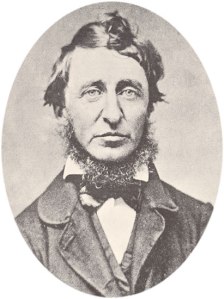
In the mean time, if you are contemplating becoming a walker yourself, or already are, you may enjoy Henry David Thoreau’s short essay on the subject. It’s a favorite of mine from a surveyor and philosopher who spent much time walking in the woods.
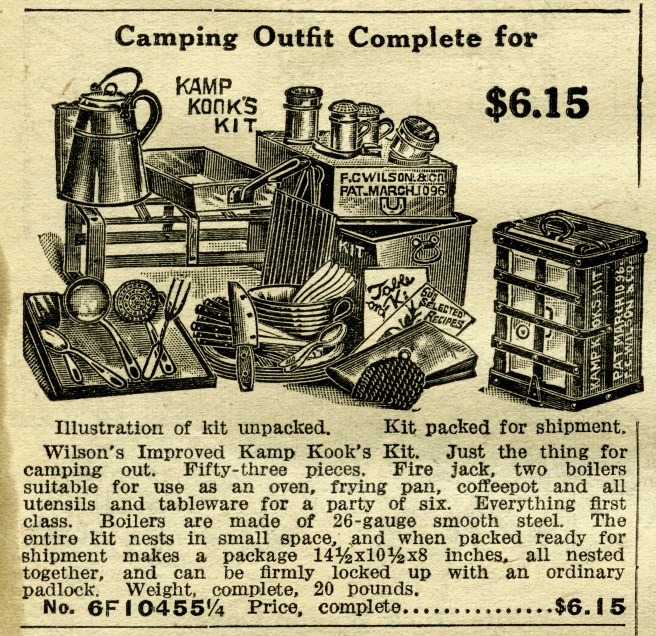
Complete Camping Cook Outfit for Only $6.15! Get your’s today!
I want to share a classic camping advertisement for the F. C. Wilson & Co. from the 1916 Sears, Roebuck and Co. catalogue. Weighing in at 20 pounds it might be a bit heavy for backpacking but would be great for the car, wagon, pack-horse, or canoe. According to the online Inflation Calculator, this $6.15 kit would cost an equivalent of $149.05 in today’s U.S. dollar. At first this sounds ridiculous but after looking at a recent REI catalog I think it might actually be quite a good deal.
Winter is here. For some of you it is here with real gusto. Growing up in Missouri and being sent out to ‘play’ no matter what the weather or who was around I learned a lot about how to entertain myself. Snowfall in the Mississippi valley could be heavy and wet throughout the winter and was a great medium for construction snowmen, fortresses, and quinzhees. Of course, we didn’t know such an exotic word at the time but we did learn good tricks and techniques for safety later in the Boy Scouts.
Image from Boy’s Life magazine. Click for a short “how to.”
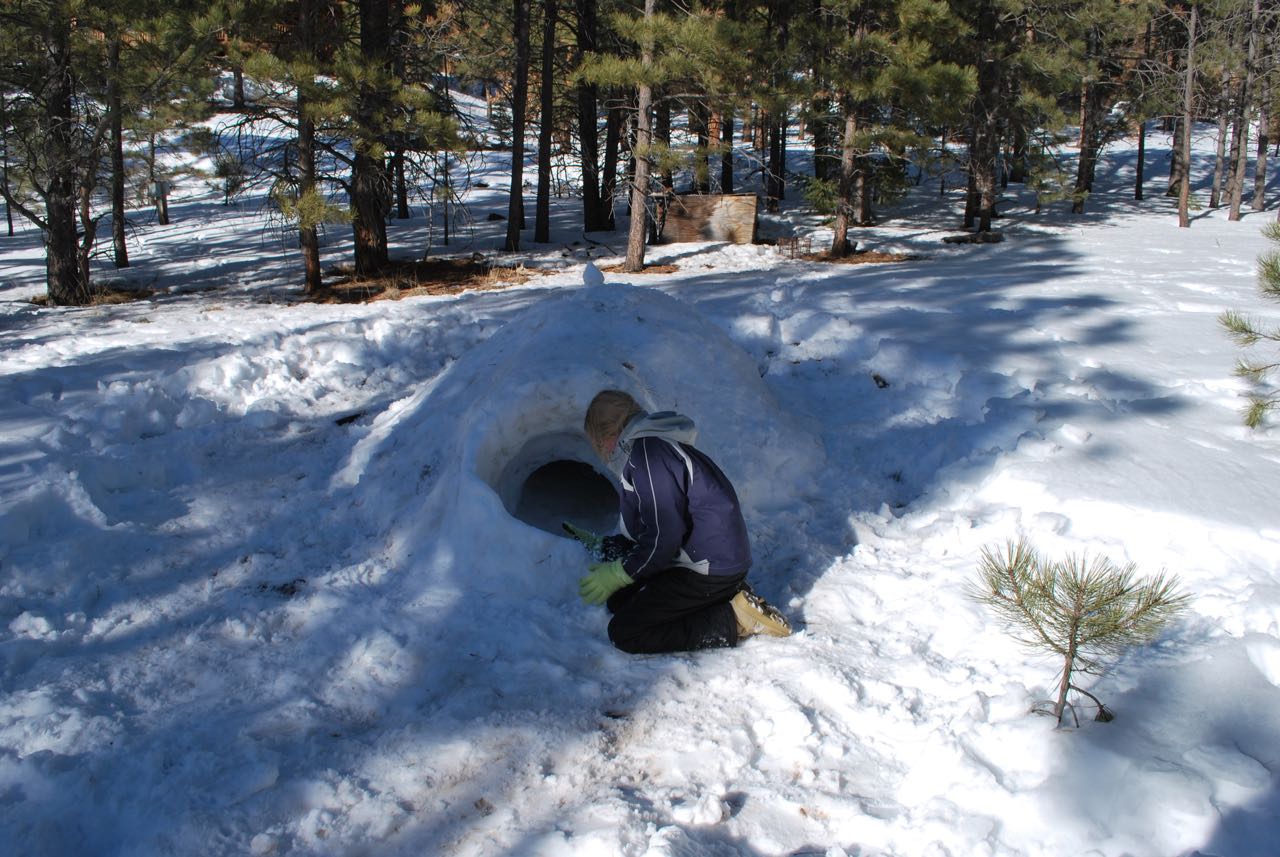
I’m certain there are no photos of the sometimes elaborate, and often not so elaborate, snow shelters my friends and I built as kids (I don’t think parents played outside with kids in my era). I was reminded that we had our own photos of one built with my daughter several years back. We were staying with a friend in the Sangre de Cristo mountains for the holiday at about 8,000 ft AMSL (ca. 2,500 meters). The snow was perfect and wet so we couldn’t pass up the chance for a little shelter building. “Teachable moments” surround us every day. It’s up to us to take advantage of them.
Working on the wind wall. If you look closely, you can see the miniature chimney and rain shield on top.
The snow wasn’t deep and we weren’t intending to spend the night inside so it was kept pretty small for ease of construction.
View into the vestibule. The opening was kept narrow for warmth.
It was a chance to talk about safety, collapse, and fresh air exchange. Valuable information for later in life. Ours faced south.
The dog was, of course, a great help, mostly chasing snowballs.Testing out the fit.
It was definitely kid-sized but an adult could squeeze in more-or-less comfortably for a while. The dog was not enamored with the confining space.
Enjoying the evening by the warmth of a candle.
It was just another fun day, experimenting with the gifts that nature provided, and passing on knowledge to the next generation of wilderness lovers.
Talk about convergent timing … It seems that Paul Sellars was reading my mind when he put up another useful video early today.
This is a bit of a ramble I’ve been pecking around on for a while now. Sometime in the 1980s we seem to have forgotten how to sharpen our own tools. That was an era when the woodworking and camping gear market was flooded with jigs, guides, angle-finders, and other contraptions came in a flood to the common shop. Suddenly, a whetstone and strop were out of fashion. I can’t even count how many times I was scolded for sharpening a plane iron by hand! An excellent carpenter friend of mine wouldn’t even attempt a chisel without his low-speed Japanese wheel system with an automatic water drip feed. Anything else was impossible. I was a carpenter/rigger and semi-serious college student by then and needed a knife every day.
I had fortunately learned to sharpen tools from my grandfather and expanded on this knowledge with the aide of several knowledgeable Scout Leaders throughout my youth. There were even tests in the Scouts to make sure you learned about safety, handling, and maintaining tools. On the home front, a dull knife was met with gentle but stinging ridicule.
My first real knife was a Camillus BSA. A good beginning.
In our early teen years, it became a matter of some pride in my little circle of friends to carry a well-tended, razor-sharp pocket knife for everyday tasks as we camped, hunted, and fished. For this, you had to learn your way around a whetstone. For many years, I had only three stones in my life; a two-sided mechanic’s black stone, a small medium-hard Arkansas whetstone, and a very old two-sided razor stone. With these few tools, and a good bastard file, there is nothing I own that cannot be sharpened; from lawnmowers to axes, chisels, or knives. It is a skill I am glad to have acquired.
The missing element is TIME.
This is NOT a “how-to” post for sharpening but encouragement for someone intimidated by the whole process. There are plenty of print resources and good information on the Internet as long as you know that sharpening takes time, patience, and attention to detail which only comes from practice. Big Box sporting good and hardware stores can lead you to believe you need several-hundred dollar sharpening “systems” before you can do anything at all. These are labor-saving devices, not magic pills.
And finally, there is more than one way to skin the proverbial cat.
There is no one way to sharpen or polish an edge onto steel and this leads to some belief in “right and wrong” ways to accomplish he same outcome. Even recently, I had a young bushcrafter tell me he didn’t think I was “doing it right” when he saw me touching up a blade. When I asked why he thought this it was because he had learned a different method in a half-day class and wanted to know “who’s class did I learn that in?” In an ensuing discussion it was posited that there was no way to hand sharpen a knife to an edge comparable to a modern wheel system. This is advertising propaganda gone wild. Think Japanese sword polishers or old-time straight razor makers; it just requires the skill and time.
Learning is an ongoing process, not an event.
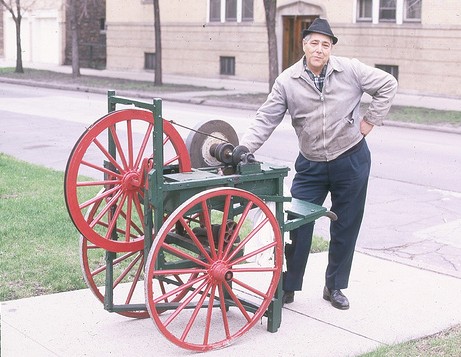
Different tools require different approaches but the essential are the same; finding the angle of the edge, direction of motion, consistency, lubrication, etc. It becomes a real Zen thing to practice. I’m not shooting down the contraption-based sharpening either. They have their place, especially in a busy shop. As I said before, sharpening takes time. For this reason, and probably a certain level of laziness in the family, we sent things to specialists like the knife grinder. Growing up in South St. Louis, we still had a knife grinder making a circuit around the neighborhood who got our business of kitchen cutlery and grandma’s best dress-making scissors. This isn’t him, but I’m glad to see the business still flourishes.
St. Louis Knife Grinder.
Back to the point.
Don’t be intimidated or misled about sharpening your tools. You can certainly do it without an expensive setup. If it becomes too much, there are sharpening services at sporting good stores and elsewhere to help you out. It’s easier to maintain a sharp tool than it is to start from scratch so keep it sharp! Your ancestors did it and so can you.
Now, have a look a Paul Sellars newest video. As always, it’s excellent stuff.
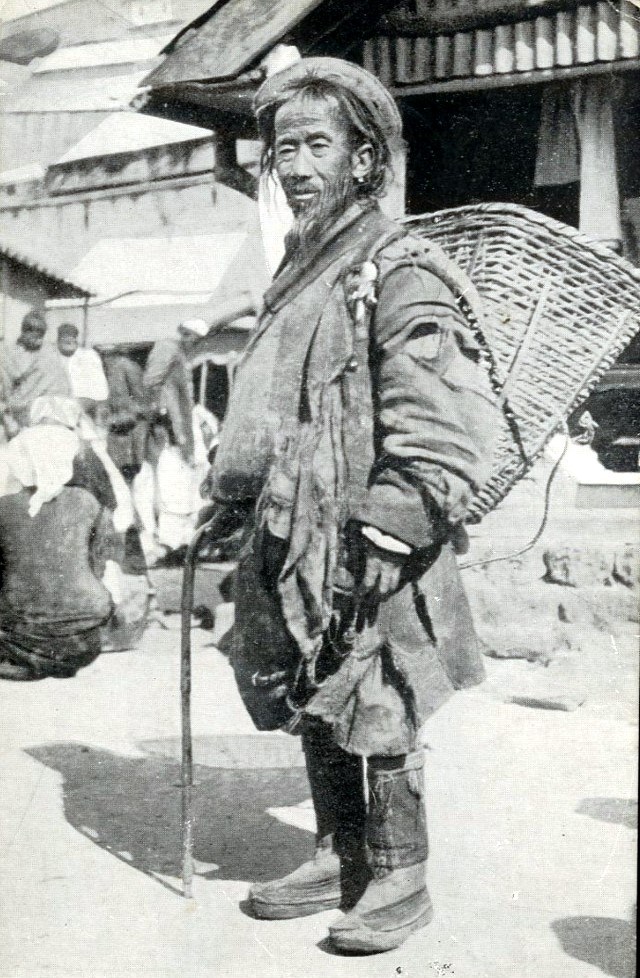
If you know me at all you know that I am interested in pack baskets. Because of this, they catch my eye when I’m browsing historic images.
I could find no information whatsoever about this one. I suspect maybe Tibet in the early 20th century? Pack baskets have been underrated in the west. I’m glad to see more and more of them used in the primitive technology, bushcraft, and survival communities. I love the one I made but I know there are even better ones out there.
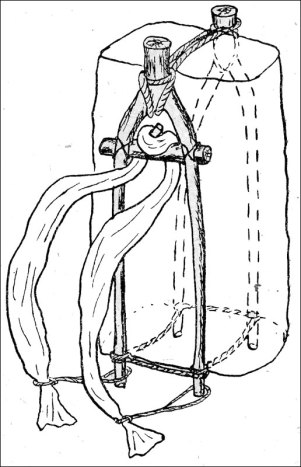
I was interested in the harness system here. It seems to sling around the entire basket for support. It took me some time and effort to come up with one I liked for mine but based on some historic examples, I was able to come up with one that worked.
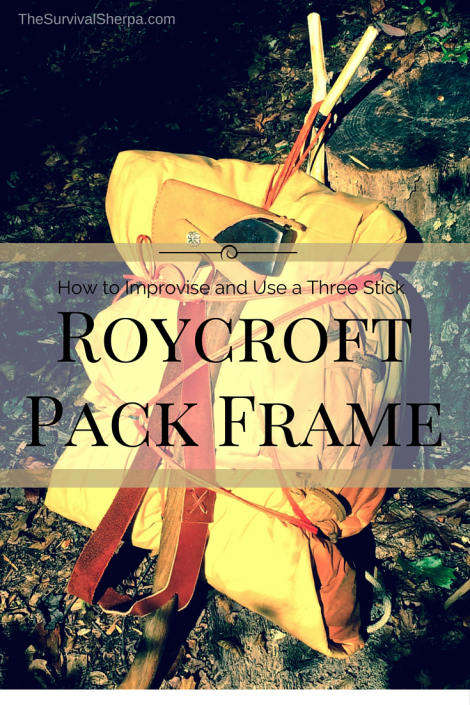
Thanks to Survival Sherpa for posting this look at making a pack frame. Making a quick, three stick pack frame is a valuable bit of knowledge. How serendipitous that this came up (seems to be a lot of convergent thinking around my world lately) as I am beginning to tweak my own wooden pack frame for some experimental travel. And while we’re on the subject here’s a link to a broad look at pack frames from around the world on Markus Kittner’s fine web page.
Have a look at Survival Sherpa by clicking the link below.




 I want to share a classic camping advertisement for the F. C. Wilson & Co. from the 1916 Sears, Roebuck and Co. catalogue. Weighing in at 20 pounds it might be a bit heavy for backpacking but would be great for the car, wagon, pack-horse, or canoe. According to the online



 Preindustrial Craftsmanship