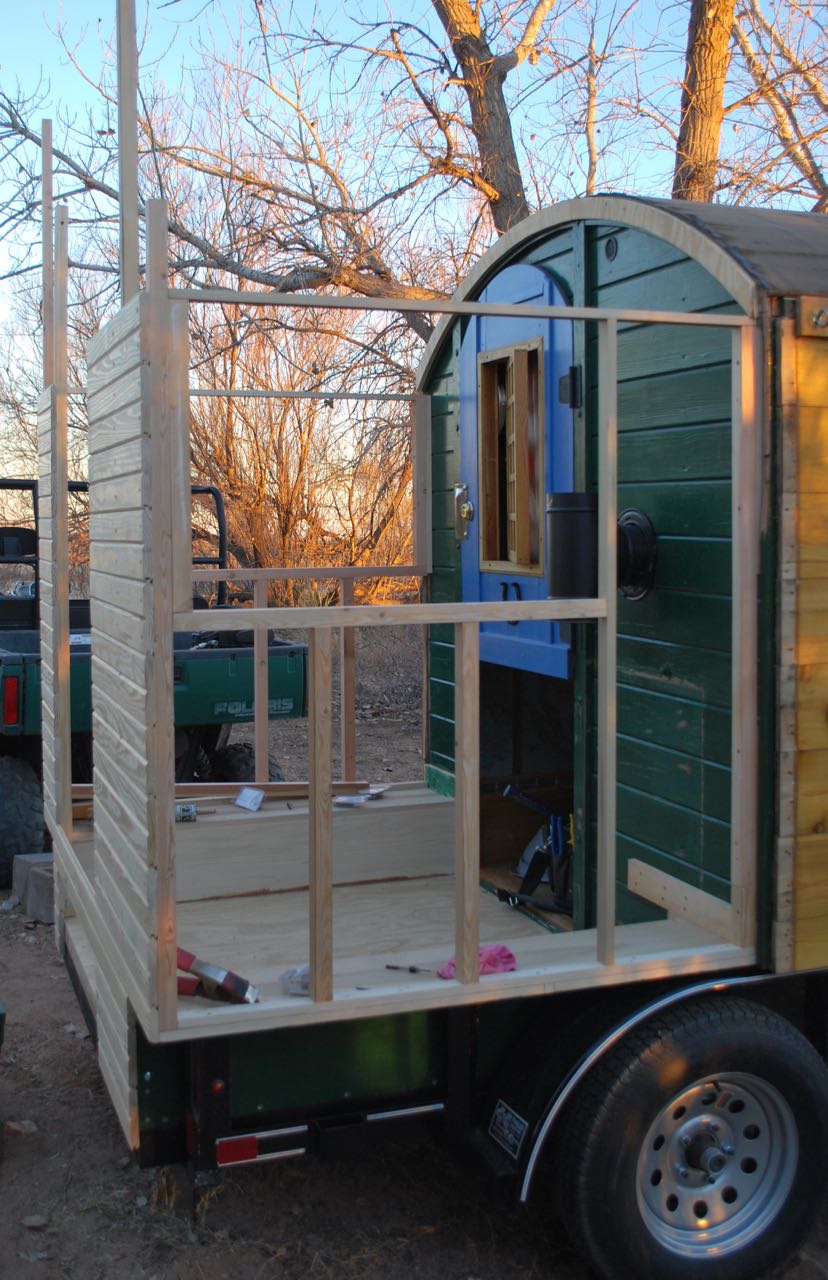
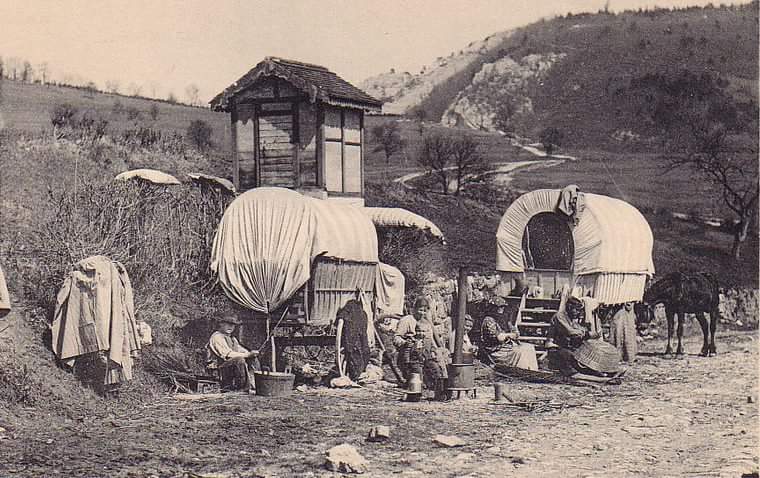
Door and Frame, Vardo Remodel Part 8

Every home needs a door.  It’s a tricky bit that must fit well, open and close easily, provide some security, and hopefully, look good doing it.  

We found a mahogany, two-panel door at the Habitat Re-Store in Lubbock a couple months ago and since the price was right ($10), we bought it.  It was clearly well-made and I suspect it ended up at Habitat due to a largish scratch near the bottom on one of the rails.  The only down-side for me was it’s height.  At 94″ (2.38 m), it was far too tall for a simple,  tiny vardo.  I knew I had to cut it down and was willing to risk the $10 as it went to a good cause either way.  I suspected the panels were solid but, as is usual with this type of door, the rails and styles would be laminate over pine (or similar).  I had not initially considered a professionally made door but the final selling point was the nice arch-shape to the top of the upper panel.  It was an arc that I could match when came to finishing the door.
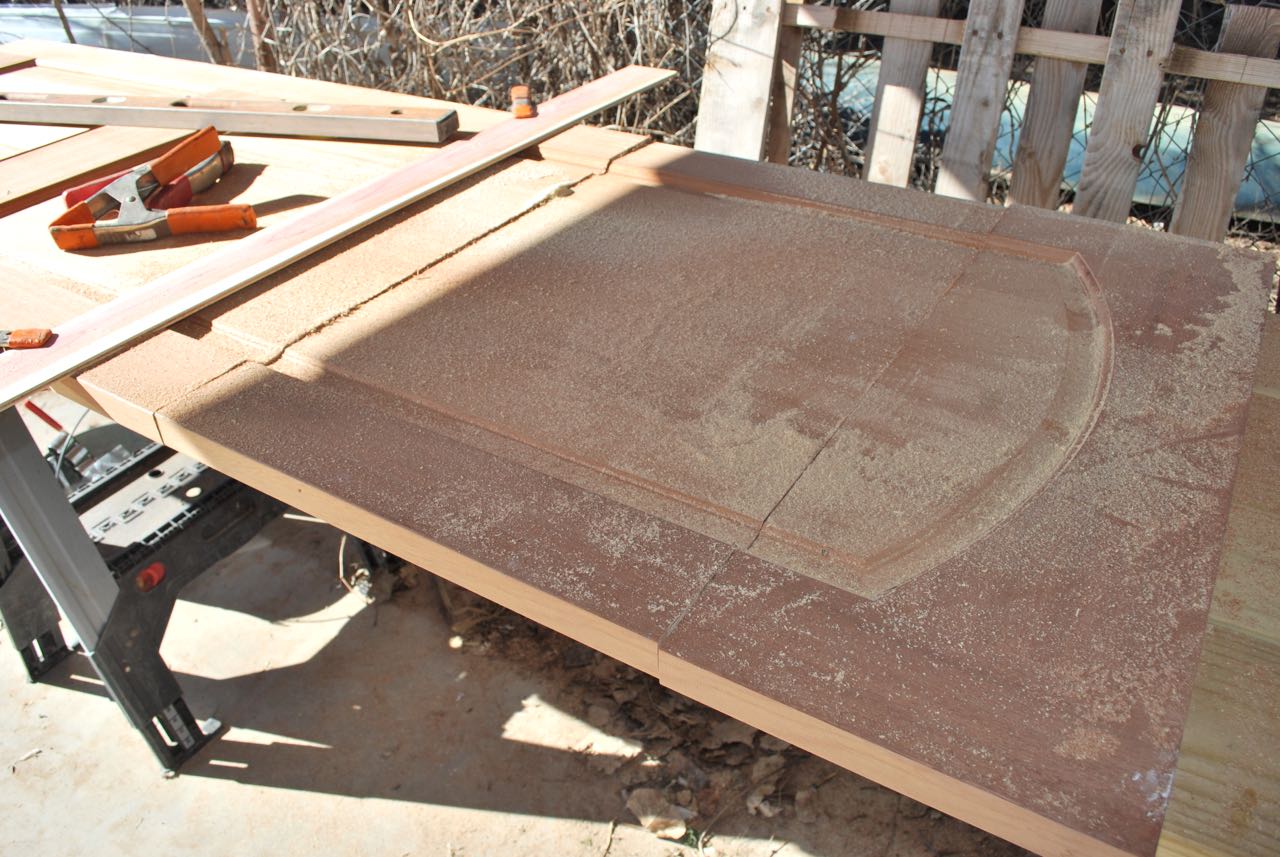
DSC_0032 (2)
Some stressful cutting; 20 inches removed.

The circular saw seemed the obvious choice for a long, straight cut like this so I set up a board as a guide and went at it, taking a full 20 inches out of the middle.

Matching the glue surface.

The top was then folded down for planing to get a precise fit for gluing surface.  This part took a lot of fidgeting and tweaking to get it correct over the entire run, but I achieved it in the end with only a little frustration and some muttering.

Clamping it back together.

To hold it all together, I decided to use polyurethane Gorilla Glue. I don’t use this for much but it can make an extremely strong and waterproof bond.  A couple very long screw completed the hillbilly engineering and I was confident with the result.  With the loss of 20 inches from the middle, the grain no longer lined up perfectly, but at a short distance, it isn’t very noticeable.  Hey, it’s a $10 solid mahogany door after all.  Talk about some good and frugal recycling.

Top arc is cut and the glue line looks pretty clear here. It's a lot less noticeable in real life.
Top arc is cut and the glue line looks pretty clear here. It’s less noticeable in real life and will be less so as the door darkens with age.

I cut the top of the door to match the arc of the inset panel and I think it’s a great match for the curves of the wagon.  But now, it came down to making a door frame, after the fact, to match the new door shape, compound arc and all.
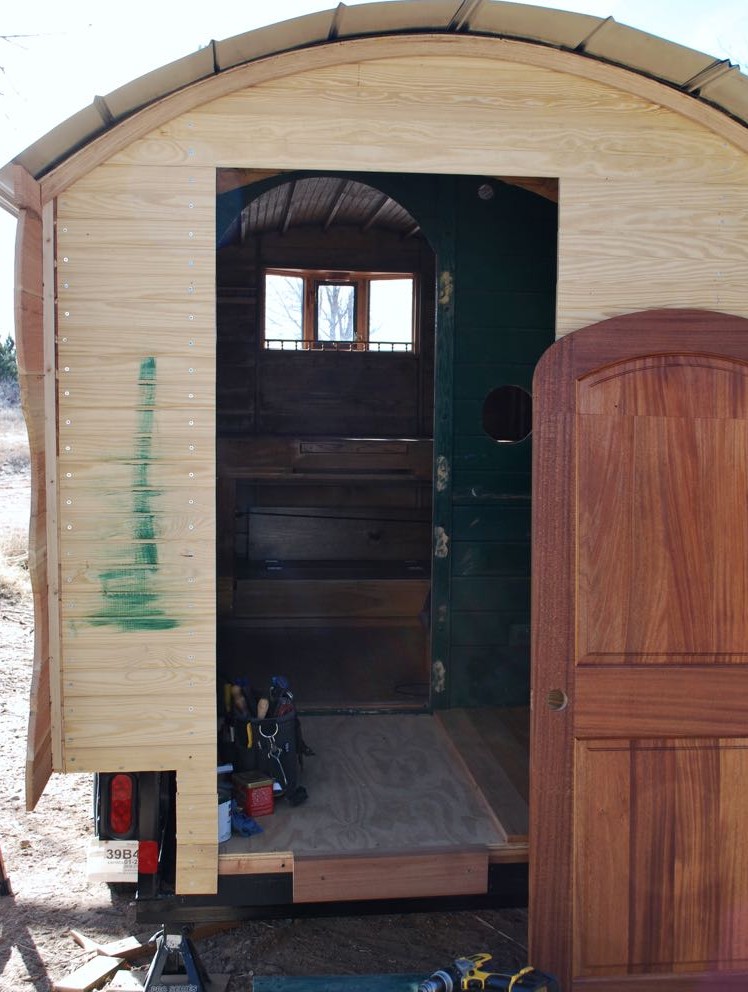
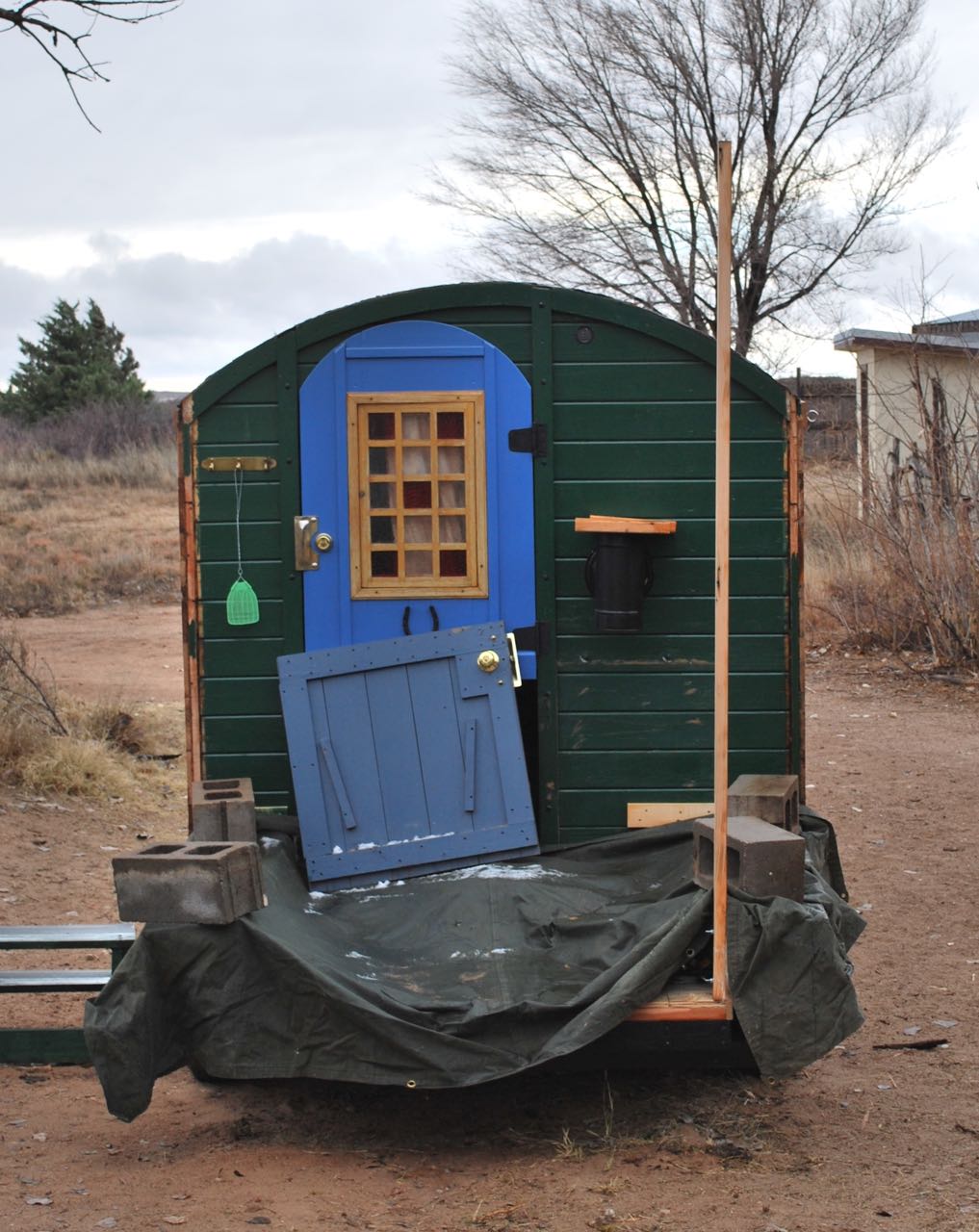
Square hole, round door.
Square hole, rounded  door.  A scrap of wood was secured to hold the door in position while fitting and marking for the frame.

Obviously, the hole for the frame was the next step; requiring another stressful free-hand cutting job.

Matching the arc in the opening.
Matching the arc in the opening.  There is hope for the new door.

Cutting and sanding complete, it was time to build up the frame from oak to provide stiffness and stops to seal the interior.  Fortunately, outside of a couple fierce storms, the weather has been extremely clement this winter, making for good working conditions.
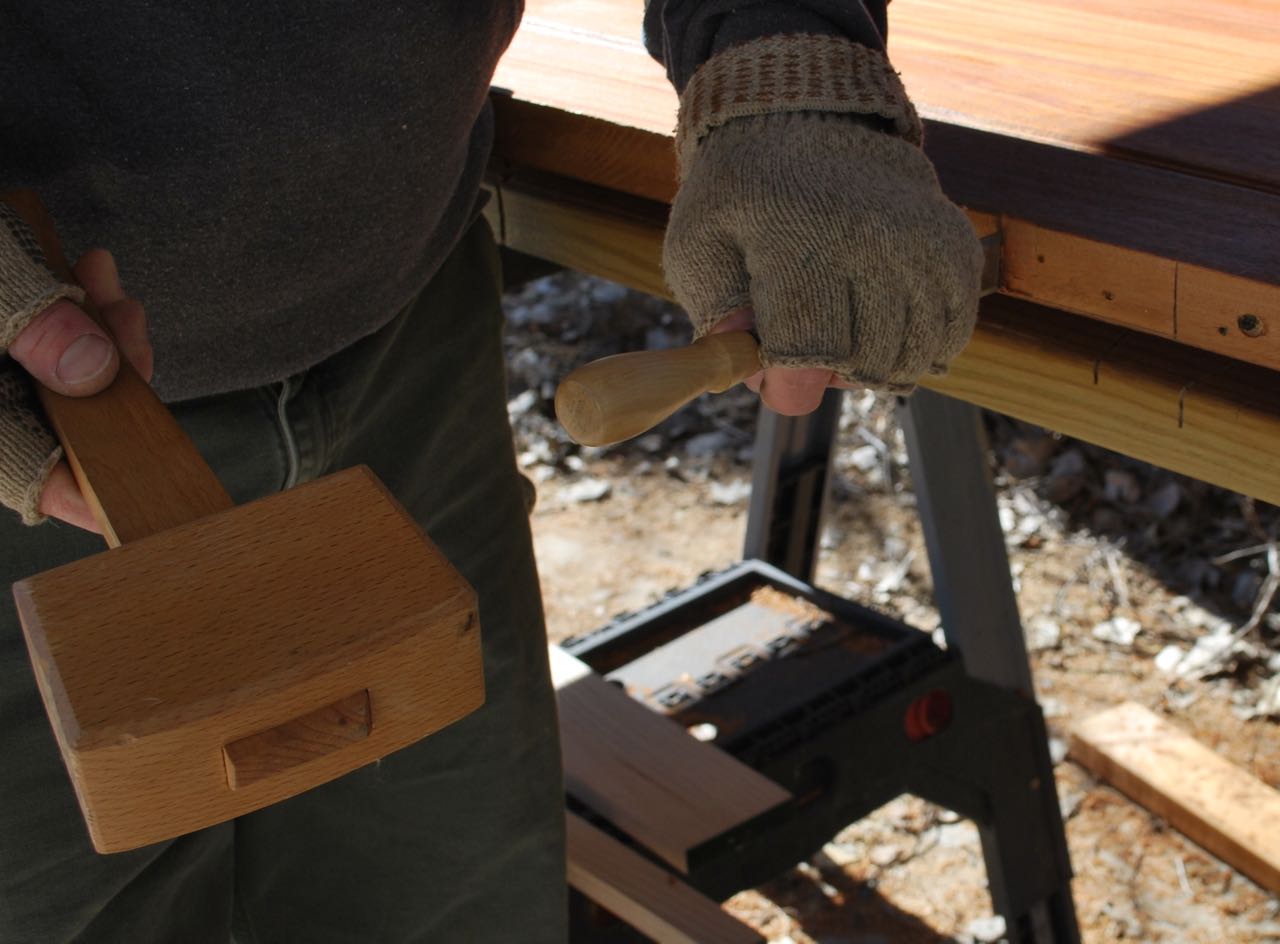
Mortising for the hinge.
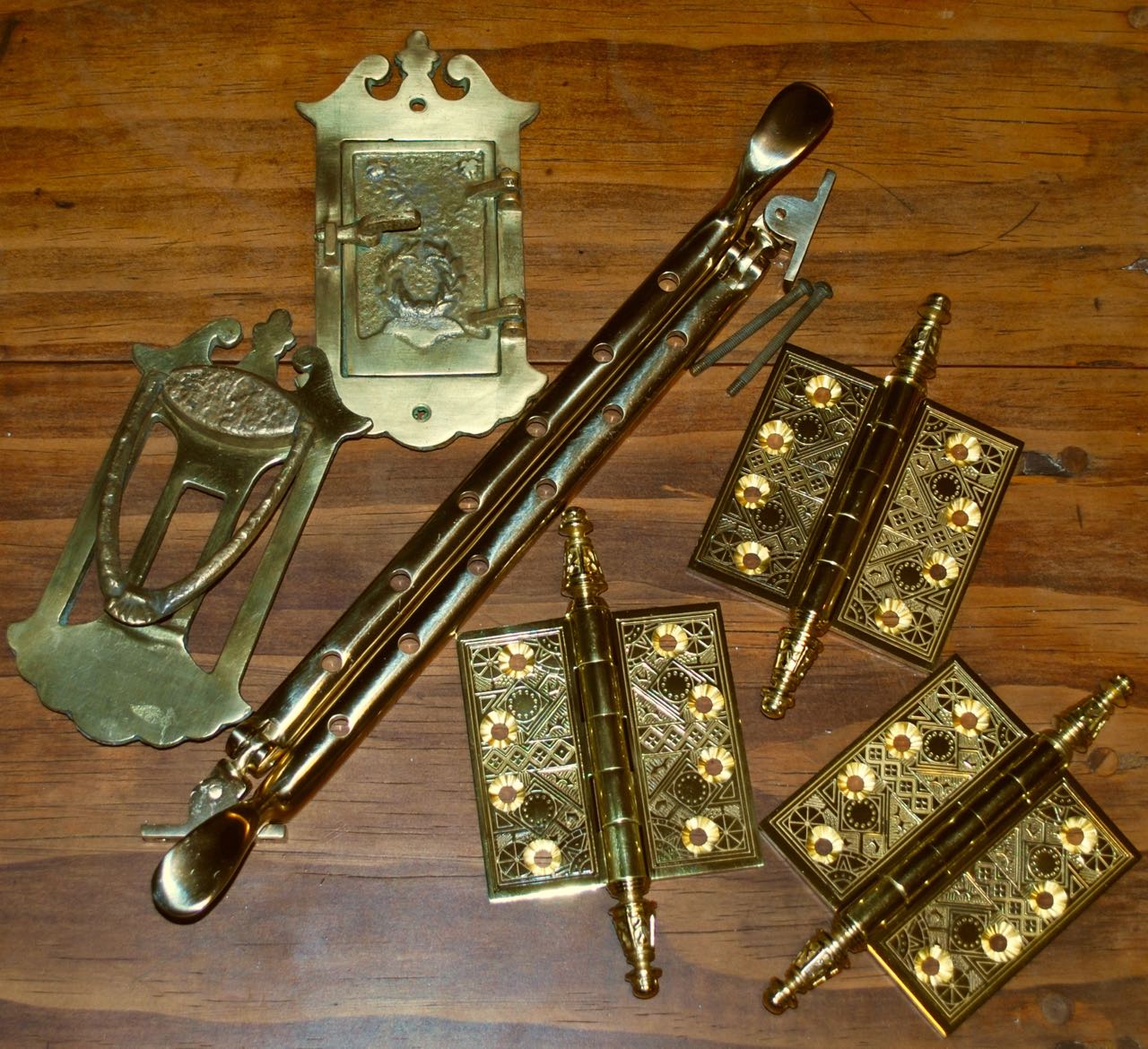
A smattering of new and old hardware.

I both got lucky and splurged a bit on new hardware.  The hinges are real beauties and very sturdily built. There is no perceptible play in them whatsoever and they operate very smoothly.  I went with a 19th century Eastlake pattern from House of Antique Hardware in Portland, Oregon.  Great stuff, great service, just too much to choose from.

DSC_0031 (2)
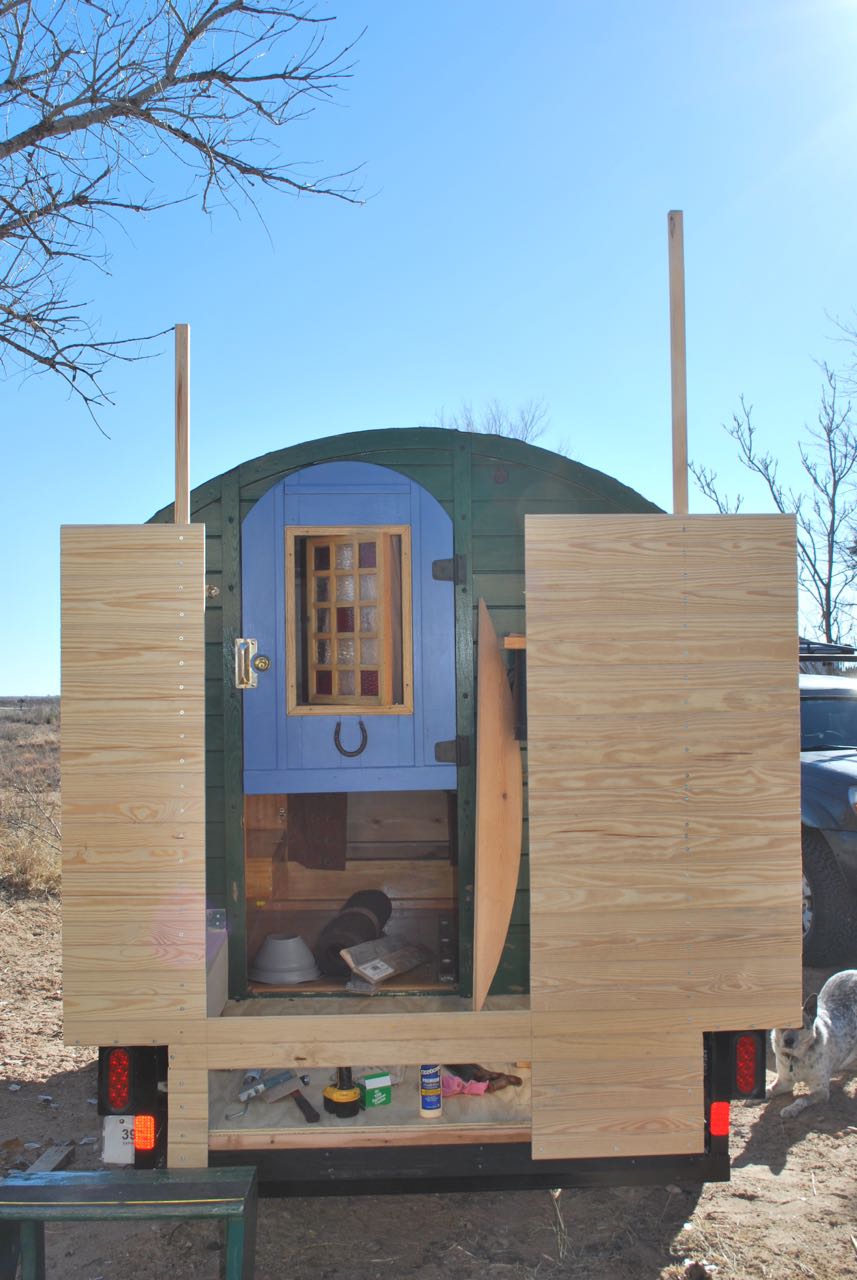
The door is nearly fitted into it’s final position in this photo. High quality hinges not only look nice but function so much better than the cheap, temporary ones they replaced.

I’ll admit that this tricky bit of framing isn’t perfect but is far better than I could have hoped for and suits us fine.  A small speakeasy grill will complete the door and even serve as a small vent when necessary.

DSC_0032 (3)
Eastlake style.  Notice the beauty of the natural mahogany next to the oak.
DSC_0033 (4)
Test-fitting the new hinge mortises.  I just couldn’t pass these beauties up.  Still some finishing work to be done on the door but without an indoor shop, something had to be in place.

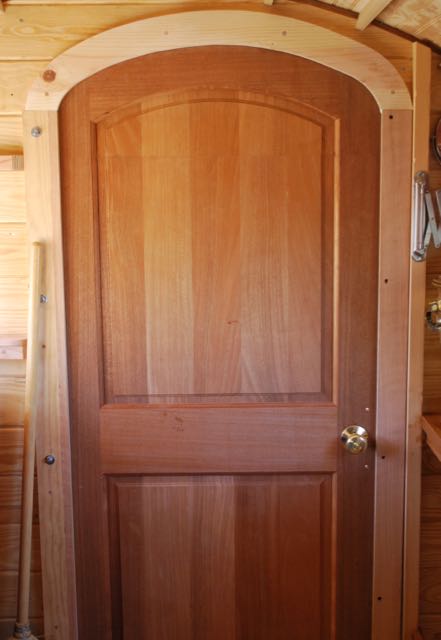
There are lots of small steps that still need to happen but at least there a door in the hole.
DSC_0118 (4)
Piecing together the door jamb and frame.

There is a lot more to report and I’ll get it posted as soon as I can.  Great things are afoot and I can even see a distant light at the end of the tunnel.

For Part 1 of the rebuild/addition then CLICK HERE.

Or on to PART 9.

Real World Construction

I saw this on Tumblr and absolutely couldn’t pass it up.  All I can find about this image is that it comes from the famous Farm Security Administration photos documenting the depression.

October 1937. "Old school bus. Williams County, North Dakota." Medium-format negative by Russell Lee for the Farm Security Administration.
October 1937. “Old school bus. Williams County, North Dakota.” Medium-format negative by Russell Lee for the Farm Security Administration.

This appears to have started life as another wagon, maybe even a delivery van or bus but has been repaired beyond recognition.  I did a reverse image lookup and found a larger version (shown here).  Comments on THIS PAGE indicates it started as a Studebaker School Bus but was probably converted into a dwelling.

Click the photo for full-size image.

More Historic Caravans in Art

Copyright The Munnings Collection at The Sir Alfred Munnings Art Museum / Supplied by The Public Catalogue Foundation
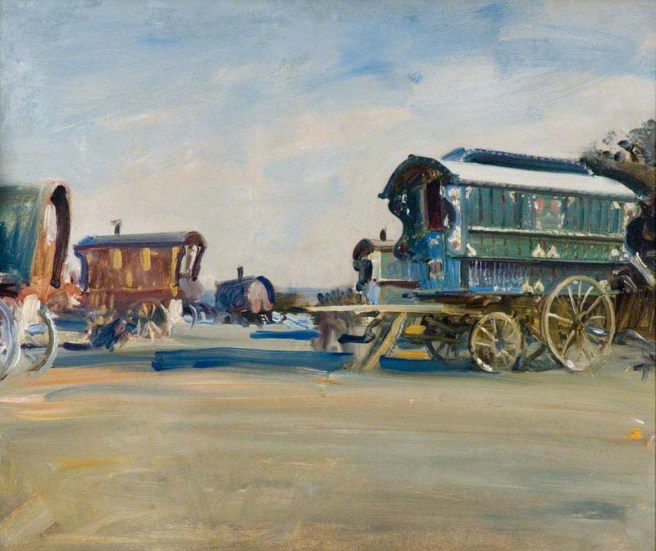
Copyright The Munnings Collection at The Sir Alfred Munnings Art Museum.

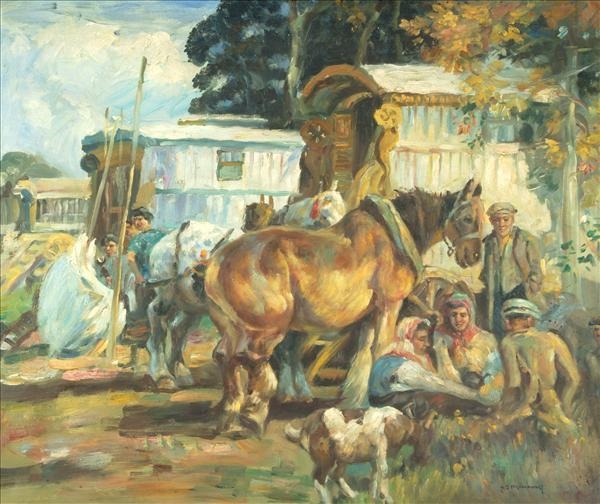
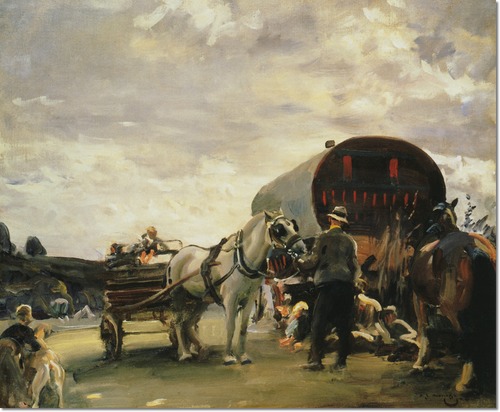
Here are a couple final Alfred Munnings images of Romani caravans in an English countryside.  As a keen observer, he definitely caught the important details of each type of caravan and the essentials of camp life.  The watercolor above is somewhat unusual for Munnings as it shows no animals, people, or campfire.

alfred-munnings-gypsy-encampment
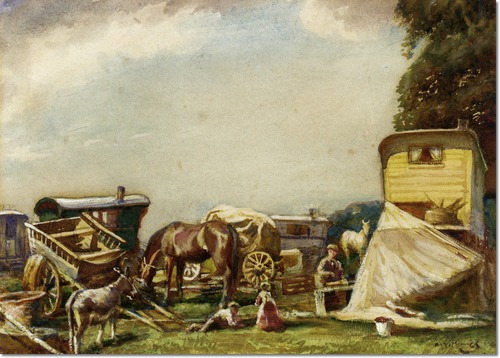
Alfred Munnings.

Above is a rarely shown rounded square-top among other carts and caravans with livestock milling about.  The variety detailed in these historic images should be helpful for those desiring to design and build a similar living accommodation.  The previous post gave a glimpse of Laura Knight’s work on the subject and her subjects are remarkably detailed and informative.

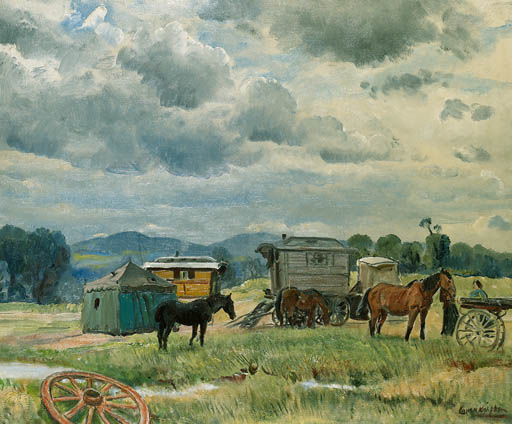
Gypsy Camp, ca 1938, Dame Laura Knight.

This is one of my favorite scenes of a camp in the countryside; two beautiful ledge wagons and a marquis tent in a field.  I could picture this in a high parkland of the Rocky Mountains.  Many people don’t know that the outlier tent, awnings, and tarps are almost ubiquitous with the old caravans.  This allows for a very flexible and expandable living arrangement or a sheltered kitchen area.

Young Gypsies 1937, Dame Laura Knight.

If you look closely at the sketch above, you can see that this is the same encampment from another angle, focusing on the kids at play.  It looks like a fine way to grow up.

gypsywagonandtent
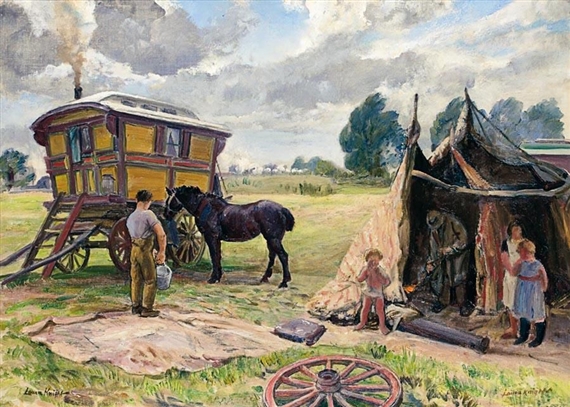
Gypsy Wagon and Tent, Dame Laura Knight, 1962.

And finally, another favorite of mine.  I suspect it’s the same little yellow wagon next to the sketchiest bender tent ever.  Probably a makeshift shelter for work or cooking.  A wagon wheel in the foreground seems to await repair while the kids look on.  Note the size of these caravans relative to today’s “needs” and remember that whole families lived and were raised this way.

If you missed the previous post about historic caravans in art go HERE or check out a whole page of images I have curated HERE.

Historic Romani Caravan Paintings

These images might whet the appetite for summer days, picnics, an caravanning off into the great unknown; or it might just be a bunch of pretty pictures if the former isn’t your cup of tea.  Anyway, these are generally labelled and classed as Gypsy images although we know that this is often seen as an offensive word to many Romani (Roma, Romany, etc.), I don’t think it was intended this way in many cases.  For that matter, when not applied to an actual people, the word gets thrown around in art, aesthetic style, dance, music, and many other ways.  I have only known a few “Gypsies” in my lifetime and that was the term used; maybe out of simplicity, maybe just as resignation to the common language.  But enough of this digression, enjoy the paintings.  There will be more to come.

Dame Laura Knight, Gypsy Caravans, 1935. LONDON.- Trinity House.

“Knight … bucked trends through depicting liminal sites, such as circuses and gypsy settlements, from the very beginning of her career. An example of this is her delightful work Gypsy Caravans (1935).”

The caravans depicted above are the Rolls-Royce’s of their day; highly ornamented Reading Wagons with mollycrofts, awnings, windows, and fine paint work.  They would catch they eye of any artist.  I am particularly fond of the domestic scene around the hearth; laundry being done and hung out to dry in the background.

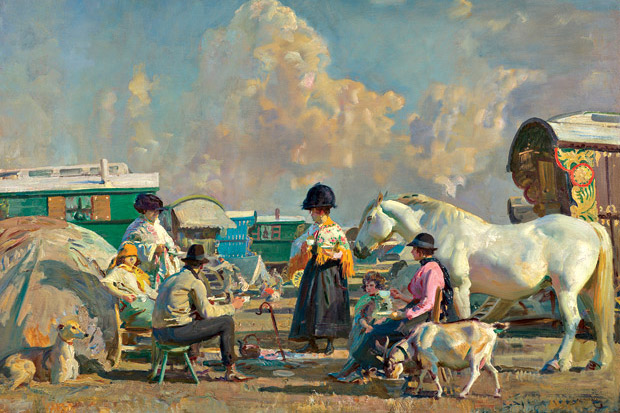
The paintings below are by Sir Alfred Munnings (1878-1959), a British artist who made many beautiful watercolor paintings of horses, encampments, and caravans.  What better, more colorful, and dynamic subject matter?  Alfred Munnings’s biography states that he clearly considered himself accepted among the gypsies when he was able to persuade several of the older women to bring out the brilliant shawls, boldly coloured aprons, and flamboyant ostrich feathered hats that were special occasion wear for the women.”

ALFRED-MUNNINGS
Sir Alfred Munnings.

The ubiquitous fire hook and kettle rest as the true center of this scene.  Everyone is done up in the Sunday best at Epsom Downs.  We see all kinds of accommodations from a bender tent to various quality of living wagon.  And no camp is complete without a lurcher (dog) and the milk goat.

Munnings became president of the Royal Academy and was made a Knight of the Victorian Orderwhile Dame Laura Knight (1877-1970) served on a panel of European judges for an international exhibition at the Carnegie Institute and was appointed as an official artist for the Nuremberg War trials for her technical abilities.  In other words, good documentary artists.

ALFRED-MUNNINGS3
Sir Alfred Munnings.

Travellers and their goat gather ’round the morning tea.  I envision Mick’s garden will look like this once Jim and I get our ‘vans parked for the summer.

alfred-munnings-gypsy-life-the-hop-pickers
Gypsy Life, the hops pickers, Sir Alfred Munnings..
ALFRED-MUNNINGS4
One of my favorites.  So much going on here and a great color scheme.

More images added HERE.

Progress is slow but steady, Vardo Remodel Part 7

The weekend was cold, I was tired (read lazy), and other things had to be attended to so this update is just baby steps in the big scheme.

DSC_0031 (1)
Inspired by the true pinnacle of Victorian wagon design.

Although mine is a purely pragmatic build, I wanted an homage to the classic Dunton Reading wagon.

Suffolk_Reading_Wagon_1887

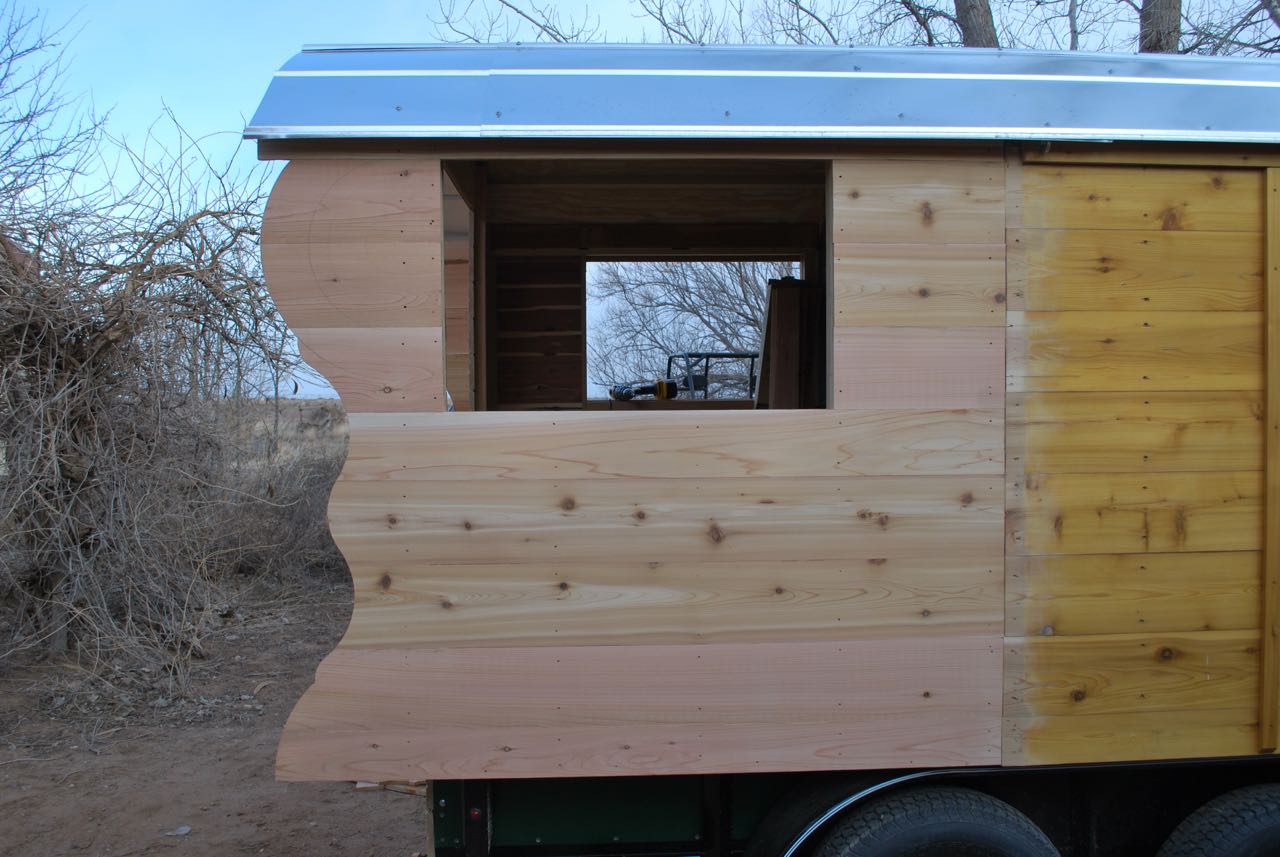
Taking a plain profile and giving it simple compass curves jazzes up the entire look, or so I hope.  If you notice the roof, there is a seam.  This is not a measuring error but the result of switching to off-the-shelf roofing steel.

DSC_0033 (1)
Sanding and finishing still required.

We wanted large windows for light and ventilation in the new room.  This one looks big enough to sell tacos and coffee from.

DSC_0034 (1)
I think I am liking where this is going.

I plan to take a day off work this coming week for important business in the afternoon.  However, if the weather holds, I should get a few hours under my belt for significant progressWe made what I think is an interesting decision about cabinetry which may be surprising.  Also, I am re-purposing a couple old desk tops as counters and I hope they look as good as I imagine they will.

Dreaming of travels to come...
Dreaming of travels to come…

If you are looking for Part 1 of the rebuild/addition then CLICK HERE.

On to Part 8!

Fitting the exterior, Vardo Remodel Part 6

What follows is a somewhat terse step-by-step of the past couple weeks.

I had about a week of stolen moments before the winter holidays to dive in and make as much progress as possible, knowing that winter could bring just about any kind of weather and a 60 degree variance in daily temperatures.  My goal was to have the roof covered before bad things could happen.  Last minute unexpected issues with work severely limited my time and ability to really focus so it was difficult to stay on track, but being exposed to the elements, the roof was a pressing issue.

DSC_0003 (6)
The addition taking shape, purlins set, and roof sheathing going on.

Building the wagon from the inside out, you can see the interior tongue and groove pine and the battens that will stiffen the wall and provide a place to mount the cedar siding.  As I feared, the arc I cut on the end wall was not perfect and had to be compensated for while setting the purlins (the small beams seen above that will ultimately hold the roof structure). This was a critical phase of measuring, eyeing, and double checking everything because it would be glaringly obvious to the most uncritical eye if the roof-line was not straight.  Needless to say, I fretted and tweaked each board until I felt sure from every angle that the alignment was right.

It was about this time that we began hearing a forecast for severe weather, including substantial snow and high winds, in the coming days.  This added a real urgency to the need for roofing and wrapping up the current steps.

DSC_0014 (4)
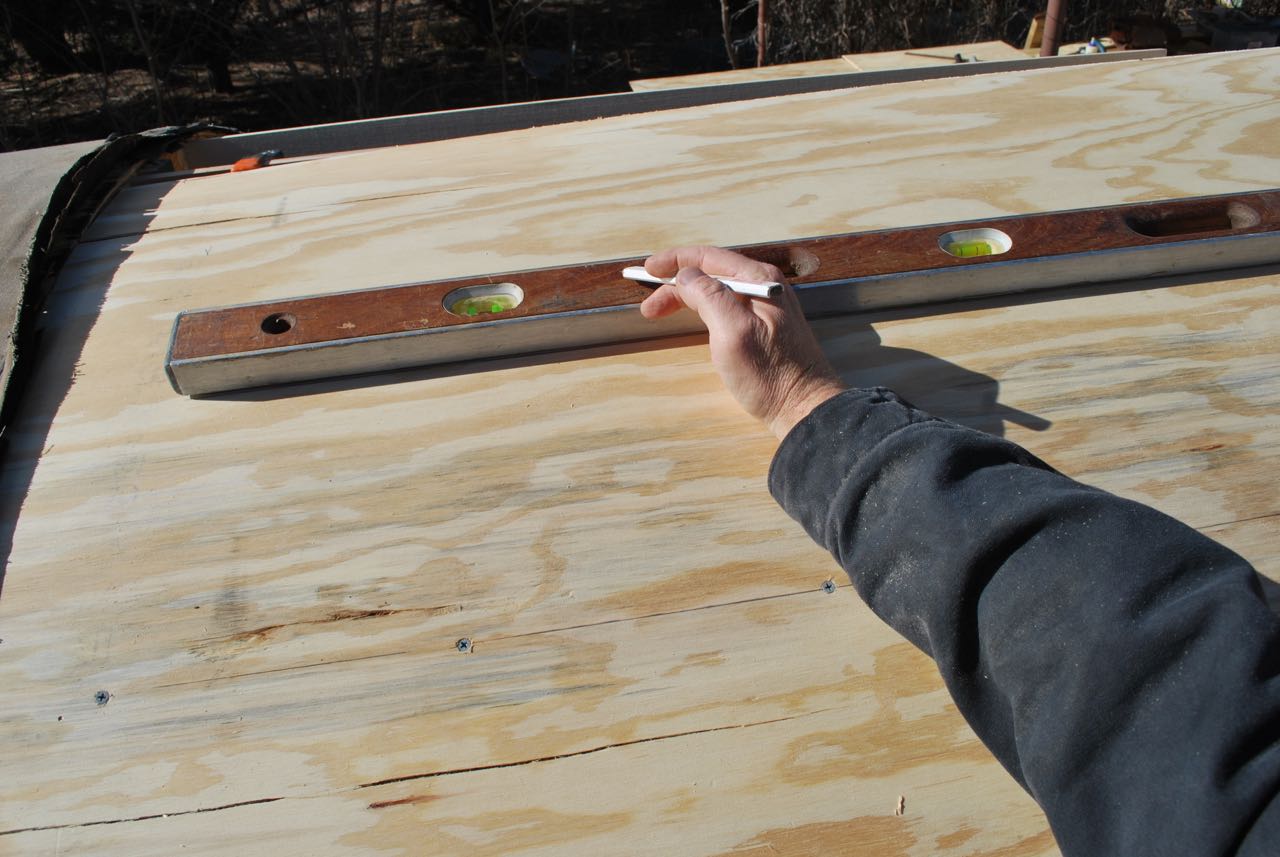
Checking the roof-line for a smooth transition.

After tacking down the plywood ceiling, it was time to mark screw locations.  A 3/4 inch  (ca. 2 cm) purlin is a small target to hit blindly.

DSC_0018 (2)
Laying out the lines.

A couple near misses with roofing nails were required to get things lined up but once marked, things moved along simply enough.

DSC_0004 (6)
Fastening down the roof.

I didn’t take photos of the roofing paper or waterproof canvas that overlays the plywood but those steps are pretty self-explanatory.

DSC_0029
Clamping the laminations that form the arch.

Now it was time to add a strengthening arch to the back wall.  After a couple of less-than-exact attempts to create a perfectly matched form from plywood I had a Eureka moment when I decided to use the wagon itself as the form.  Cutting a pile of 3/16 inch oak strips, I then glued and clamped them in place overnight.  Fortunately, the temperature stayed well above freezing through this entire step.  The metal was laid on the roof and tacked down while we hunkered down for the storm

Knowing where I live, and the capriciousness of the weather here, we took the blizzard warnings seriously and wrapped up the entire back half of the wagon in an enormous tarp, attaching it with roofing nails.  It was a good thing too.  What followed was over 30 hours of straight-line winds from 50-70 miles per hour (80-112 kph) with gusts reported at the nearby Air Force base up to 87 mph (140 kph).  Thousands of cattle died in the region and we had structural damage to one of our buildings but the vardo survived.

20151230sm
The 5 foot drift of snow, ice, and dust that filled our driveway.

The cold week that followed was time to take a break, eat, drink, and be merry over the holiday.

DSC_0032 (1)
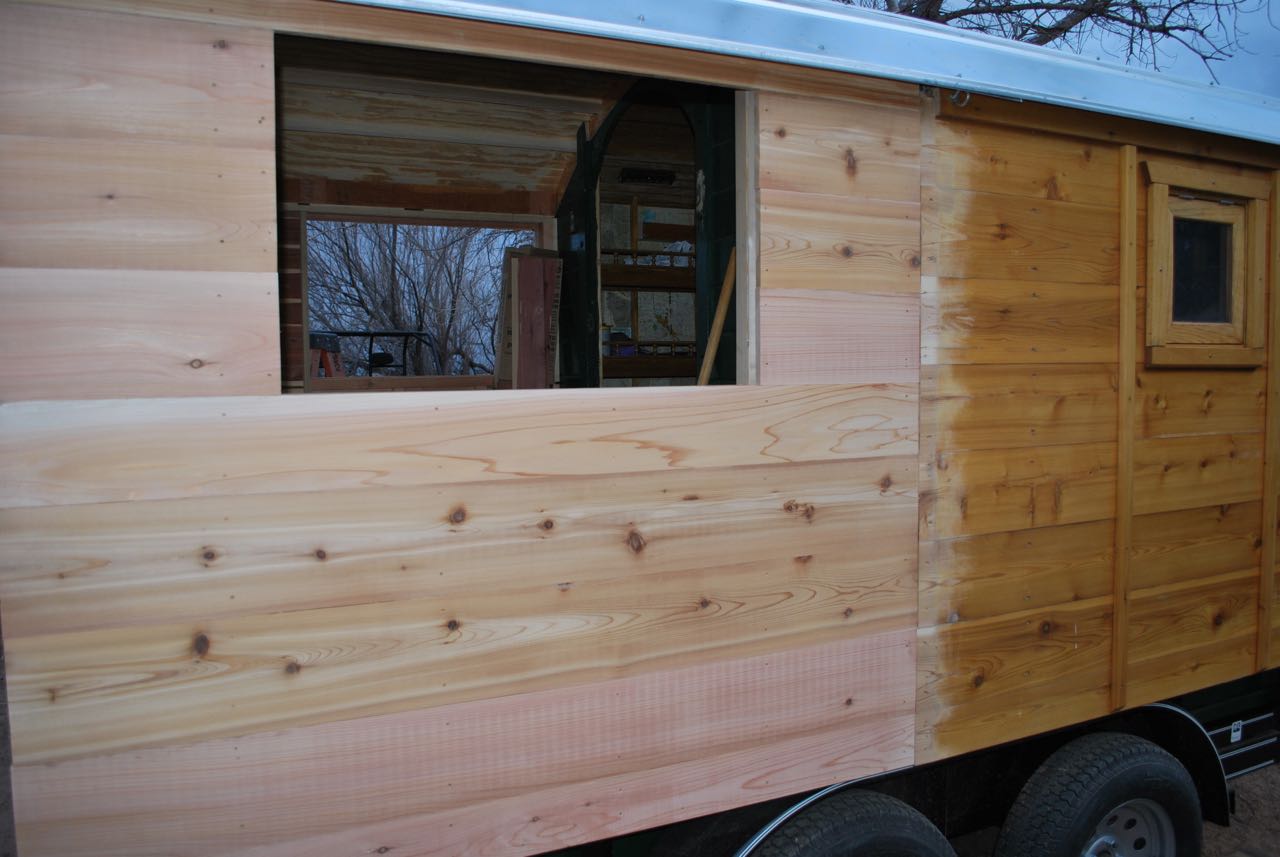
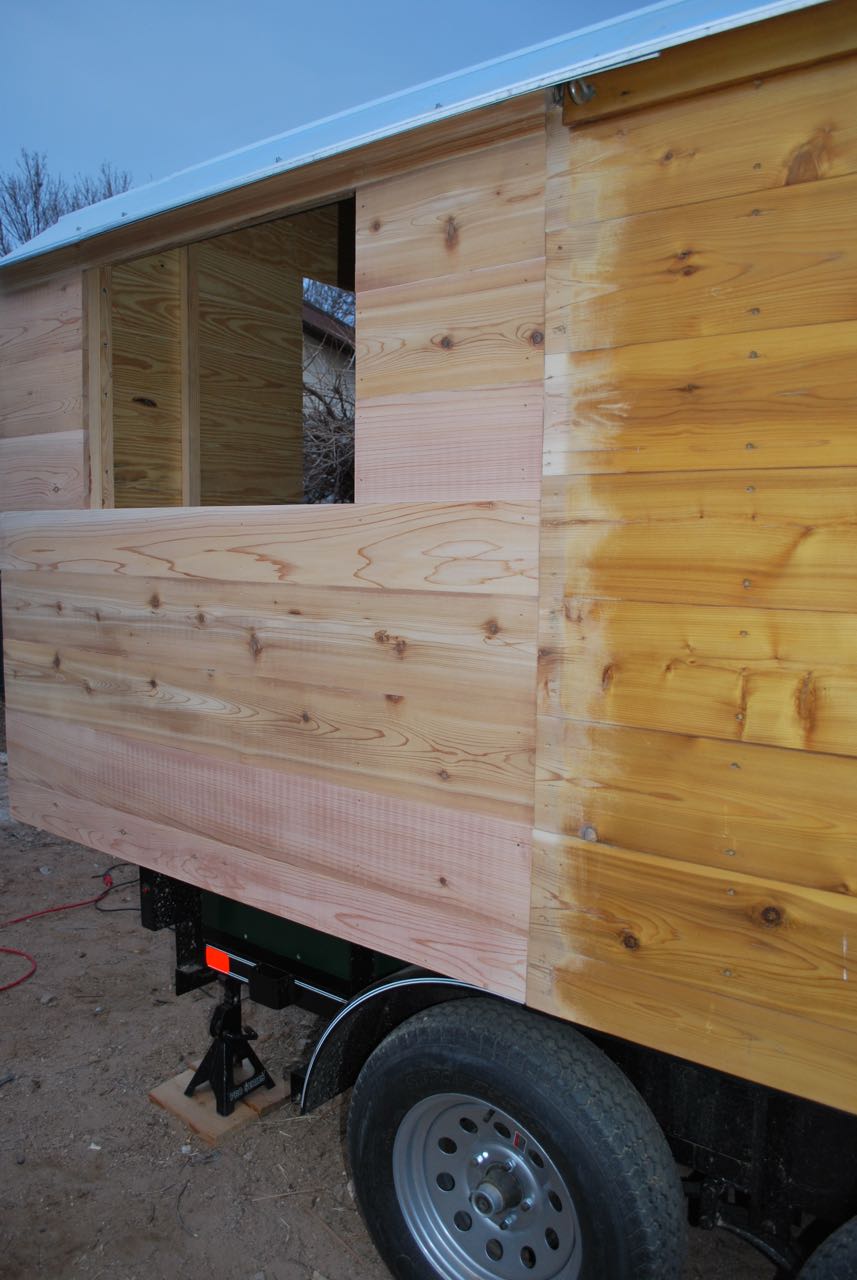
Metal attached and siding placed.

Getting back to the task at hand, the roof was finished and cedar planking added to the sides; the ends running long until they are cut into an ornamental shape.

DSC_0031
Siding running wild, awaiting it’s final shape.

DSC_0033
An ugly transition beginning to be sanded.

The butt-joint will be covered with another batten to seal the joint.

DSC_0034
I can finally feel some real progress but there is a long way to go before I can rest easy.

The weather had stayed cold, limiting some of the work but the need to weatherize the exterior presses on my mind.  I’ll be back to the grind in a little while and will update the progress as best I can.  Comments are certainly welcome!

If you are looking for Part 1 of the rebuild/addition then CLICK HERE.

On to Part 7!

Detailed to the Last Dollar

desk4

Not a pretty little Victorian-style caravan here today but a sturdy, well-thought-out modern living accommodation for someone looking to escape the mortgage anchor most of us have felt.

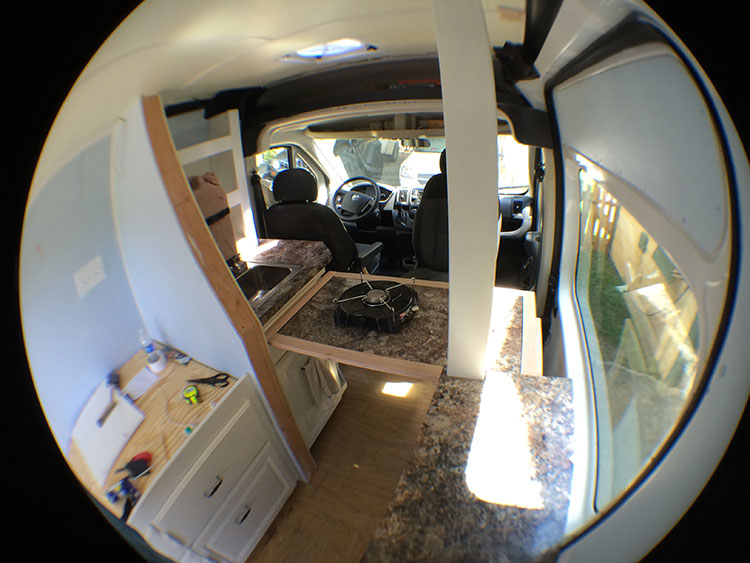
Here is an extremely well-documented van conversion into a very frugal but comfortable micro house created in 38 days from 2014-2015.  Sean (the builder) has done a remarkable job of tracking nearly every aspect of this life-changing event from the decisions that made this happen, to getting rid of everything that didn’t work in his 60 square foot dream, to purchasing and building his version of the perfect live-in rolling home.  There’s even a downloadable spreadsheet of the expenses incurred and great details for those seeking some real “how-to” guidance.

Sean’s blog takes us from the emptying and selling of THIS:

house

To the purchase and planning of THIS:

And through the entire build and beyond:

first-night2

It’s a remarkable journey and I thank him for sharing this with the world.  If you don’t have time or want just a quick overview, watch the short video:

And the entire write-up can be found here at:

F*ck the Banks, I’ll Build My Own Damn House


Tying it all together, Vardo Remodel Part 5

DSC_0002 (6)
Diving into the next stage of construction.

All earthly structures begin with a foundation of some sort, even living wagons. In our case, the trailer frame is the earth, the ledge and subfloor serve as the foundation upon which, all is built.  I proposed to attach the new section pretty much the same way and addition is connected to a house, by supplementing the structure at the joining lines and creating “nailers” to provide fastening surfaces for the new wood.

DSC_0001 (8)
With an afternoon that included a 30 degree temperature drop, an unexpected rain shower changing to freezing rain changing to snow we had to switch gears, tarp up the project, and retreat indoors. New Mexico in the winter!

Going back to the day job for the week left me with only limited work times.  No real workshop means no light and submitting to the ever-changing weather.  This became the perfect time to make lumber from the piles of miscellaneous scrap and recycled boards I have been hoarding the past couple years.  This is boring work and requires a lot of noisy time with the table saw and planer but yields a lots of free, well-seasoned lumber for building great things.

DSC_0004 (5)
Building up the back wall.

It’s satisfying to begin seeing real progress, even if it’s only just a shell going up.  Pre-cut tongue-and-groove pine makes for easy work at this stage.  The sad old door is being kept in place to help shelter the interior from unforeseen weather.  We hope to get the bedroom area cleaned up, repairs made, and some re-varnishing done in the coming weekend.

DSC_0006 (5)
Framing out the plan.

Corner posts were secured and, unlike the first edition of the build, framed walls were created and await their double layer skin.  I took this opportunity to mock-up the arch from plywood and test fitted it against the existing wall.  Finally, it feels like real progress.

If you are looking for Part 1 of the rebuild/addition then CLICK HERE.

On to Part 6!