Door and Frame, Vardo Remodel Part 8

Every home needs a door.  It’s a tricky bit that must fit well, open and close easily, provide some security, and hopefully, look good doing it.  

We found a mahogany, two-panel door at the Habitat Re-Store in Lubbock a couple months ago and since the price was right ($10), we bought it.  It was clearly well-made and I suspect it ended up at Habitat due to a largish scratch near the bottom on one of the rails.  The only down-side for me was it’s height.  At 94″ (2.38 m), it was far too tall for a simple,  tiny vardo.  I knew I had to cut it down and was willing to risk the $10 as it went to a good cause either way.  I suspected the panels were solid but, as is usual with this type of door, the rails and styles would be laminate over pine (or similar).  I had not initially considered a professionally made door but the final selling point was the nice arch-shape to the top of the upper panel.  It was an arc that I could match when came to finishing the door.
DSC_0032 (2)
Some stressful cutting; 20 inches removed.

The circular saw seemed the obvious choice for a long, straight cut like this so I set up a board as a guide and went at it, taking a full 20 inches out of the middle.

Matching the glue surface.

The top was then folded down for planing to get a precise fit for gluing surface.  This part took a lot of fidgeting and tweaking to get it correct over the entire run, but I achieved it in the end with only a little frustration and some muttering.

Clamping it back together.

To hold it all together, I decided to use polyurethane Gorilla Glue. I don’t use this for much but it can make an extremely strong and waterproof bond.  A couple very long screw completed the hillbilly engineering and I was confident with the result.  With the loss of 20 inches from the middle, the grain no longer lined up perfectly, but at a short distance, it isn’t very noticeable.  Hey, it’s a $10 solid mahogany door after all.  Talk about some good and frugal recycling.

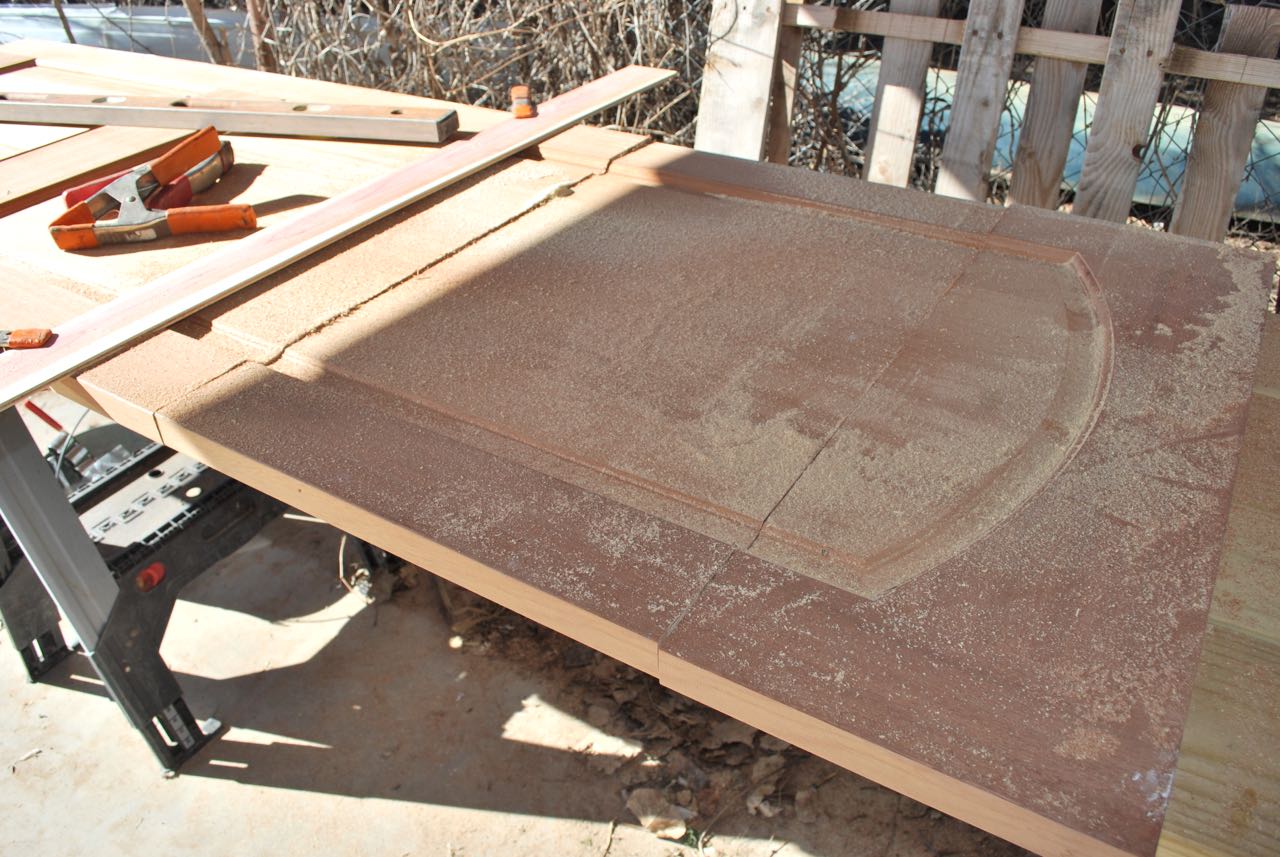
Top arc is cut and the glue line looks pretty clear here. It's a lot less noticeable in real life.
Top arc is cut and the glue line looks pretty clear here. It’s less noticeable in real life and will be less so as the door darkens with age.

I cut the top of the door to match the arc of the inset panel and I think it’s a great match for the curves of the wagon.  But now, it came down to making a door frame, after the fact, to match the new door shape, compound arc and all.
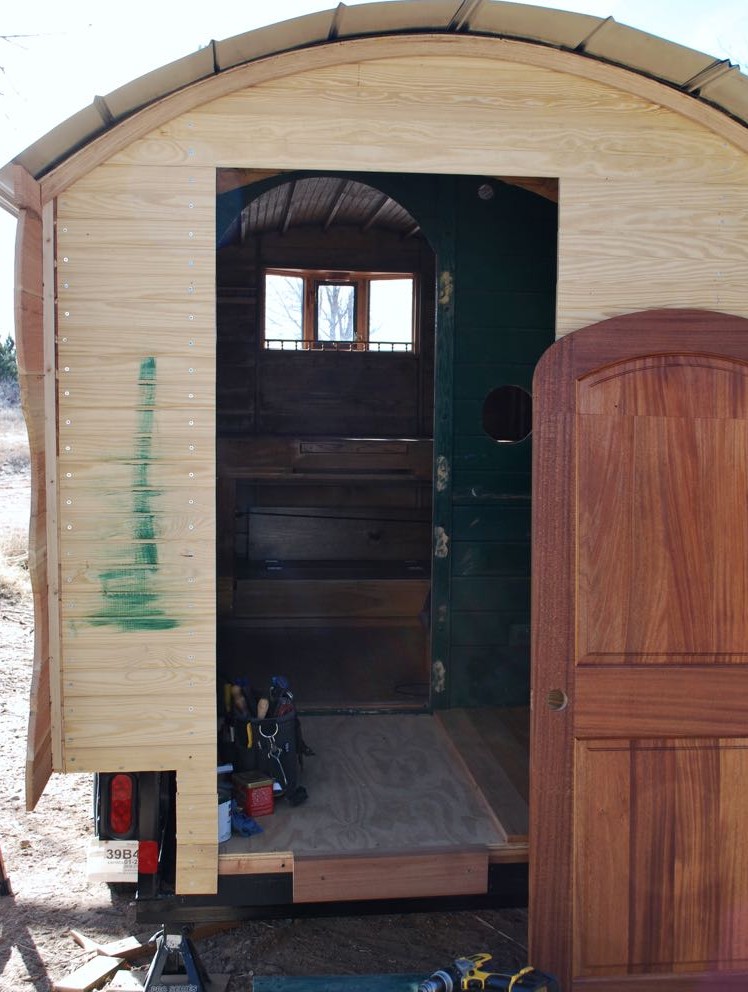
Square hole, round door.
Square hole, rounded  door.  A scrap of wood was secured to hold the door in position while fitting and marking for the frame.

Obviously, the hole for the frame was the next step; requiring another stressful free-hand cutting job.

Matching the arc in the opening.
Matching the arc in the opening.  There is hope for the new door.

Cutting and sanding complete, it was time to build up the frame from oak to provide stiffness and stops to seal the interior.  Fortunately, outside of a couple fierce storms, the weather has been extremely clement this winter, making for good working conditions.
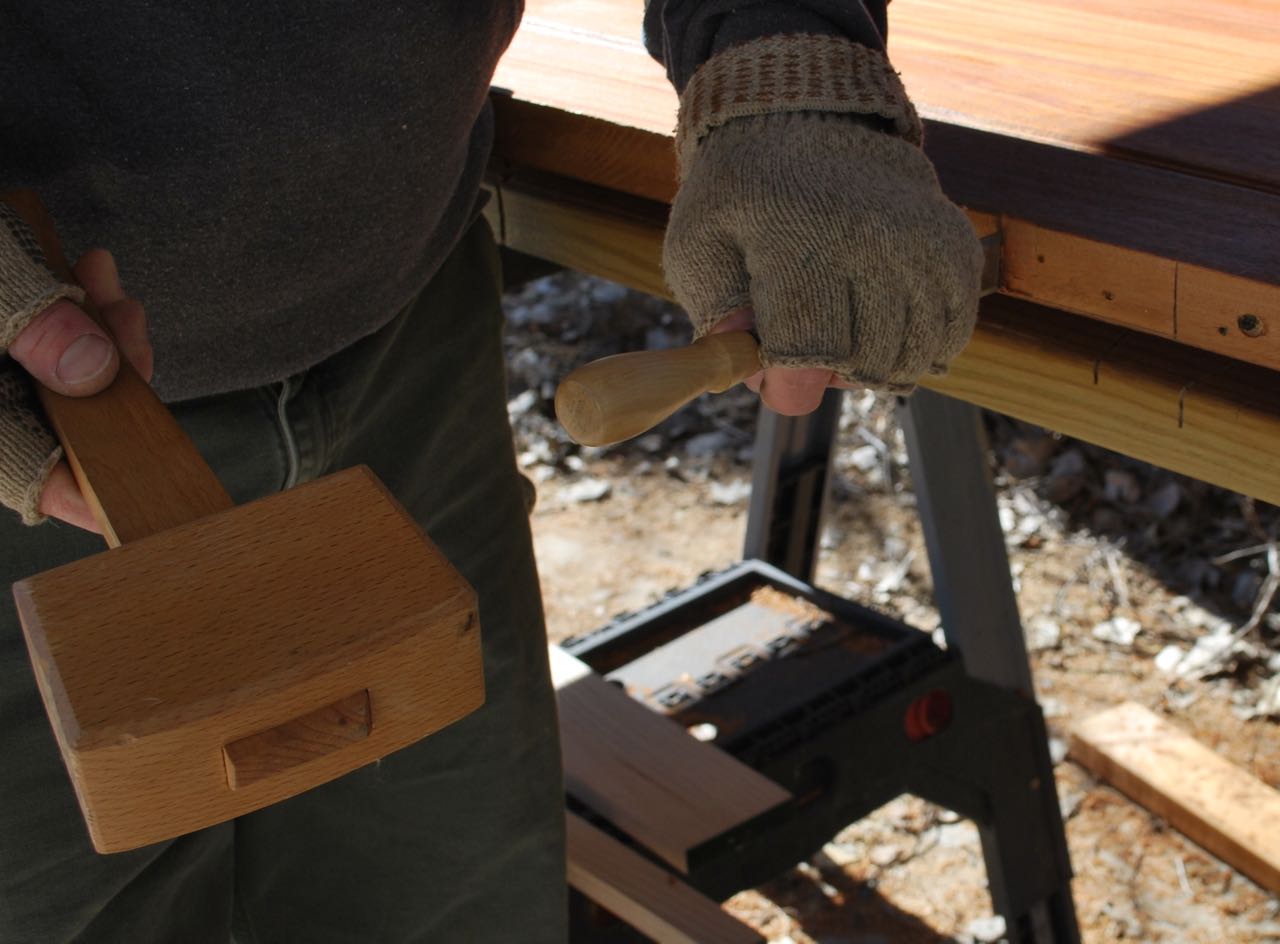
Mortising for the hinge.
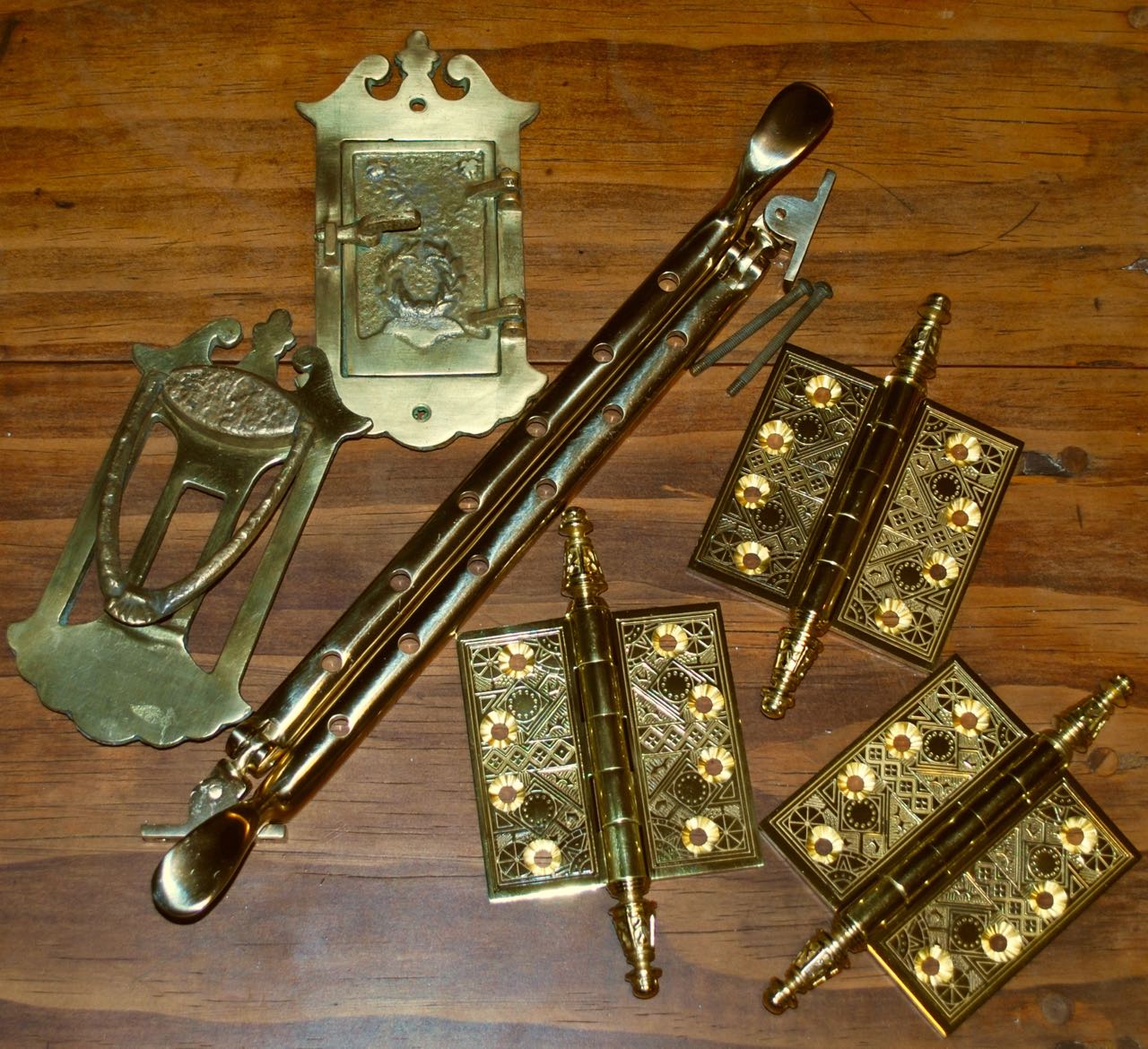
A smattering of new and old hardware.

I both got lucky and splurged a bit on new hardware.  The hinges are real beauties and very sturdily built. There is no perceptible play in them whatsoever and they operate very smoothly.  I went with a 19th century Eastlake pattern from House of Antique Hardware in Portland, Oregon.  Great stuff, great service, just too much to choose from.

DSC_0031 (2)
The door is nearly fitted into it’s final position in this photo. High quality hinges not only look nice but function so much better than the cheap, temporary ones they replaced.

I’ll admit that this tricky bit of framing isn’t perfect but is far better than I could have hoped for and suits us fine.  A small speakeasy grill will complete the door and even serve as a small vent when necessary.

DSC_0032 (3)
Eastlake style.  Notice the beauty of the natural mahogany next to the oak.
DSC_0033 (4)
Test-fitting the new hinge mortises.  I just couldn’t pass these beauties up.  Still some finishing work to be done on the door but without an indoor shop, something had to be in place.

There are lots of small steps that still need to happen but at least there a door in the hole.
DSC_0118 (4)
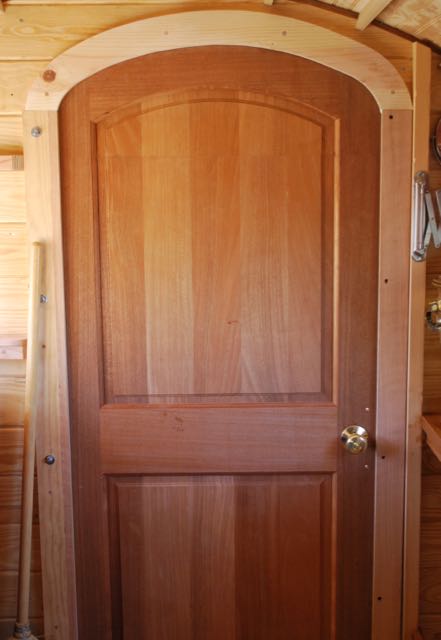
Piecing together the door jamb and frame.

There is a lot more to report and I’ll get it posted as soon as I can.  Great things are afoot and I can even see a distant light at the end of the tunnel.

For Part 1 of the rebuild/addition then CLICK HERE.

Or on to PART 9.

Homemade Ricotta

Rachel Falco's avatarHow to Provide

Ricotta is the easiest cheese to make — hands-down.  You can use all lemon juice or all vinegar.  If you use all lemon juice, it will have a lovely fruity flavor and will yield very soft curds.  If you use all vinegar, you will have a tangy flavor and will yield firmer curds.  I like combining the two.

2 quarts Whole Milk

2 tbsp Lemon Juice

1 tbsp Vinegar

1 tsp Sea Salt

In a 4 quart saucepan, mix all of the ingredients together.  Put over a low heat and watch it, stirring occasionally.  Bring to a boil, stirring frequently to ensure it doesn’t boil over for another minute.  Pull the saucepan off the heat.  The milk will be curdled.  Place a flour sack towel over a fine mesh strainer and place over a bowl.  Pour the milk mixture into the strainer.  Let the cheese drain for an hour or…

View original post 36 more words

Real World Construction

I saw this on Tumblr and absolutely couldn’t pass it up.  All I can find about this image is that it comes from the famous Farm Security Administration photos documenting the depression.

October 1937. "Old school bus. Williams County, North Dakota." Medium-format negative by Russell Lee for the Farm Security Administration.
October 1937. “Old school bus. Williams County, North Dakota.” Medium-format negative by Russell Lee for the Farm Security Administration.

This appears to have started life as another wagon, maybe even a delivery van or bus but has been repaired beyond recognition.  I did a reverse image lookup and found a larger version (shown here).  Comments on THIS PAGE indicates it started as a Studebaker School Bus but was probably converted into a dwelling.

Click the photo for full-size image.

Traditional Pottery Maker

I only know Kelly vaguely but I know she is an extremely talented artisan.  I am continually impressed by her skill level and ability to make it all seem so effortless.  I believe that is an indication of true mastery.  Here is a short documentary of her work to inspire the inner-Maker in you.

Watch artist and primitive potter Kelly Magleby learn about and make Anasazi style pottery. Kelly went into the backcountry of Southern Utah with a knife and a buckskin to try to learn about Anasazi Pottery by doing it the way the Anasazi did it. “Earth and Fire” is a documentary poem about a passionate artist. Funded by Primitive Found (.org) Music by Jason Shaw @ audionautix.com Check out Kelly’s art at anasazipottery.net This the 1st video of 2016 for The Talking Fly short documentary project by filmmaker Steve Olpin, Enjoy!

Enjoy the Ride; Happy Birthday Edward Abbey

Don’t Forget to Enjoy the Ride

This is a re-post from last year.  However, I think the message is a strong one and worth think about again.

Life is short.  If you’re fortunate enough to live with the means and privilege and food security, consider yourself lucky.  When I feel low or unhappy, I always want to remember the people subjected to abject poverty worldwide through no fault of their own.  It seems that the privileged, the comfortable, and those with the least to complain about are the most vocal and judgmental and superior acting.  A few words by Edward Abbey from a speech to environmentalists published in High Country News, (24 September 1976), under the title “Joy, Shipmates, Joy!”

DSC_0326
Columbia River 2015, G.T. Crawford.

One final paragraph of advice: […] It is not enough to fight for the land; it is even more important to enjoy it. While you can. While it’s still here. So get out there and hunt and fish and mess around with your friends, ramble out yonder and explore the forests, climb the mountains, bag the peaks, run the rivers, breathe deep of that yet sweet and lucid air, sit quietly for a while and contemplate the precious stillness, the lovely, mysterious, and awesome space.

Enjoy yourselves, keep your brain in your head and your head firmly attached to the body, the body active and alive, and I promise you this much; I promise you this one sweet victory over our enemies, over those desk-bound men and women with their hearts in a safe deposit box, and their eyes hypnotized by desk calculators. I promise you this; You will outlive the bastards.

Edward Abbey

The Tobasco Donkeys, a little known musical group working at the Philmont Scout Ranch recorded a song using Abbey’s words in one of the verses.  It fits well and brings a smile to my face.

8 World War II Survival Lessons We Must Never Forget

I love this post…

Rachel Falco's avatarHow to Provide

WW2-Lessons

[repost source: http://www-offthegridnews-com/extreme-survival/8-world-war-ii-survival-lessons-we-must-never-forget/%5D

Our ancestors simply were better equipped for survival than the people of our generation. Just look at it this way: Could you imagine your neighbors heading out cross-country in a covered wagon to settle “out west” somewhere?

For most of us, the answer to that question would be a resounding “No,” probably with a few laughs thrown in. Yet there was a time in our country’s history where that was happening all over. People would pack up what they could and take out across country; sometimes with hardly any notice at all.

How is it that they could do that and we can’t? Basically, it’s because their lifestyle caused them to do many things on a regular basis, which we would call “survival skills” today. Their lives were very different, and those differences helped them face a crisis and come out on top.

When we talk about…

View original post 1,138 more words

Flacket – the other leather bottle

So, I hung my leather bottle over the wood stove one evening and awoke to find it very dried out and the wax, hitherto virtually invisible had run to the bottom then onto the hearth. While seeking out design ideas, I recalled the excellent tutorial from the Leatherworking Reverend from way down under. I hope he doesn’t mind the publicity as I am reposting his Flacket-style bottle design here. On my ever growing, rarely shrinking list of things to do!

Wayne Robinson's avatarThe Reverend's Big Blog of Leather

A flacket is a type of leather flask or bottle made from only two pieces of leather, one for the front and one for the back. It has no base, but may additionally have a welt or gasket piece between the front and back. Depending on your cultural prejudices, these are sometimes also known as pumpkinseed- or pear-flasks.

Examples are few, pointing to it being an older design than those we more commonly see, such as costrels and the two- or three-piece leather bottels. Most of the surviving examples come from the Mary Rose (1545) and are regarded as among the last exemplars of the form. Accordingly, Baker is of little help other than on p59, remarking “Flasks (Flascones) as well as bottles are mentioned in Alfric’s Colloquy in the 10th century as being made by the shoe-wright…”

Designed mainly for upright use such as hanging on saddles…

View original post 1,609 more words

Live Well

“God gave us the gift of life; it is up to us to give ourselves the gift of living well.”
~Voltaire

Voltaire was on to something there.  Here is a very inspirational family making good in the wilds of Wisconsin.  I would love to see more as they sound like some truly genuine artisans and keep craftsmanship alive in this consumer era.

I want to continue being inspired by people like this with positive spirits and keeping an eye on the important things in life.  Feel free to submit links like this or comment if you have feeling about a handmade life.

IMG_1501

And don’t forget to check out their own web-page, photos, and blog by clicking the image below.

IMG_4539

Quinzhee Snow Shelter

Winter is here. For some of you it is here with real gusto.  Growing up in Missouri and being sent out to ‘play’ no matter what the weather or who was around I learned a lot about how to entertain myself.  Snowfall in the Mississippi valley could be heavy and wet throughout the winter and was a great medium for construction snowmen, fortresses, and quinzhees.  Of course, we didn’t know such an exotic word at the time but we did learn good tricks and techniques for safety later in the Boy Scouts.

Image from Boy's Life magazine. Click for the link.
Image from Boy’s Life magazine. Click for a short “how to.”

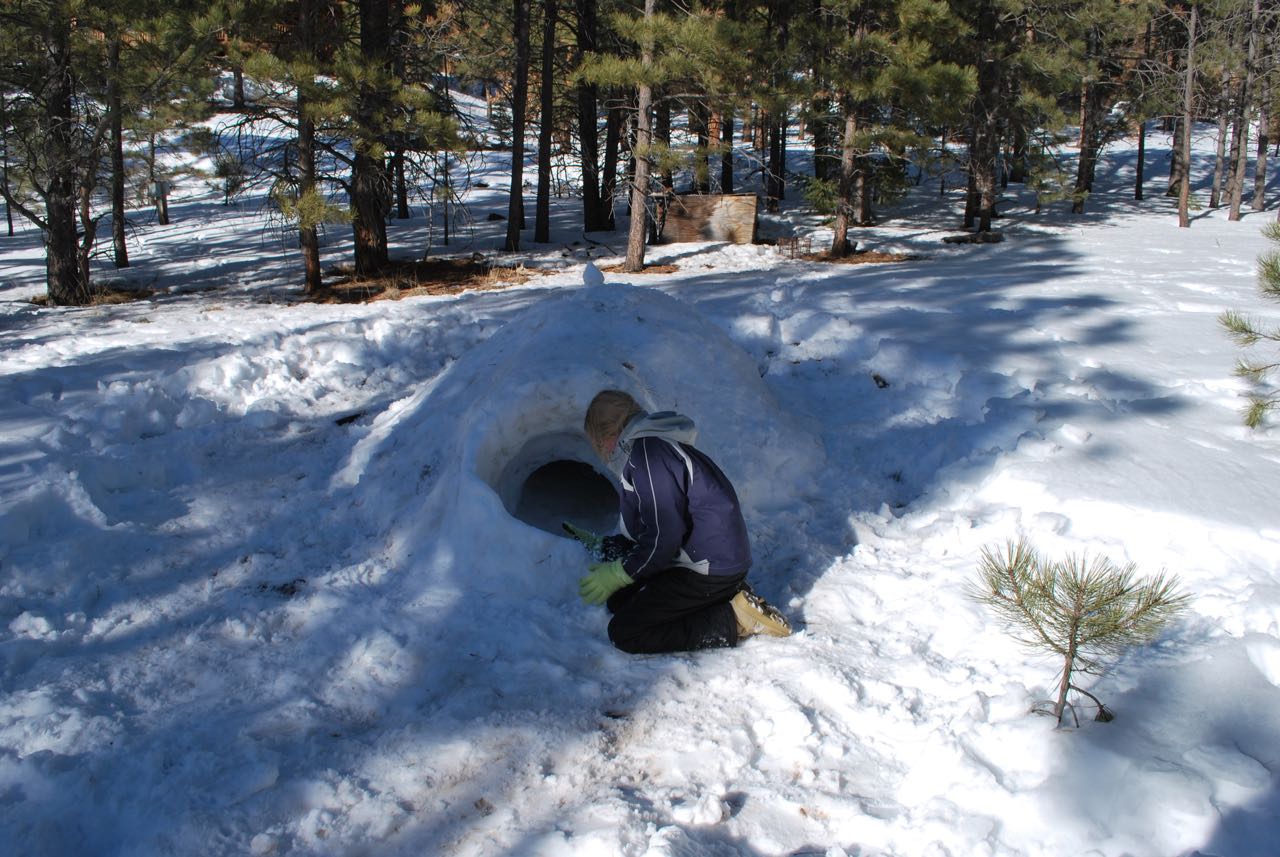
I’m certain there are no photos of the sometimes elaborate, and often not so elaborate, snow shelters my friends and I built as kids (I don’t think parents played outside with kids in my era).  I was reminded that we had our own photos of one built with my daughter several years back.  We were staying with a friend in the Sangre de Cristo mountains for the holiday at about 8,000 ft AMSL (ca. 2,500 meters).  The snow was perfect and wet so we couldn’t pass up the chance for a little shelter building.  “Teachable moments” surround us every day.  It’s up to us to take advantage of them.

Working on the wind wall.
Working on the wind wall.  If you look closely, you can see the miniature chimney and rain shield on top.

The snow wasn’t deep and we weren’t intending to spend the night inside so it was kept pretty small for ease of construction.

DSC_0007 (5)
View into the vestibule. The opening was kept narrow for warmth.

It was a chance to talk about safety, collapse, and fresh air exchange.  Valuable information for later in life.  Ours faced south.

DSC_0014 (5)
The dog was, of course, a great help, mostly chasing snowballs.
Testing out the fit.

It was definitely kid-sized but an adult could squeeze in more-or-less comfortably for a while.  The dog was not enamored with the confining space.

DSC_0018 (3)
Enjoying the evening by the warmth of a candle.

It was just another fun day, experimenting with the gifts that nature provided, and passing on knowledge to the next generation of wilderness lovers.