In my life-long quest for better designs and finer gear, I am constantly on some sort of hare-brained mission to make something new. Some readers may remember the earlier backpack I made and eventually traded off to a new owner. My friend Jacob, even made a fine copy for himself and it now lives happily in Botswana, hopefully seeing many great adventures.
Snapshot of the pack, ready for waxing.
Leather and Brass? (or, what the hell were you thinking?)
One thing that can be said about real leather is that it will, barring some mishap, last a lifetime but eventually fade back into to earth, leaving little trace. Leather is strong, wears well, is abrasion and heat-resistant, feels good to the touch, and cannot be beat for beauty. While I considered antler for buckles, I decided to go with a slightly more modern closures and fasteners made from solid brass. As I use antler in most of my creations, I chose to make a few well-shaped toggles as practical accents.
The downside? These materials are heavier than modern, lightweight materials but, for me, the trade-off is completely worth it.
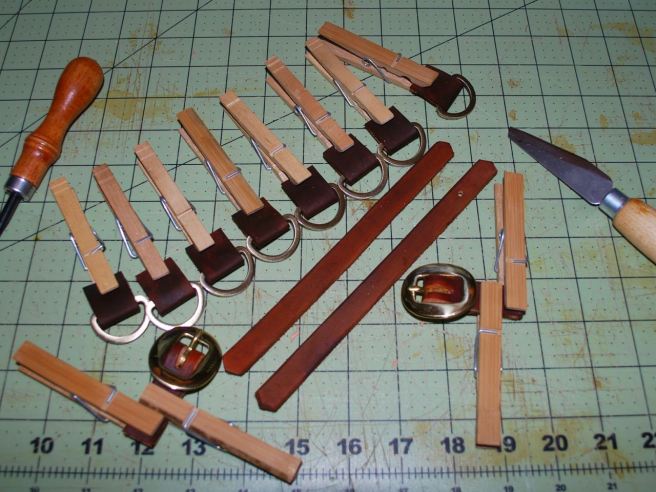
It begins with the little things. There are many repetitive steps in large projects such as this.
This backpack started off as some daydreaming and sketches on graph paper sometime last November but other projects and commitments made me set it aside again and again. This was good though; it allowed me to rethink the plans and make modifications as they occurred to me in the quiet hours of the night.
The harness system took some time, thought, and modelling before work could commence.
What were the design parameters?
Design is always the toughest part when creating something new. I’ve been looking at handcrafted bags and packs for years so I’m sure there are a thousand images bouncing around inside my skull influencing the composition of this piece. Honestly, choosing a size was the most puzzling part of all for me. I’m a biggish guy and have a tendency to go big when I make gear so I was determined to keep this one reigned in.
Once the more difficult decisions were made, cutting and sewing could begin.
I already had a “look” in mind and already decided on the construction technique. Should it be a six panel body for easier layout or single panel around the body for a more seamless build? Should it be sewn, laced, or riveted and what pockets does it need? Will it be “turned” (seams hidden inside) or will the closings be visible? Finally, where to begin construction? We can’t close the body until the external sewing is done so pockets and straps were a good place to start.
Not long after getting most of the parts gathered and cut, I found myself wounded, with only one arm for practical use. This slowed down sewing to a crawl. What should take fifteen minutes took over two hours so this bag became an exercise in patience.
Still, I managed to make headway and the pack came together over several weeks.
A “turned” pocket freshly attached to the body.
Maybe not my prettiest stitching ever, but as it will be mine, and not for sale, I will still cherish every flaw.
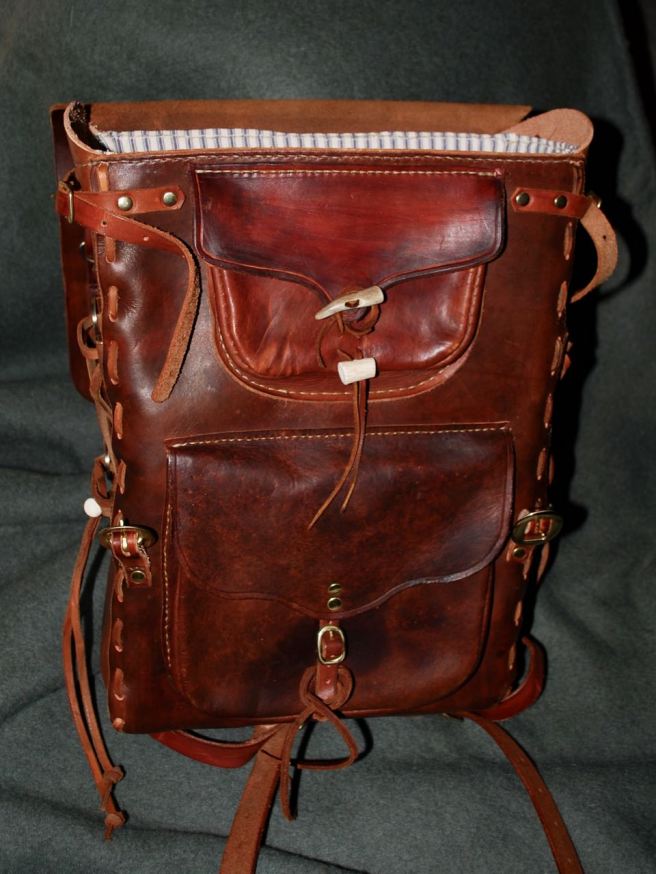
Large pocket accessible with the main flap closed.
As a prototype, there were changes that must be made on the fly but overall I was happy with the design.
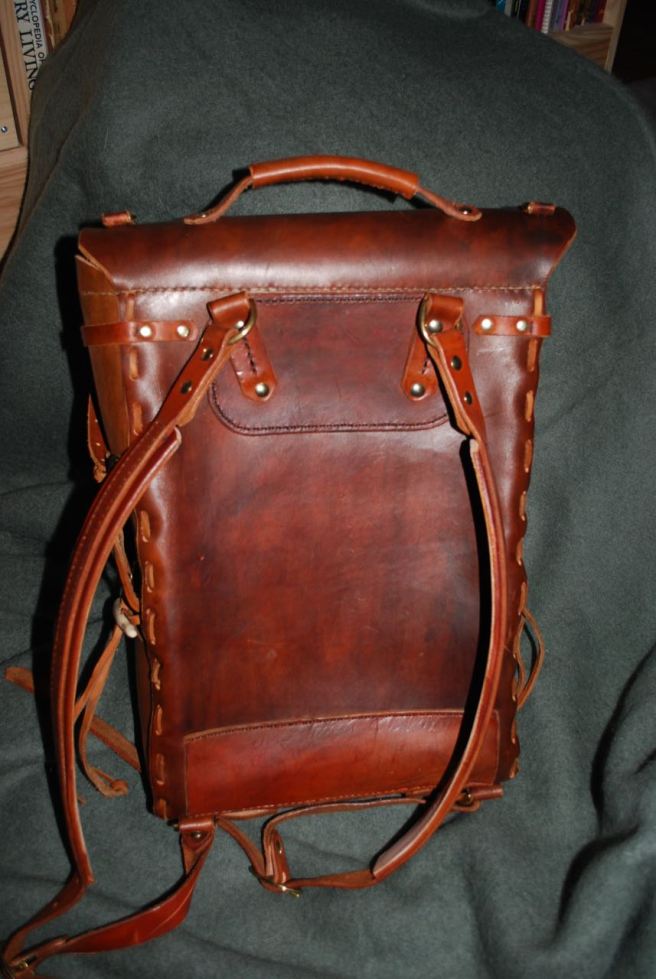
The shoulder straps were made to be replaceable without too much hassle and are long enough to accommodate a heavy coat in winter.
A carry handle was a heavy debate in my mind but makes a lot of sense for modern travel.Each side has a slip pocket, tie down D rings and a compression strap at the top of the pack.Bottoms up! I was able to place a scar in the hide on the bottom of the bag. The two rectangular patches are for blanket straps.Details – brass rivets, antler toggles, and beautiful leather called for a heavy pillow ticking to serve as the liner.Waiting to be packed for an adventure. I hope to get it waxed and outside later this week. Hopefully, I’ll get some photos of the new pack in use.
Dowel Cutter – A useful tool for large-scale production
A version of this post appeared here in 2012 but here is an update as prelude to a coming post.
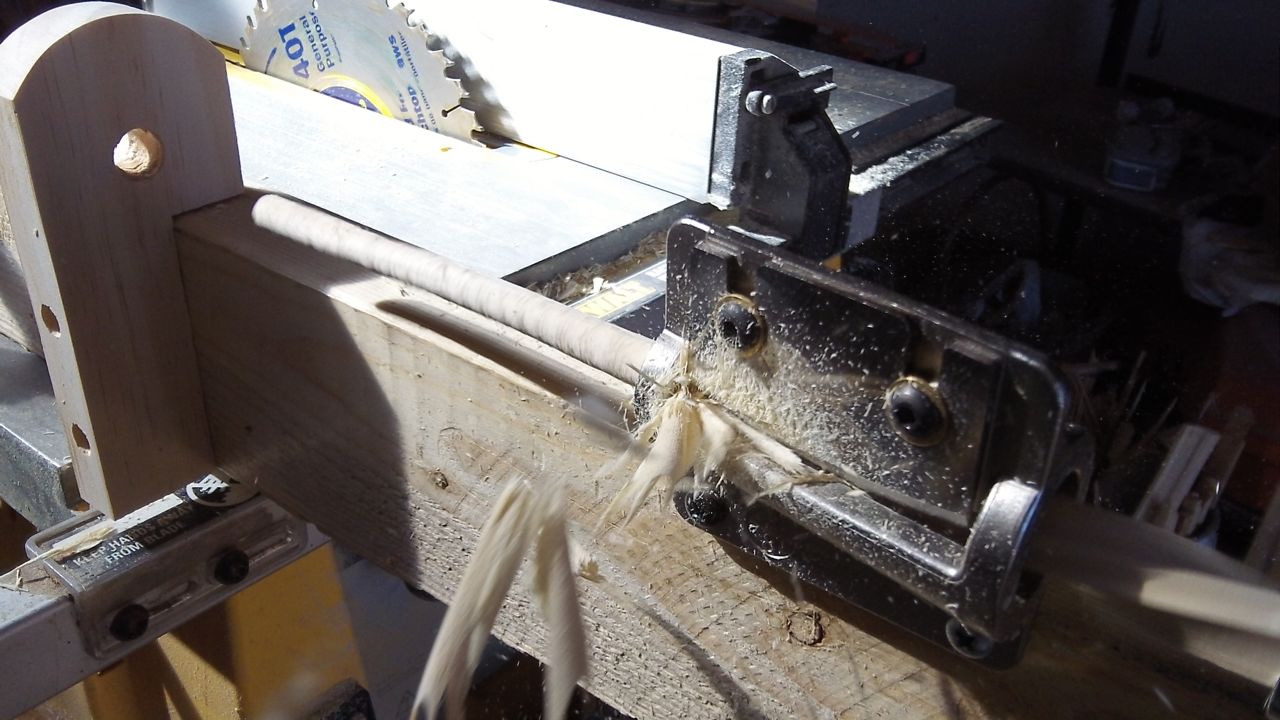
I’ve been using a Veritas dowel and tenon cutter to rough out arrow shafts from planks. Quite a while ago I posted about the jig I built for cutting the shafts and thought it might need some follow-up. Although I didn’t have much in the way of appropriate wood available for arrows on the day the cutter arrived, I did have one well-aged straight-grained poplar board that had been set aside to age for arrows to experiment with. The cutter, once set up, takes a piece of square stock of 7/16″ – 1/2″ and cuts it down to a 3/8″ dowel.
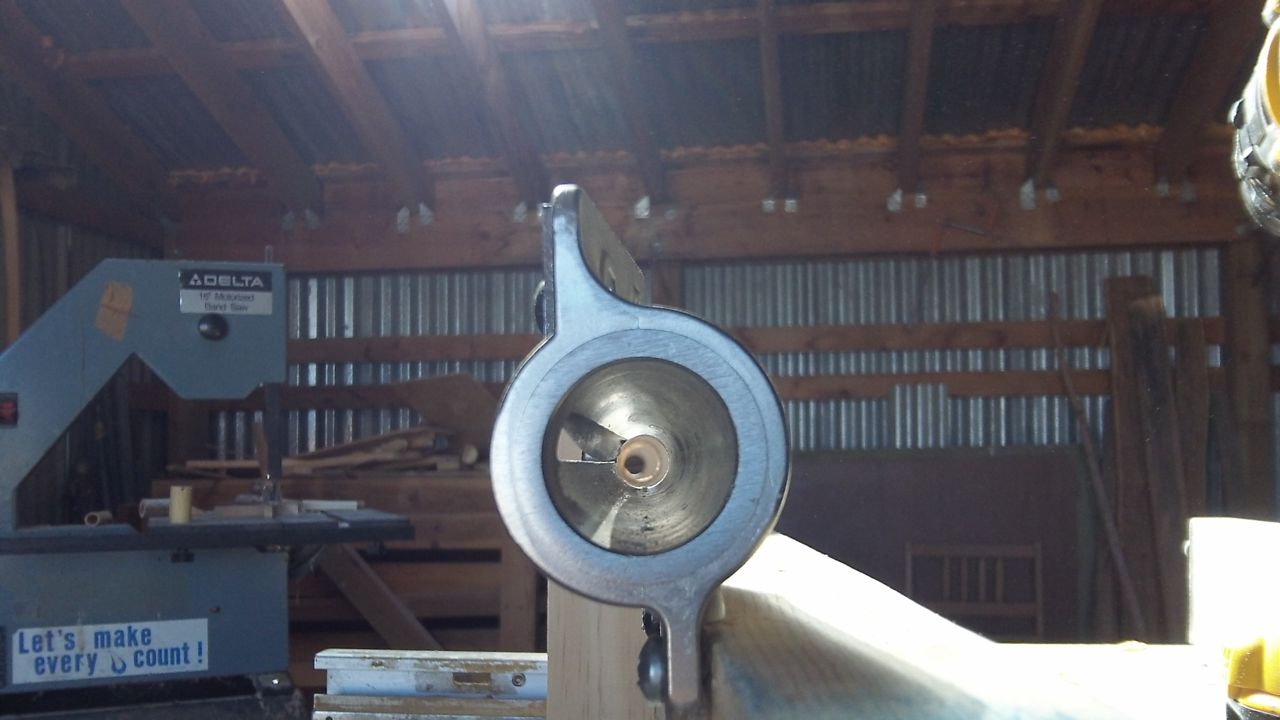
Looking through the feed end of the dowel cutter.
When the shaft comes out of the cutter it tends to start wobbling and the effect increases quickly. The solution is to create some sort of guide for the shaft so I came up with wooden blocks, as seen below with slightly oversized holes drilled inline with the cutter. There is a second identical block set back a few inches further to increase stability. After the first few experiments I could really tell that the stabilized shafts were much smoother than the unstabilized ones.
Shavings as they exit the cutter.
The wood can be turned by hand or a wrench or, as in this case, it can be driven by a drill motor chucked with a square socket (not pictured). The drill motor is not only faster but seems to cut smoother due to the high rate of rotation.
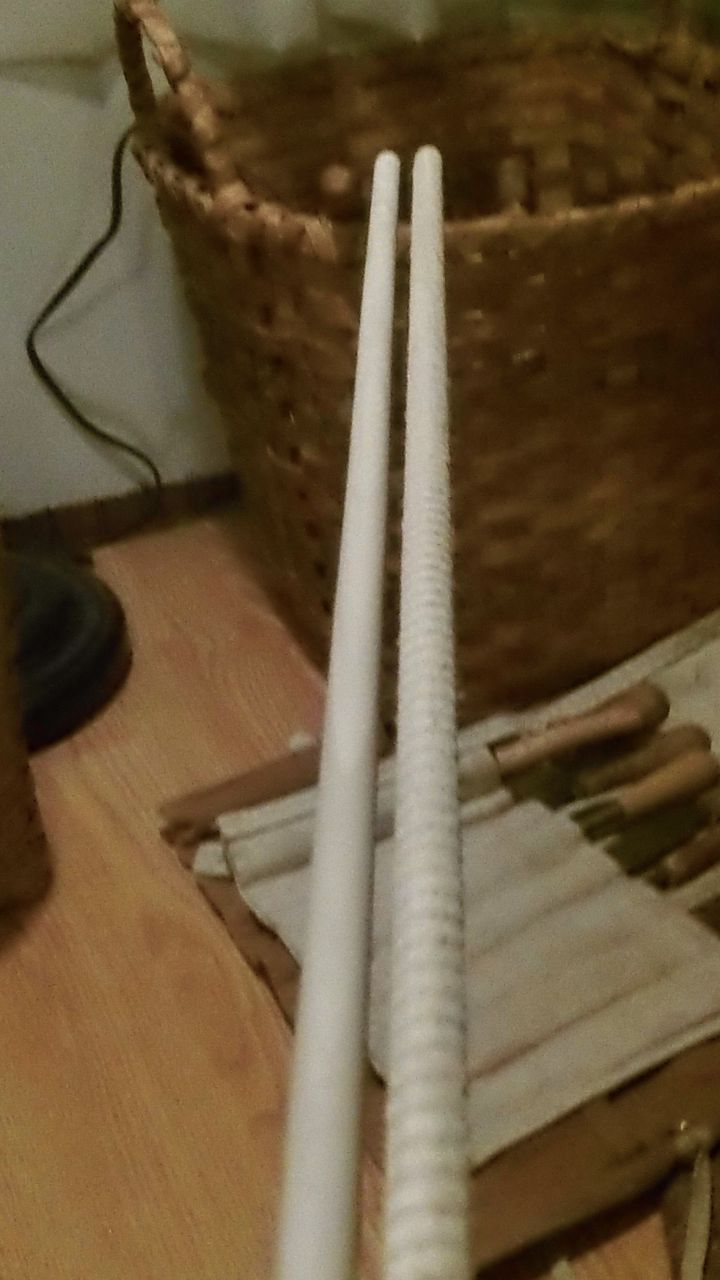
Before and after a light sanding. Sharpening the blade reduced this spiral of fuzziness.
The above photo is blurry but the right shaft demonstrates the rough “fuzzy” state as they come out of the the jig and the left is after a few minutes with some 100 and 220 grit sandpaper. They are subsequently burnished and await nock reinforcements as the next step. After putting a better edge on the blade, the shafts come out a littler smoother but it really seem to vary with the type of wood being used.
Image from the English War Bow Society. Click the image to link to their site and find out more about English warbows.
I was able to turn out eight experimental shafts in a short time. Two were rejected immediately as they has little kinks in the grain and two were rejected during sanding due to blemishes in the wood. They’ll probably be okay for light weight kid’s bows but are not acceptable for heavy, fast bows. The spine feels a little light to me but I’ll hold out to see what comes of them. The goal is to create some fairly standard issue British war bow arrows and see how they perform. Since I use wooden dowels to peg together many other projects, very few shafts have gone to waste since this purchase.
Note: many great arrows have been cut with the Veritas cutter since the original post in 2012 and I will do my best to continue documenting the work.
Several years ago I starting documenting some of the arrow-making I do. I wrote the original version of this piece in 2012 but as it always draws a lot of interest I have re-edited it and am posting it again.
Arrows have been much on my mind after seeing how ratty some of mine have become. Even though shooting takes its toll on the fletchings, it seems they get at least as much damage in storing and travel.
I was intending to start with a set of British longbow style arrows but having received some beautiful arrow bamboo (Pseudosasajaponica) from a friend who grows the stuff, I changed plans to suit the new material. Prior to this project I had never used real arrow bamboo but have used it’s distant cousin the american bamboo or rivercane (Arundinariagigantea). It could not be much more perfect for the job.
Since I hoped to do this right, I decided to photo document the process as best I could. Good arrow making isn’t easy or fast so unless you are dedicated to perfection, you are probably better off buying them.
Matching shafts.
High-grading the materials
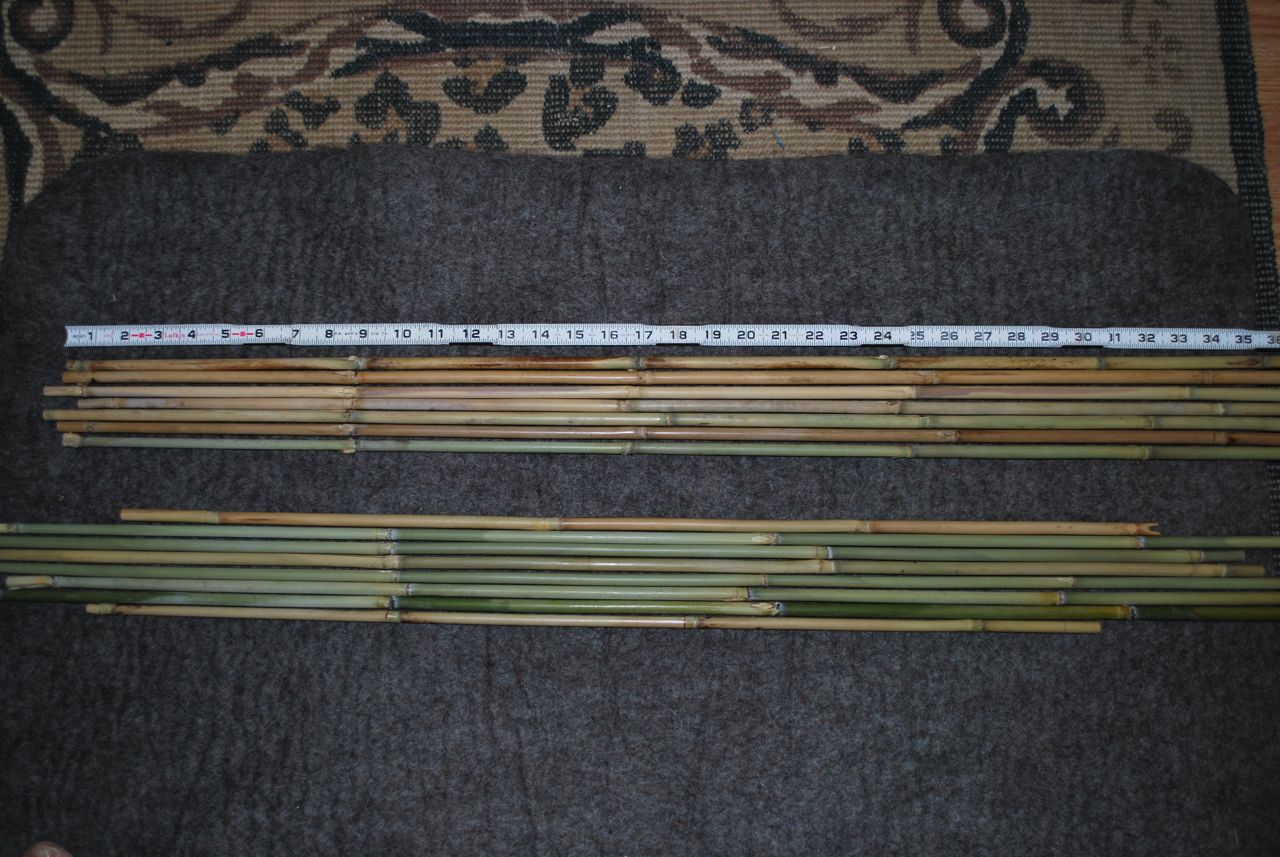
The first thing to do is to select shafts. I didn’t have hundreds to choose from but these were pre-selected for diameter (hence spine), straightness, node alignment, etc. so this made my work easy. I parsed out a half-dozen I liked for starters and cut them to length. Note similarity in diameter and node alignment. The scale above the shafts is in inches. I could hardly ask for better.
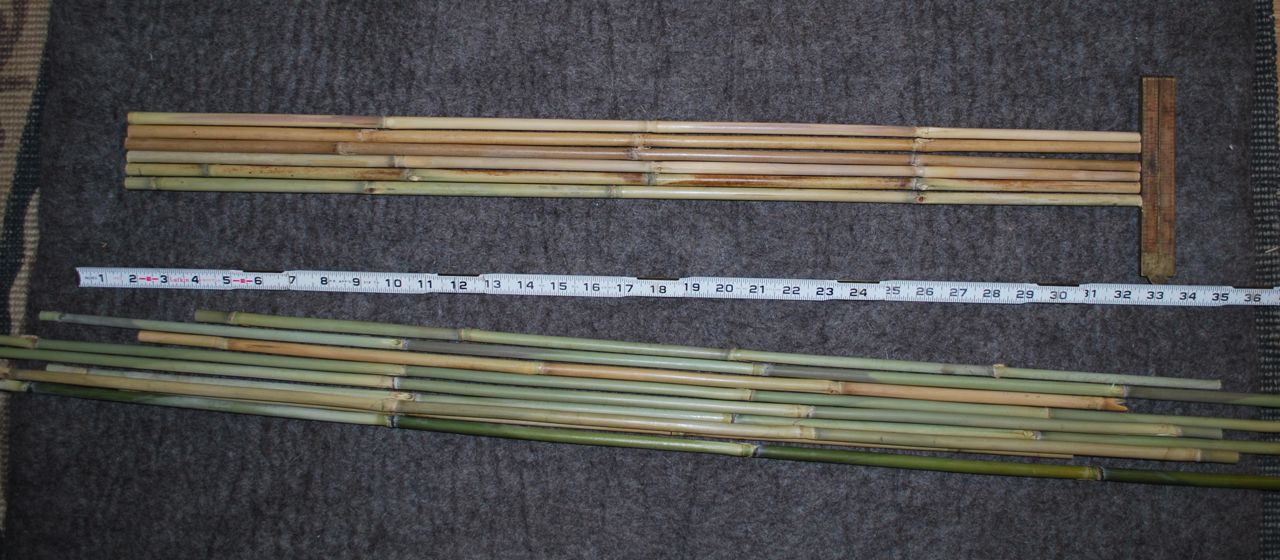
A preview of shafts selected, straightened, and cut to length.
Attributes to look for in bamboo or cane shafts
Your arrows should be a consistent diameter, consistent weight, similar spine, long lengths between nodes, similar node placement, with very little taper overall. Most people seem to think that bamboo is straight coming right out of the ground but this is rarely the case. Expect to heat straighten and you shafts. Your best work will be done in groups to get a consistent set, not just a one-off product.
After a lot of reading, I decided to approximate Korean style arrows with inserted wood nocks. These have worked well for me in the past but I have never started with this great of bamboo.
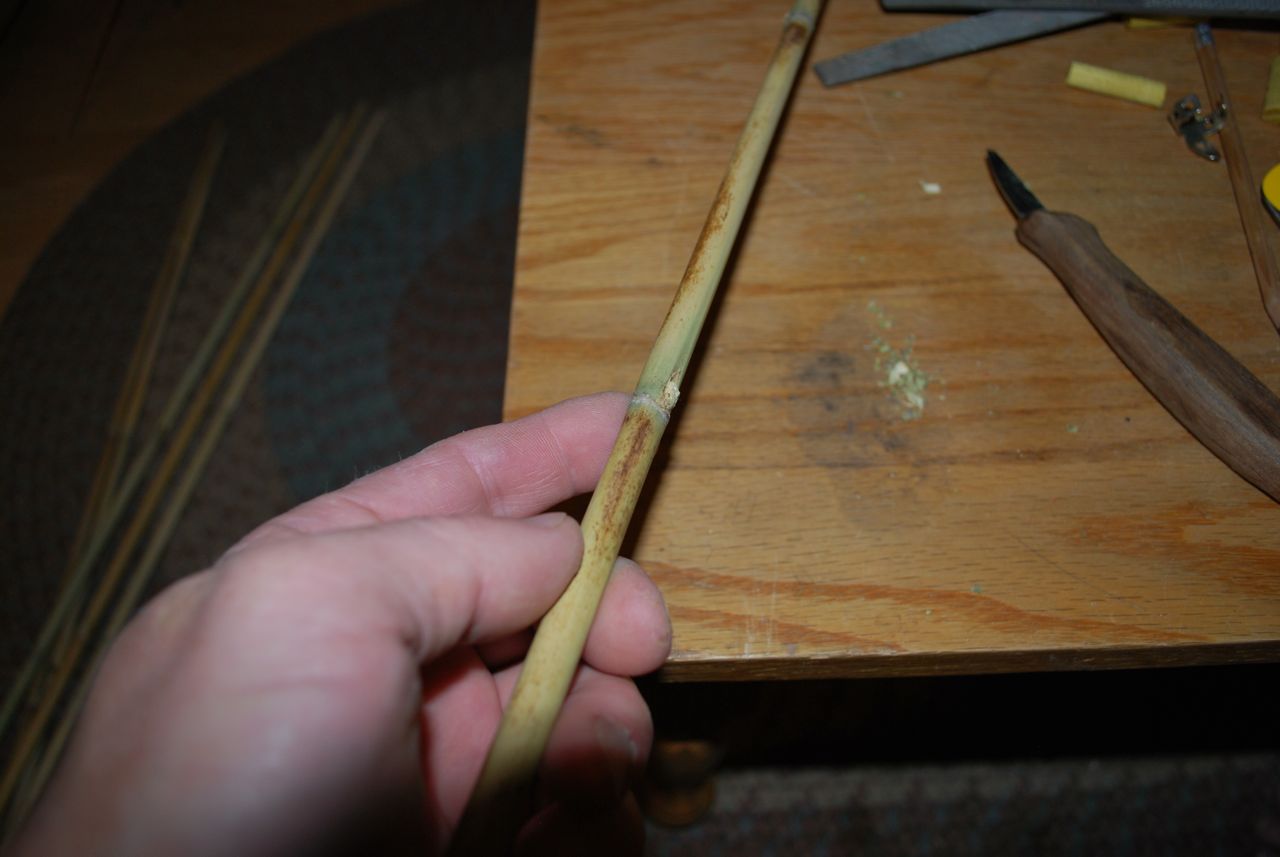
Remove the flares at the node sections.
Cleaning up the shafts
Raw bamboo has a flair at each leaf node that must be removed for a smooth arrow shaft. I do most of this with a knife but a small plane or file will suffice. You don’t want something bumping over the hand or bow as the arrows is loosed.
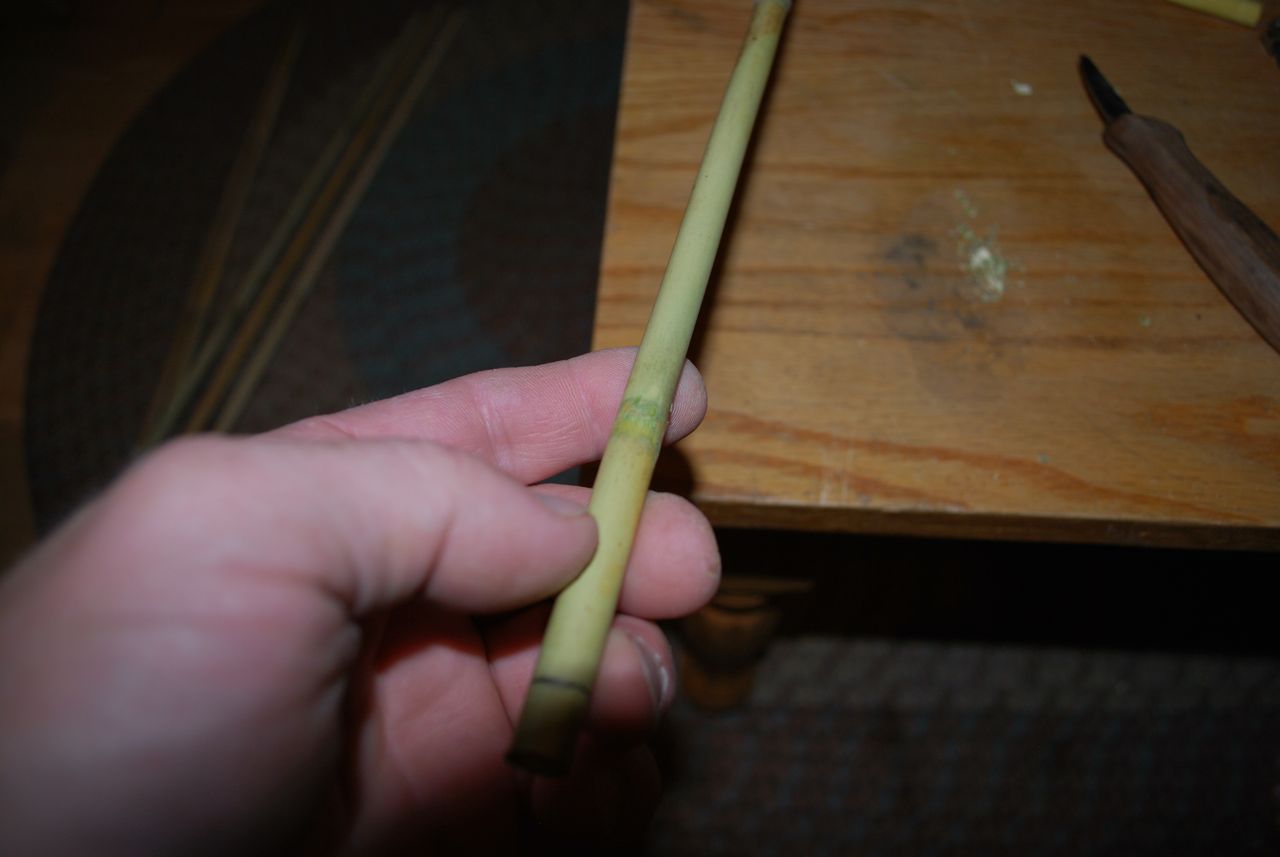
Smoothed node.
The node above is cut smooth.
Further smoothing.
I have a neat little shaft plane (made by Dick Baugh) that helps at this stage but a rasp or sandpaper will work too. You might have a divot at the joint but this won’t really affect your arrow.
Nodes are smooth.
The nodes of the set are now relatively smooth. Now, any final straightening should be done over gentle heat. This can take several hours so don’t rush it. Keep fixing little bends and make sure to heat the entire shaft to temper it. I stand over the stove for this but have used coals from the fire in a pot to achieve the same purpose. Wear gloves and be patient.
Whittling nock inserts.
I selected Osage orange for the nocks. Horn or other hardwoods can be used here as well. The above photo shows a blank and finished nock preform.
More whittling.
This photo shows the basic method. With a very sharp knife, score a ring around the nock. Whittle away from the score to narrow the piece slowly. Repeat until it fits the shafts. At this point I will say that I omitted a photo of an optional, but I think important, step. That is, to wrap the end of each shaft with sinew and hide glue to prevent the shaft from splitting while pressing in the wood. If, for some reason, sinew isn’t available, silk thread can be used in its place but you should top the silk with a little thinned white glue to help prevent it unraveling through abrasion. As sinew is free and carried around inside all the higher life forms, it should be pretty easy to get some.
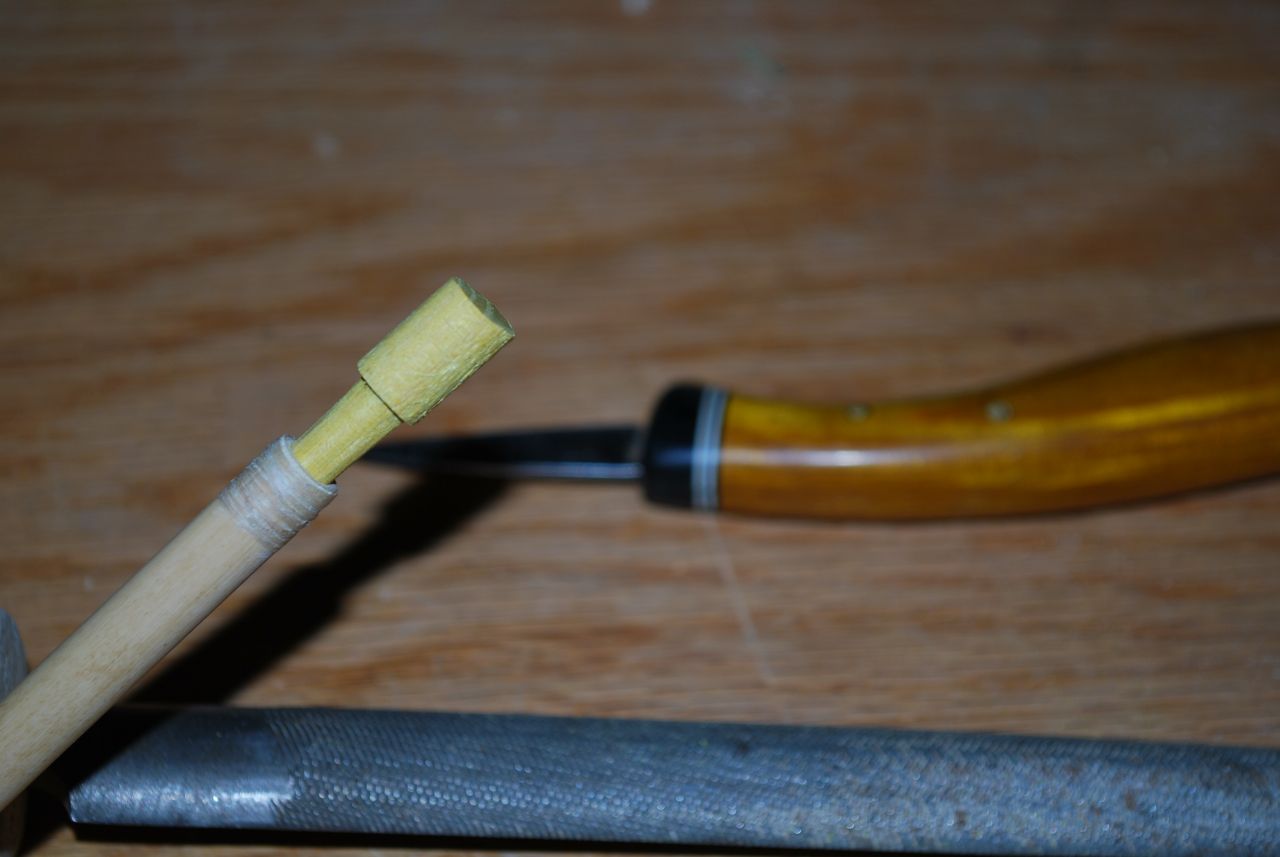
Almost a tight fit.
As you get close, keep test fitting the nocks until they are a perfect fit.
A perfect fit.
You can see the sinewed shaft ends being fit with the inserts. Glue the nocks in place with a water-soluble wood glue for easier repair.
Steps in forming the notch.
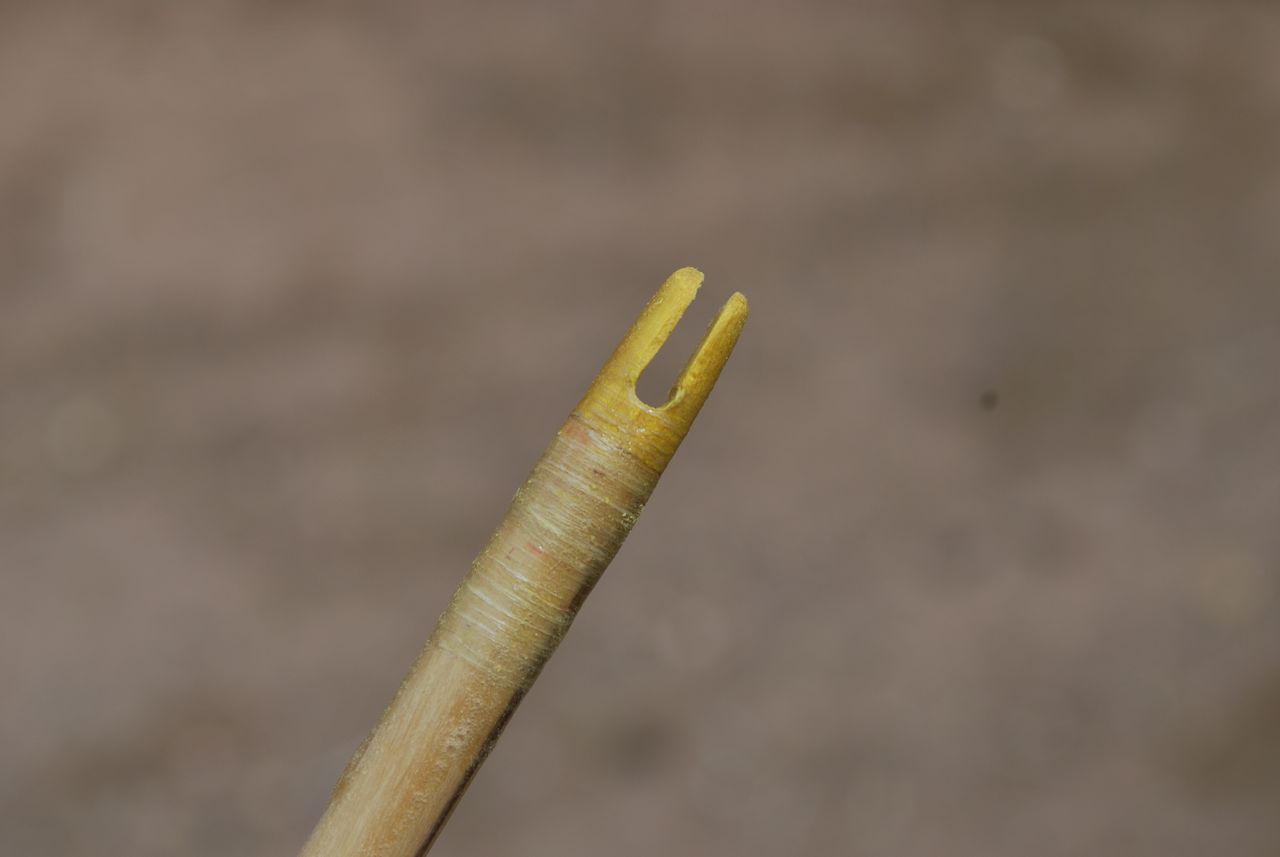
At this point, several simple steps create a nice notch. First, wrap the joint with more sinew and coat in a thin layer of hide glue. Second, drill a small hole through the nock, preferably at 45 degrees across the grain. Make a small saw incision to start the carving and remove the waste with a small knife. Use a very small file or sandpaper to open the notch and smooth the surfaces.
The finished product.
At this point, you have the essence of an arrow.
Foreshafts, points, and fletchings
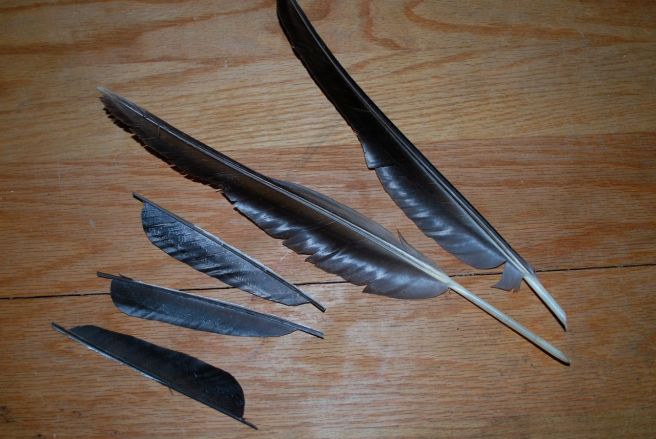
The next step to make these fancy sticks into arrows is to fletch them with feathers. To make fletchings, the best feathers must be selected. I am using some goose wing feathers given to me by a friend which have been graded to the last three per wing. Perhaps common knowledge in the fletching world but it worth noting that all three feathers must be from the same side of the bird (i.e., all right wing or all left wing). I cut a template from Bristol board to serve as a guide so that all the fletchings are the same size and shape. After the quills are split and trimmed, the bases (where they will be glued to the shaft) must be trimmed smooth and sanded flat to lie against the arrow. This is a very time-consuming task but critical in proper fletching.
Feathers to fletchings.
Again, there are only about three feathers on each wing suitable for fletchings and all three on an arrow need to come from the same wing to have the same shape and twist. To produce the needed 18 fletchings I cut about 24 as some may go to waste. I always ruin a few in the final trimming or end up weeding them out due to defects. Save them for later repairs if you have any left over.
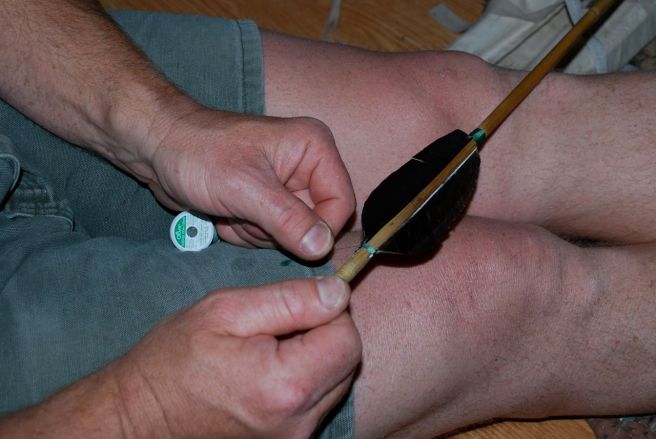
Serving the feathers with silk.
After gluing them in place by hand, the ends are served with two layers of fine silk. This is a slow and tedious job and neatness really shows but the end product will be sturdy and handle a lot of abuse through shooting.
Silk in the sunlight.
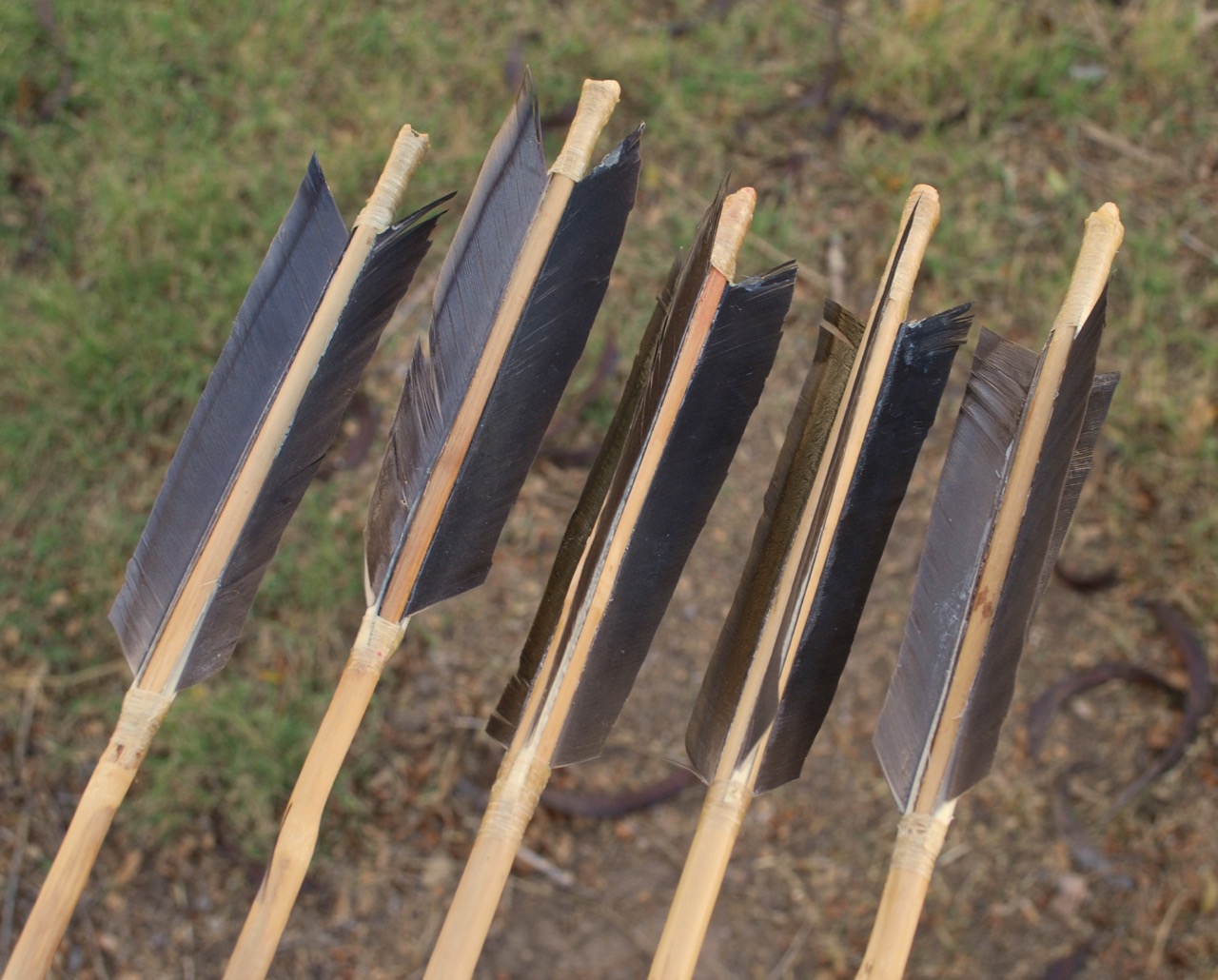
The arrow above is now fletched, reinforced, and has a sturdy wooden nock. Real silk is strong and shimmers beautifully in the light and comes in virtually any color.
Inserted wood nock and goose fletching.
It takes me nearly an hour for each arrow so I took a break after the first four.
Footings
The foot is the front portion of the arrow that reinforces the shaft and connects to the point or head. This was done exactly as the nocks above but instead of drilling and cutting a slit, they are tapered to match the heads they are to be attached to.
Bodkin, foot, and sinew reinforcement.
As for points, I chose some traditional bodkins since they are good looking and very efficient. Many cultures came up with this essential design. These are English copies and are known to punch through heavy armor. They are surprisingly sharp and tear through most targets easily.
Bodkins test fitted. The joint at the wooden “foot” is reinforced with sinew.
For the photo, I dropped these from about six inches above and they all stuck in the oak. I should mention that these points haven’t had the final fitting yet and are just stuck on by friction. If you look closely in this photo, the ferrules don’t quite fit the foreshafts yet.
First four finished.
Arrows are difficult to photograph so I took this high oblique shot to show them as nearly done. I hope these images help a fledgling fletcher somewhere as it isn’t an easy task. Be patient, don’t lose hope, and be consistent. Good things take time and it really shows in their performance and longevity.
A bit of red ochre paint completes the set.
I marked my shafts with a little ochre paint made with a base of boiled linseed oil with a drop of turpentine and ground pigment. I love the natural look of ochre and enjoy knowing I found and ground the pigment myself.
These remarkably fast and true arrows suit my bow very well. A little luck, experience, and patience pay off big rewards in the end.
Some Thoughts on Making Arrows, an Underappreciated Art –
I have been making my own arrows from scratch for a couple decades (since 1987 to be precise) and thought I’d showcase some I have made over the past few years. I don’t generally make them to sell and I rarely hunt these days but there is something very satisfying and meditative in gathering the materials and constructing something so practical, with such fine tuning and narrow parameters in functionality. I learned many tough lessons along the way, having no actual teacher, but I gleaned all I could from the historical resources I could find. Most cultures of the world have a martial tradition of archery and each have their advantages and limitations.
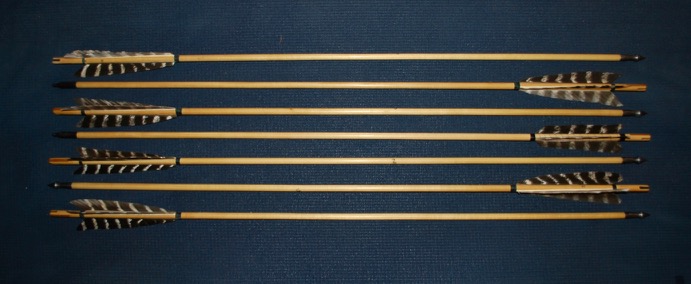
A set of seven hand-turned poplar arrows in the English tradition.
The poplar arrows above were made from aged, straight-grained wood that was split along the grain then turned in a dowel cutter. The nocks are reinforced with Bois d’arc (Osage orange) wood for added strength. The heads are conical bodkins, fletchings are prime turkey wing secured with glue and silk binding.
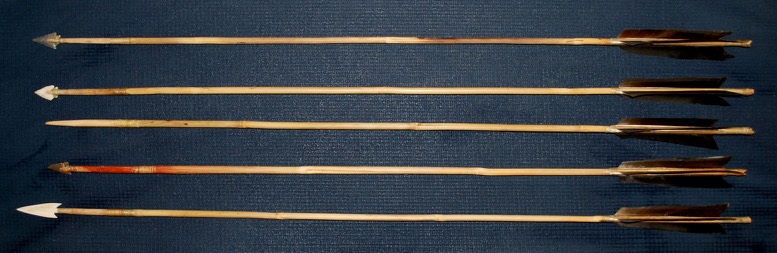
A “primitive” set of cane arrows with hardwood foreshafts tipped with a variety of point types.
Making matched sets –
I sometimes come across beginning arrow-makers (fletchers) who only produce “one-offs” without attempting a matched set. This is fine as an experiment or as a learning tool but does not suffice for someone who plans to actually use them for precise or regular use. The minimum I make is three but I try to produce arrows in sets of six or twelve. Since the plank used for the the arrows above worked out to produce exactly seven shafts, I kept the group together.
I believe it was a writing by Arthur Young where I first learned that to have a truly great set that sometimes you had to sacrifice a few as imperfect. With all the work that goes into an arrow, it is painful to cull one out but sometimes it must be done. The weights may match, the spine may feel the same, but one may just not fly as perfectly from the bow as the rest. In the past, I have marked these and they become stump shooters of ones that you don’t mind risking on a long or difficult shot.
Finding a perfect set of rivercane shafts can involve a lot of looking, sorting, and luck. People who want to purchase these hand-crafted materials and products rarely appreciate how much work goes into just gathering the materials. A dozen matched cane shafts may come from sorting a hundred plants, then aging, curing, and straightening before the arrow can even be started.
Rivercane (Arundinaria) arrows with reinforced self nocks.
Fletchings –
To produce enough fletchings for the above, one has to acquire three feathers per arrow, matched by side (all rights or lefts) and placement on the wing of the bird (e.g., second or third wing feather). This could mean wings from seven to fifteen animals depending on how picky one is just to produce five sets of fletchings.
Antler point.
Points –
Finally, the points are considered based on the needs of the archer. Will these be for hunting large or small game, target shooting, or just all around fun shooting? I use bone, antler, stone, wood, and steel depending on the intended use of the set. Although I purchase most of the metal points I use, a lot of time can go into making matched heads from natural materials.
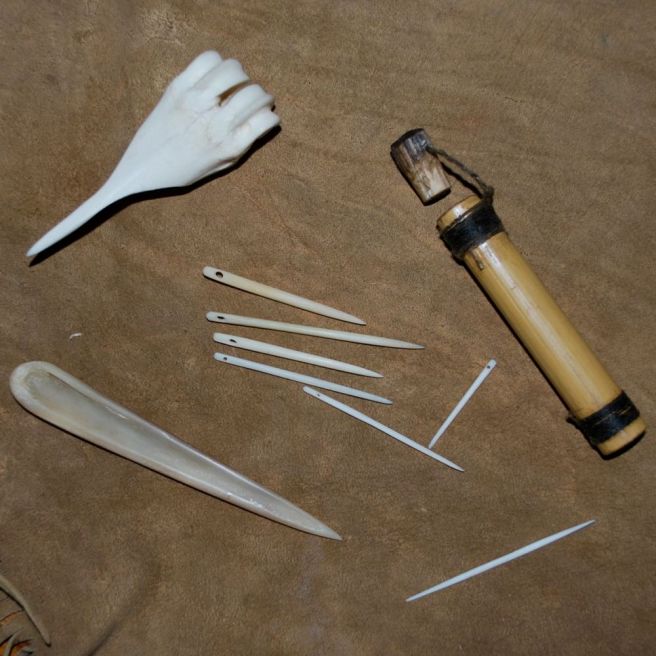
Tools, clockwise from lower left: large awl, sewing awl, rivercane needle case, bone toothpick, sewing needles in center.
Sewing
I do quite a bit of sewing and I feel it is an essential skill for nearly everyone. My sewing includes new buckskin trousers, cotton shirts, shoes, a few leather bags, backpacks, and repairs to clothes to name just a few projects. All this has caused me to think about sewing without manufactured goods. Over a few evenings I decided to make a better primitive sewing kit. Although I can’t say that bone could fully replace the smallest steel needles in my day-to-day sewing basket, I have been able to make some very small ones indeed from some deer legs I have lying around.
This 7 centimeter (2 3/4 inch) needle, dated to approximately 50,000+ years before present, was made and used by our long extinct Denisovan ancestors, a recently-discovered hominin species or subspecies. the material is bird bone. Photo: Siberian Times (click the image for the full article).
Needles
I’ve learned that very small holes can be made with a largish stone flake or knife if it has a sufficiently acute point, drilling from one side and joining it with a hole from the other. From a sewing perspective, the smallest hole possible will provide the strongest needle. during the finishing on the smallest needles, I had a 50% failure rate splitting out the eye. It isn’t generally a total loss since the needle can be shortened and the hole drilled again. I actually found that using the flake like a knife (as opposed to a drill bit) was the best way to start a tiny hole, scraping a small slit until a significant indent is made. As with all new skills, knowledge and experience were gained along the way.
Eyed needle from the burial at Horn Shelter, Texas (links to overview of this remarkable shelter). Click the image for and article explaining the needle context specifically.
Despite their fragility, bone needles are found far back in the archaeological record of Europe, Asia, and North America. Small, eyed needles are generally considered, in the Anthropological community, as proxy evidence for tailored clothing or, in a few cases, surgical or first aid related. Unfortunately, needles don’t often survive and, no doubt, many small and broken fragments have been lost through the screen during excavation.
Awls
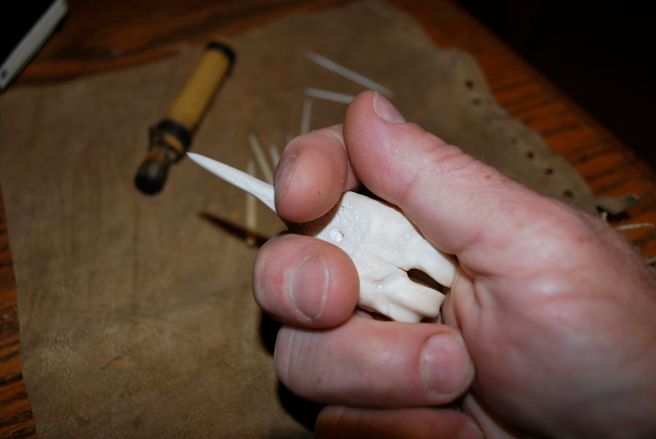
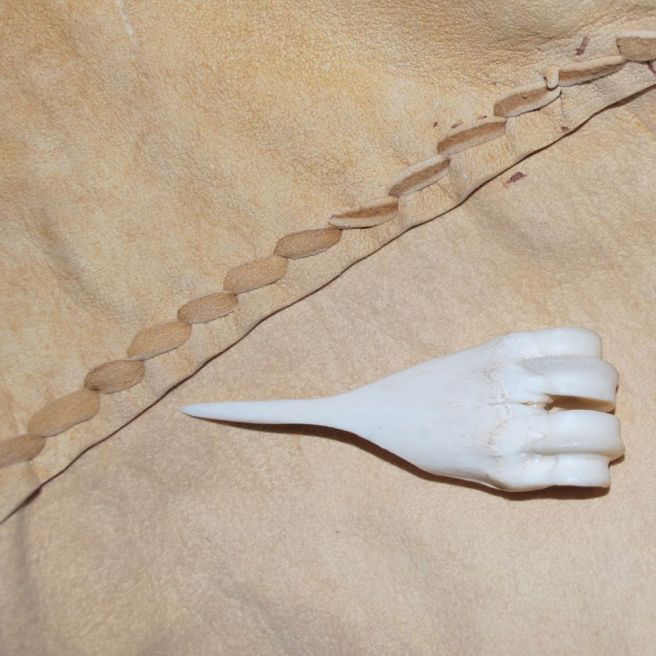
Awls are essentially a small spike used to pre-punch holes in tough or thick materials. Both the awls shown here are also based on archaeological examples; the awl being a universal tool in human communities. The metacarpal “knob” on the sewing awl still needs a bit of refinement but the round handle works well for repeated stitching in buckskin. Bone (and antler) can be made surprisingly sharp and hold an edge reasonably well.
Storing the Needles
Needles are sharp and dangerous to leave lying around so the next obvious step was to make a case to hold them. This is a simple affair made from rivercane with a yucca stem stopper. The cordage strengthens the tube and prevents splitting and the whole thing was rubbed down with pine tar for preservation (hence the dark coloration of the cord).
In use on buckskin lacing project.
Finally, with a thin scrap of bone I ground out a bone toothpick to keep in the travel kit as a toothpick is always a handy thing to have in the bush.
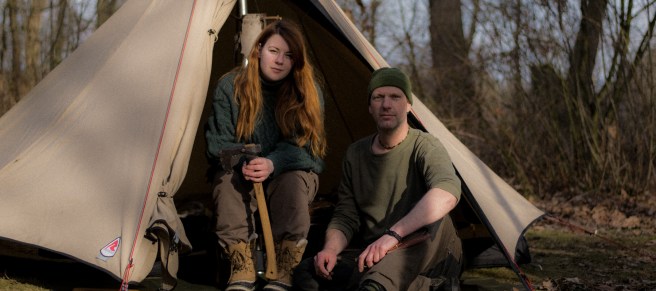
From one of my new favorite blogs Running With Sheep. Johan and Sanne are a couple of remarkable outdoors – bushcraft – survival enthusiasts with more than a touch of philosophy thrown in.
Their most recent project shows how to convert a run-of-the-mill thrift store find into a functional pack basket. From what I can tell, they are adept leather workers so their skill shows in this project. Re-using found objects is an excellent way to economize both money and time, especially if it is something outside your skill set or craft specialty.
Pack baskets are light and strong and a perfect choice for hauling anything from food to dirt. Prehistoric people used them for everything, and the solid structure makes them useful even when not carried on the back (most of the time).
If you can cut a few straight lines, do some minimal sewing, and hammer a rivet, this project is for you. For the complete post, head over to Running With Sheep to learn more. I suspect you’ll want to stay a while and catch up on their other posts as well.
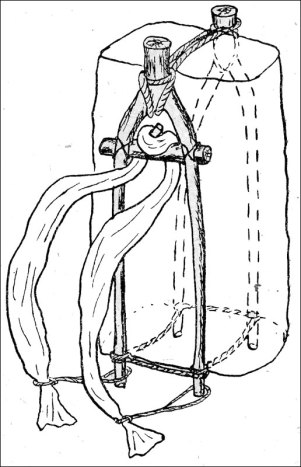
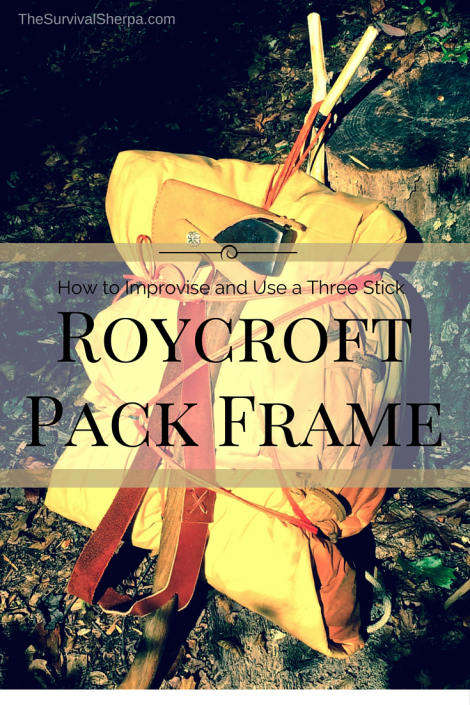
Thanks to Survival Sherpa for posting this look at making a pack frame. Making a quick, three stick pack frame is a valuable bit of knowledge. How serendipitous that this came up (seems to be a lot of convergent thinking around my world lately) as I am beginning to tweak my own wooden pack frame for some experimental travel. And while we’re on the subject here’s a link to a broad look at pack frames from around the world on Markus Kittner’s fine web page.
Have a look at Survival Sherpa by clicking the link below.
A fun and relatively tame primitive technology event for a good price located in southwest Missouri put on by good friends of mine. Here’s some information from their website:
This unique event has two parts – a free knap-in/native arts-crafts show starting Thursday, with top-notch knappers, artists, and crafters from a 20-state area making and selling their work. In the Workshop Area starting Friday, a pool of some of the area’s finest instructors offer workshops on various wilderness skills and crafts. You can learn the survival skills of our ancestors, and in many classes, take home a completed project.
Overnight camping and vendor-knapper setup – $5/night, a limited number of electric sites available on a first-come basis – $15/night. If you arrive before Wednesday, leave camping fee in the deposit box, Wednesday and after, please pay at the Registration Booth. Food Concession provided by the Dade County Historical Society.
Admission to the Workshop Area – $60/day or $150/3 days:
Get your hands on it, and learn with some of the finest primitive skills instructors in the midwest!
Below is a partial list of workshops available – the list may change to to instructor availability, check registration for an updated schedule.
Friction Fire
Flintknapping
Flute-making
Basketry and Pottery
Deadfall Traps
Pine Pitch and Hide Glue
Pump Drills
Bow and Arrow Construction
Atlatl Construction
Bone Tools
Tracking and Trailing
Primitive First Aid
Bowls & Containers
Knife Sharpening
Primitive Cooking
Braintan Buckskin Hide Tanning
Buckskin and/or Cattail Moccasins
Cordage & Netting
Shelter
Rivercane Blowguns
Edible, Medical Useful Plant Identification
Edible Insects and much more!
HEAD OVER TO THEIR WEBSITE FOR MORE INFORMATION, MAPS, ETC.




















 Preindustrial Craftsmanship