This is a beautiful photo of Travellers in Britain, 1950. I came across it a while back while searching out vardo images for my own inspiration. This one has some great details and has a distinctive Scottish feel.
There’s a flag of the Scottish Caravan Club flying on the roof and some great signage on the walls as well as the typical harness brass horse shoe on the door. I would love to find out more about this one. Comments? Thoughts?
I would like to re-share this older post I wrote about a caravaner, scholar, and philosopher I am quite intrigued by – Dugald Semple
Dugald Semple was a Scottish philosopher of the early 20th Century and an advocate for simple living. After becoming and engineer he took to the woods and, for a period, a life on the road, living in a tent and in various caravans in order to write and travel and avoid the enslavement of increasingly urban society.
Semple on the beach.
His major question was always “How ought we to live?” an ancient subject for thinkers the world-over and a very important topic in Asian philosophy as well. His teachings are interesting and he still has a serious following of vegans, fruitarians, and Christian Phlosophers around the world. He apparently never ate meat, eggs, or cheese, and subsisted on a mostly fruit diet. It clearly worked well-enough, as he died at the age of 79 in 1964. Not bad, but think of all the bacon he missed!
Of course, my interest in Dugald lies primarily in his simple lifestyle and his fondness for caravans and living in the open. He married well. Cathie, his wife was a widow who was independently wealthy, owning a large house and grounds. This certainly contributed to the success of the life-long experiment in simple living. Even as he settled down, he still philosophized and associated with his old friends who roamed the countryside and set up guilds of craftsmen (Nerrissa Wilson, Gypsies and Gentlemen). He envisioned a new generation of skilled travelers who could pack up their trades and families and move to where the work was, thus alleviating some of the new stress of urban life.
Semple in his summer camp.
I love this camp. This wagon seems perfectly suited for summertime use with the fully opening sides. Too bad his dream didn’t catch on, but he admitted that life on road could be stressful and difficult. At least we can give it a try; even if in a limited capacity.
As an end note, here’s a quote he is well known for on his philosophy of a vegan lifestyle:
Personally, I began rather drastically over 50 years ago by cutting out not only all meat or flesh foods, but milk, eggs, butter, tea and coffee. Cheese I have never eaten; indeed I hate the very smell of this decayed milk. Next, I adopted a diet of nuts, fruit, cereals and vegetables. On this Edenic fare I lived for some ten years, and found that my health and strength were greatly improved. Probably this was also because I lived more in the fresh air and closer to Nature. (Emphasis added by the ed.).
I just don’t know if I can fully trust a man who won’t eat cheese…
Working away on a weekend day a little while back. Enjoying time on the prairie in my little rolling home; coffee, a banjo, and connection to a HotSpot so I can get some work done. The best of all worlds.
A reminder to myself as to how the vardo is in constant change. Little updates happen all the time and I often forget them until looking back on a photo like this one.
I don’t remember for sure but I suspect there is a dog or two laying on the floor or, more likely, under the wagon keeping an eye out for wildlife. I’m itching to get back out on the road.
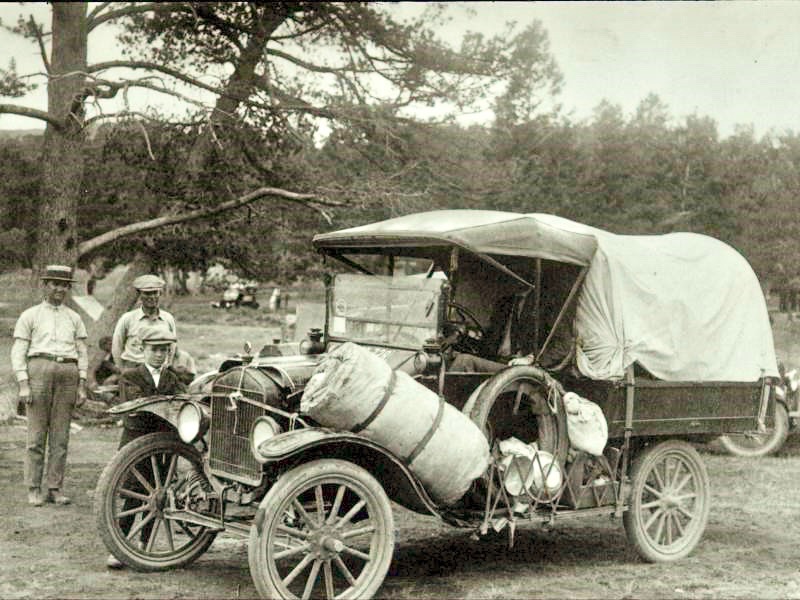
I love finding old images like this. They show that we never really change yet are on a continuum of adaptation. The bows that support the canvas top on this (I believe aftermarket) truck bed are reminiscent of much earlier wagons of the Old West.
Camping in Yellowstone 1924 – Mattress on the fender, pots, pans and a tool kit on the side board, these spiffy fellas were ready for an adventure. Image – https://www.nps.gov/parkhistory/
Space was extremely limited in the cab of these old vehicles so if there were three on-board, I suspect someone, probably the boy, rode in back with the luggage.
Rolling homes go back almost as far as rolling vehicles and the modern era of motor driven cars is not an exception. If you have followed this blog at all you may have seen some great contraptions, especially from the 1920s and 30s. The counter-culture of the 1960s lead to a generation of rolling home builders and dwellers ready to hit the road.
Luckily…
Photographer Paul Herzoff took a series of photos of some of the interesting, home-built, house trucks between 1971 and 1973 on the American West Coast. Many of these images are now housed at the Smithsonian American Art Museum. Since I save a LOT of reference images, I sometimes forget what is even there. I picked a few from my files to share here since they gave me many ideas since I first encountered them many years ago.
Paul Byrd’s Old West-themed truck is among my favorites and has a lot of charm in the details. I hope it survives somewhere today.This thing looks like a mid-century sheep wagon mated with and early Airstream (its descendant) and gave birth to a little COE camper. The giant drop down porch looks like a precursor of a modern day Toy Hauler camper.The interior of Bob’s Bus. It appears to have a lot of great storage space and utilizes a loft for added room. You have to love the plants as well.This one is called “Cab, Craftsman’s Van.” Again, I just love the homeyness of the plants on board.Not much information about this other than the title “David.” It is a very utilitarian door that appears to be made from a recycled packing crate and a re-purposed window. I wouldn’t put a hasp on the outside unless it could be locked in the open position. I think there would be too much chance of mischief.Here’s another pragmatic interior with a guy named George. Small bed, maybe it folded out?Here’s another bus interior decorated with recycled cloth. Very Bohemian.Craig’s house truck really speaks to me. It has a great form with the compound curve of the roof and a mollycroft. You’ll notice the water barrel on top and the ever important stove pipe poking up.Another view of Craig’s home. Not only does it have a mollycroft, but it has a sunroof as well.Here’s a pragmatic plywood beauty. Maybe not very aerodynamic but it sure looks spacious.And finally, probably my favorite from the set. I suspect it is ridiculously heavy but I think this truck can handle it. There are a lot fine details to note with this one.
If you are preparing to build a rolling home, there has never been a better time to find pertinent examples to learn from on the web. Enjoy the views.
There are quite a few images from the Golden Age of the Gypsy Caravan* floating around the web, many without appellation. Still, they have much to offer the potential traveler or yearning nomad today.
I quite like seeing the nearly universal items one needs for living on the move such as the folding tables, water coolers, wash basins, buckets, and lanterns. If I were to guess, I’d say this one was taken in some muddy side-alley in southern England around the beginning of the 20th century.
And let’s not forget that a large market for the high-end and custom wagons was for professional showmen, another group living on the road. I have kept the above image in my stock because I really like the awning over the door.
Click for a larger image.
I think one of the appealing aspects of these wagons is their almost timeless flavor. An image from the 1950s at the Appleby Fair looks much the same as one from 1985 or 1895 with the addition of an occasional automobile. The Open-Lot design above is out of favor with the modern American crowd due to the lack of security but I can see the advantages on a warm summer day.
*”Gypsy” has fallen out of use due to the pejorative overtones when applied to the people known as the Roma or other Travellers (sic). In terms of describing the living accommodations it is kept here for historical purposes, for the time being, for lack of a better universal term.
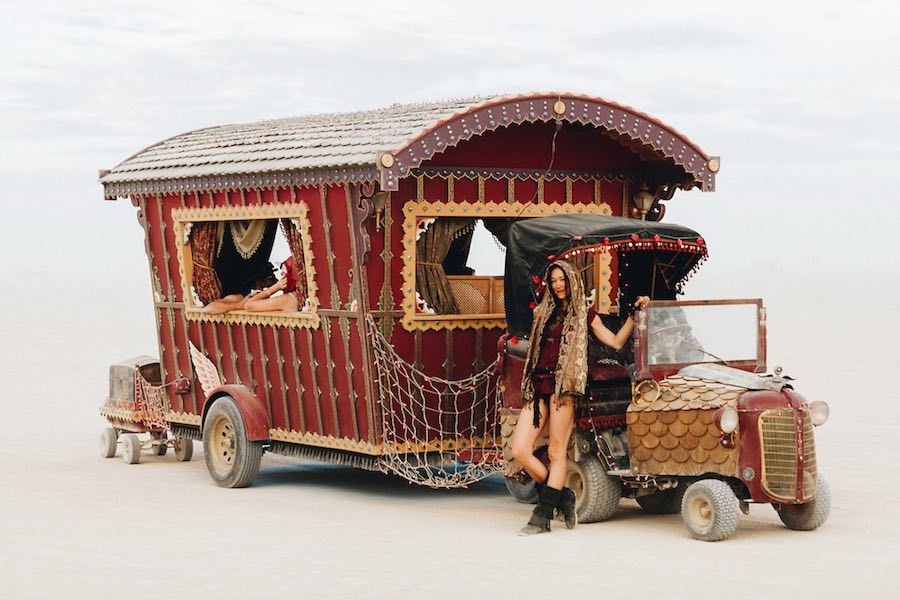
I don’t really know anything about this beautiful rig but I like what I see. A converted mower in front as a tow vehicle and it’s pulling a little trailer of it’s own behind. If anyone knows any more about this one please let me know! I found it on Tumblr but was able to image search it back to this source:
I always enjoy hearing from others who have built their own caravans, especially when accompanied by photos and descriptions. If you follow this blog you probably saw Kevin’s original photos here recently with a short post about his build. If not, you can read about it HERE.
Classic vardo layout with underbed storage, box bench seats, and slide out bed.
The perfect classic profile combining an arched roof and a beautiful dutch door.
The actual living space of a vardo is the great outdoors with the camper itself serving as a secure sleeping and foul weather quarters.
The promised follow-up is finally here as I have posted the images and text he sent. Honestly, this is my favorite kind of living wagon where old and new technologies are melded into a practical, yet affordable dwelling whether for long-term living or just overnight luxury travel. As shown here, there is a great use of fine woodworking and joinery combined with modern materials and hardware to create a rugged and practical living space that is road (and off-road) worthy.
Here is the rest of Kevin’s mighty fine vardo project (his original text in italics).
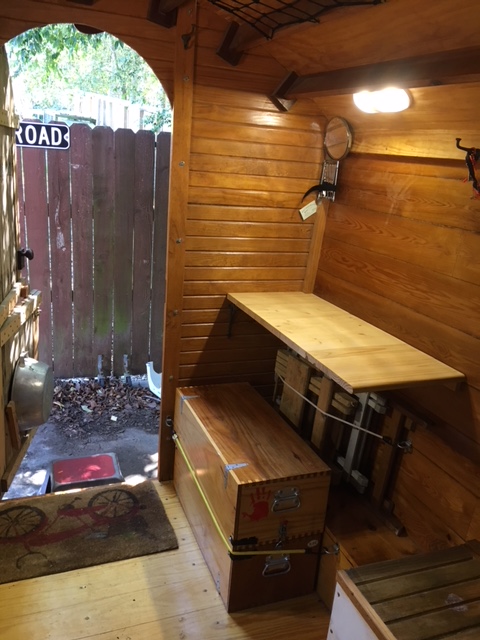
This shot offers a view of the short bench with built-in AC/Heat ducts, one for cooled/heated air (right), and one for return air (left). As well as accommodating air circulation, the bench provides handy storage. Also shown is a 110 volt outlet that provides power to the interior when the Vardo is attached to the generator or some other power supply. There are three interior outlets (the other two are hid pretty well), and three exterior outlets on the camper. There are also 12 volt power plugs inside the camper that are tied to the vardo’s battery. These are great for charging phones and running fans at night. It gets pretty hot along the Texas/Mexican border.
You can see a top view of the access doors to the under-bench storage provided in the long bench. You can also see the flip up section that turns this bench into a single bed. On the side of the door, if you look hard, you can see the hinged corbel that provides some of the support for the flip-up section. At the top of the photo you can catch a glimpse of the bungee net that provides overhead gear storage. This works very nice for carrying fishing poles and a broom.This is how the “chuck box” (cooking box) is stowed when traveling, or when not in use. The small counter top is very handy when brushing your teeth and emptying your pockets at bed time. Underneath, as can be seen, typically is stored a pickers stool, a larger folding camp table, and a folding chair.This wagon can haul a whole mess of Hunting gear. A trip to the desert requires a lot of ice and water. Everything is packed for travel, keeping the weight forward and the trailer stable on the road.A photo of our south Texas hunting camp, with the Vardo set-up. We always get a bunch of comments and compliments along the way. The wagon provides comfortable accommodations for 1-3 hunters.The chuck box gets unloaded and set up for use in camp.
This vardo looks very familiar to me and I think I’d be right at home in it. Thanks so much for sharing this with us and the community.
I always appreciate getting mail and comments on the blog; especially when someone is able to take information away and create something of their own. I recently received some fine photos from Kevin with his own Vardo build. I emailed back for more information but haven’t heard anything yet.
The wagon is a lovely and familiar design and it’s great to see it out in public alongside the more normal modern camp setting.Kevin also builds beautiful coolers that I hope to see more of in the near future. One is visible next to the vardo in the image above. Here’s the email I received and I hope to hear (and see) more from Kevin soon:
George:
Hello. I have been following your blog for a few years. I’m writing to you directly as I want to share some photos of the Vardo that I built, using yours (and a few others) for much of the inspiration. I wasn’t sure how to go about posting the photos to your blog, so I figured I would send them directly to you.
I live near Houston and own property in Buffalo Wyoming, home to a historical population of Basque sheepherders, and many currently rolling sheep wagons. Living in two extremes, I have had some issues with changes in humidity affecting the performance of the wagon and would likely do a few things differently, if I were to do it all over again (but wouldn’t we all).
I haven’t seen any updates on your Vardo-make-over in quite a while. Hopefully there’s more coming. I know the work on mine is never done. There are always items hanging around on the list of future improvements.
Let me know if you have any questions about the construction and performance of the wagon. I’m happy to carry on a discussion if your interested, and willing to send more photos if you request. You’ll notice in the photos some glimpses of one of my hand made coolers. They’re marine fiberglass coated wood on the inside, and out; built sort of like a cedar strip canoe. I built the chuck-box in the first photo as well. It travels in the rear of the wagon to be set out for camp cooking. I figured these were both items that might interest you.
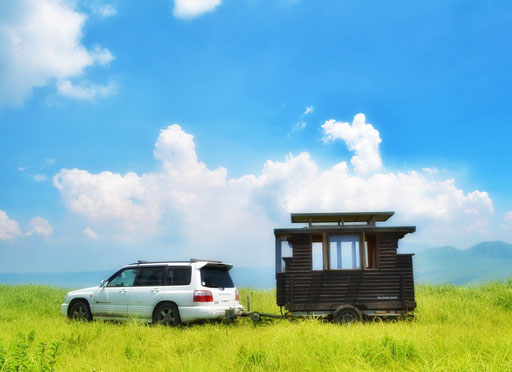
I say Vardo because that’s really what it is. You can sense that the presenter of this show isn’t too familiar with true rolling homes, caravans, vardos, or whatever you want to label them but his enthusiasm is real. I like this home a lot but there is too much gymnastic restructuring for my taste. I’m probably just lazy. I’m not knocking his aesthetic or design though; they are spot-on. Mr. Tagami fit a lot of useful ideas together to create a wonderful living space. Several of these innovations are being integrated into my future plans.
If you haven’t seen this yet, here’s a video detailing one of his creations and the happy owners who inhabit it.









 Preindustrial Craftsmanship