Ramblings

In an effort to make my mark, I’m working on a splash page image, a logo, and a flag.  Something catchy and symbolic, but not already taken. Simple, smart, and understandable.  This one about sums it up but I  think it may already be in use. compasssquarelevelMy personal image for the web page needs to be something as iconic as this pre-war “selfie” by J. Harris Stone.  A travelling man like myself.

CaravanningEx01Also, in the spirit of the early caravanners of a century ago, I am attempting to create a logo, without restricted use, for kindred spirits to fly from their rigs when on the road.  This idea struck me several years ago when seeing one of the simple logos from the Society of Primitive Technology on a car in the parking lot of a bookstore far from home.

rabbitstickI knew, when I saw it, there was likely a kindred spirit nearby.  Probably someone I know or have very few degrees of separations from.  In other words, a person I could probably trust in a pinch.wintercountThis was reinforced on me this year while I was driving a thousand miles from home, someone recognized my rig and had his young son hold up an image he knew I would recognize.  How cool is that?  Icons work to let us know, in this overpopulated yet disjointed world community, who belongs to our tribe.  Just as gang members have signs, symbols, and colors, so do law enforcement, military, and fraternal organizations.  I’m not saying this is necessarily good, just that it is.

We are tribal at heart for good or ill.  I want to put it to work for good.

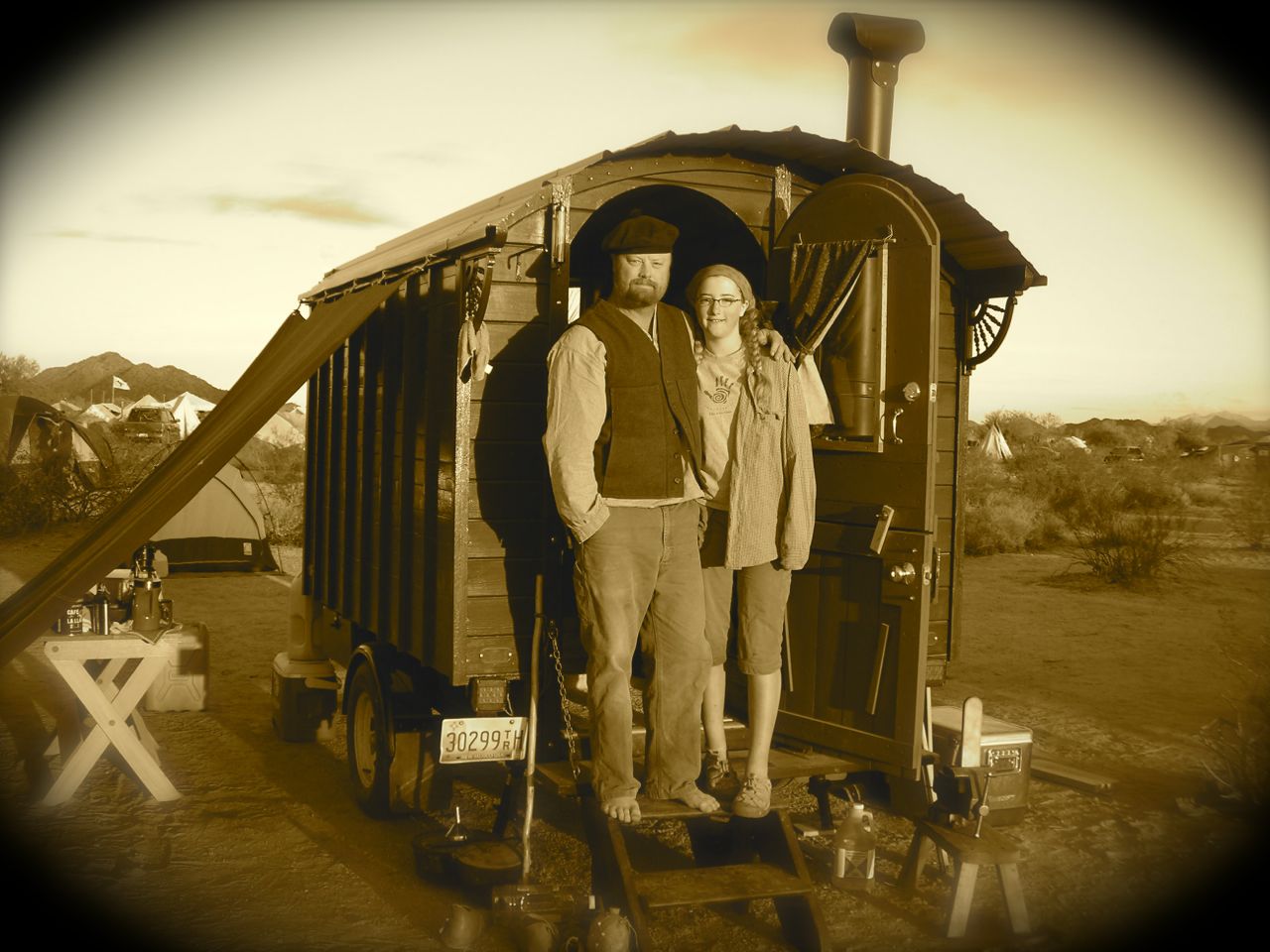
CoverontheroadThis photo dates back to a time prior to the completion of my caravan but far enough along to travel across the country.  Maybe not iconic, but a document in the life-history of my home.

As there are more and more of us in our circle of fellow travellers, sometimes we are readily recognized.
CoverWintercountVSometimes we are not.  Maybe we need a flag of our own to fly when we’re lost on the road and maybe not so recognizable.  Something like the pennon of the Caravan Club in Europe before the Great War.

CCVI welcome designs from fellow travellers but I hope to create something no matter what.  Or maybe it’s just the Saturday evening cocktail talking.

Baumeister_-_Holzschnitt_von_Jost_Amman_-_1536.svgAfter this ramble, it’s clearly time to get back to work on the bigger problems; seeking knowledge and trying to make my little world a better place.
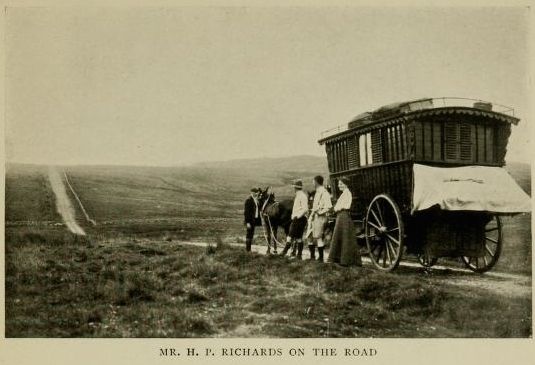
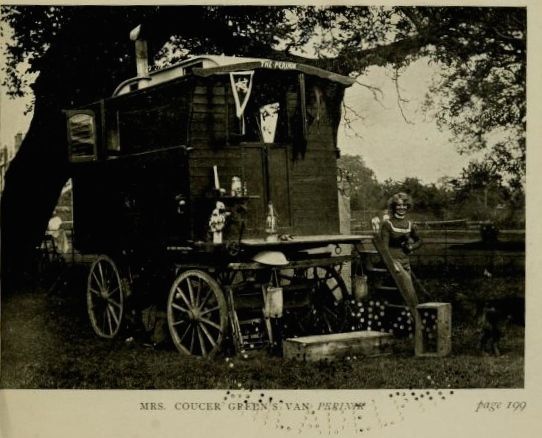
Mrs. Coucer Green and Other Great Old Photos

MrsCoucer
The PERINIK. A beautiful living van.

Three great and rare books have come to me in the very recent past.  Each has it’s own merits and is full of great stuff.  I am scanning, reading, and summing up some excellent stuff and will get it out as soon as I can.  In the mean time, enjoy these great photos ca. 1911-1914 the Golden Age of Caravanning.

LadyMore and better details on the way, including plans and historic photos that have lots to show us about design.

Further Evolution of the Little Vardo

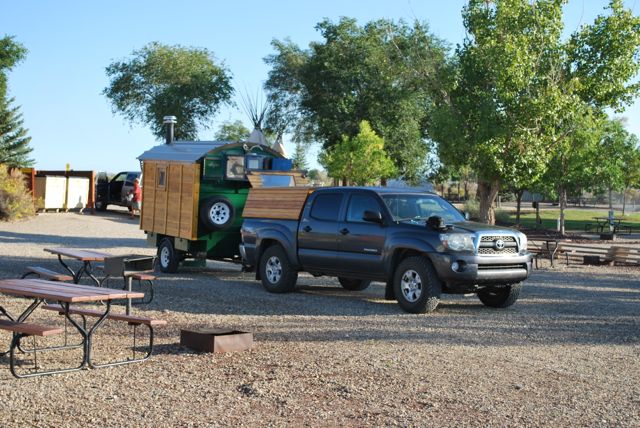
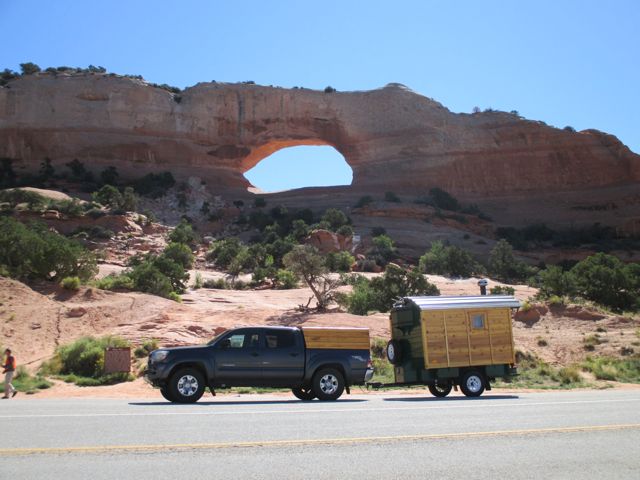
We just put another couple thousand miles on the Little Green Vardo.  It’s always an adventure when you are pulling something like this around the country and it makes for some interesting conversations.

DSC_0080
Campground in Cortez, Colorado.

Most of the people we meet are great but the comments are sometimes a little difficult.  Of course, the number one question from most people is “what does it weigh?”  Not that the numbers mean much to them but it just sounds like something to ask.  Another favorite is “does it leak a lot?”  I guess this is a reasonable question for someone.  If my house leaked, I hope I would remedy it pretty quickly.

snail2
What we look like going down the road.

It’s great to get all the smiles, nods, and waves from other travelers.  It must say something that out of the thousands of vehicles you might see on a trip, only a few evoke any real response.  It’s hard to get gas or take a break without having a real conversation about it with someone.  While getting coffee in a small Colorado town a watched a woman burst out of an office door across the road and sprint across a busy four-lane road just to have a peak.  It was flattering when she said “I know you from the Internet! I’m a huge fan of tiny homes and little campers!”

Another fun interaction happen in Monticello, Utah when an elderly man came running out from a house to talk about Sheep Wagons.  His wife grew up in one and wanted to have her own after they retired.  As this was a tall order, he built her this beautiful scale model sheep camp complete with tiny dutch oven, pans, tools, a broom, and even a tiny fried egg.

IMG_0188
Looks like I need a different hitch.

Maybe, not too long from now, I’ll be able to take to the road for a longer adventure.

IMG_0197Coming home to Purgatory, New Mexico with a list of improvements and a slew of minor changes to the Vardo.  I can’t wait for the cooler weather to make this happen.

Vardo – Topper Makeover

Because there’s always room for improvement.  In my case, a lot of improvement. snail2
Rehung siding, new paint, fresh varnish, little fixes, and lots of cleaning.  We’re hooked up to get out of town for a bit.

snail1Dietz lanterns, Kelly kettle, fuel, and lamp oil packed away in the pan box.  The steel disk serves as a heat shield to minimize ground scarring under the fire.

snail8A view from the bed.  Still more to pack up but things are looking good and nearly ready to go.

snail7The new windows are great and really perk the place up.  Bright and airy makes for a pleasant space.

snail3Still, the little Snail is far from perfect; made on a shoestring budget during snatches of time between work and bad weather.  Although I don’t live in it full-time currently I have come to see this as my home.

Photographer – Nukshi Alice

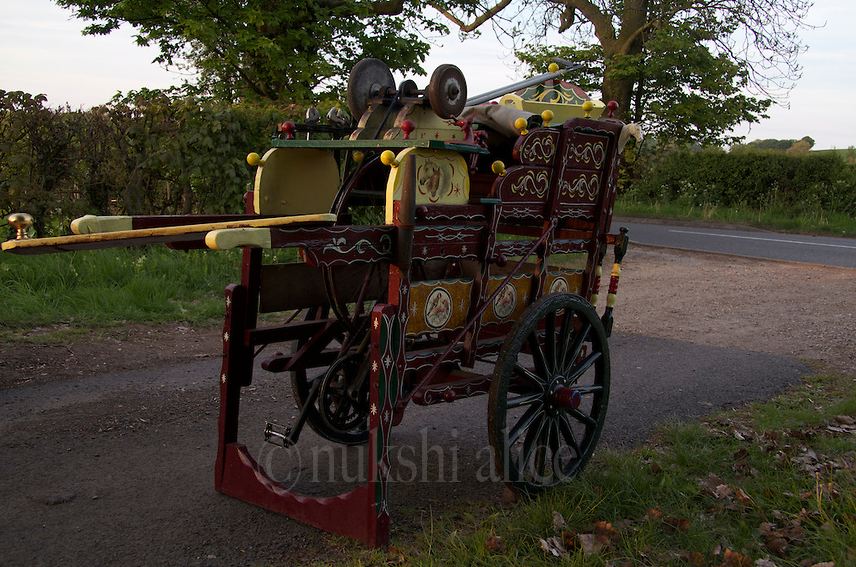
NukshiAliceFrom her ABOUT Page:  Nukshi is a documentary and portrait photographer and an artist living and working in Nottinghamshire.
Her sensitivity to situations, culture and people, has allowed her to adapt well to new challenges and environments.  She captures her images by getting involved with people, their culture and lifestyle, which motivates her to preserve those times and moments.  Knowledge and empathy with her subjects is the key to her image success, especially when intimate portraits are involved.

With an open mind and a quest to explore extreme situations, places, cultures, people and learn from that interaction. She intend to travel more, in doing so broaden her abilities. Often able to impart new skills to individuals in an exchange for their confidence in her, which has allowed her to bond with them easily.

VardoWhen a friend sent a link to her website I was, of course, immediately interested in the vardo.  Looking beyond the structure, there is wonderful documentation of life on the road.  An exterior wash stand tripod, pragmatic stairs, cooking tripod, and the ubiquitous tea kettle extend the home.

fullinteriorA homey interior, with an eye for beauty is shown in this “typical” vardo.

CookingA rare site where I live.  Nomads and Travellers are not often welcome in the modern world.  I’m glad this couple can live as they wish.

interior

More details are documented on her website.  I picked a few of my favorites for this post.

GeorgeAnd let’s not forget the people who keep this tradition alive.  It’s all well to look at the staged “gypsy” wagons across the web, but it’s important to remember that these are truly home, made complete by their inhabitants.

grinderA way to make a living. I still remember the knife grinder who made his way around the city in St. Louis many years ago.  His was not quite this flashy but had the housewives scurrying out with handfuls of knives and scissors when he came around.  I suspect that’s a rare job in America today.

Many more images from this series and others are viewable on Nukshi’s website.  Have a look and read the little story that accompanies the photos.

Images from “Gipsy Life” by George Coalville

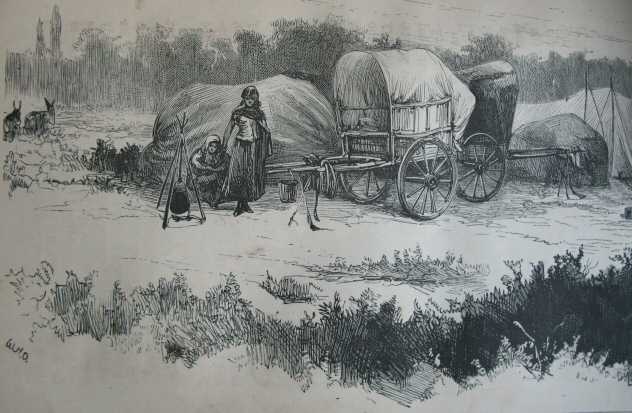
From a book published in 1880 about the Roma and some thoughts on how to “improve” their condition in Britain.  He traces their history in Britain from their first recorded arrival in Scotland in 1514 and is an interesting and somewhat sympathetic read.  Here are some images and a couple snatches of the writing.

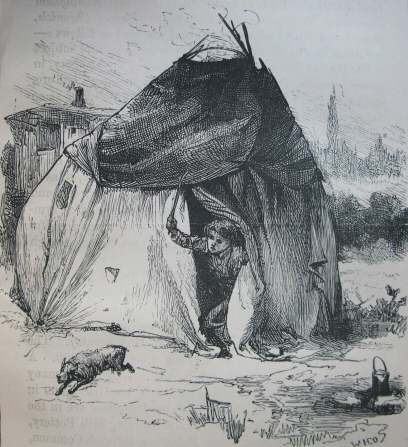
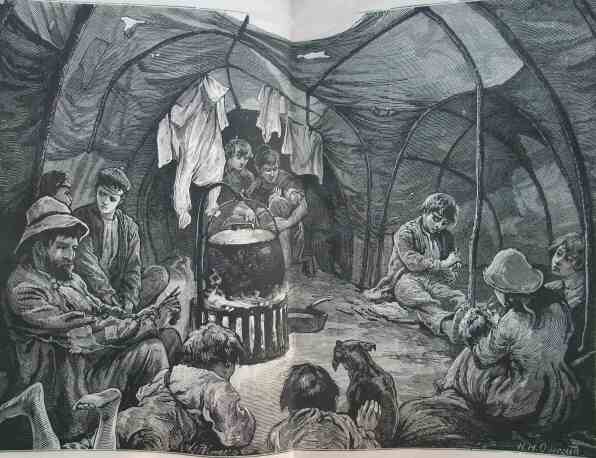
bendertentSeveral types and qualities of bender tents are illustrated and show a realistic view of camp life.

smallwaggonmakeshift

“For the dance no music can be better than that of a Gipsy band; there is life and animation in it which carries you away.  If you have danced to it yourself, especially in a czardas, then to hear the stirring tones without involuntarily springing up is, I assert, an absolute impossibility.”  Poor, deluded mortals, I am afraid they will find—

“Nothing but leaves!
Sad memory weaves
No veil to hide the past;
And as we trace our weary way,
Counting each lost and misspent day,
Sadly we find at last,
Nothing but leaves!”

familytentI was for the first ten minutes fully occupied in trying to keep a respectable distance from a number of dogs of all sizes and breeds, which had the usual appetite for fresh meat and tweed trowsering, and, at the same time, endeavouring in vain to find solid ground upon which to stand, for the place at the entrance and all round the tents was one regular mass of deep “slush.”  It soon became known that my p. 228pockets were plentifully supplied with half-ounces of tobacco and sweets.  These I soon disposed off, especially the latter, for there seemed no end to the little bare-footed children that could walk, and those that couldn’t were brought in turn by their sisters or brothers.  I was invited to visit all the tents, but I could gain but little information beyond an account of the severe winter, bad state of trade, your visit in one of the black, dense fogs, &c.

vardowccampfireandpipefancyvardoTo be quite honest, I’m mostly into this one for the images but for those interested, the book can be found online HERE.

Adding Windows

Finally, I’m getting around to adding side windows to the Vardo.  I’ve wavered for a long time as to whether this was what I wanted.  In the end, the ventilation and view won out.  Many decisions needed to be made.  What kind of opening, size, materials, etc.  In the end, I chose reclaimed oak as it is very stable, strong, easy to work with, and looks good.

window03This isn’t a high-tech, double-glazed thermal window.  It is a simple square frame of oak around a Lexan pane with a simple, chromed piano hinge and a nice brass casement window mechanism.

window02The discolored oak is visible here as I didn’t bother to remove the patina from the parts that will be invisible once installed.

I am sometimes criticized here for not giving enough of the remedial steps when building something new… So here it goes:

How to install a window into your Vardo.

window04First, choose where the window will be placed.  I have kept this spot in mind from the beginning and have kept it free of shelves and cubbies.   I decided to center the window on the structural stud.

I knew where the window needed to be located on the inside, but finding the exact placement on the outside wall can be difficult.  In order to find the point on the outside wall, I drilled a small hole where the top center of the window should be.  Why did I need to do this?  Because the cutting from the outside smooth wall is far easier and less messy (keeping the sawdust mostly on the outside).

Using the hole as a marker, a line was created to layout the opening.

A framing square was used to square up the other three sides of the opening.  The circular saw was used, making a plunge cut (using two hands) as deep as possible, following the guide lines.

The nature of the circular blade prevents the saw from cutting into the corner so a hand-saw was used to finish up.

window15After a dry fitting to check the size, silicone caulk was applied to seal out water and the window was inserted.

window14Having a look at the new window.

Checking the functionality.  Interior framing is not yet complete here.

Next step… making the shutter.

Revisiting the Enchanted Bike Wagon

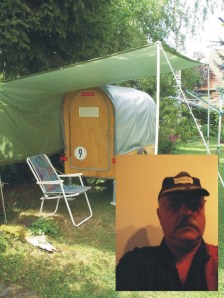
I have mentioned this unique little wagon before but it is worth revisiting as a near perfect mini traveller’s wagon.  Günther Lorenz, a maker from Bayern designed and built this bike-towed caravan without a plan or significant financial outlay.
0031

It makes me happy to know that this was built, fueled by beer and a dream, in three weeks worth of evenings.  It weighs in at 55 kilograms empty (120 pounds) so it isn’t exactly light-weight but provides the comforts of a dry bedroom while on the road.

0035The body is 2 meters long by 1.04 meters wide (79 by 41 inches).  The frame is constructed from 20 mm square steel tubing welded together and the 5 bows are made from 8 mm tubing covered with garden hose.  The whole thing runs on 28″ wheels.

0008If you’re looking to build something like this, head over to Günther’s web page for a more complete photo-set.  They’re thumbnailed on his page but can be downloaded and viewed at higher resolution.

Ich
Click the image to view the rest of the images.  His website is in German but the photos speak for themselves. 

Bear the Tinker

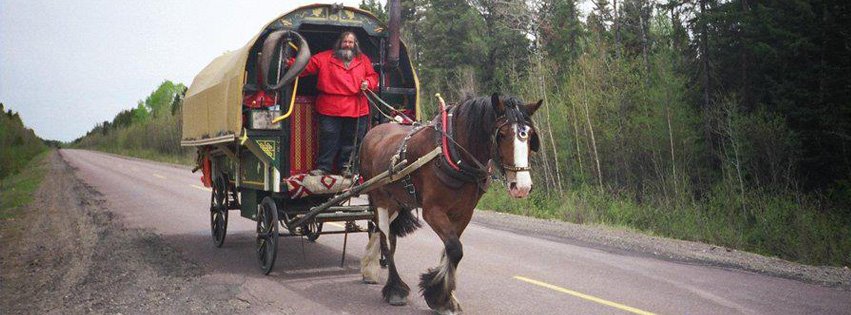
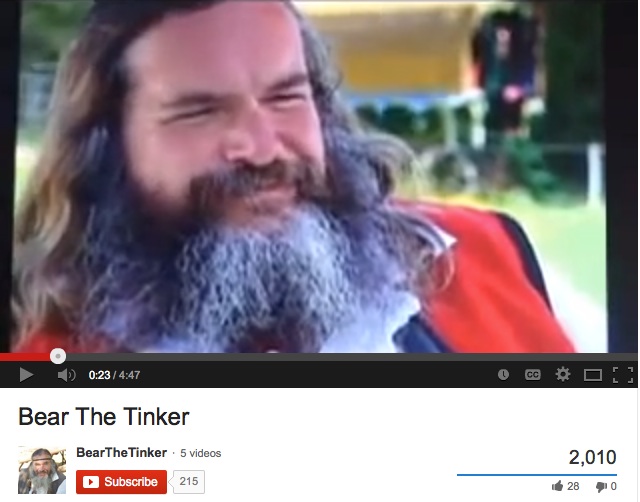
Bear the TinkerHere’s a man making his way in the modern world but likes being stuck in the late 18th century.  Farrier, blacksmith, storyteller, and musician living in his bowtop.

BearTinkerVidAbove is a short interview with the man himself from a few years back (opens in a new window).

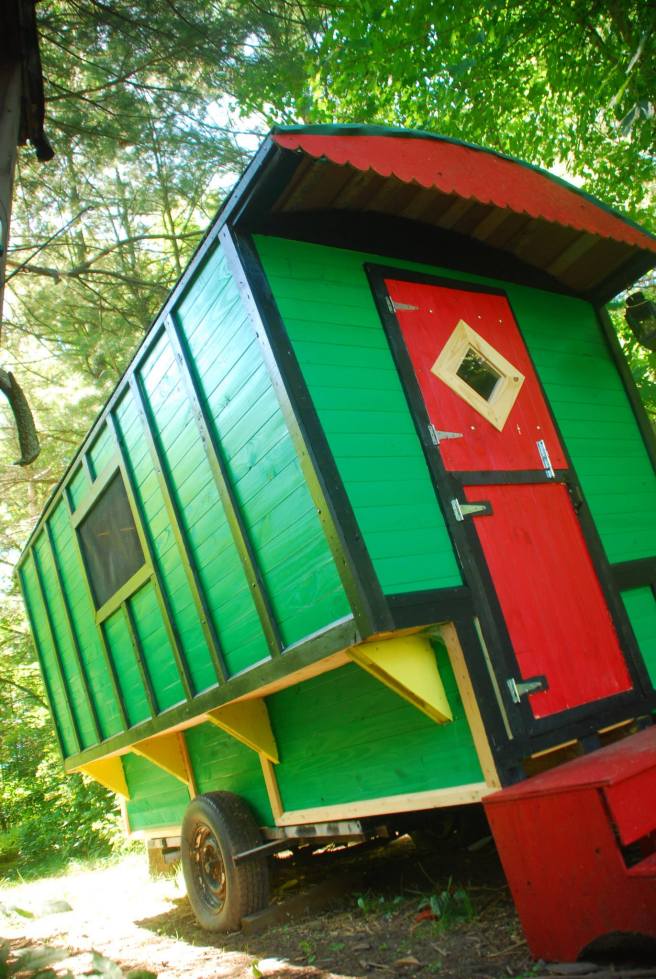
Small LedgeLiving in the 21st century, he even maintains a Facebook presence, of sorts.  Click on his new little Ledge Wagon above to see what he’s up to.