I made it out for a brief stay in the eastern Ozarks this week. The rain and cold came back just in time for my outing making it a little less comfortable than it could have been but I still enjoyed the time out.
I chose to stay fairly low-tech with the exception of a sleeping bag instead of the old blankets and I sheltered under an old military poncho instead of the more usual canvas. Since I was out, in part, to work on some crafts I packed in very heavily with tools and a few raw materials.
It’s easy living for the most part in the Ozarks and I think I could happily live primitivly in this environment indefinitely. There is not much legal hunting this time of year as the furry critters are off procreating and having babies so I brought some basic foodstuffs with me. I’m back in civilization now but expect to get back out very soon. Maybe the sun will stay out for a few days and dry things up as a preview of Spring. I’ll post some follow-ups about gear and some things I’m working on very soon.
Don’t leave the kids out of the things you find important…
Nota bene! The following ramble was written at three in the morning and may contain sentiment, ramblings, and a bit of opinion. I don’t want this to sound preachy. What was intended as a few childhood pictures from primitive technology events ran away with itself in the dark hours between sleeps. ~G
Learning to shoot at an early age. Skills like this build coordination, confidence, and an understanding of the greater things in life.
There is a certain amount of balance that can become of the unique skills we gain along the path of our lives. Some people come to events, take classes, and return to the ‘normal’ life at the end of the week relatively unscathed by the learning they paid for and the time spent.
The first brain-tanned shirt and wearing it with pride. It was a hand-me-down from a friend’s daughter.
To closely paraphrase a linguistic anthropologist I knew long ago,
“Some things we love are embraced the way most people embrace their religion, they take away some message, feel strongly about it, but leave it for Sundays. When we find the thing that is our passion, we embrace it like a lover; it encompasses all our thoughts and becomes our entire life.” ~L.F.
This is how I feel about primitive skills, wilderness living, and pre-industrial craftsmanship. Without consciously trying, it just became a part of life growing ever stronger from teenage into full adulthood. While living in the consumer world, this alternative floated in the background of the mind and continued to influence activities when our child came along.
We were not perfect parents. Far from it. But we were consciously better than our own. We really tried. We learned. I sometimes wish I had it to do all over again. Overall, I think we did pretty well and were lucky in many ways. We encouraged exploration, learning, and self-reliance. By not child-proofing everything or creating needless prohibitions, we were forced to be more aware and in the present. Yes, it is probably more work and yes, it can be exhausting but children should learn their most valuable lessons at home from family, whatever ‘family’ may mean to you and yours.
Every kid and every family is different. They aren’t robots and it is clear to any observer that they have a mind and ideas of their own from a very early age. We can only steer them as best we can, present them with our ideas and beliefs, and provide the types of opportunities we think will give them a good grounding for their future lives before setting them free to try their skills in the world.
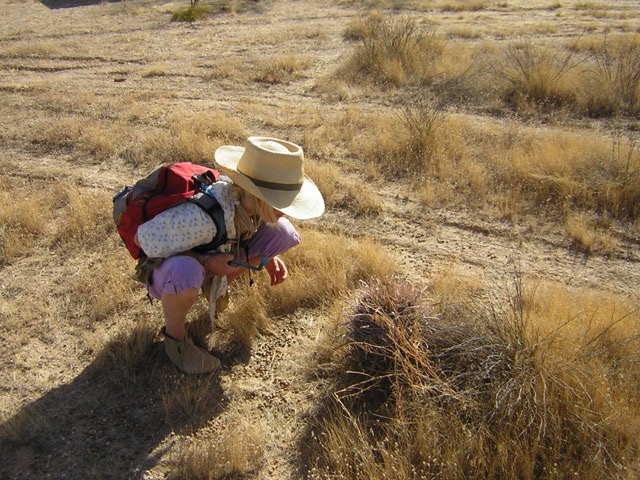
Examining a fish-hook cactus in the Sonoran desert.
It makes me sad hear or to read in social media that parents that I actually know are so down on the next generation. Complaining that they don’t go outdoors, have useful lifeskills, proudly hitting them, or even ridiculing them for using the technology they themselves provided. If that is the case, the blame is only ours! We cannot place the blame on media and movies and video games, schools, government or a general millennial malaise. It is not anyone else’s job to raise our children well. We are, to a large degree, culpable. When I hear a parent complain that their kid watches too much TV, or plays too many video games, I am baffled.
None of us are perfect, but we can give the following generations the values and ideals we may only cherish in the abstract.
Modelling the yucca fiber skirt with her buckskin shirt. A monumental amount of yucca processing.
The intended descriptions have strayed into a hopelessly sentimental post, but anyway, enjoy some of my favorite photos I dug out recently.
Making fire in the Arizona desert 2009.
I leave you with this broad paraphrasing of Edward Abbey:
Give them the skills and encouragement to get out there and hunt and fish and mess around with friends. Let them ramble out yonder and explore the forests, climb the mountains, bag the peaks, run the rivers, breathe deep of that yet sweet and lucid air. And at the end of the day, sit quietly for a while with them and contemplate the precious stillness, the lovely, mysterious, and awesome space we call earth.
We are fed by those that surround us. Choose wisely.Blacksmithing her first knife.
I hope to see a few of you in the great outdoors very soon. And don’t forget to bring the family if you can.
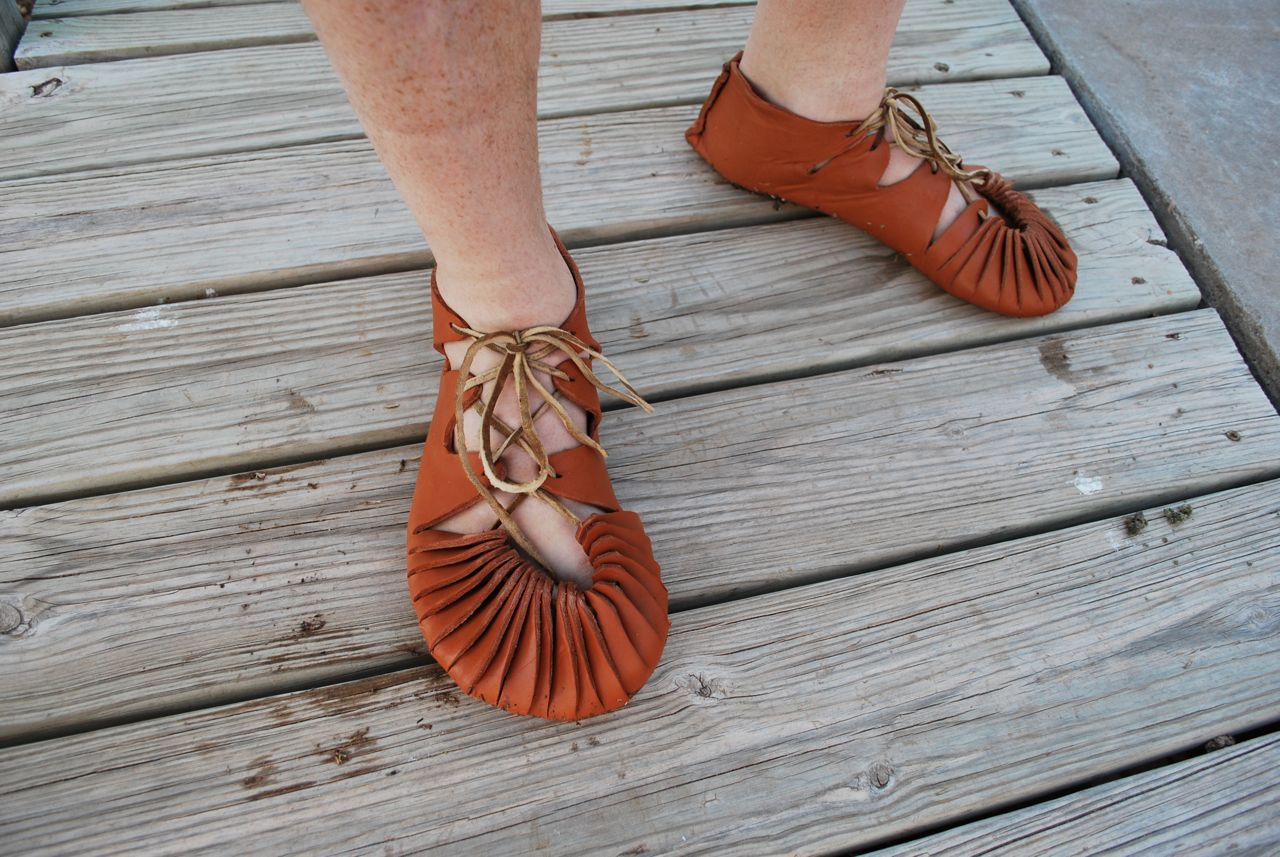
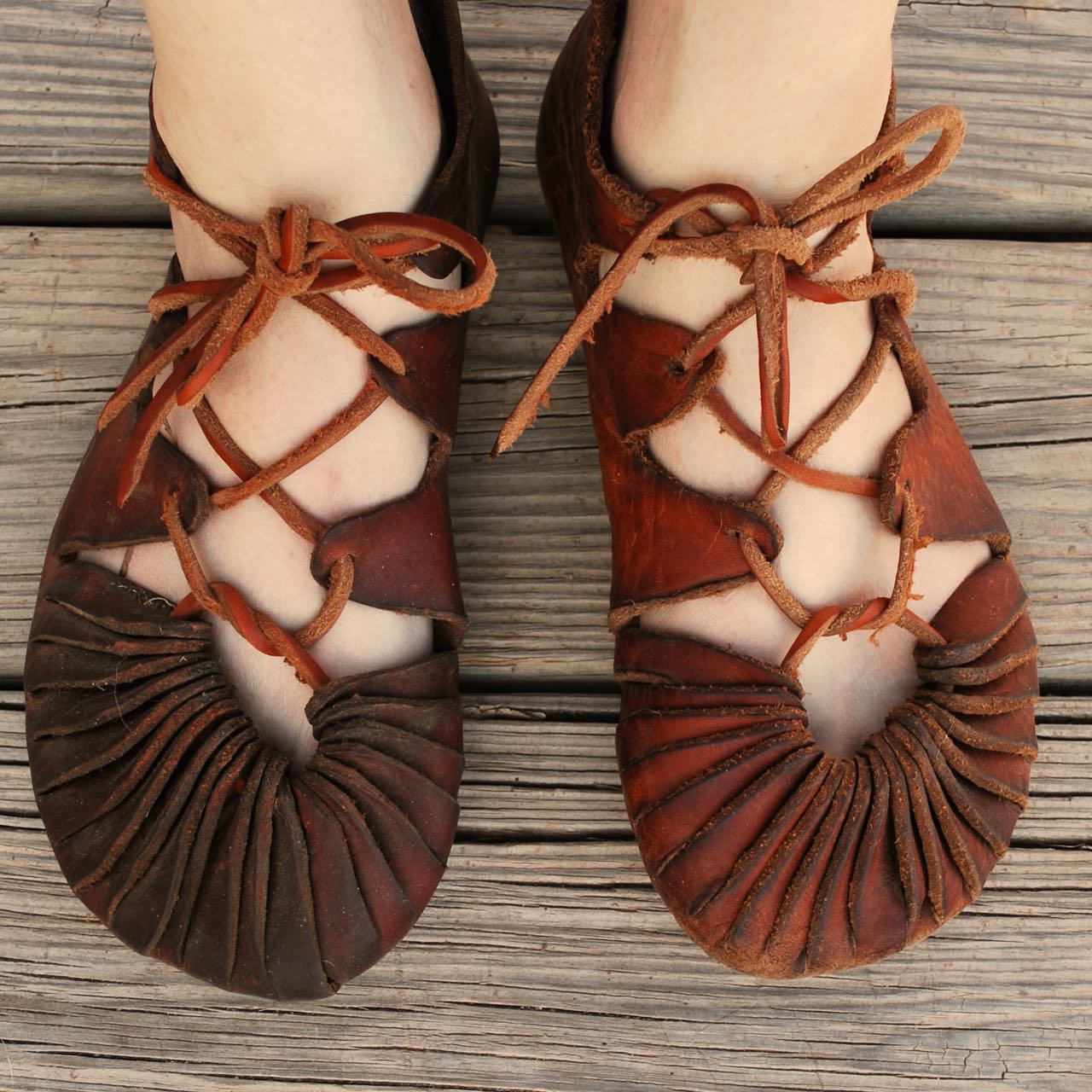
Here’s a simple shoe design that was made by our ancestors before there were shoe shops or Zappos. Much of the Europe population, both male and female wore a variation of this for many millenia, right up into the early 20th century. They are commonly associated with their Celtic cousins in Scotland, Wales, and Ireland but they are essentially the same as the simplest Roman carbatina. Essentially, it’s a basic European shoe.
I made a set of these around 1986 with a little instruction from an Eighteenth Century reenactor and loved how simple they were to make. My experience up that point was with Native American style moccasins the difficulty I had with sewing in those days. This was a perfect option for me and I find that it is a popular class when I offer it as an introduction to leather working and moccasin making.
While this isn’t exactly a tutorial, it does provide the basic information necessary to get started on a pair for yourself. I would suggest a pattern to be cut from heavy cloth before diving into cutting valuable leather just to get the fit right. It’s a forgiving design so,
Don’t Panic.
pattern and finishedrear viewsewn heellacing the toeafter wetting and shapingdrying before oiling
And finally, six years later, they still function well. The soles are getting thin so it’s almost time to renew them. Fortunately, a pattern can easily be made and adjusted from the old pair by wetting them, letting them dry flat, and using that as a starting point.
Recently, I realized I needed to make a new batch of darts (spears) for an annual atlatl event at Blackwater Draw. This is a recurring problem when teaching large groups, so several years ago I came up with a system that works well for mass producing these Ice-Age weapons with just a few common power tools. Nothing about this project is particularly difficult but if you need to produce darts by the dozen, it can get pretty tedious and take many hours. Power tools, in this case, decrease the necessary time and energy allowing free time to pursue more satisfying occupations.
After several decades teaching and demonstrating primitive technology I have learned that people are not careful with other people’s hand-made items (kids doubly so) so making robust and easily replaced models is a real time-saver. Also, having tried many designs with kids and adults, I have found a size, weight, and flexibility that I think covers a wide range of body types and skill sets so that most people, most of the time, can have some success in just a few throws (except Jim Gnapp, he’ll just never get it). After promising to do this for several years now, I put together a recipe for mass producing atlatl darts.
GEORGE’S RECIPE FOR LARGE BATCH ATLATL DARTS –
INGREDIENTS:
Straight-grained kiln dried hardwood, 3/4″ oak or hickory; three side planed or better
Super glue, gel type or favorite fletching glue
Strong, thin thread (I use silk for my personal arrows and darts but any standard sewing thread is fine)
Feathers, TruFlight full length arrow feathers or other feather splits; three dozen or package of 50
TOOLS:
Table saw
Bench sander
Sandpaper, 100 and 150 grit; finer paper optional
Optional: arrow taper tool for centering and precise fitting of points
Small hand saw, band saw, or similar to cut shafts to length
Tapered countersink drill bit
Ripping the board into 1/2″ strips.
Preparing the Shafts: Rip board into 1/2″ strips, then re-saw to create 1/2″ square cross-section.
Second rip to square off the shaft.
Set table saw to 45° to further re-saw shaft into octagon section. This can then be smoothed by hand with sandpaper or on the belt sander.
After the shafts have been ripped into octagons (six passes total for each), the bundle is cut to length. I generally make these 84″ (213 cm).
Cut shafts to length. I generally cut them to 7′ (84″).
Tapering the final 6″ to fit the points.
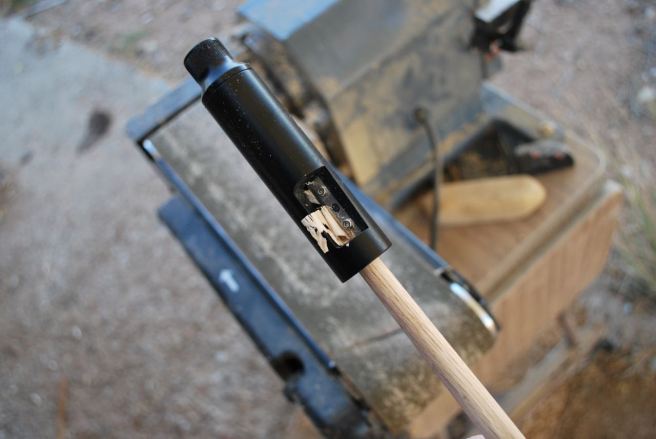
At this point you will notice that the shaft is far to wide for standard arrow field points so some free-hand shaping on the sander will be required. Taper the final 3-6″gently down to a scant 3/8″ diameter, rounding the shaft as you go.
Using a tapering jig for a tight fit to the head.
Taper the shaft to fit the field point and test fit a point.
The gang ready to be inserted into their heads.
Repeat until board is consumed and all shafts are all prepared. At this point, further shaping of the shaft can be accomplished on the bench sander to round out the octagon shape.
190 grain (ca 0.5 oz.) field point test fitted and ready to glue.
Mix a small batch of epoxy and attach the heads to the dart. I give them a final tap after insertion by holding the dart point down over a hardwood scrap and dropping it a couple feet, sealing the point. Wipe off any excess epoxy and wait the recommended cure time.
Tying down (whipping) the quill. This one is not pretty but will work.
Fletching: Tear off about 1/2 inch of the vane or barbs from the quill (the barb is the hairy or fuzzy part). Place a dab of super-glue on the forward end of the quill and hold down about 7-8″ forward of hind part of the shaft. Once this sets, repeat two more times placing the feathers evenly around the shaft (one-third way around). Trim the rear of the feather to make all three match in length.
Trimming to length.
Using a scant quantity of glue, attach each feather to the shaft. You can skip this and just tie them down but the glue makes for a robust and neat-looking fletching. Whip down the front and rear of the feather with thread and coat lightly with super glue to prevent unraveling.
Using a countersink to create the dimple.
Using the tapered countersink bit, create a notch in the base of the dart. For security and strength, I recommend whipping the final 3/8″ of the shaft with thread and coating with super glue to strengthen to wood.
Take a break, drink a beverage, and congratulate yourself on a job adequately done. You now have a set of tough darts for play and learning that should, with some care, last for several years of hard use.
THROWERS:
Whittled hook on hickory thrower.A smattering of throwers made in about 30 minutes for a class instruction. Ripped out on a band saw, roughly sanded to create smooth round edges, and steamed for 30 minutes prior to free-hand bending.
Now for the thrower… “It is to be created in the usual fashion, neither too long or too short, too heavy or too long.” ~pt
My personal favorite (at the moment).
Antler hook on hickory handle.
And, for mine, I added a turk’s head knot in vegetable-tanned leather to keep hand placement consistent.
The sacred connection.
Seriously though, there are myriad ways to create a stick with a hooked end and I won’t go into the finer points here. I will say that this is really the simple part and can be achieved with either hand or power tools in a short time. There is much about spear thrower design (atlatls) on the web and it is important to remember that most cultures world-wide used these efficient tools. As their prey and use varied, the styles varied as well. They broadly fall into a few categories but the most common in the U.S. are variations on the “Basketmaker” or “Great Basin” styles and what I like to think of as the hammer-handle styles (above). The latter are more akin to the early designs from the Ice Age and are found throughout Europe, often make from reindeer antler, over many millennia.
My second favorite; Osage orange wood, buckskin, sinew, pitch glue and red argylite.
As for style, I personally recommend finding a cultural group you are interested in or just a design that strikes your fancy and dive in. Wood is cheap, easily worked and plentiful. Worry about the details later.
Click the image to learn more about this thrower.
FINALLY, FIELD TESTING:
They work! and all survived a day of heavy use.
Oh but wait! There’s more! Here are a couple other respectable links to get you started:
The existence of ovens like this is easily documented for the 18th century. In fact, just about every ancient culture had a very similar oven. There’s one particular wood cut illustration from medieval times depicting an earthen oven built on a wagon. There are references in 18th century literature and also archaeological evidence that you […]
I only know Kelly vaguely but I know she is an extremely talented artisan. I am continually impressed by her skill level and ability to make it all seem so effortless. I believe that is an indication of true mastery. Here is a short documentary of her work to inspire the inner-Maker in you.
Watch artist and primitive potter Kelly Magleby learn about and make Anasazi style pottery. Kelly went into the backcountry of Southern Utah with a knife and a buckskin to try to learn about Anasazi Pottery by doing it the way the Anasazi did it. “Earth and Fire” is a documentary poem about a passionate artist. Funded by Primitive Found (.org) Music by Jason Shaw @ audionautix.com Check out Kelly’s art at anasazipottery.net This the 1st video of 2016 for The Talking Fly short documentary project by filmmaker Steve Olpin, Enjoy!
“God gave us the gift of life; it is up to us to give ourselves the gift of living well.” ~Voltaire
Voltaire was on to something there. Here is a very inspirational family making good in the wilds of Wisconsin. I would love to see more as they sound like some truly genuine artisans and keep craftsmanship alive in this consumer era.
I want to continue being inspired by people like this with positive spirits and keeping an eye on the important things in life. Feel free to submit links like this or comment if you have feeling about a handmade life.
And don’t forget to check out their own web-page, photos, and blog by clicking the image below.
Winter is here. For some of you it is here with real gusto. Growing up in Missouri and being sent out to ‘play’ no matter what the weather or who was around I learned a lot about how to entertain myself. Snowfall in the Mississippi valley could be heavy and wet throughout the winter and was a great medium for construction snowmen, fortresses, and quinzhees. Of course, we didn’t know such an exotic word at the time but we did learn good tricks and techniques for safety later in the Boy Scouts.
Image from Boy’s Life magazine. Click for a short “how to.”
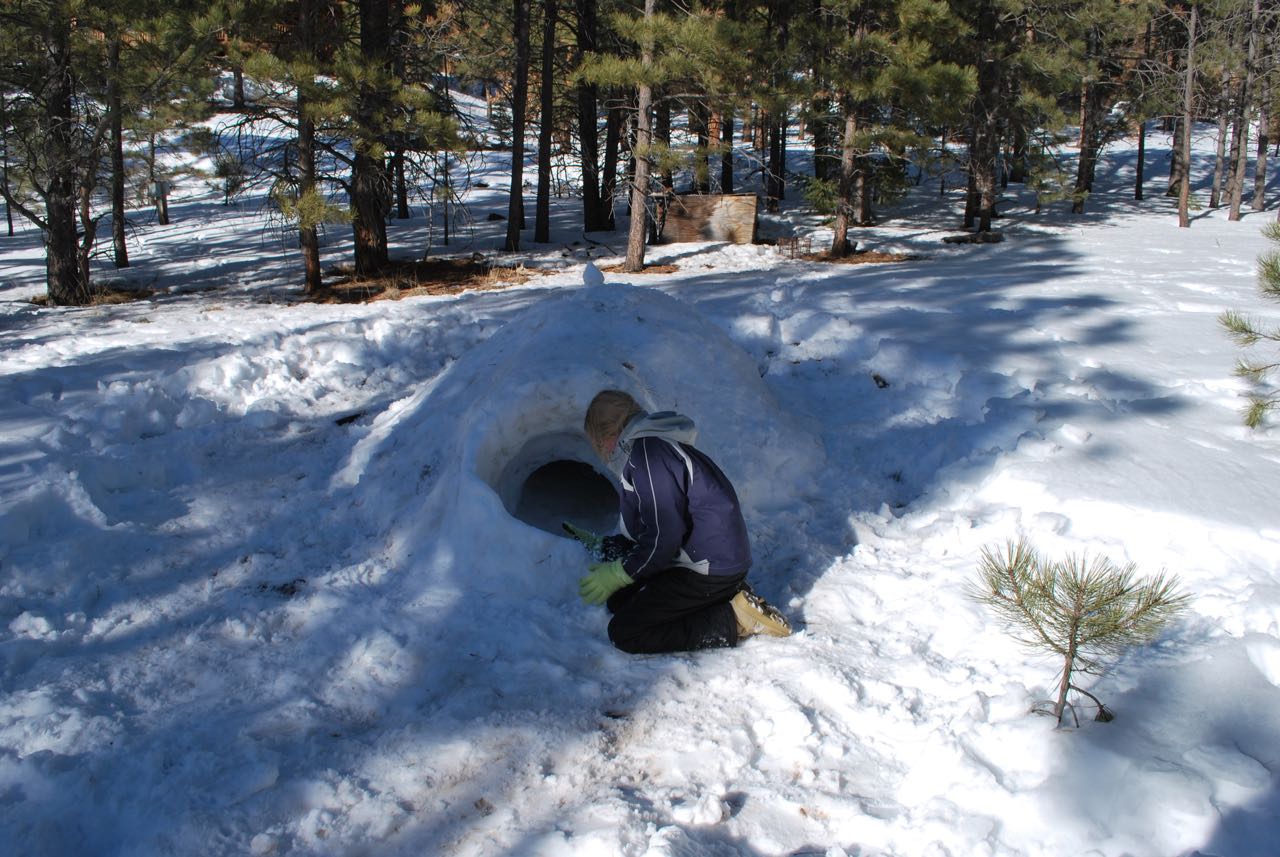
I’m certain there are no photos of the sometimes elaborate, and often not so elaborate, snow shelters my friends and I built as kids (I don’t think parents played outside with kids in my era). I was reminded that we had our own photos of one built with my daughter several years back. We were staying with a friend in the Sangre de Cristo mountains for the holiday at about 8,000 ft AMSL (ca. 2,500 meters). The snow was perfect and wet so we couldn’t pass up the chance for a little shelter building. “Teachable moments” surround us every day. It’s up to us to take advantage of them.
Working on the wind wall. If you look closely, you can see the miniature chimney and rain shield on top.
The snow wasn’t deep and we weren’t intending to spend the night inside so it was kept pretty small for ease of construction.
View into the vestibule. The opening was kept narrow for warmth.
It was a chance to talk about safety, collapse, and fresh air exchange. Valuable information for later in life. Ours faced south.
The dog was, of course, a great help, mostly chasing snowballs.Testing out the fit.
It was definitely kid-sized but an adult could squeeze in more-or-less comfortably for a while. The dog was not enamored with the confining space.
Enjoying the evening by the warmth of a candle.
It was just another fun day, experimenting with the gifts that nature provided, and passing on knowledge to the next generation of wilderness lovers.
Primitive is a loaded word for some people. To me, it means simple and lacking industrial materials. That’s not to say primitive cannot be complex or fine work; in fact, it’s often just the opposite. Sometimes even, it involves recycling the detritus of the modern world, such as tire rubber for shoe soles.
18th century style.
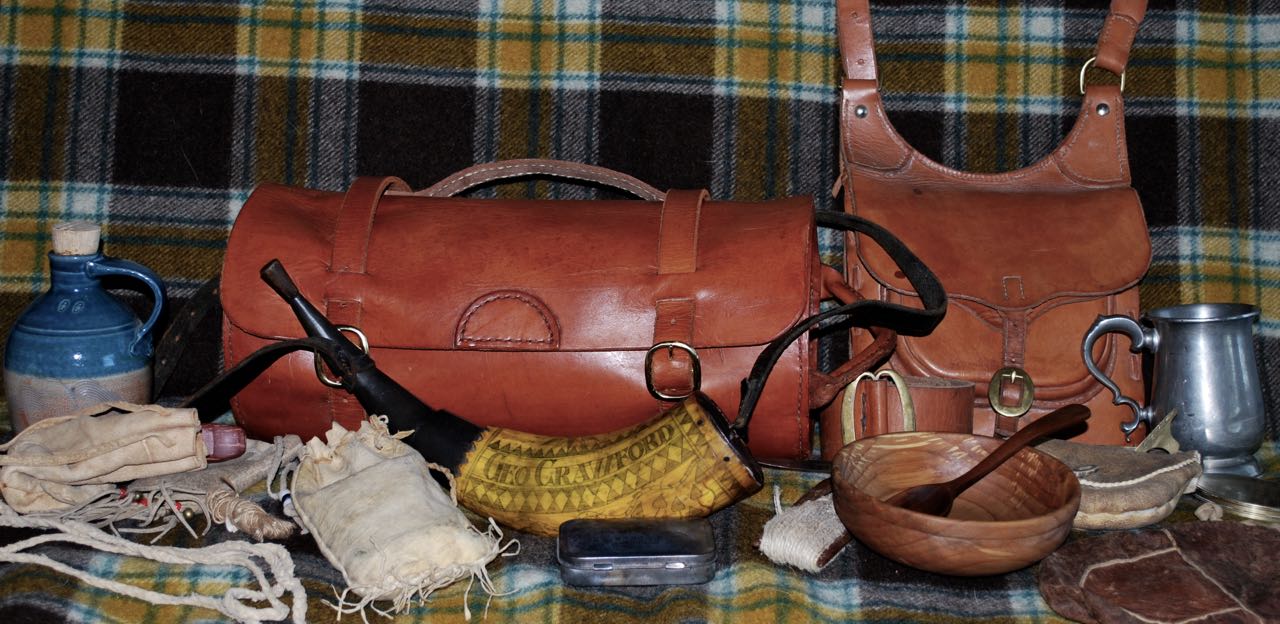
Looking at my high-graded and favorite camping gear I came to the realization a couple of years ago that by removing a few modern items my kit looks about 250 years out of date. That made me kind of happy. I’m not really a reenactor but I do occasionally participate in period events. It seems my tastes really do just lean toward a quieter, handmade, preindustrial world.
An overview of traveling gear. I see this format on the web a lot so I’m stealing the style from far better photographers than I.




















 Preindustrial Craftsmanship