There are quite a few images from the Golden Age of the Gypsy Caravan* floating around the web, many without appellation. Still, they have much to offer the potential traveler or yearning nomad today.
I quite like seeing the nearly universal items one needs for living on the move such as the folding tables, water coolers, wash basins, buckets, and lanterns. If I were to guess, I’d say this one was taken in some muddy side-alley in southern England around the beginning of the 20th century.
And let’s not forget that a large market for the high-end and custom wagons was for professional showmen, another group living on the road. I have kept the above image in my stock because I really like the awning over the door.
Click for a larger image.
I think one of the appealing aspects of these wagons is their almost timeless flavor. An image from the 1950s at the Appleby Fair looks much the same as one from 1985 or 1895 with the addition of an occasional automobile. The Open-Lot design above is out of favor with the modern American crowd due to the lack of security but I can see the advantages on a warm summer day.
*”Gypsy” has fallen out of use due to the pejorative overtones when applied to the people known as the Roma or other Travellers (sic). In terms of describing the living accommodations it is kept here for historical purposes, for the time being, for lack of a better universal term.
Learning a thing or two from the past…Part 1, 21st century Westerners are not the first to minimalize.
How much stuff do we really need to lug through life?
“The things you own end up owning you.” Chuck Palahniuk, Fight Club
There’s a lot of recent talk about Minimalism as a social movement and this fits well with my personal philosophy and my interests in preindustrial technology and survival. Not long ago, minimalism was mostly associated with artists, aesthetes, wanderers, mystics, and philosophers. That is to say, the fringe element, outsiders, and weirdos. These things come in cycles and I think, as a backlash against generations of sell-out philosophy and the creation of a professional consumer class, many people are reaching for something new.
We come to learn that everything old is new again.
I’ve been pondering history and prehistory on a full-time professional basis for several decades now. As hard to believe as it may be, I even get paid a salary to do it. One of my professional interests involves the tools, tool-kits, and strategies for surviving that various people have come up with for dealing with the world. As a sometimes primitive skills-survival instructor and full-time frugalist I think it important to not reinvent a lifeway when we have millennia of ancestors who dealt with most of the same issues we do today.
A San bushman demonstrating fire-making. Ostrich egg canteen in the foreground. These people probably resemble our ancestral way of life and have very few possessions, even in their harsh environment.
For most humans, for most of our history, owning too much stuff has never really been an issue. We had what we needed and either made what we needed or did without the things we didn’t have. It brings a smile to my face to know that more than 2,500 years ago, various thinkers people in China, India, Greece, and the Middle East were contemplating the nature and evils of acquiring stuff; some were even writing about it. That’s not to say that I have immediate plans to become a wandering mendicant like a medieval friar (as appealing as that might sound to some) but I do have an interest in lightening my material load and some very specific goals for the coming year.
Medieval European mendicants represented by a pilgrim and a friar.
My foundation as a minimalist (and I may not be very good at it)-
I have been thinking about what stuff a person needs to survive since I was a teenager who enjoyed backpacking and travel. Like virtually every young boy, I had grand ideas of escaping the family and traveling unhindered across the world. My family weren’t exactly readers but I devoured Jack London and Mark Twain stories as a kid. I loved the extensive and well-thought out gear lists provided in the Boy Scout Handbook, the Explorer’s Handbook, and the Philmont Guides. I read Larry Dean Olsen’s great book of Outdoor Survival Skills and Colin Fletcher’s The Complete Walker again and again. I read about the mountain men of the fur trade, and always, took note of what they carried or didn’t seem to need. I would copy lists into a notebook and revise them while sitting in some boring high school class, making my own lists of what I have, what I need, and what I want. This thinking encouraged me to work and save money to buy a better knife, backpack, or camping stove. I was probably the only kid I knew who wanted, and got, a file and whetstone for Christmas one year (my grandpa was good that way). My friends and I spent our teens and early twenties hiking and camping year round, mostly in the woods of the Ozarks in southern Missouri testing our mettle at that time in life time when all teenagers know they are invincible. Some of us even made it to Europe, Asia, Africa, and beyond.
A few of the many books I ended up possessing on a quest toward fewer possessions.
In a modern sense of survivalist, many people look to the military or the loonies of the social media. Often, military service is the time when young men and women are introduced to such things for the first and only time in their lives. Realistically however, the military itself acknowledges it’s shortcomings on a personal basis as (with the exception of a few special operations units) its entire system is dependent on lengthy and complex supply lines, support chains, and de-emphasis of the individual and personal decision making. Military survival is generally approached as a means of keeping alive until help arrives. Great for fighting a war, but not always so good when you are turned loose into the world. This sort of survival strays from our point here anyway.
More (and less) to come soon.
* here are a few links to modern Minimalists of various ilks and philosophical merit. A journey through these links will hint at the breadth and depth of people on different paths but moving in the same direction.
Sometimes I wish carrying a walking stick was more acceptable in daily life. Maybe it’s just my yeoman heritage or my fondness for the old ways…
A review of Scouts, Calgary 1915.
To do so now, you tend to either look like a hoodlum or the walking wounded. Living for so long in wild country I found that a staff was a handy tool that lends some confidence when encountering a wild hog, a rutting elk, or dog. In my professional work as a field scientist it isn’t common to carry one either due mostly to the logistics of carrying a map, notebook, compass, GPG unit, pin flags and the like. The reality is, you only have two hands.
The author with his antler-fork walking stick and his dog begging for a walk.
However, in the perfect world of semi-fantasy that I inhabit, I tend to keep a walking stick nearby and have several on-hand at any given time. I’ve wavered over the years as to whether or not the extra burden is worthwhile and the truth I have settled upon is “yes, mostly.” Other than the confidence it gives in an unwanted encounter, a staff really helps a walker crossing a stream or other rough terrains when heavily loaded.
As the great traveler Colin Fletcher wrote many years ago, “it converts me when I am heavily laden from an insecure biped into a confident triped” The Complete Walker.
The staff instills confidence and provides stability for the walker.
Here are a few other ideas for a walking stick and its many uses found around the Web. I’ll post a few more pictures of my own in upcoming posts.
In the mean time, if you are contemplating becoming a walker yourself, or already are, you may enjoy Henry David Thoreau’s short essay on the subject. It’s a favorite of mine from a surveyor and philosopher who spent much time walking in the woods.
I always enjoy hearing from others who have built their own caravans, especially when accompanied by photos and descriptions. If you follow this blog you probably saw Kevin’s original photos here recently with a short post about his build. If not, you can read about it HERE.
Classic vardo layout with underbed storage, box bench seats, and slide out bed.
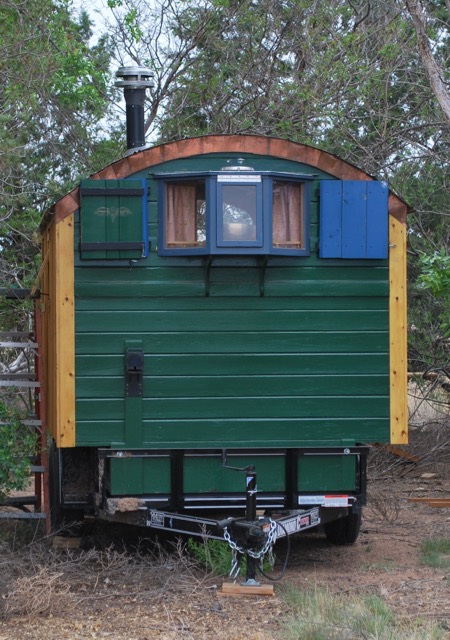
The perfect classic profile combining an arched roof and a beautiful dutch door.
The actual living space of a vardo is the great outdoors with the camper itself serving as a secure sleeping and foul weather quarters.
The promised follow-up is finally here as I have posted the images and text he sent. Honestly, this is my favorite kind of living wagon where old and new technologies are melded into a practical, yet affordable dwelling whether for long-term living or just overnight luxury travel. As shown here, there is a great use of fine woodworking and joinery combined with modern materials and hardware to create a rugged and practical living space that is road (and off-road) worthy.
Here is the rest of Kevin’s mighty fine vardo project (his original text in italics).
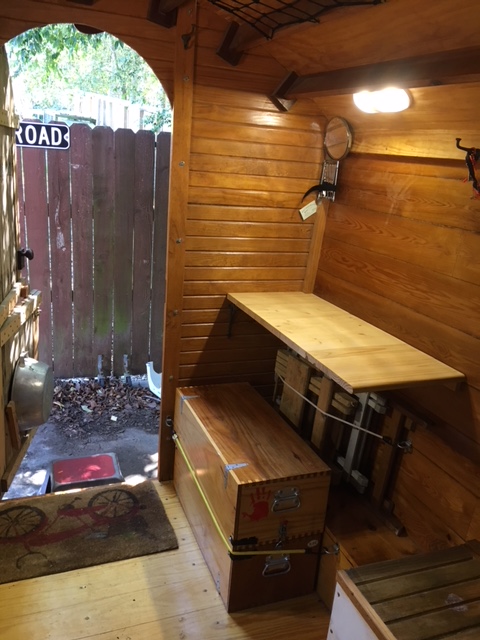
This shot offers a view of the short bench with built-in AC/Heat ducts, one for cooled/heated air (right), and one for return air (left). As well as accommodating air circulation, the bench provides handy storage. Also shown is a 110 volt outlet that provides power to the interior when the Vardo is attached to the generator or some other power supply. There are three interior outlets (the other two are hid pretty well), and three exterior outlets on the camper. There are also 12 volt power plugs inside the camper that are tied to the vardo’s battery. These are great for charging phones and running fans at night. It gets pretty hot along the Texas/Mexican border.
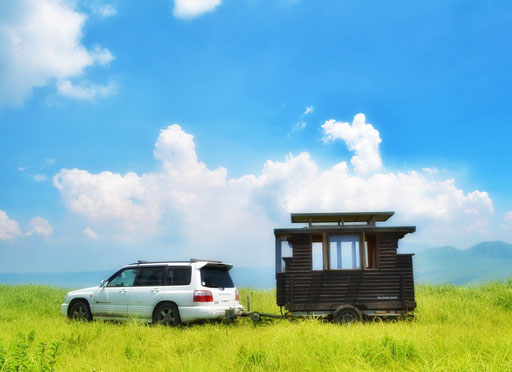
You can see a top view of the access doors to the under-bench storage provided in the long bench. You can also see the flip up section that turns this bench into a single bed. On the side of the door, if you look hard, you can see the hinged corbel that provides some of the support for the flip-up section. At the top of the photo you can catch a glimpse of the bungee net that provides overhead gear storage. This works very nice for carrying fishing poles and a broom.This is how the “chuck box” (cooking box) is stowed when traveling, or when not in use. The small counter top is very handy when brushing your teeth and emptying your pockets at bed time. Underneath, as can be seen, typically is stored a pickers stool, a larger folding camp table, and a folding chair.This wagon can haul a whole mess of Hunting gear. A trip to the desert requires a lot of ice and water. Everything is packed for travel, keeping the weight forward and the trailer stable on the road.A photo of our south Texas hunting camp, with the Vardo set-up. We always get a bunch of comments and compliments along the way. The wagon provides comfortable accommodations for 1-3 hunters.The chuck box gets unloaded and set up for use in camp.
This vardo looks very familiar to me and I think I’d be right at home in it. Thanks so much for sharing this with us and the community.
I love these things. I saw quite a few parked on ranches from Colorado to Idaho last week. I know they aren’t highway capable but it seems they could provide a real housing alternative for low-income minimalists. Way better than a housing complex or apartment for sure. The photos link to Ken Griswold’s Tiny House Blog. If you haven’t figured it out yet, I’m a fan of his site.
I took a fair amount of design inspiration from these wagons but added a bit of class along the way. I wouldn’t mind having a cook stove like this one though.
Off-the-shelf or build it yourself? I love these details in hand-built structures. This looks way better to me than the local hardware store option.
I always appreciate getting mail and comments on the blog; especially when someone is able to take information away and create something of their own. I recently received some fine photos from Kevin with his own Vardo build. I emailed back for more information but haven’t heard anything yet.
The wagon is a lovely and familiar design and it’s great to see it out in public alongside the more normal modern camp setting.Kevin also builds beautiful coolers that I hope to see more of in the near future. One is visible next to the vardo in the image above. Here’s the email I received and I hope to hear (and see) more from Kevin soon:
George:
Hello. I have been following your blog for a few years. I’m writing to you directly as I want to share some photos of the Vardo that I built, using yours (and a few others) for much of the inspiration. I wasn’t sure how to go about posting the photos to your blog, so I figured I would send them directly to you.
I live near Houston and own property in Buffalo Wyoming, home to a historical population of Basque sheepherders, and many currently rolling sheep wagons. Living in two extremes, I have had some issues with changes in humidity affecting the performance of the wagon and would likely do a few things differently, if I were to do it all over again (but wouldn’t we all).
I haven’t seen any updates on your Vardo-make-over in quite a while. Hopefully there’s more coming. I know the work on mine is never done. There are always items hanging around on the list of future improvements.
Let me know if you have any questions about the construction and performance of the wagon. I’m happy to carry on a discussion if your interested, and willing to send more photos if you request. You’ll notice in the photos some glimpses of one of my hand made coolers. They’re marine fiberglass coated wood on the inside, and out; built sort of like a cedar strip canoe. I built the chuck-box in the first photo as well. It travels in the rear of the wagon to be set out for camp cooking. I figured these were both items that might interest you.
Here’s a great story I read years ago about being raised in a family of six in a sheep camp measuring about 7 x 8′! (I think that’s the floor space). I recently relocated the article in Mother Earth News.
Nice layout sketch of a sheep camp.
Here’s an excerpt:
“The canvas-covered sheep wagon was roughly about seven feet wide by eight feet long. On the front end a door opened out of the middle and you stepped down onto the wagon tongue and thence to the ground. From the inside looking out, the stove was on the left of the door. On the right was a small wash stand with several wooden drawers for storage of linens, towels and socks. A bucket of water and washbasin were on the oil cloth covered top and a small mirror hung above the basin for shaving. Soap, toothbrush, razor and essentials rested on top of the stand when in location or were stowed in a drawer when moving.”
I say Vardo because that’s really what it is. You can sense that the presenter of this show isn’t too familiar with true rolling homes, caravans, vardos, or whatever you want to label them but his enthusiasm is real. I like this home a lot but there is too much gymnastic restructuring for my taste. I’m probably just lazy. I’m not knocking his aesthetic or design though; they are spot-on. Mr. Tagami fit a lot of useful ideas together to create a wonderful living space. Several of these innovations are being integrated into my future plans.
If you haven’t seen this yet, here’s a video detailing one of his creations and the happy owners who inhabit it.
A beautiful, dark, wintery day spent in the Vardo, getting things in shape and spending some quality time reading led me to thinking about shooting a few photos. The place is a bit unkempt but I think it shows how the space is used in real life.
The hearth corner with miscellaneous junk piled on the surfaces. This is the view from where my head lies on the bed.A lot of wood types were used throughout the build as some was recycled and some was purchased based on availability. We are out beyond the end of the realm so supplies are limited. The small photo over the door is my grandparents who played a major role in my upbringing.The samovar corner with sink in place. The wood for this built-in comes mostly from an old (pre-war) desk that had seen better days. They used excellent materials that I really didn’t want to discard so I’ve been hanging onto them for several years now. The mirror is more useful that I would have ever thought and fits the space perfectly. The Samovar is strapped in by a belt connected to the wall and Stacey provided a cute octopus hook for wash cloths and other things. I’m just finishing the windows so they have yet to be varnished.Copper sink made from a french mixing bowl (thanks to Mick for the idea).A view aft from seated on the bed. I won’t lie, cutting all the cedar was not pleasant to conform to the arc but it ultimately turned out fairly successful. Apparently, I was trained well back in my life as a carpenter.My view of the stained glass window from bed with a small candle lantern next to it.Cluttered corner. Things are slowly finding their homes.The dog, trying to figure out what I’m up to but staying close to the heater. She climbs underneath the master bed when it’s time to sleep for the night.
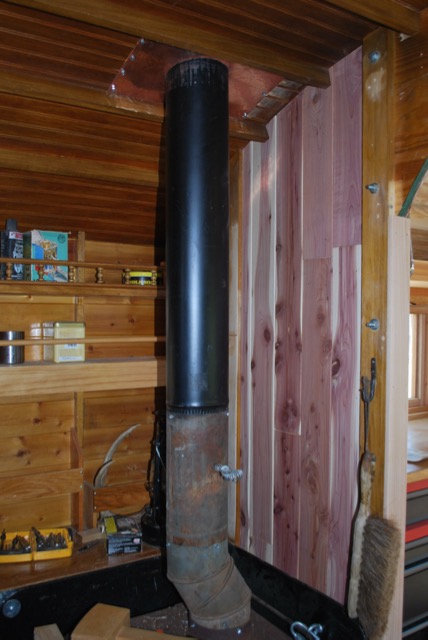
I have not been entirely idle on the vardo project but have not had time to post here. Work life has been eating up my spare time with travel, and fun though that may be, it means nothing else gets done outside the work day. Cutting a hole in my nice, dry roof haunted me for several months but with the aid of a high-temperature silicone stove-pipe flange, I was ready to dive in. I didn’t want to remove the roofing panels so the cutting was difficult. I did what I could with the circular saw and gnawed the rest out by hand with a chisel. Not pretty, but it worked in the end. Then it was just a matter or cutting a hole through the steel and cleaning it up with a file.
The ugly hole. Fortunately it will be hidden.
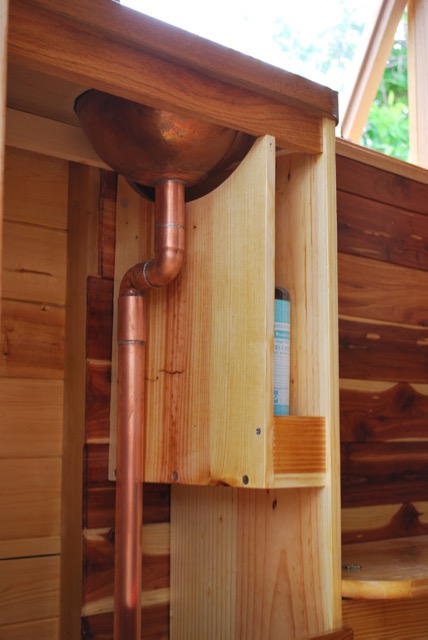
I created a cover for the hole from an old, solid copper serving platter (see photo below) that looks nice, and will cover the ugly. The gap between the layers was filled with stove gasket insulation.
Matching up old, very old, and new pieces to make the connection. The offset was used so that the pipe lands between the purlins.
The upper pipe will get a coat of high heat paint while the lower portion will get stove polish along with the stove itself. In the background, the new juniper paneling is visible. Otherwise, the place looks like a wreck. The mallet is handy to solve all measurement problems.
The silicone flashing isn’t as ugly as I feared but still hope to pretty it up with copper sometime.
Learning from experience, I created this new chimney setup so that the outside pipe could be easily removed, if necessary, for off-road travel. I will probably shorten the pipe by a few inches as it sticks up fairly high. Once this was completed, I could get back to the good stuff.
Sink area with a new-purpose-built soap holder.
In order to maximize storage space a small shelf was created to hold soap. The size was determined by a standard Bronner’s soap bottle and it holds two comfortably.
A little carpenter’s geometry.
Some scraps from the wood pile were recovered and planed down to rejuvenate them for use. Nothing fancy here, just utility.
The large under storage area is designed to hold the beautiful copper cistern from the tinker Robins.
Everything in the area has another coat of varnish so as soon as create a method of securing the Samovar, the washing-up area will be complete.
First coats of varnish on the oak.
Finally, I have begun varnishing the floor. The new oak contrasts with the old but will darken soon enough.













 Preindustrial Craftsmanship