Another Great Design

From Casual Turtle Campers

Peter at Casual Turtle Campers has come up with a great new design in a minimalist caravan.  I have posted his earlier work here a couple times and this new design is worth a look..  This model looks like it would work well as a base camp for one or two people who don’t need a substantial kitchen or keep the cooking gear in the tow vehicle.  The low profile will certainly appeal to people who drive lower vehicles as well.

12
Peter Pavlowich of Casual Turtle Campers

It has his signature roof-line as found on his other designs.  The compound curved roof is a nice, artistic touch.

4
It reminds me of an old Ben Roy design or a Teardrop on steroids.

I wouldn’t be able to do it justice so here’s the description that Peter sent along:

The Hatchling – Here’s a new model that I’ve been wanting to build for a while.  It’s sort of in the size and tradition of a teardrop, but in Casual Turtle Campers style – dead simple, cedar, domed roof, lots of windows, etc.  In fact, it’s quite a bit roomier than most teardrops – and by leaving the entire trailer area as living space, the cabin feels damn near palatial!  Not really, but it is a nice little space that two people and a couple dogs could be perfectly comfortable in.

As an unsolicited build, I had planned to insulate and finish out the interior myself – but then I thought it might appeal to someone looking for either a dead simple, lightweight little camper, or someone looking for a project.  One could add nothing to it and have a very comfortable, capable, simple camper – or features could easily be added to their desires – storage, gear hooks, bed platform, etc.  And I’m perfectly happy to discuss building out an interior for someone. 

Here are some of details… It’s built on a very nice, custom 5’x8′, fully boxed trailer frame with 13″ tires from a great manufacturer here in northern Colorado.  The cabin’s frame is mostly western Hemlock, with Western red cedar siding.  The bottom of the cabin has a 90 mil PVC membrane covering, and the roofing is a fully adhered, 60 mil, ivory-colored TPO membrane – thermally welded at the seams.  It has four opening windows with screens, and two large fixed windows (forward bulkhead and door) for pretty good through-visibility.  It weighs 840 lbs, with about 110 lbs of tongue weight.  There are more specifications/details on the website –casualturtlecampers.com.

I really like this camper, and I can see using it just as it is – or with a more developed interior.  Either way, its a great platform for someone looking to get into a very easily towed, comfortable, unique little camper.  At 840 lbs, this model could work with a wide variety of tow vehicles.  The forward bulkhead is short enough (66″) to tuck in well behind most crossover and small SUVs.  I even towed it around town with our little Subaru Impreza.

I’m 6’2″ and 195 lbs, for scale.  As a shell version, the walls and roof assembly are left open, showing the OSB roof deck’s bottom side – though it could easily be insulated and closed in.  If anyone has any thoughts/ideas/questions please email me at casualturtlecampers@gmail.com.  I’d be happy to discuss this camper or something similar/different that you might be interested in.  And I’m also happy to discuss full or partial delivery from Fort Collins, CO for a rather nominal, mileage-based fee.

Thanks for having a look – and please share it with anyone you think might find it interesting.  I’m tentatively calling this model the Hatchling, but any other ideas for a model name would be welcome, too!

Price – $6,250

static.squarespace.comAnd he obviously has good taste in literature:

“I had to go alone…a kind of casual turtle carrying his  house on his back.” – John Steinbeck, from Travels With Charley.
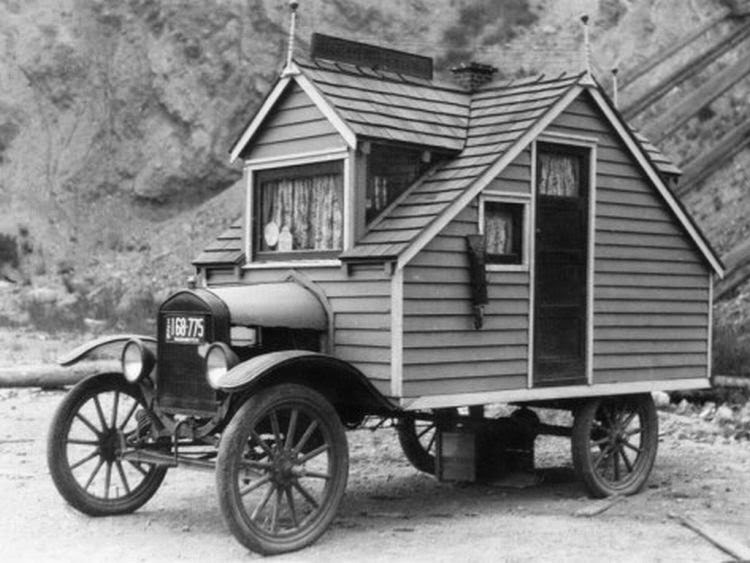
Awesome House-Car of the 1920s

There just might be a few blind-spots with this one.

Found on the Vintage Everyday blog.  It is thought to be from circa 1926 and is a real beauty.  It has some nice details as well.  The sign on the roof, lightning rods, and even a little chimney.  A great solution of one facing homelessness but still had the car.  Possibly a nightmare to drive?

Caravans for Christ

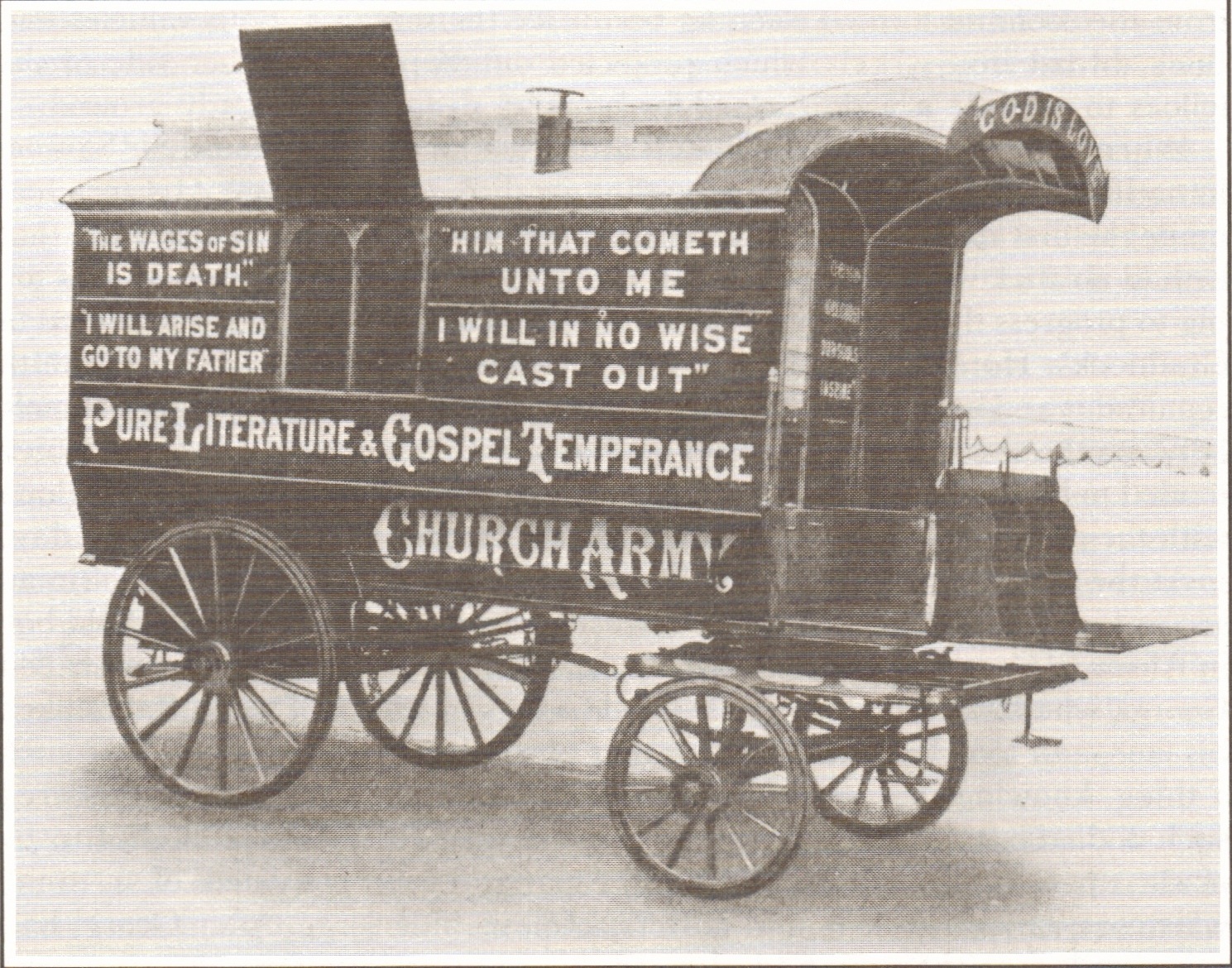
It seems only natural that evangelical ministers would take to the caravan as a way to bring the Gospel to the people.  Christianity is a missionary religion after all.  The caravan served as a sort of home base for missionaries and a vicarage for ministers, even being outfitted with a harmonium (pump organ) in some cases.

Church1
Like hawkers of more earthly wares, church denominations competed for trade by using their wagon walls as billboards.

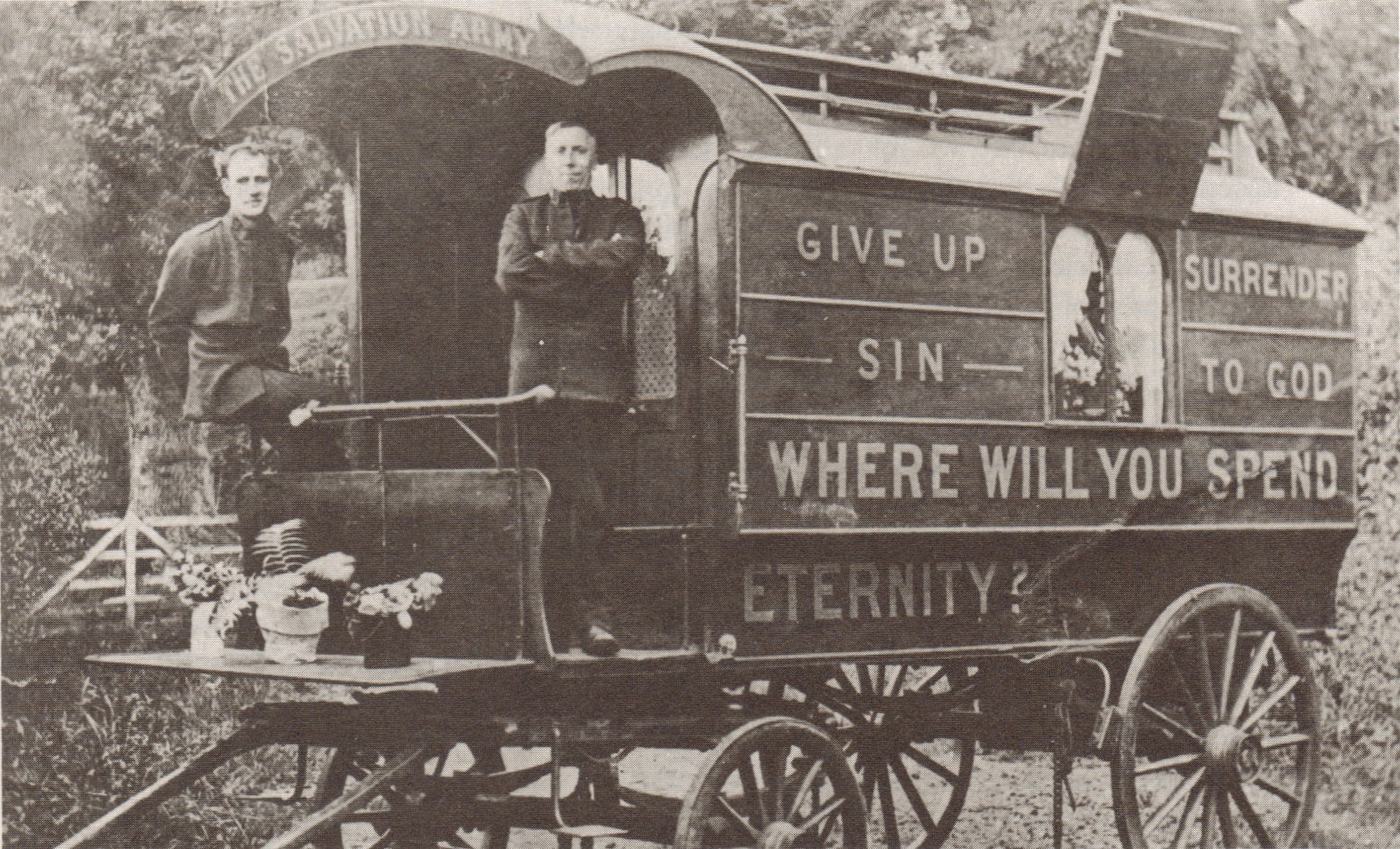
Anyway, here’s another aspect of the caravan life we don’t often see.

Church2
Some could now claim that the whole world was their parish.

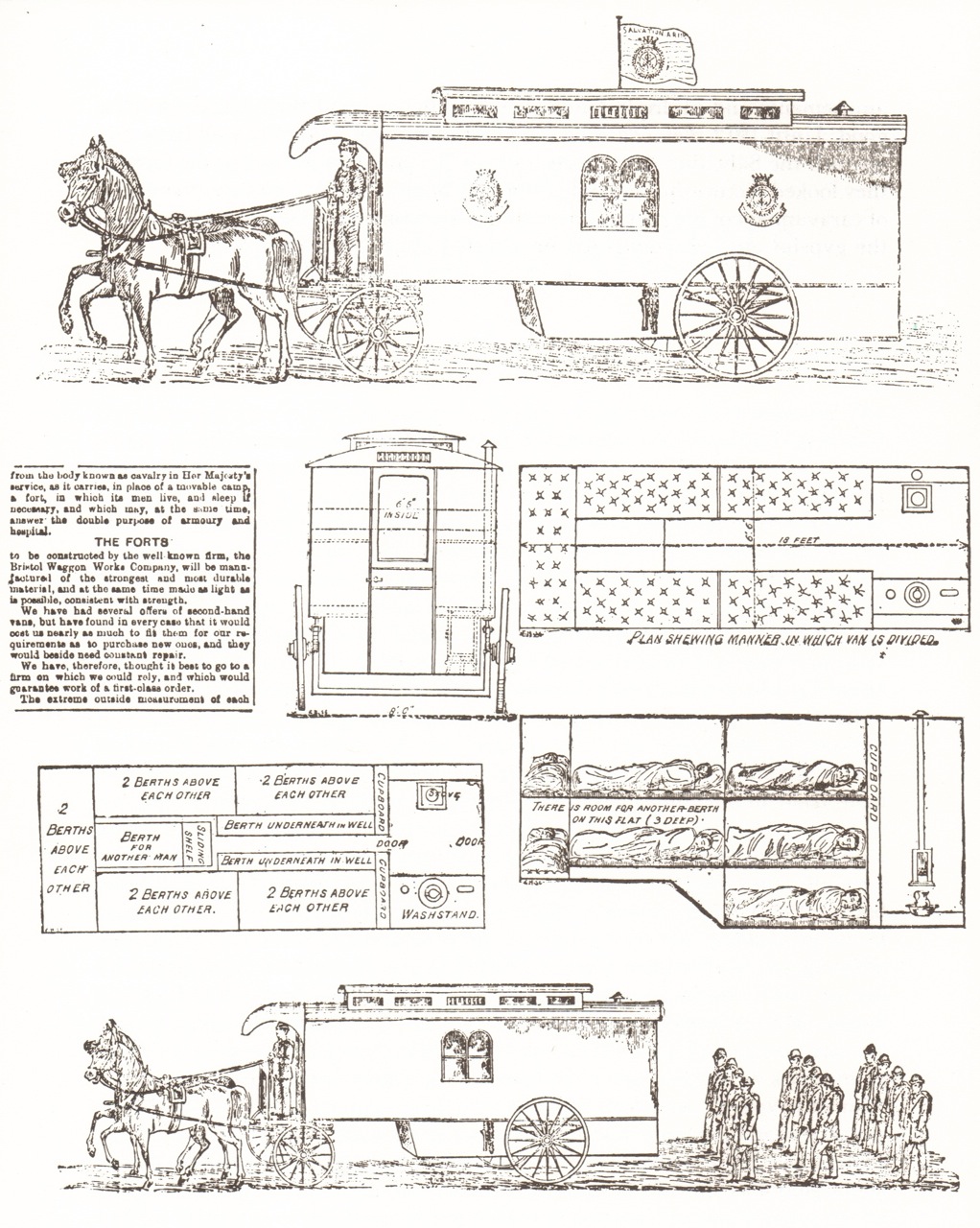
Finally, the FORTS.  A concept of the Salvation Army to travel the countryside, gathering pledges of abstinence and converting the destitute.  Definitely the forerunner of the  modern fifth-wheel camper.

The schematics of "The Fort" from Gypsies and Gentlemen by Nerissa Wilson.
The schematics of “The Fort” from Gypsies and Gentlemen by Nerissa Wilson.


Lightweight Touring Caravan Design from the 19th Century

Touringvan
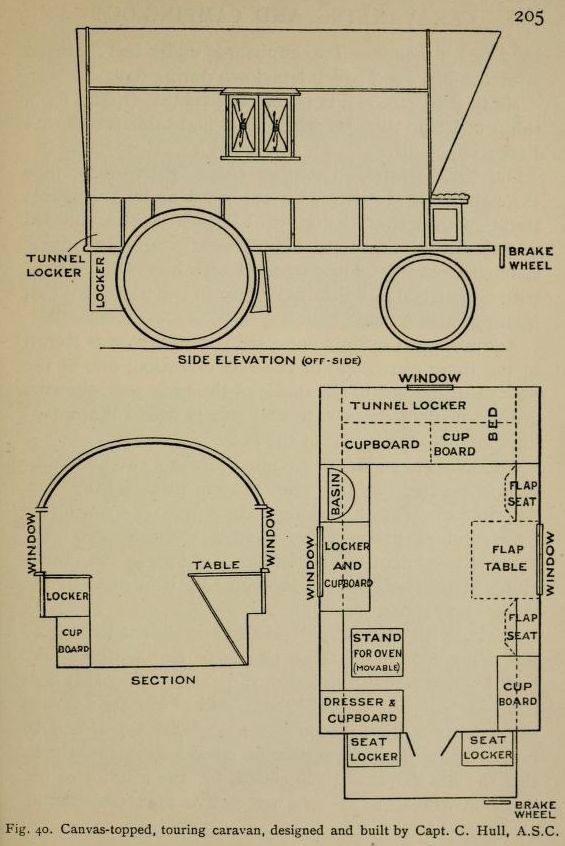
From Caravanning and Camping-Out by J. Harris Stone 1914.

Here’s a great design from the late nineteenth century.  I could not find an associated photo for the finished caravan but there are a couple of innovations I will want to include in the future.  I believe this wagon was about 12 feet long overall and is a nice setup for 1-2 people.  The flap table makes for added floorspace when needed and there is ample storage both inside and out.  The tunnel locker under the bed is also a great idea that I thought was a recent invention.

Towersvan
A caravan with the ubiquitous storage tent.

This isn’t the same caravan but similar in size and design.  I really like the enormous opening at the front for ventilation.  Another innovation for the future.  Also, it’s good to keep in mind that there were normally a tent or two pitched with the van when parked for storage, dogs, kids, etc.  I thought this was a cop-out of mine but it seems I’m not the first to notice the extra space is a godsend on extended trips with more than one person.

Caravan Design: The Open-Lot

An ongoing series of caravan designs to aide the modern builder.  A little history goes a long way to solve our design problems. 

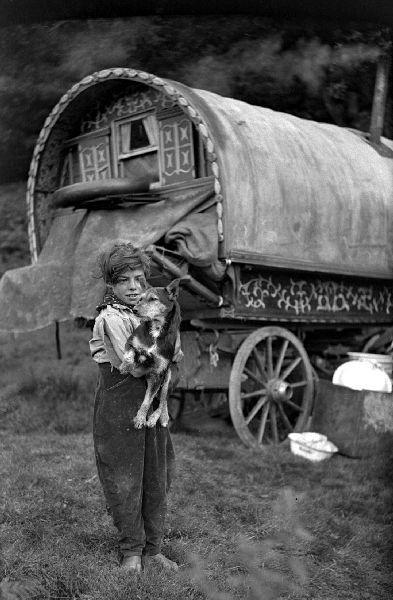
The Open Lot is about the simplest of the true living wagons (properly “waggons”) of the 19th century.  Of course any covered wagon or cargo trailer can suffice when necessary but once these become real homes, some forethought in design goes a long way.  It is worth remembering that the caravans we know and love evolved in the cool, temperate region of northwest Europe and this influenced their design.  If these had originated, as we know them now, in hot, windy deserts or steamy jungles of southeast Asia, other considerations would have prevailed.  For instance, the near universal inclusion of a wood stove would not have occurred.  Better ventilation would have certainly been key.

OpenLotFloor
Illustration by Denis E. Harvey in The English Gypsy Caravan, by Cyril Henry Ward-Jackson.

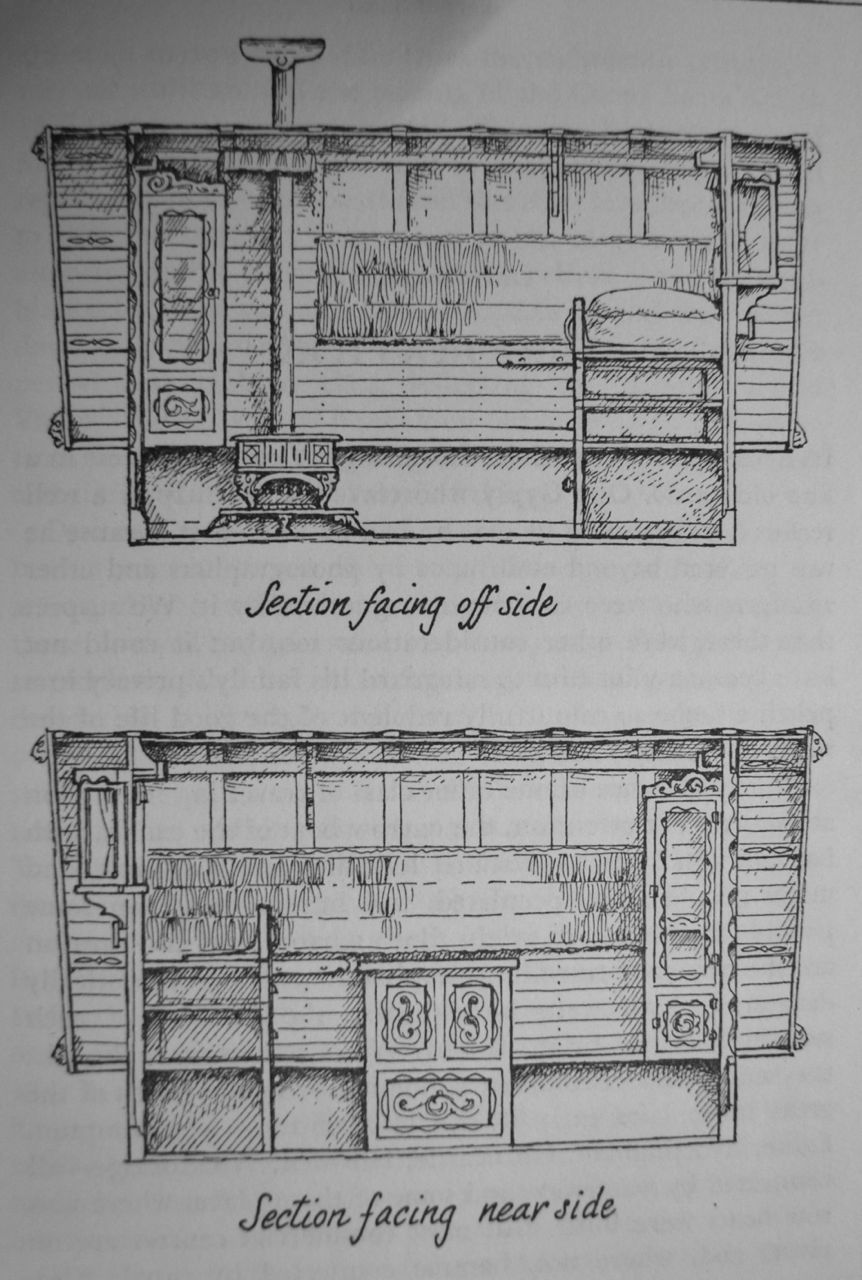
Some of the earliest truly purpose-built living wagons in our lineage are the Open Lots.  Essentially and early covered wagon with closed ends and built-in furniture.  To maximize living space, the bed slides out for sleeping.  There is ample floor space, a built-in chest of drawers, cupboards and under-bed storage.  The massive cabinet under the base of the bed was used for storage or for children, as need arose.  The example above is essentially the pinnacle of this design whereas some were far simpler.

OpenLotCross
Illustration by Denis E. Harvey in The English Gypsy Caravan, by Cyril Henry Ward-Jackson.

The Open Lot is almost the blank canvas for later designers to expand upon and improve.  On possible drawback to this design was and is the curved walls, limiting the ability to build upon and essentially eliminating the possibility of side windows.  The positive feature of this design was it’s light weight.  Note that even in this era, side walls were built up, out of normal reach from outside for safety and security.

From Gypsies and Gentlemen by Nerissa Wilson.

The Open Lot remained the base-level caravan and saw wide popularity until recent times amongst horse powered travellers in Britain and Ireland.

Marketing to the Caravan Craze: Caravan Case and Contour Books

 Presenting the traveling requisites; a caravan case and road-grade book.

CaravanCaseAdvertisement for a lightweight but implicitly tough (it is sole leather after all) suitcase or light trunk for the traveler.   Road grade books were very handy in the days of principally human and animal power.  If you are cycling cross-country or pulling and immense showman’s van you may choose to avoid some of the worst grades.  Britain was notorious for poor roads for centuries so you don’t want to be stuck in ruts on an eight percent grade at nightfall.  These books were lifesavers.

The Tiny House Movement

Here’s a recent conversation I had, as best I can recall, of creating disappointment and maybe using the wrong words when describing the Vardo.

A woman in a grocery store parking lot jogs up to the vardo while I’m making a sandwich shouting, “Oh my gosh!  That is so cool!  Wow! Is that a Tiny House like on TV? Can I have a look inside?”

“Yes, of course.  You can look inside.”  So far, it’s progressing just like a hundred other conversations I’ve had over the years.

“Is it like the little TV houses? You know, like on that show?”

“I don’t know the show but it’s actually a little camping caravan.”

“It’s not a Tiny House?  Oh, never mind then,” turning on her heel she walked away without a backward glance.  Then to another gentleman walking towards us she shouts, “It’s nothing.  It’s not like the Tiny House Show” shaking her head in disappointment.  The gentleman and I proceeded to to tour the little wagon and had a merry talk about the Vardo and having it as a traveling companion.

The Vancott.  From J. Harris Stone, 1914.
The Vancott, moveable cottage designed to solve housing problems for working families in England. From J. Harris Stone, 1914.

A Clarification – Something I find myself explaining on the road when pulling the little caravan is the difference between a Tiny House and a true caravan or vardo.   A Tiny House is just that; a very small house.  Because of codes and strong laws about housing in the Industrial Nations, Tiny Homes are usually placed on a trailer for legal and logistic reasons.  This doesn’t mean that most Tiny Houses should or could be dragged all over the country.  That’s not really the point.  They are generally too heavily built (rightly so) and use materials like factory-built house widows and normal pitched roofs.  While these make for a nicer living structure they are not designed for the sustained tornado-like conditions and severe jarring that come from over-the-road travel.

Showman's2
Late 19th Century-style Showman’s Van, Arguably the first true stand-alone caravan for full-time living. From J. Harris Stone, 1914.

When the world moved a little slower, some of these issues were not as important, such as real glass windows and hurricane-proof roofs, but now, we certainly don’t want parts to fly off at 70 miles per hours on the highway, or to show up in camp with shattered glass on the bed.

Definitions:

Tiny House – Very small home often mounted on a trailer frame.  Designed to be towed  to a final location or towed for occasional moving.

Vardo or Caravan – Small dwelling designed to be regularly towed to new location.

Primus Stove Accessories

 “Do you ever Hunt? Fish? Paddle a Canoe? Explore? Prospect? Climb Hills or Sail on a Yacht?”  Such was the opening line on an 1899 advertisement for Primus stoves.  That covers just about anybody of worth that I know.  Of course you need a stove.  Buck up and buy one (that means you Jim).  The ad goes on to say “It cures all ills that campers are heir to.  It is the one thing needful to make camp life a dream of Elysium.”   You just can’t ask for more than that.

1277439611-PrimusPicnic_1908-01Improving the Primus Stove experience began early on.  Putting the stove in a tin case, disassembled, made for easier packing and kept the parts together.  And of course, a toaster rack that works while the tea kettle is heating on top would become indispensable.

1392681847-primus_usa_1899Unlike what was taught in the Boy Scouts, Primus highly encourage its use inside tents; going so far as to suggest drying clothing and bedding.  I’m not sure my old Scoutmasters would approve but really, it’s nearly the twentieth century, right?  Seriously though, some of the better information concerns the economy.  One quart (0.95 litres) will burn for 5 hours, or as one prospectors testimony claims “A quart of kerosene lasts a week and cooks three meals a day for us.” 

Now I just need to find the right tin box and the remarkable flatiron griddle shown in the upper right of the second ad.