 An Ancient Rebel, Watercolour by Sir Alfred Munnings
Adventures of an Imperfect Man In Search of a Handmade Life

An Ancient Rebel, Watercolour by Sir Alfred Munnings
Over the weekend, I was able to design and nearly finish a new leather haversack. I’ve wanted to make one for a while but I’m always hesitant to start a big sewing project if I don’t think I’ll finish it in a short time… I hate lingering unfinished projects (not to say I don’t have a few lying around).
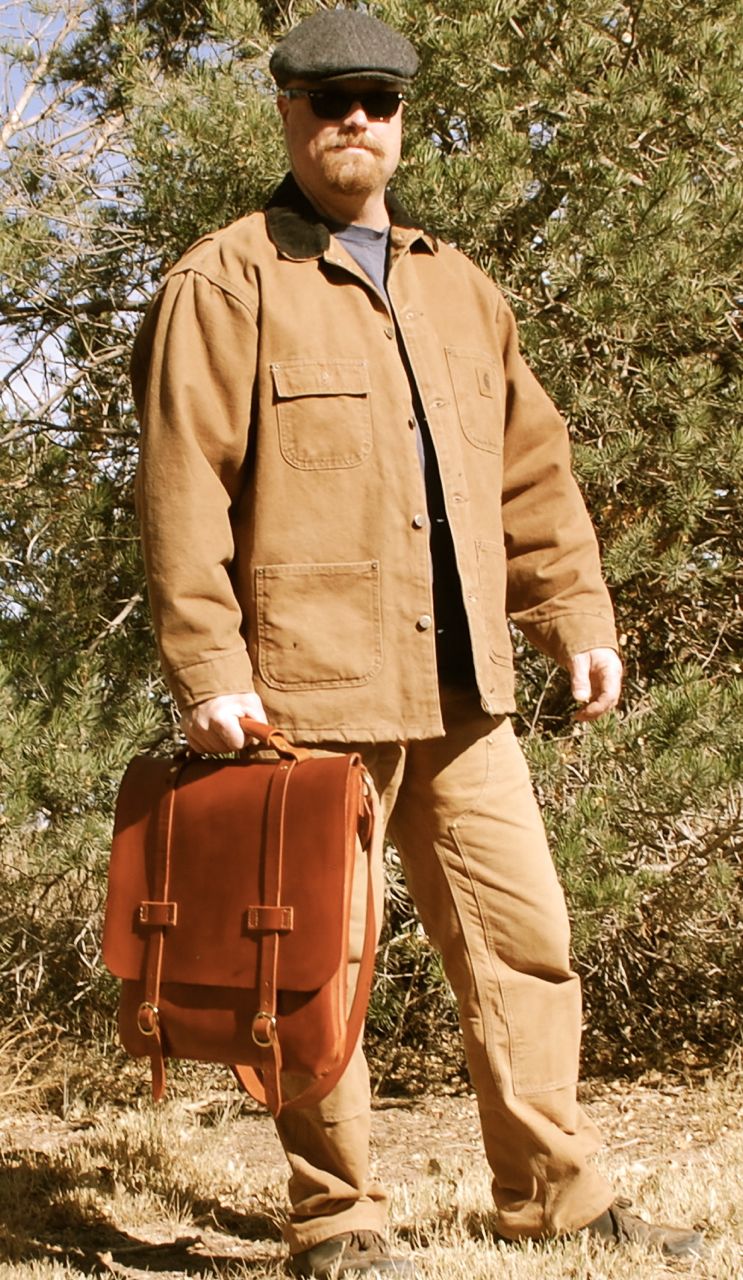 [update: outdoor photo of the finished haversack.]
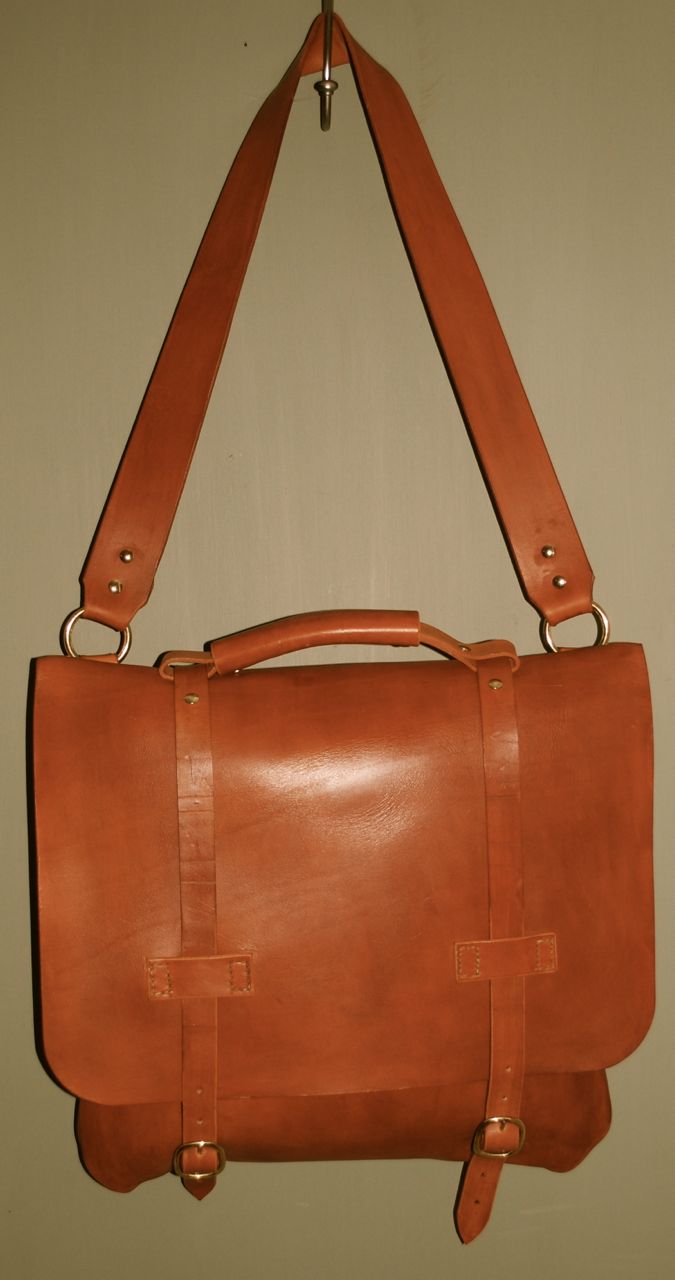 So, while this idea has been bouncing around in my skull for some time, I was inspired by running across a beautiful bag from Morocco in a store in Santa Fe a couple weeks ago. It was about 20″ square with a flap that covered the entire body and was supplemented by a small pocket inside and a larger, open pocket outside. So voila! That’s exactly the design I was pondering.
 It didn’t occur to me to document the process right away, and I didn’t do it well, but here’s how to make a haversack in a few pictures and very few words.
A little historical trivia because I am an archaeological geek; “haversack” means “oats bag” and is associated with soldiering, pilgrims, and other travelers for at least two millennia. Something very like this was carried by Roman Legionnaires and is shown on Trajan’s Column. Here’s a likely reconstruction of their bag:

Okay, back to the business at hand. The layout consists of three connected square sections, in this case 18″ x 54″ (18 x 3). I happened to have a beautiful soft bend of 8 oz. vegetable tanned leather from Spain that just barely fit the size I needed. This used most of the side, so I used some similar weight shoulder for the pockets. I gave the whole thing a dye coat of tan water dye as the pieces were cut.
Below is the basic bag coming to life, outside pockets visible, with a third pocket inside, not shown.
 I like the simplicity of this design, but at this point was forced to decide as to whether the stitching will be outside and visible making a flatter, but bigger bag (see backpack for external stitching).

An observation: folks who don’t MAKE stuff, don’t always appreciate the large number of steps in an apparently simple project like the above. For example: the inside pocket must go on before the outer (so you can get to the stitches), rivets need to be set before they are hidden away, edges skived, beveled, and burnished, stitch holes punched, etc. Above is the bag nearly ready to “close”. Hope I didn’t forget anything.
I sewed it “inside out” to hide the seam and to puff out the body a bit. Turning back out was quite a chore and took some struggling but in the end, I think it looks good. It’s not really quite this red but that’s an issue with my camera and photography skills.


 It shouldn’t be assumed that this is cheap. The body alone is 6.75 square feet of leather meaning you need about 10 square feet of good hide to start with to make the entire bag. With the materials and all the labor involved, it’s easy to see how a leather worker can often charge $500 or more for a similar project. I buy up leather in quantity when the price is low when I can but this project still could cost over $150 in materials alone.
But in the end, it’s really an heirloom of a centuries-old design. It will improve with age and hopefully this is a creation that will outlive me.
A very interesting vardo build by artist Barry Howard. He created a guest post on Tiny House Talk earlier this summer to discuss his ultra-light, fold-down, micro vardo to tow behind his bike. It provides about 12 square feet (1.1 square meters) which is about the minimum needed for an average size human or two to sleep. As an artist, he uses it for carrying art supplies, transporting his finished paintings, and as a bedroom. With a fold down table inside, it provides a place out of the weather and a table outside to cook on.

I’ll bet he gets even more gawkers than us gas powered travelers.

Note the standard mounted bottle opener. No self respecting vardo traveler is without one.

Great details in the paint, and even a stained glass window. I wish I had these skills myself.
 I love the mini mollycroft. It gives it a very classy look.
 Creating a folding box like this adds a real degree of difficulty, especially while keeping it lightweight. He seems to have manged it beautifully.
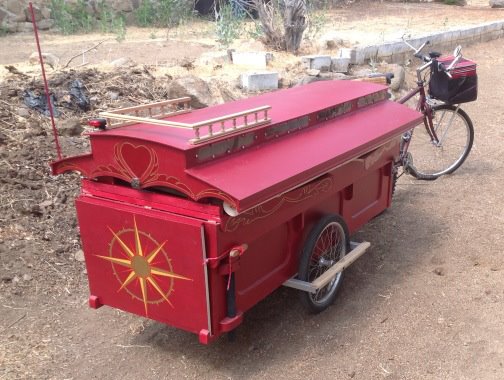
Folded, it presents a low profile for less wind resistance and a low center of gravity.
Visit Barry Howard’s Facebook page for more photos or check out his blog to see what he’s up to with his very cool vardo.

Not a new story, but one that seems to keep resurfacing. Maybe there’s a crumb of wisdom that intrigues people about this concept. Most people in the Western World have never, for a second, considered life without money, yet for most of the world, and nearly all of our history, this was the natural condition.
Can we all do it tomorrow? No. Can we move toward a less abstract, personally productive life? Yes. Click the photo to read the short article or link below to visit the website and his book.

“I believe the fact that we no longer see the direct repercussions our purchases have on the people, environment and animals they affect is the factor that unites these problems. The degrees of separation between the consumer and the consumed have increased so much that it now means we’re completely unaware of the levels of destruction and suffering embodied in the ‘stuff’ we buy.”
This is the most salient point that so many of us miss in our daily routine.
“Very few people actually want to cause suffering to others; most just don’t have any idea that they directly are. The tool that has enabled this separation is money, especially in its globalised format.”
“I am not anti anything. I am pro-nature, pro-community and pro-happiness. And that’s the thing I don’t get – if all this consumerism and environmental destruction brought happiness, it would make some sense. But all the key indicators of unhappiness – depression, crime, mental illness, obesity, suicide and so on are on the increase. More money it seems, does not equate to more happiness.”
Mark Boyle is the founder of the Freeconomy Community www.justfortheloveofit.org. The Moneyless Man, a book about his year without money, is available here and elsewhere on the web.
Here’s some images from a short eBook on woodworking by Peter C. Welsh. A quick read with some good stuff in it.

Not just eye candy, there is good information contained in this study of tools. But really, I’m just in it for the tool porn.

I particularly like the comparison of tools owned and used by actual people. For instance, in a Virginia workshop of 1709:
“John Crost, a Virginian, owned, in addition to sundry shoemaking and agricultural implements, a dozen gimlets, chalklines, bung augers, a dozen turning tools and mortising chisels, several dozen planes (ogees, hollows and rounds, and plows), several augers, a pair of 2-foot rules, a spoke shave, lathing hammers, a lock saw, three files, compasses, paring chisels, a jointer’s hammer, three handsaws, filling axes, a broad axe, and two adzes.”
A man could get a lot done with that tool kit.

In 1827, a Middleborough, Massachusetts, a carpenter lists his tools and their value. This is likely a representative set of tools for an actual tradesman of the time.
1 set bench planes $6.00 1 Broad Axe 3.00 1 Adze 2.25 1 Panel saw 1.50 1 Panel saw 1.58 1 fine do— 1.58 1 Drawing knife .46 1 Trying square .93 1 Shingling hatchet .50 1 Hammer .50 1 Rabbet plane .83 1 Halving do .50 1 Backed fine saw 1.25 1 Inch augre .50 1 pr. dividers or compasses— .71 1 Panel saw for splitting 2.75 1 Tennon gauge 1.42 1 Bevel .84 1 Bradd Hammer .50 1 Architect Book 6.50 1 Case Mathematical Instruments 3.62-1⁄2 1 Panel saw 2.75 1 Grafting saw 1.00 1 Bench screw 1.00 1 Stamp 2.50 1 Double joint rule .62-1⁄2 1 Sash saw 1.12-1⁄2 1 Oil Can .17 1 Brace & 36 straw cold bits 9.00 1 Window Frame tool 4.00 1 Blind tool 1.33 1 Glue Kettle .62-1⁄2 1 Grindstone without crank 1.75 1 Machine for whetting saws .75 1 Tennoning machine 4.50 Drafting board and square Bevel— 1.25 1 Noseing sash plane with templets & copes 4.50 1 pr. clamps for clamping doors 2.17 1 Set Bench Planes—double irons.— 7.50 1 Grindstone 300 lbs @ 6.25 1 Stove for shop—$7.25, one elbow .37 & 40 lbs second hand pipe $4.00 11.62 1 Bed moulding 2.00 1 Pr. shears for cutting tin.— .17 1 Morticing Machine 10.75 1 Grecian Ovilo 1.13 1-3⁄16 beed .67 1 Spirit level 2.25 1 Oil stone .42 1 Small trying square .48 1 pareing chisel .37 1 Screw driver .29 1 Bench screw .75 1 Box rule .50 1-3⁄4 Augre .41 11 Gouges 1.19 13 Chisels 1.17 1 small iron vice .52 1 pr. Hollow Rounds .86 4 Framing chisels 1.05 1 Grove plough & Irons—Sold at 4.50 5.00 1 Sash plane for 1-1⁄4 stuff 1.50 1 Copeing plane .67 1 Bead 1⁄4— .75 1 Bead 3⁄4 1.00 1 Rabbet (Sold at .92) .92 1 Smooth plane 1.50 1 Strike Block .92 1 Compass saw .42 6 Gauges 1.83 1 Dust brush .25 1 Rasp, or wood file .25 1 Augre 2 in. .76 1 Augre 1 in. .40 1 Do 3⁄4 .30 1 Spoke shave .50 1 Bevel— .25 1 Box rule .84 1 Iron square 1.42 1 Box rule 1.25 1 Spur Rabbet (Sold—1.17) 1.33 1 Pannel plane 1.25 1 Sash plane 1.25 1 pr. Match planes 2.25 1 Two inch chisel or firmer— .42 1 Morticing chisel 3⁄8 .25 1 Large screw driver 1.00 1 Pr. small clamps .50 1 pr. Spring dividers .92 1 do-nippers .20 1 Morticing chisel 1⁄2 in. .28 1 Ovilo & Ostrigal 3⁄4— 1.25 1 Scotia & Ostrigal 5⁄8— 1.08 1 Noseing— 1.08 1 Pr. Hollow & rounds 1.33 1 Ogee— 1⁄2 inch 1.00 1 Ostrigal 7⁄8 inch 1.00 1 Bit— .15 1 Beed 1⁄2 inch .83 1 Claw hammer .67 1 Fillister 2.50 2 Beeds at 5⁄8 1.83 1 Pair Quirk tools 1.50 1 Side Rabbet plane .83 1 Large steel tongued sq. 1.71 1 Saw & Pad .67 1 pr. fire stones .50 1 small trying sq. .50 1 Set Bench planes double ironed without smooth plane 6.00 1 Bench screw .75from “A Yankee Carpenter and His Tools,” The Chronicle of the Early American Industries Association (July 1953), vol. 6, no. 3, pp. 33–34.
I could ponder this list for a long time and find only a few things to add from our modern arsenal of gadgets and labor-savers.

Overall, Welsh does a decent job of outlining the changes in woodworking tools over the last three centuries, and provides great period illustrations too. Read the complete book for free HERE.

“Perpetual devotion to what a man calls his business, is only to be sustained by perpetual neglect of many other things. And it is by no means certain that a man’s business is the most important thing that he has to do” Robert Louis Stevenson.

Humans are, by nature, makers of things. That’s how we deal with the world… or did, until the Industrial Revolution tore us away from our connection with the earth. Somebody is still making all the stuff, of course, its just outsourced and corporatized, repackaged, and branded. Strangely, the stuff that should last, like clothes, housing, or tools are generally poorly made and often unfixable while the junk that should be disposable is made from plastics that will endure for a geologic age or poison our descendents. But maybe, with a little effort, it doesn’t have to be this way.
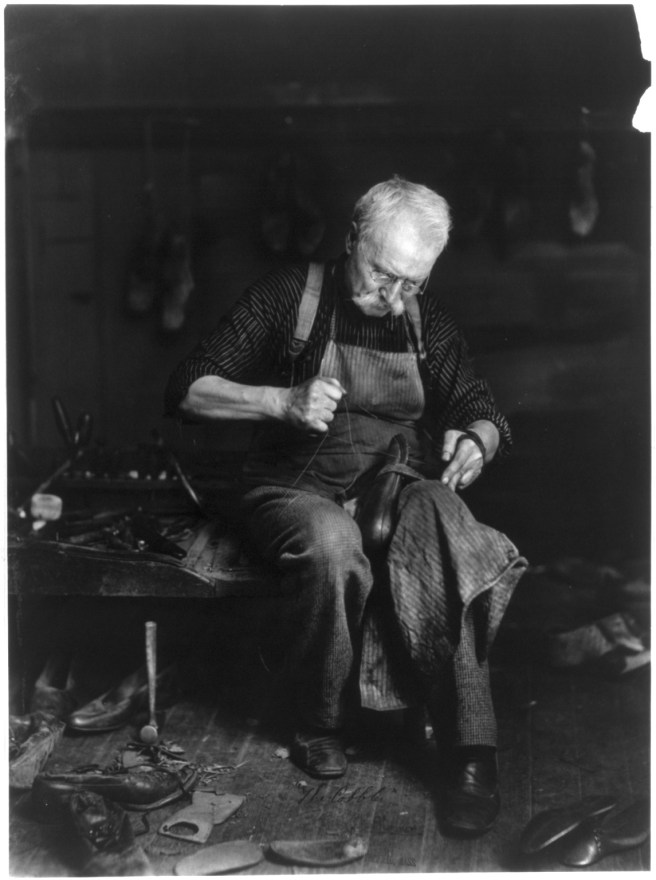
Today, instead of procuring our needs directly or through someone we know, we trudge off into an abstract man-made environment to be treated as children and told to perform an obtuse task or two or twenty. And in exchange for giving up our time, we get slips of paper (or more likely, digits only readable to a computer on a plastic card) that confirm that we have performed our work and are now in a position to gather food, shelter, clothing, heat, etc. from a middle-man where profits are almost never seen by the makers.

Creating things like fire, rope, or cutting tools, not to mention shoes or housing will baffle most modern people. Weaving a blanket, sewing a shirt, or butchering an animal are simply out of the question for most of us in the western world. Many of these activities will get you strange looks at best or a call to the authorities at worst. This mindset means that most of us can’t feed or cloth ourselves any longer even if we really want to.
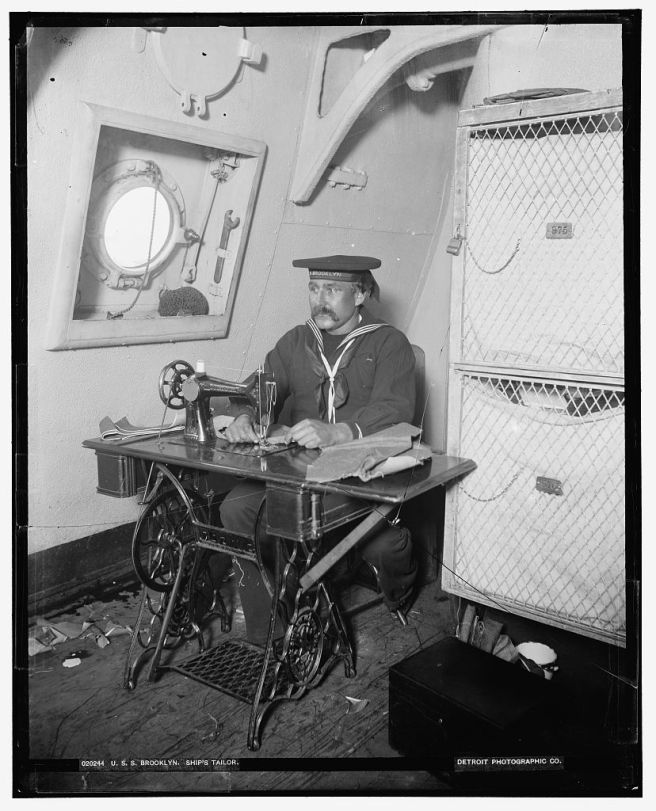 Makers are the hope. We’re out there. Doing things and making stuff. Fending for ourselves in an hostile but lethargic world of expected and nearly enforced consumerism. Once you realize the machine doesn’t work, you can realize it doesn’t really exist.
Most of my adult life, I’ve noticed an interesting paradox. Typical wage-slaves who proudly give 50 hours per week to a faceless and unappreciative mechanism are convinced that the dreamers and the creators are just a bunch idlers and flâneurs when it’s, in fact the lifestyle that they really envy. If it isn’t recognized as drudgery, somehow it’s not real work. But how much do we really need to be happy?

As a side note, many modern philosophers trace this thinking directly to the Protestant Reformation when, as they claim, much of the fun was beaten out of life and holidays were things to be frowned upon. But here I digress.
The internet actually gives me hope, especially seeing the wonderful documentaries of real craftsmen and makers around the world that are emerging from obscurity. Maybe to many, Makers are just a novelty. Something to be ogled at. But knowing there are others out there looking for a deeper purpose and a better existence makes me feel a little better about humanity.

Let’s be realistic; most modern folks wouldn’t opt to live as hunter gatherers as their ancestors did, but maybe we can reach a better balance with our lives than to adopt the imposed role as absolute consumers. And hopefully conscience people can do some good things along the way. Maybe by thinking outside the consumer mindset and choosing to build our homes, make our own socks and shirts, ride a bike, and hunt our meat we can make a difference by both our action and our inaction.
In the words of Samuel Johnson, “To do nothing is within everyone’s power.”
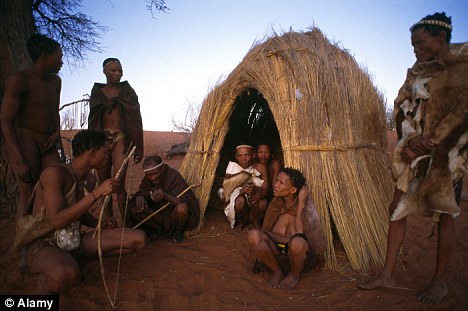
Remember: “An idle mind is a questioning, skeptical mind. Hence it is a mind not too bound up with ephemeral things, as the minds of workers are. The idler, then, is somebody who separates himself from his occupation: there are many people scarcely conscious of living except in the exercise of some conventional occupation”
Robert Louis Stevenson, idler extraordinaire.
 Why not go make something? Your great grandparents did.
P.S. Pardon the Friday late night ramblings. My disdain for the modern world is heightened at the end of a ridiculous week at work.
Wow. Simply wow. I’m happy whenever I see we haven’t lost our craftsmanship.
A beautiful short film about the maker.
Pieces of wood, love, knowledge and 299 hours of work, condensed in a 3 minute film.
 by joshua minnich

 Preindustrial Craftsmanship