 Everything old is new again..
Adventures of an Imperfect Man In Search of a Handmade Life

Everything old is new again..
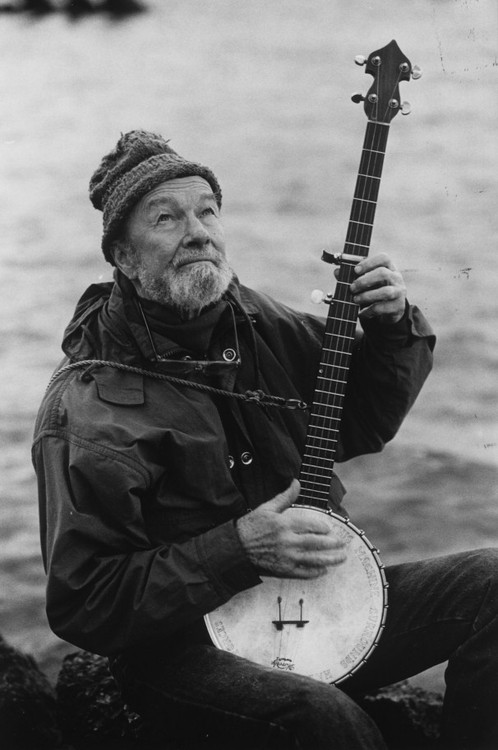
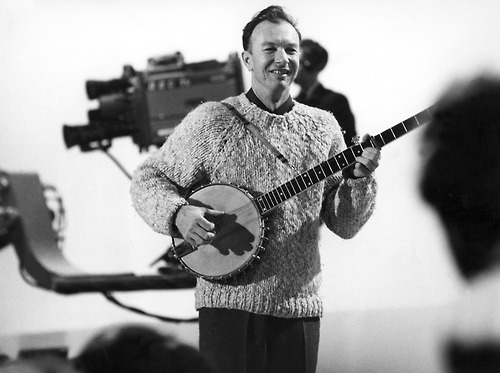

I was a closet banjo picking classical music major when I really got into Pete Seeger. A great man with high morals, and a willingness to fight for what he believed in.
 Wandering Monks part 1 – The Buddhist monks that travel much of the year throughout Asia are about as minimalist as one can reasonably get. Early Buddhist monks were instructed to own, as based on the Pali Canon, a very simple set of eight items. Things have, of course, changed over time and religious wanderers have changed with it.
Everything thing else was communal or gifted to them, including food.
 Wandering Buddhist Monks part 2 – Things have changes in the past 2,500 years and the natural hardships of a traveler’s life warranted a few additions to an allowable kit of possessions. A revised and more modernized version adds a few more necessities (not everyone is up to the task of living in real poverty or misery; also, the communities of non-mendicants have some expectations about cleanliness, etc.). So in addition to the above eight possessions, the monks carry:
It should be remembered, these monks were part of a Sangha (intentional community of Buddhists) so there were communal objects for the rainy season when they weren’t traveling and there is a long tradition of charity towards holy men that we no longer practice in the West (other than tax exemption for churches and the National Football League).
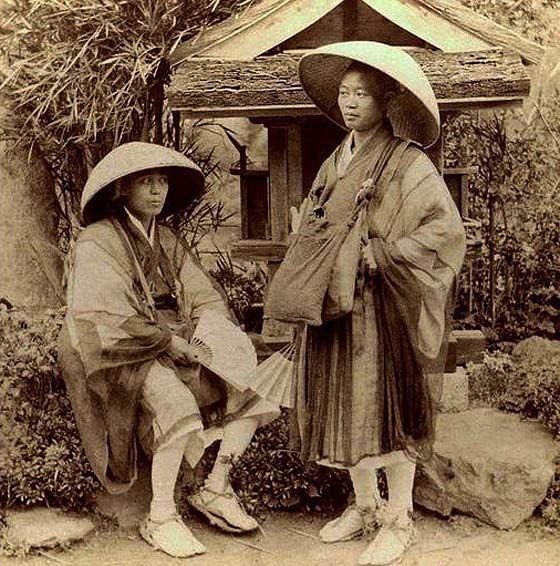 Wandering Buddhist Monks part 3 – Of course, the world changes and the esoteric lifestyle adapts with it. Modern Buddhist mendicant monks might carry a few extra things in order to live reasonably within the modern world. This becomes a very realistic list for the modern traveler. Over many centuries, it became apparent that being acceptable and able to fit into society in general was an important thing. Good appearance, cleanliness, and preparedness helps one not be a burden on the community. I understand the need to fit-in and remain incognito when appropriate. After all, isn’t that what our daily costumes achieve?
Later realists again modified the kit of the wandering Buddhist mendicants in eight types of personal utensils or belongings (adapted, in part from RAHU website, Singapore). There are a total of 8 necessary requisites of the Buddhist monk garments and utensils. I big part of the teachings of the Buddha are concerned with an intentional, non-harmful, and simple life.
In addition the initial eight things, some items have been added, not just for survival, but for the comfort and convenience as monks might find themselves as guests in a temple, in major cities, suburban settings, or the wilderness.
The latter list is a very complete list of real essentials. Having a codified list to pack from can be comforting, just like the lists the Boy Scouts still make for High Adventure programs. Looking at a little knowledge gained by our predecessors goes a long way.

Why did I choose the Buddhists specifically for this example? Europeans have our own traditions, just without as much documentation. We’re a free-form lot. These folks certainly can sleep rough as need arose on a holy pilgrimage and don’t appear to be overburdened with stuff.
Matthew, Mark, and Luke all report that Jesus taught his disciples; “If you wish to be complete, go and sell your possessions and give to the poor, and you will have treasure in heaven”.
Coming next – Ultra Minimalists, Part 4 – Modern Minimalism – a re-blog from Joshua Fields Millburn.
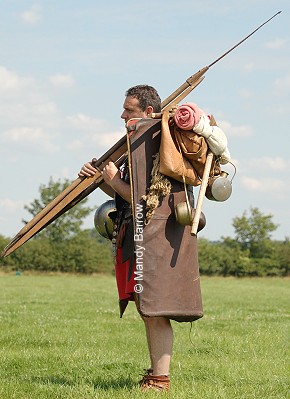 Roman Legionary – Let’s go back to the beginning of the modern military. As militaries go, Rome had a pretty successful run. After their first couple centuries being beaten up by the Celts they certainly learned a thing or two about fielding an army. More importantly, when wars were no longer fought to defend one’s home things had to change. Expansionist politics meant a paid, professional military (i.e., a mercenary army like we have today).
Without delving into a long history of the Roman military, here’s the pertinent synopsis for our purposes. In order to make the army fully mobile (not tied to a wagon or mule train and to rid itself of non-combatant lackeys), it was determined that the individual soldier should be responsible for more than just showing up, sword and shield in hand (for some historical references, see: Scipio Aemilianus Africanus and later, Marius’ reformations). In order to get rid of as much support staff as possible, and remove the competition in out-gearing each other, each soldier was issued (this was a new idea) a set of gear, including a full sarcina (marching pack) which included the essentials of daily living. The fact that they wrote about this and portrayed it in art gives us a pretty good idea of what equipment was used in the field.
Archaeological/historical side note: this, in-turn, led to the first systematic recycling program we know of; collecting the old stuff and remaking, re-tooling, and re-issuing gear. Metal is especially recyclable.
The sarcina (marching pack) of a Legionary soldier is about as pared down as one can get yet still travel in comfort:
I created the above list from several sources and it covers a period of about 5 1/2 centuries but the essentials don’t really change. This list of course, doesn’t include arms and armor or specialized things like saws, mattocks, hatchets, axes, etc. that were also carried. Various contemporaries state that soldiers carried between 3 and 14 days of food when on the march in a haversack.
Overall, this isn’t a bad list of essentials and looks a bit like my packing list for a camping trip. For a modern traveler, or someone looking to completely pare down their life, this might be a good starting point.
Curiously, there is no mention of a fire kit and they are rare archaeological finds in general. When I was in graduate school, I recall this being noted and it has been surmised that either (a) fire was everywhere in a settled continent and easy to come by if necessary, (b) coals were carried in the luggage and simply re-lit as needed, or (c) fire making was so common that it is not even worth mentioning in ancient texts or depictions.

Next time: Wandering monks of Asia…systematic, codified minimalism we can all learn from. On to Part 3.

This is a lengthy ramble. So long in fact, that I have broken it into several posts to be trickled out over the coming days, weeks, or months. Skip on to the fun stuff if you aren’t interested in Minimalist* philosophy. There’s a lot of recent talk about Minimalism as a social movement. Not long ago, it was associated with artists and aesthetes, wanderers, mystics, and philosophers. That is to say, the fringe element, outsiders, and weirdos. These things come in cycles and I think, as a backlash against generations of sell-out philosophy and the creation of a professional consumer class, many people are reaching for something new.
We come to learn that everything old is new again.
I’ve been looking into history and prehistory on a full-time basis for many decades now. As hard to believe as it may be, I even get paid a salary to do it. One of my professional interests involves tools, tool-kits, and strategies for surviving that various people have come up with for dealing with the world. As a primitive skills-survival instructor and full-time frugalist I think it important to not reinvent a lifeway when we have millennia of ancestors who dealt with most of the same issues we do today.

For most humans, for most of our history, owning too much stuff has never really been an issue. We had what we needed and either made what we needed or did without the things we didn’t have. It brings a smile to my face to know that more than 2,400 years ago, well-to-do people in China, India, and the Middle East were contemplating the nature and evils of acquiring Stuff; even writing about it. That’s not to say that I have immediate plans to become a wandering mendicant like a medieval friar (as appealing as that might sound to some) but I do have an interest in lightening my material load and some very specific goals for the coming year.

My foundation as a minimalist – I have been thinking about what stuff a person needs to survive since I was a teenager. Like virtually every young boy, I had grand ideas of escaping the family and traveling unhindered across the world. I devoured Jack London and Mark Twain stories as a kid. I loved the extensive and well-thought out gear lists provided in the Boy Scout Handbook, the Explorer’s Handbook, and the Philmont Guides. I read Larry Dean Olsen’s great book of Outdoor Survival Skills and Colin Fletcher’s The Complete Walker. I read about the mountain men of the fur trade, and always, took note of what they carried or didn’t seem to need. I would copy lists into a notebook and ponder them while sitting in some boring high school class, making my own lists of what I have, what I need, and what I want. This thinking encouraged me to work and save money to buy a better knife, backpack, or stove. I was probably the only kid I knew who wanted, and got, a file and whetstone for Christmas one year (my grandpa was good that way). My friends and I spent our teens and early twenties hiking and camping year round, mostly in the woods of the Ozarks in southern Missouri testing our mettle at that time in life time when all teenagers know they are invincible. Some of us even made it to Europe, Asia, Africa, and beyond.
 In a modern sense of survivalist, many people look to the military or the loonies of teh mainstream media. Often, military service is the time when young men and women are introduced to such things for the first and only time. Realistically however, the military itself acknowledges it’s shortcomings on a personal basis as (with the exception of a few special operations units) its entire system is dependent on lengthy and complex supply lines, support chains, and de-emphasis of the individual and personal decision making. Military survival is therefore, approached as a means of keeping alive until help arrives. Great for fighting a war, but not always so good when you are turned loose into the world.
Coming up next…Ultra Minimalists Part2. Let’s look at a military example anyway: Romans.

* here are a few links to modern Minimalists of various ilks and philosophical merit. A journey through these links will hint at the breadth and depth of people on different paths but moving in the same direction.
Read, research, think, and enjoy!
Go to Part 2Last winter I had an important epiphany about myself as a musician. I am under nor delusion that I will ever be more than a closet or campfire player. For me, for now, that’s going to have to be good enough. Although I love the fiddle more than any other instrument, I went back to my roots and picked up a Deering Good Time five string banjo a couple years back to see if I couldn’t revive my banjo playing. I hadn’t really played much in over a decade but discovered that not only did the brain still remember some old tunes, but my big, beat-up fingers were actually still suited to it. Ham-hands I’ve heard them called!

After playing the “Good Time” for a couple years, I felt I outgrew it as a player. Don’t get me wrong, it’s a great instrument for the price (ca. $650), American-made, and travels well but I just wanted a little more substance and a thumpier traditional sound. Not being able to afford anything fancy, and my playing not really being up to any professional par, spending a load of money I don’t have was out of the question. It became apparent to me that it was time to make something better myself. This isn’t quite as outlandish as it may seem as in my woodworking days in my early twenties, I made a couple banjos, a handful of mountain dulcimers, and some mandolin parts that were fair to partly decent instruments. Anybody who knows me knows I hoard parts and hardware so fortunately I had a set of tuners, some fret wire, a tension ring, and a bracket set for a banjo (obviously the universe conspired for this to happen). For the rest, a quick trip through the Stewart-MacDonald catalog located the missing elements (e.g., a White Lady Vega-style tone ring, brass arm rest, bridge, and tailpiece, as well as a maple neck blank and rosewood fingerboard, and a calf-skin for the head).
 Unfortunately, time and energy were against me when I made the initial build last summer. I was traveling and teaching for the university while working on this so I didn’t document the process. So, I essentially built this one twice. Once, to have something to play while traveling over the summer, then a rebuild in the fall to tweak the set-up and put a better finish on it (tung oil). The photos don’t really do it justice here but hopefully, it gets the idea across. Making an instrument is a doable thing.
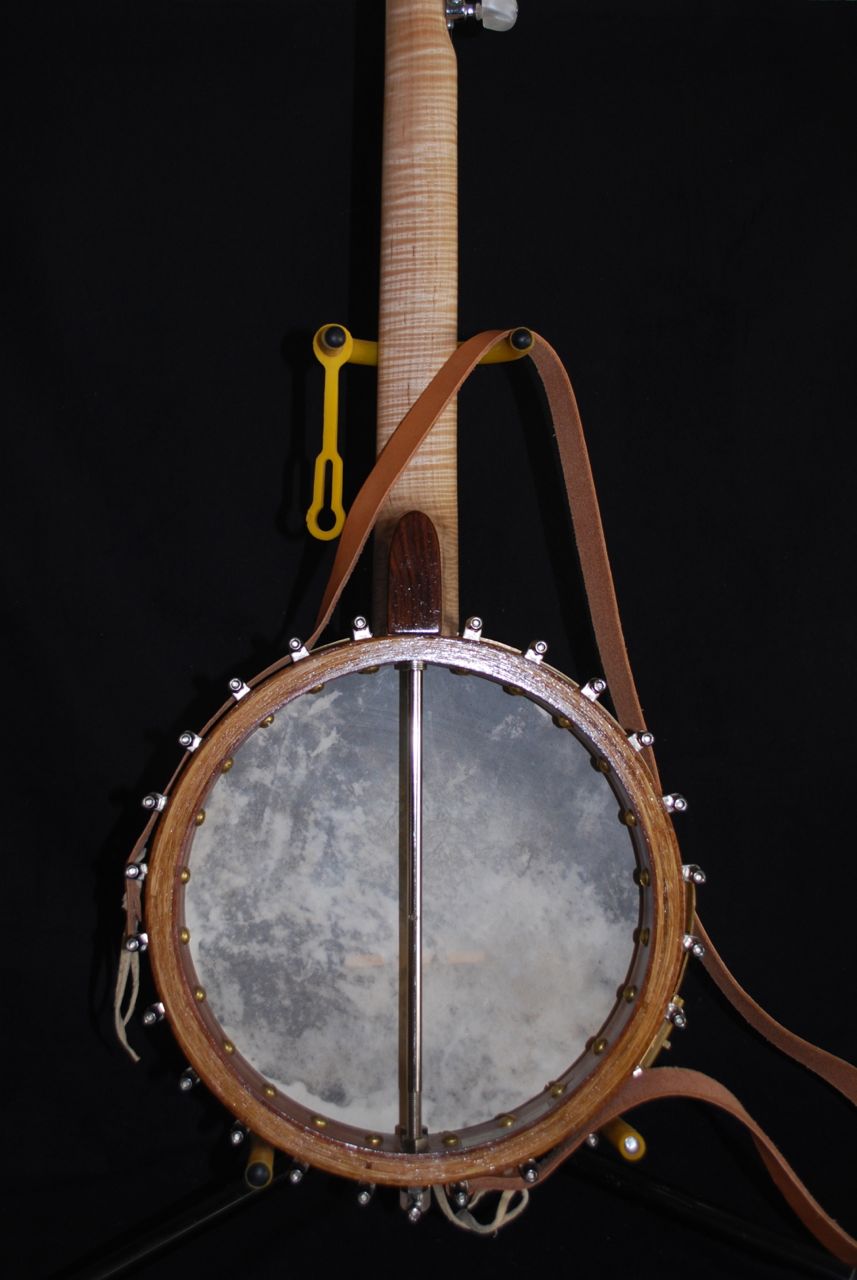
I won’t even attempt to describe the process and there are many better instrument makers who have done this before me (see the Foxfire books, Irving Sloane, Earl Scruggs and plenty of others).

To make a banjo, you essentially need a few, more-or-less mechanical parts, then find a way to attach them together in a fairly precise and meaningful way; that is to say a neck, complete with a fretted fingerboard and tuners, and a drum-headed hoop of some type. Having some experience with steam bending, this part was not as intimidating as it might seem the first time around. My choice for the body was a hickory core with walnut laminates for the outside.

These pictures already show the six months of use and she already needs a good cleaning. As can be seen though, there’s little ornamentation on the instrument; no inlay or bindings, just an octave marker on the side of the fingerboard. I did steal the peghead design from Earl Scruggs’ book where he stole and printed the Mastertone design himself. It was just too classic.
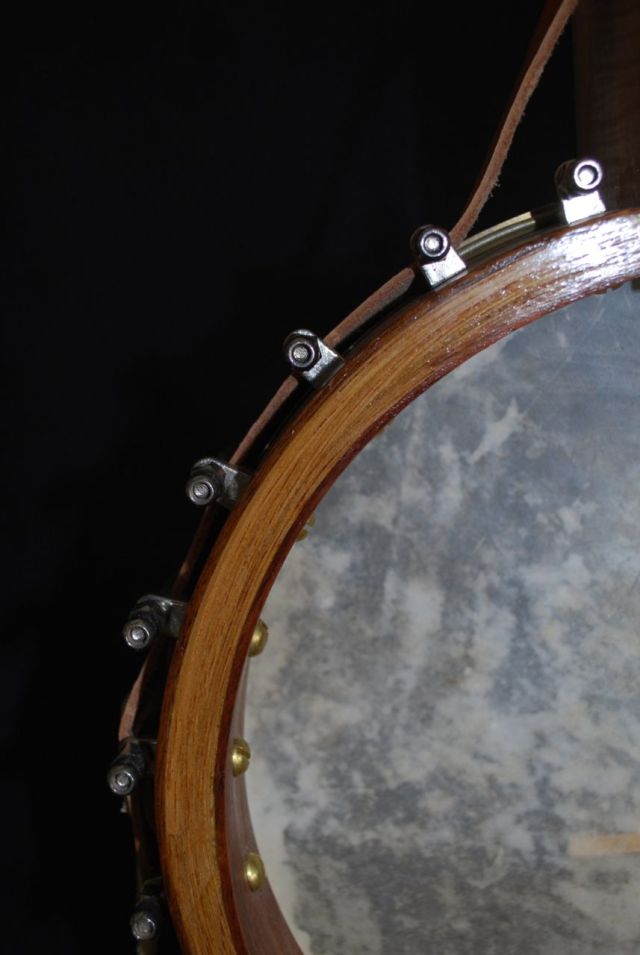
I had intended to veneer over the back but after completion, I liked the raw look that shows the construction. Maybe I’ll change my mind about this later but for now, this is it. The calfskin head can be a finicky when traveling as it is affected by humidity. Some players remedy this with a thin layer of spray-on silicone. I may try this in the future just to see how it works.

I rarely see a reason to hide a beautiful wood grain.
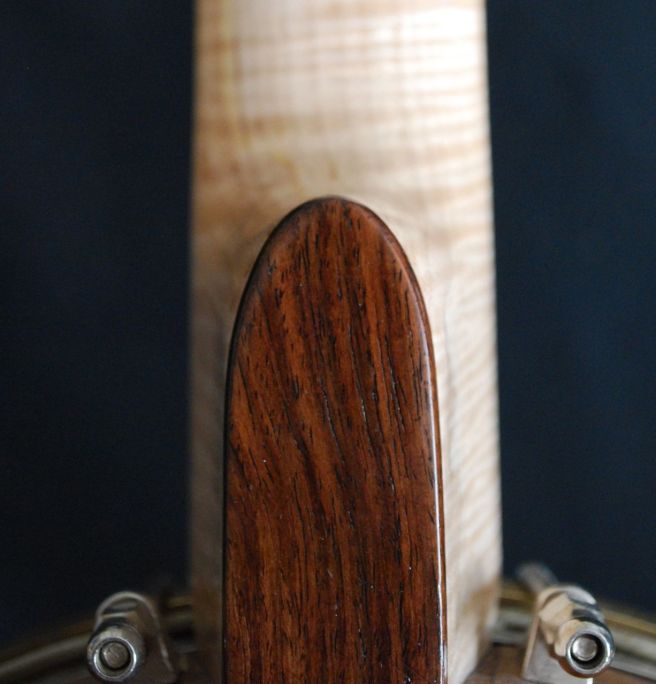

The components that make up the pot of the banjo are illustrated above. From right to left: brass tension hoop, edge of the rawhide over wire, nickel-plated tone ring, tension brackets, and wood hoop. the armrest is just visible in the lower right.
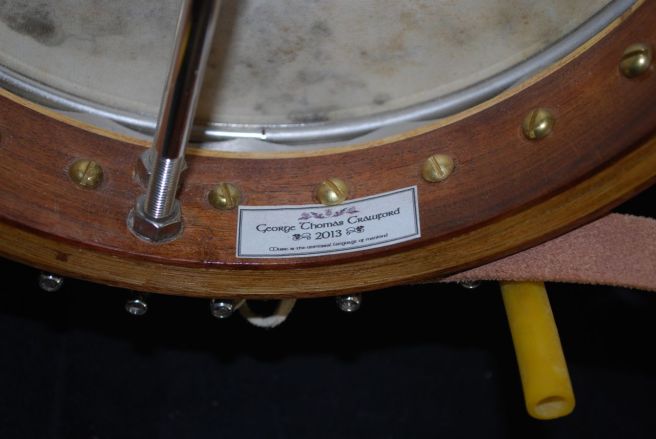
It’s remarkable how fast the weight adds up. 24 brackets, brass screws, tone ring, tension ring, tuners, and armrest make for some significant weight. I think it’s a good idea for any artisan to sign their work, even if it’s never intended to sell. This separates the hand-crafted from the mass-produced and show the care and the soul that goes into a hand-made work.
Now, time to practice.
This is one of those “in progress” posts.
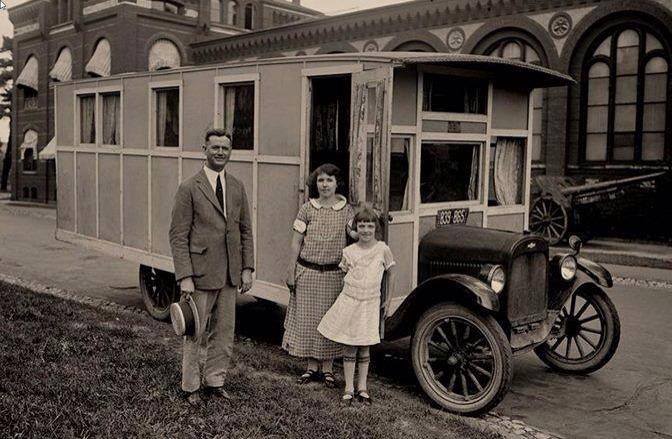
The little home is never done. I don’t expect it ever will be and I think that’s great. Trying to approach a balance that will be perfect enough to live in yet stay within the reality of time, money, and general laziness. Since the beginning, I have wanted an exterior kitchen on the vardo but, at first, I was obsessed with size and weight (or lack thereof). Over the last few months I decided to jump in on the project but, being determined to spend as little money as possible, I awaited materials to appear.

Still determined to keep the weight as low as possible, I piled up the kitchen basics on my floor and figured out an approximate volume. Two small stoves, a kettle, coffee pot, cafetiere, a couple of cooking pots, tea tins, coffee cans, and some miscellaneous space. A few essential cooking utensils for good measure. Not much really. I decided I can store the less frequently used implements inside the truck or in the tool boxes of the wagon. With that examination made, the final design was almost infinitely more simple than my initial thoughts (which contained shelves, niches, and little drawers that only add weight but some real coolness, to the overall box). These may be added later though. So here’s what I’ve come up with so far.
 Upcycling some old pine 1 x 12″ shelving boards, I decided to use these as the basic building unit and the building began. Essentially, I created a box about 33″ tall by 21″ wide with two morticed-in shelves. I wanted a fold down shelf to cook on when on the roadside or at a temporary campground and for this, I found a couple hinges off an old secretary desk (I save lots of hardware) and old steel drawer pull that came in a box of junk from some auction years ago. To attach the door, an old piano hinge that needed a little scraping a brushing to remove some ancient enamel paint was located and brushed up.


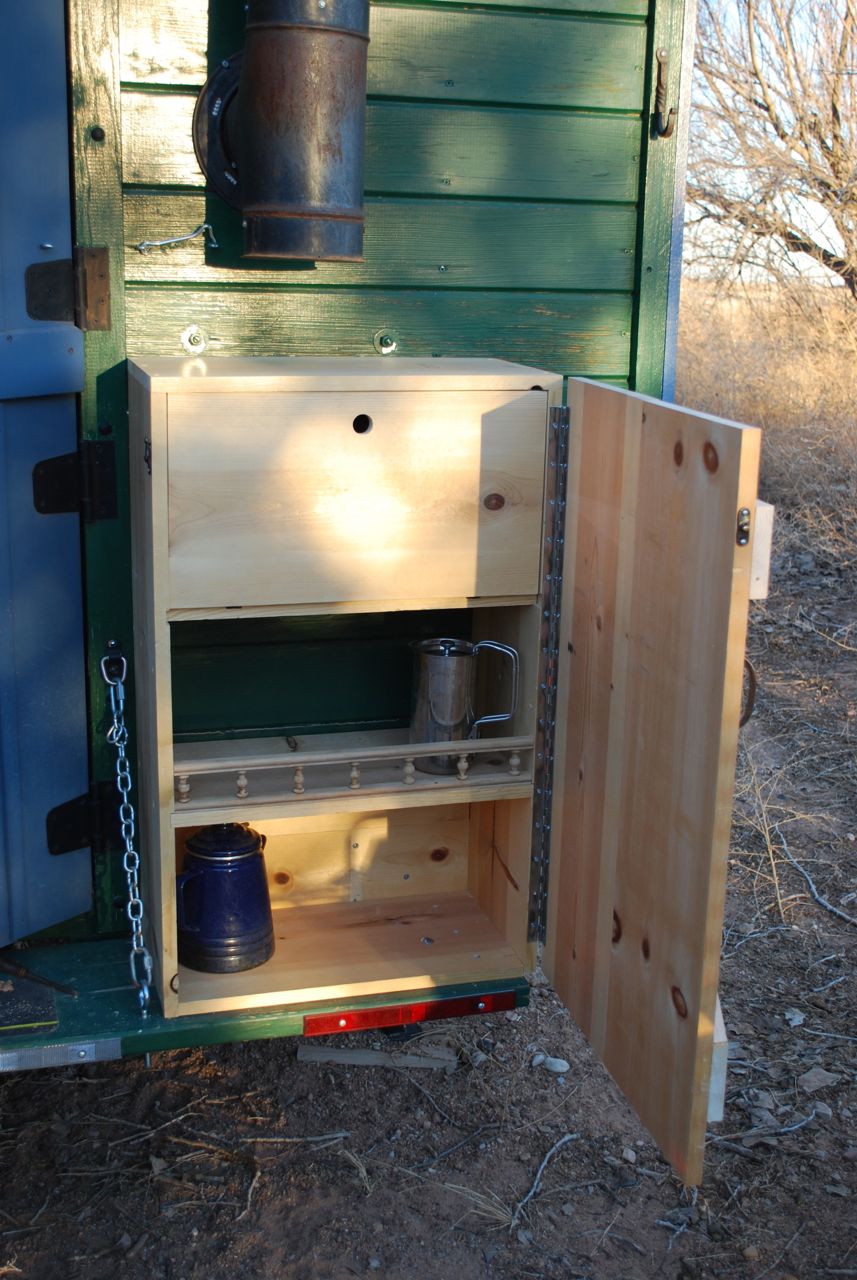


I should mention here that I did buy star-drive, stainless steel screws for the construction so I’m now into the project for about $6.00 of real money. More to follow soon I hope!
Using archaeology to find out hows things “should be” done? A response to a common question, by George Thomas Crawford
I am regularly asked about my connection to archaeology and my interest in primitive technology. I’ve also been chided by some people in the primitive tech community on behalf of other archaeologists because they (archaeologists) are not all directly interested in the primitive skills. There is so much more to the anthropology of material culture and our human past than just the replicative technology. It just happens to be what I’m into.
Many of my anthropological colleagues are way smarter and more focused than I am and go in for chemistry, microscopy studies, site and landform formation, human-animal interaction, plant-use, kinesiology, geology and humans, climate change, genetics, biocultural evolution, and a slew of other cool stuff that isn’t generally covered in the popular press.
But on that note, I scan journals and the web for hints at solutions to my own replicating attempts and experiential archaeology. These are the masters. For example: A person who earned his keep as an archer 4,500 years ago will know an infinite amount more about bows, arrows, strings, and animals than I could glean in a lifetime of the modern world. Lucky for me, this type of thinking ties directly to how I want to live. That is to say, in a style that predates, in many ways, the horrors and unforeseen consequences of the Industrial Revolution. Not as a seeker of some non-existent Golden Age but as a searcher for the truth. We have succeeded as a species in our present form for only a very short time so far, though we think of ourselves as lords and masters of all we survey. We even create institutions and religions to reaffirm this and place ourselves where we see fit in this scheme.
Moving on – I was given some excellent advice by an old professor when I was in college that guided my wild academic wanderings for many years. Unfortunately I expect this sort of thinking would not go far with many students today. The advice is essentially as follows.
– Assume that most everything you will imagine as a young scholar has been thought about, examined, and studied by your predecessors. This does not mean to lose hope, just realize you have a long way to go and a high hurdle to cross. You can’t stand on the shoulders of giants without a serious climb.
1) For a student who truly wants to learn, it is now your full-time occupation whether that is college or not. Scholar is a job. You have chosen to not just take up space in a classroom and have your named checked off as attending. Those people waste all of our time and you know who you are. Best of luck, just don’t bother us.
2) It is your responsibility to teach yourself as much as possible. This is done by filling your spare time by exposing yourself to knowledge not mindless entertainment. Leave that to the zombies and the drones of the world.
A simple way to learn is to park yourself in the library and to peruse journals. Not starting with today, but starting with research from a hundred years ago, or preferably more. I was advised (and I did this) to pick up the earliest bound volumes of Nature, Antiquity, and American Antiquity and flip through every issue. Read the Table of Contents. Now, pick at least one article from each and read it. Really read it. You may not retain all of this information but it sticks with you in some form. You will begin to see trends in how we think and study and write about what we do.
3) Stop worrying about what you will do for a job after college. People obsessed with this are the most unsuccessful people I know. If you truly just want to make money, drop out of college NOW and go learn a trade. Be a welder, mechanic, or a carpenter*. If you don’t want to contribute to society in any real way or are just of a greedy or slightly evil turn of mind, try banking or investment. If you just want to slide through without too much effort or reward, try the federal government or other forms of middle management. I see too much vocational thinking in the quest for knowledge and not enough seeking.
4) Finally, develop a passion for what you want to learn. Hopefully this is obvious and has already happened to you but sometimes we need to be told. If we don’t love what we do, this short life will be a very unhappy one (by “do” in this sentence, I don’t necessarily mean “how we earn our money” but what we identify as; e.g., potter, woodworker, musician, or knitter).
And a final caveat: I don’t think I am in any position give real advice to others but I do feel that maybe I should answer some of the questions I’ve become so adept at evading. Have a great day and hopefully a happy life.
GTC
*I personally think this is critical to become a well-rounded person anyway.
More great thoughts from Henry David Thoreau on simplifying.
“I do believe in simplicity. It is astonishing as well as sad, how many trivial affairs even the wisest thinks he must attend to in a day; how singular an affair he thinks he must omit. When the mathematician would solve a difficult problem, he first frees the equation of all incumbrances, and reduces it to its simplest terms. So simplify the problem of life, distinguish the necessary and the real. Probe the earth to see where your main roots run.”
— Henry David Thoreau to H.G.O. Blake, March 27th, 1848
 Preindustrial Craftsmanship