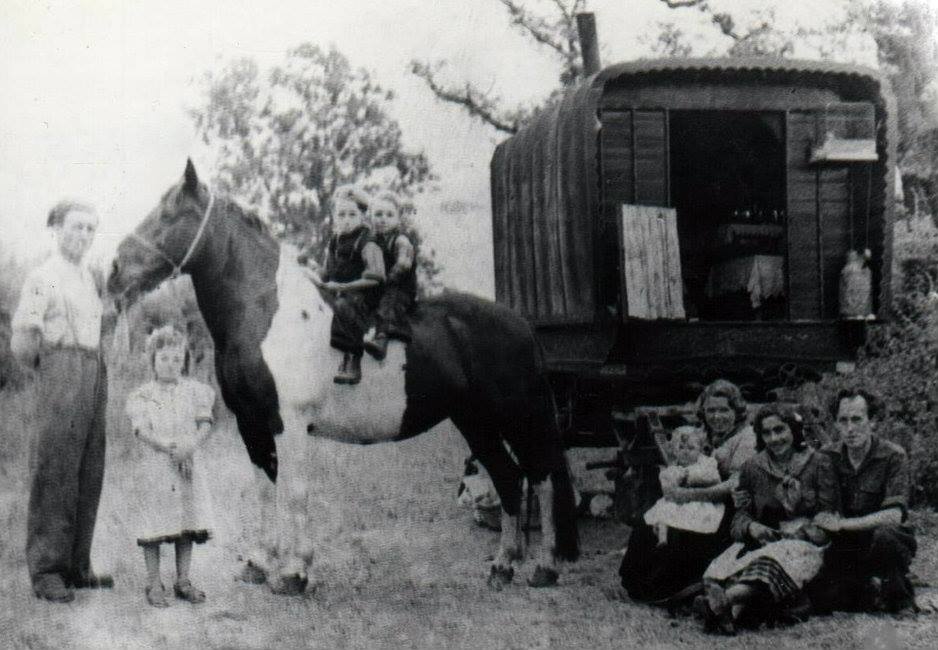
I found this beauty on http://theromanipeople.tumblr.com/. Sometimes there are some very nice images there but like much of Tumblr and Pinterest it seems to be stripped of all associated data. Anybody with any facts please feel free to pass them on to me.
A nice little roadside camp.
I suspect this is early 20th century in Britain. I like the ubiquitous water can by the door and the nearly universal birdcage. Maybe I need an addition to my menagerie.
Another one for the Great Artists at home file. A beautiful image of Django Reinhardt with his son. He was only about 34 when this was taken; ten years before his untimely death.
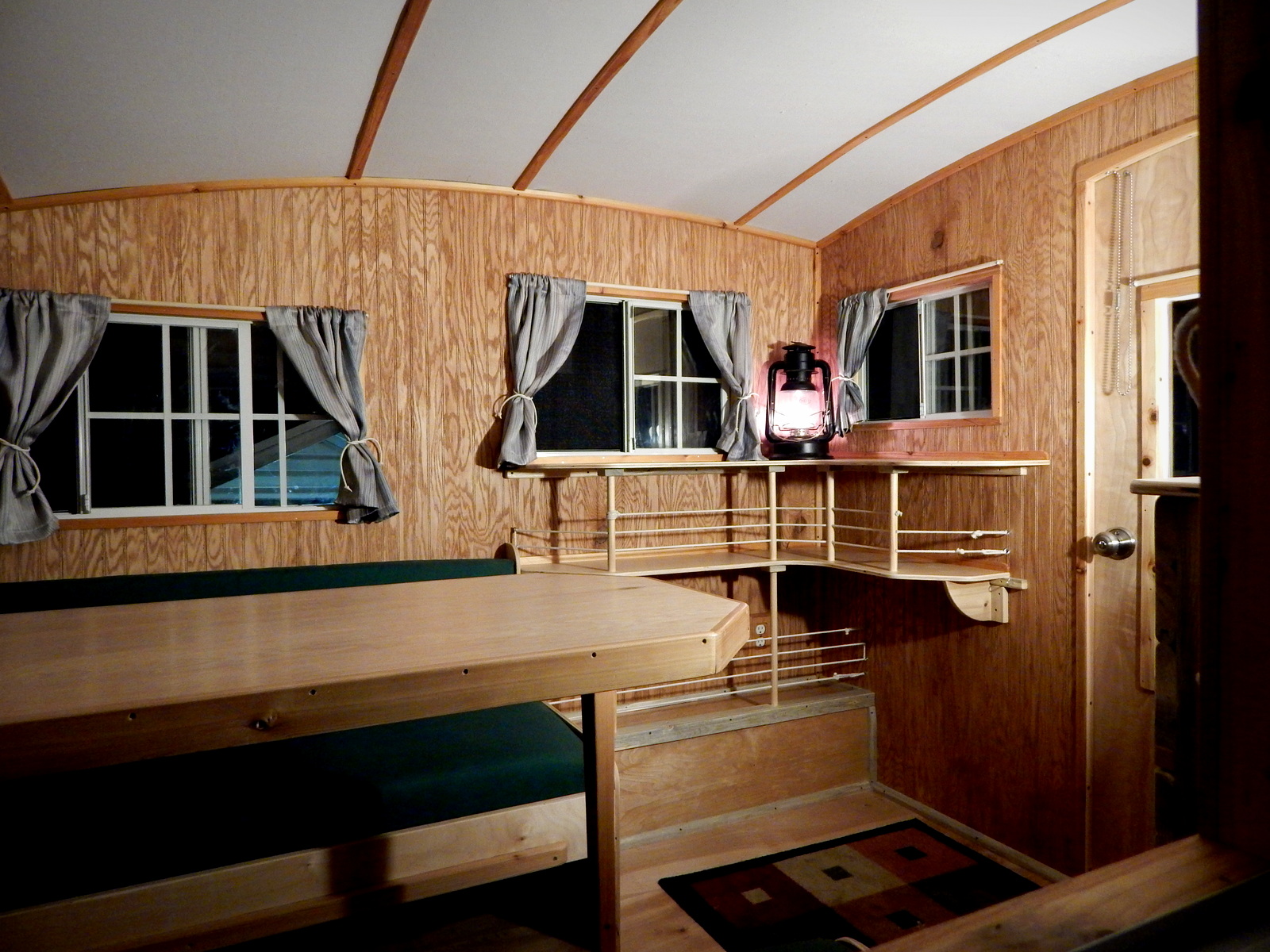
There’s a new edition to the fleet of designs coming from Peter Pavlowich at Casual Turtle Campers. The unique, curved roof lines really make his work stand out in the crowd and I’m glad to see it again in his newest model. For me, this design melds the aesthetics of the early motor caravans with modern tastes.
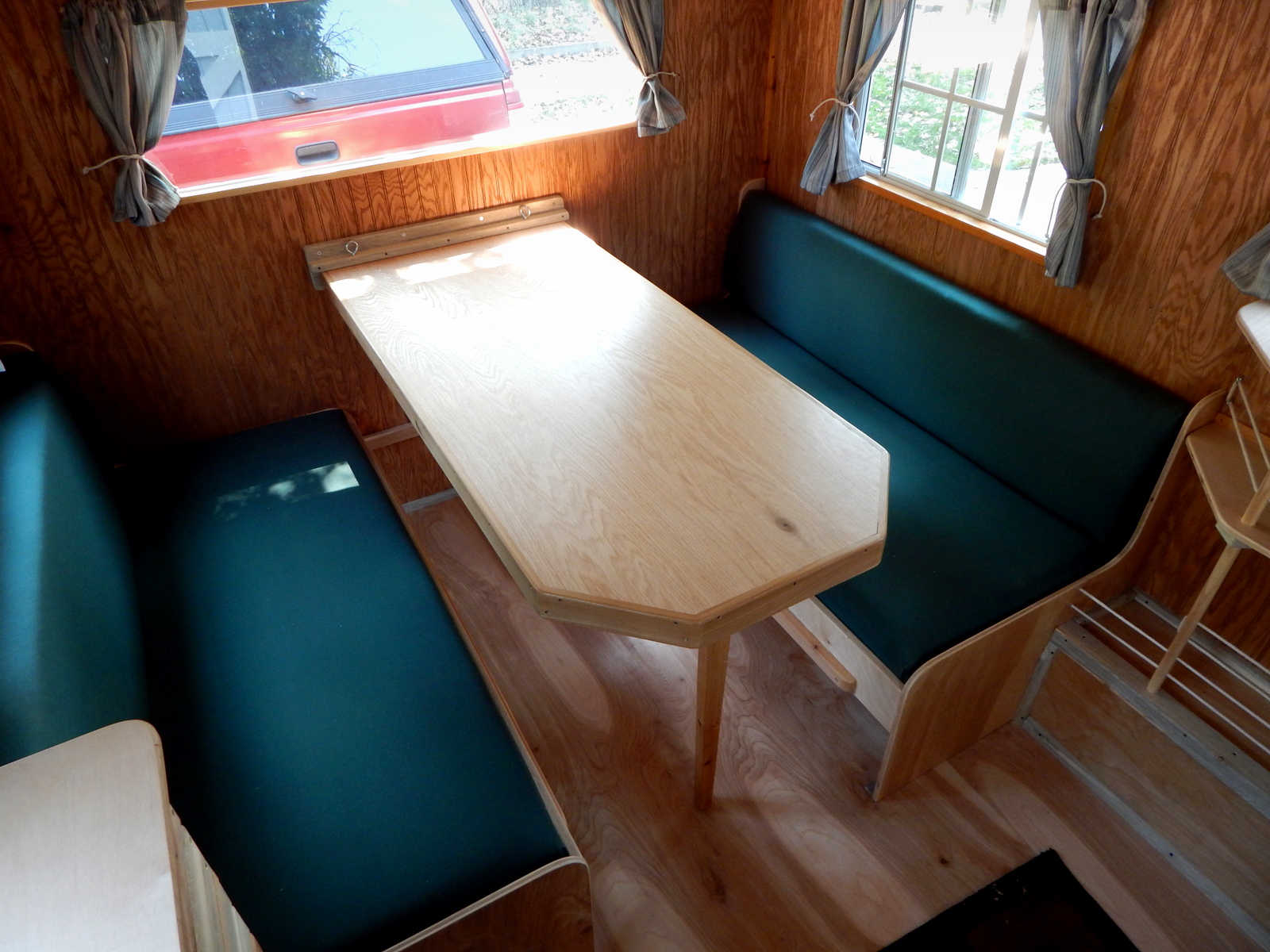
It’s a simple cabin design with a convertible table top bed setup that looks like it will work great for one or two people and answers all the basic needs of shelter on the go.
I heard from Peter (the owner and builder of Casual Turtle) last week and I think he can describe it best:
“Hey George-I thought I’d pass along a few shots of a recent build. This one was for a gentleman here in Colorado – the model I call the Terrapin. We went with a pretty full interior arrangement on this one. He opted for no painted surfaces (which I usually do), so we incorporated several different species on the cabin’s interior – oak, birch, cedar, and beetle-killed ponderosa pine – so it wasn’t a one-tone wood overload. It weighed in at 1,300 lbs, max headroom around 5’9″, and it goes down the highway just great.”
It’s compact, lightweight, and is filled with windows to enjoy the great outdoors in any weather. It would be great to see this after the new owner settles in, decorates it to his personal taste, and gives it a “lived-in” look after a few thousand miles.
“Casual Turtle Campers was founded on the belief that wood is good, small can be comfortable, and that there is still room for simplicity in this increasingly complex world. “
I enjoy the simplicity of this design. It reminds me a bit of the “canned ham” campers of the 1950s and is not overly complicated by cabinetry and appliances. The wood exterior fits in with the natural world in a way that shiny, white aluminum could never do, making it seem more at home in the woods than in the RV park. This would make a perfect base camp for hunting, fishing, or just gazing at the mountains.
Here’s a little about Peter and his company from his web page:
“The idea for Casual Turtle Campers was conceived by Peter Pavlowich in the summer of 2010. On a road trip to Colorado, he noticed an abundance of truck campers but a profound lack of variety or style. As a Wood Construction and Design graduate from the University of Idaho, he believed he could design and build a simple and attractive alternative to the big, heavy, white boxes that he seemed to see everywhere. Over the next few years, Peter slowly and methodically brought together ideas and drew up plans for what would eventually become the designs for Casual Turtle Campers.
He very happily lives in Fort Collins, Colorado with his wife, Lindsey, and their dog/shop foreman, Moxie. We love when people stop by – just get in touch!”
Have a look at this and his other work by clicking the link below. Tell him I sent you! It’s not really worth anything but tell him anyway. GTC.
“I had to go alone…a kind of casual turtle carrying his house on his back.” -John Steinbeck, from Travels With Charley.
“ Without Wodehouse I am not sure that I would be a tenth of what I am today — whatever that may be. In my teenage years, his writings awoke me to the possibilities of language. His rhythms, tropes, tricks and mannerisms are deep within me.
But more than that, he taught me something about good nature. It is enough to be benign, to be gentle, to be funny, to be kind.”
Talk about an image hook for an instrument building post! Le violon d’Ingres, Man Ray 1924.
As if I didn’t have enough irons in the fire…
I decided to make (and learn) a new instrument this summer; a three-string cigar box guitar. It took a few weekends to get it right; figure out the design, apply a finish, and re-work a few details in the setup before I was pleased with the action, feel, and sound. It’s fretless so I am also learning a lot about the slide as well. It’s got a great, bluesy sound and maybe I’ll post a few riffs when I’m feeling up to snuff.
My first CBG, but certainly not the last.
There are plenty of web and print resources for making a Cigar Box Guitar (CBG) so I leave the detailed instructional stuff to the pros. However, Cigar Box Nation is a great starting place if you are interested in homemade musical instruments and I’d suggest starting there if you have no other experience. You can even buy an inexpensive kit if you don’t know where to start but, in the spirit of the cigar box instrument movement, I decided to wing it for the first one. I did however, have to find a cigar box so I picked up one from C.B. Gitty for a very reasonable price. While there, I bought some parts for some other instruments in the planning stages and some very affordable strings to boot.
So how do you make a Cigar Box Guitar?
What follows is my brief overview of making a CBG from mostly found materials. As a side note, you are certainly not limited to cigar boxes for a resonator. A quick look around the internet will reveal some fairly ingenious sound boxes from oil cans, wine boxes, and gourds. I was tempted to save the few dollars and just knock up a box myself but decided that for my first specimen I would stick to the traditional model.
So what do you need to make a functional guitar?
There are essentially only three parts to this ancient style instrument; the neck, the resonator, and the strings. Yes, it’s a little more complicated than that but looking at the essentials helps simplify the construction.
The junk pile. A piece of oak was found suitable.
Neck
The neck is any straight piece of hardwood about 35 inches (100 cm) long, about 1.5 inches (3.8 cm) wide, and approximately 3/4 inch (2 cm) thick. Mine was made from a less-than-perfect recycled oak scrap out of my wood pile. While strings can actually be harvested from the steel radials in tires, these make for some pretty limited and primitive sounds. I just used a set of guitar strings I had around for the setup and strung it properly when complete with a set of open G tuning strings from C.B. Gitty.
Resonator
The resonator in this case is a wooden cigar box. Depending on how you decide to put it all together, the cigar boxes may need to be reinforced and modified to hold the neck. They are only intended to hold cigars so the pieces may need glued tight to avoid rattles.
Strings
The string assembly needs a few things to keep them under tension and control their length (for tuning). Starting from the bottom of the instrument you will need something to firmly attach the strings to; tacks, screws, or some sort of tail piece. I had a very cool hinge without anything to do so I used it. The screw holes are just small enough to hold the ball ends of standard guitar strings. Next, you will need a bridge. This is simply a bar with grooves to hold the strings in place at an even spacing. This should be something dense like bone, very hard wood, or even a screw laid on it’s side. At the far end of the neck the strings will need to pass over a nut which is essentially another bridge at the other end. Finally, the strings attached to some sort of tuning peg or geared machine to change tension (and tone).
Put it Together
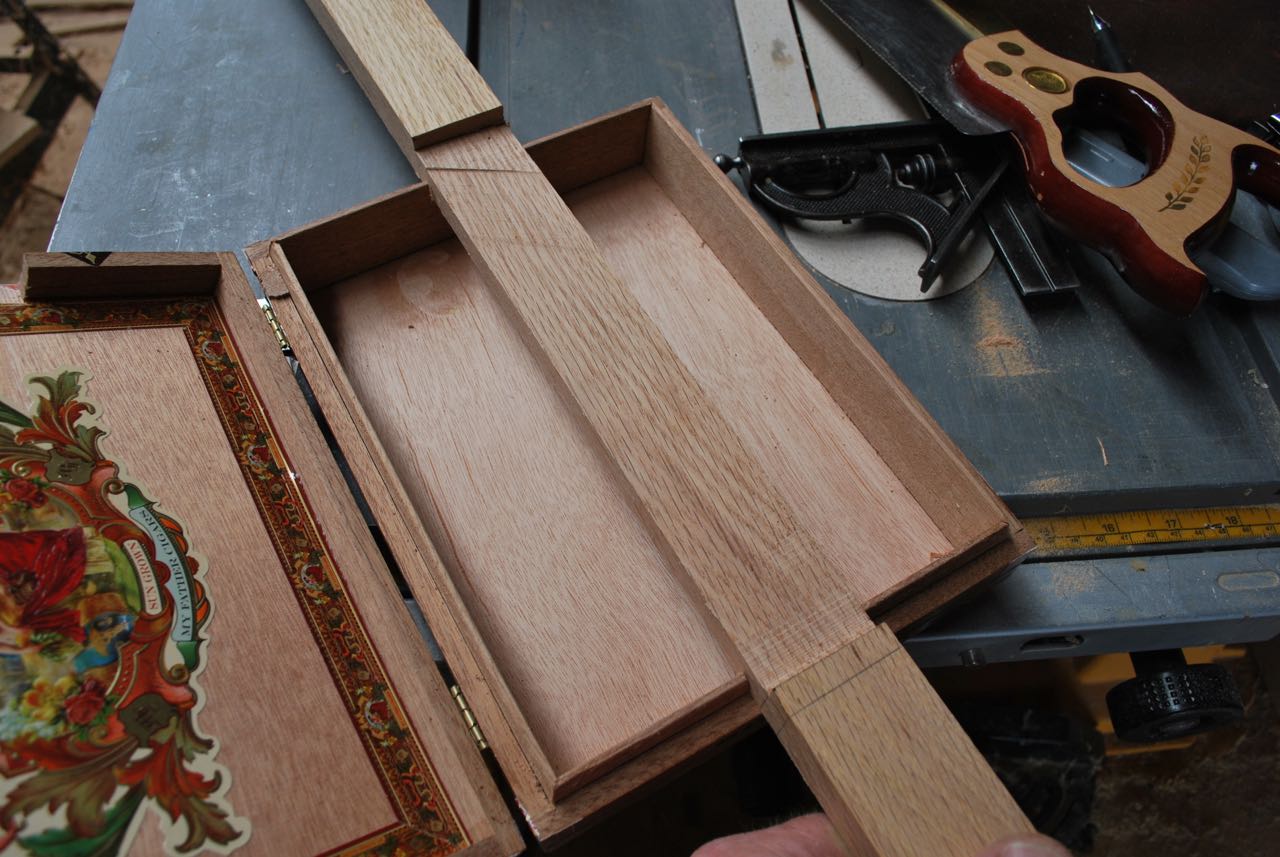
Here is the construction in a nutshell. Cut out the neck and peg head shape. If the neck passes through the body of the box (as opposed to laying over the top) it should be dished out where it would touch the top. The notches are where is will join with the box.
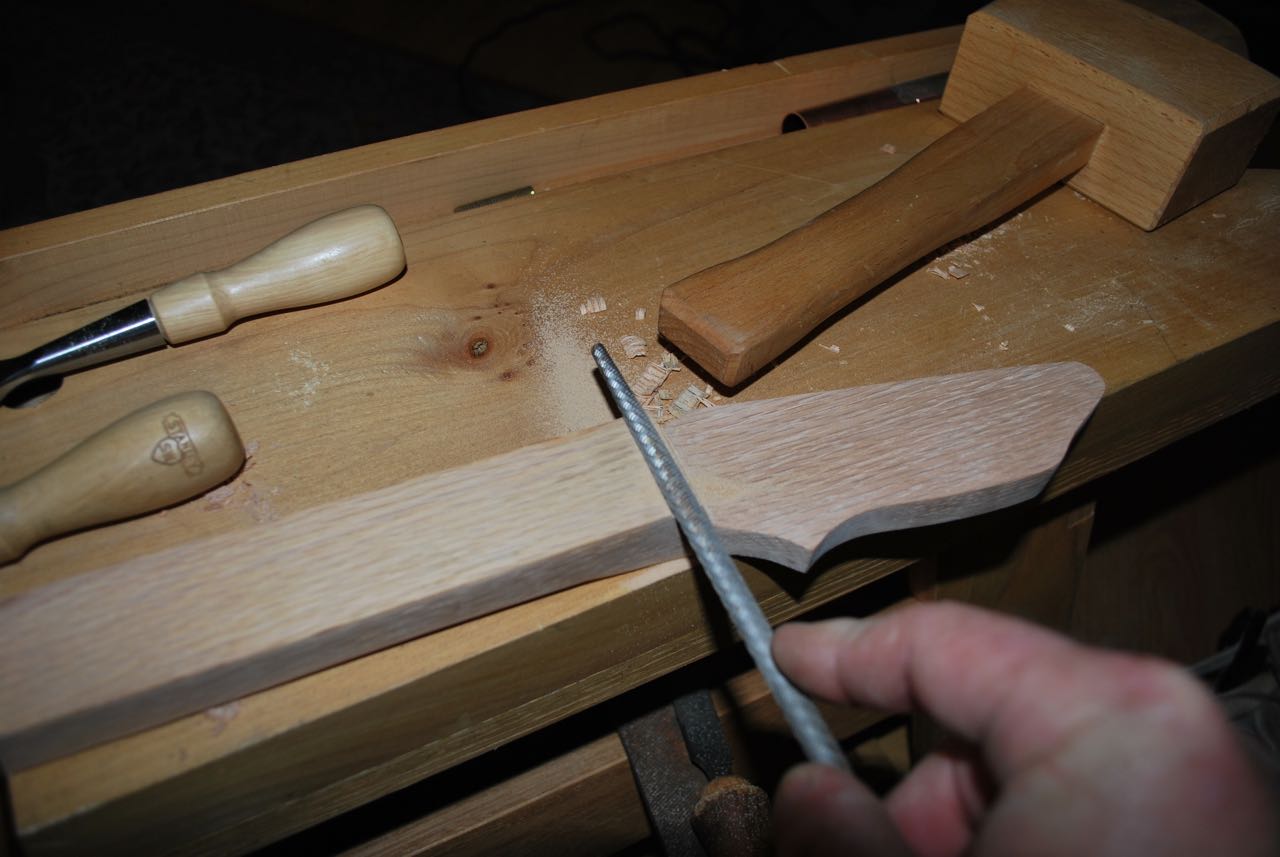
A groove was cut with a rasp to hole the 1/4″ bolt that serves as nut.
Cut this notch deeper than 1/8″ so the action won’t be too high.
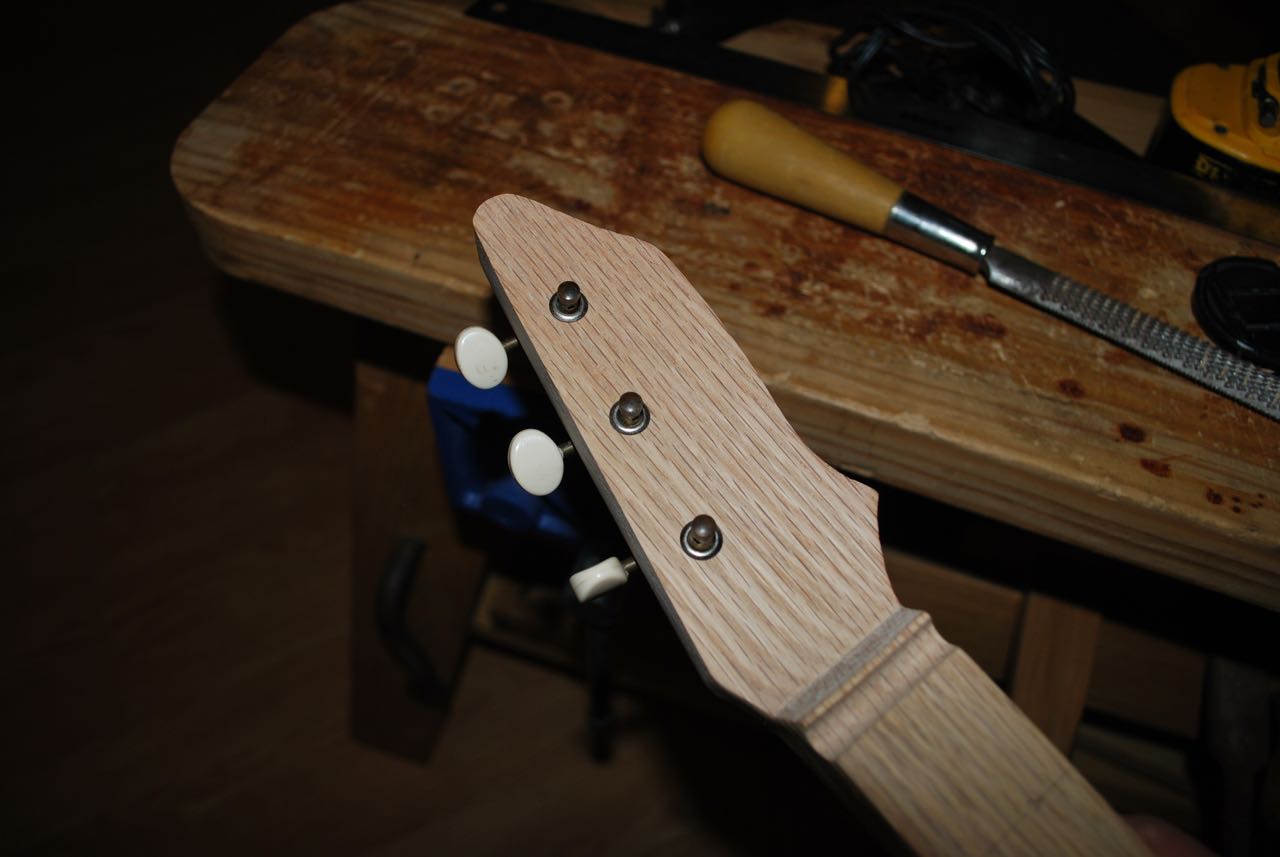
The peg head can either be set back as above or angled back like a traditional guitar. This allows the strings to be pulled down over the nut. As this left the peg head a bit thin for my taste I laminated a piece of hickory on the back for strength.
Drill holes for the machine tuners. Mine were recycled from an old Harmony guitar (a garage sale gimme) and served perfectly.
Here you can begin to see the carving of the neck. I rounded mine fairly traditionally but this is up to the maker/player. The rest of the shaping will wait until the neck is fit to the resonator.Once the neck location was determined, an appropriate corresponding notch was created in the box.
Test fitting the neck. You can see the wasted area that was removed to make sure there was no interference with the sound board (the box top).
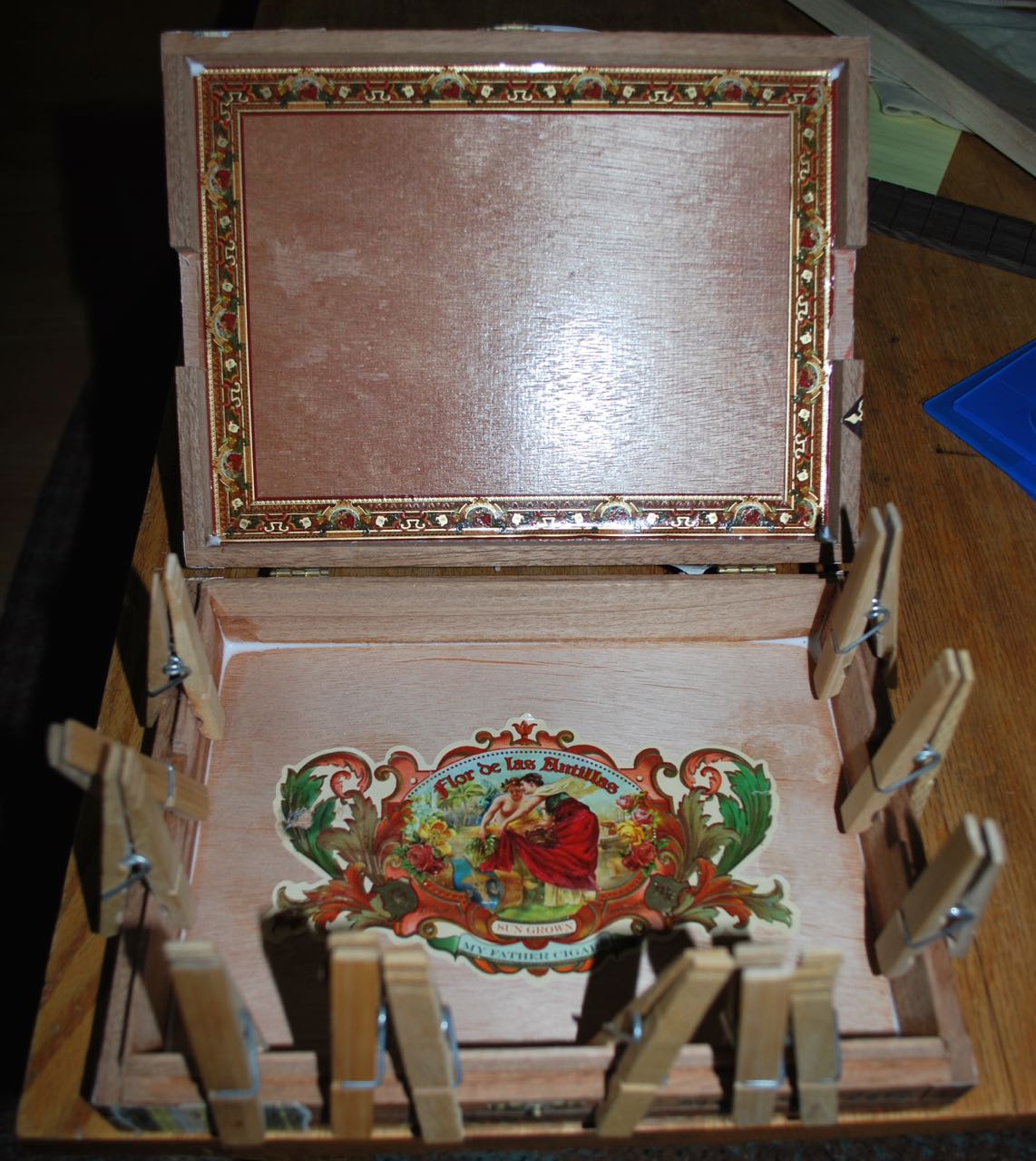
The box wasn’t too sturdy and had a bit of a rattle upon “tap testing.” All joints were glued up for strength. Note I moved the interior lid sticker to the inside back where it can be seen through the sound holes.
The resonator is dry fitted into place. After this, it was just a matter of removing the leftover bit of neck, glue the box in place, glue the lid shut, and attach the hinge that serves as tail piece.
This nifty hinge served perfectly and suited my mental need for brass or bronze fittings where possible. I didn’t like my first experiments with a bolt for a bridge so I whittled a simple one from a scrap of ebony. I played it “in the white” and made the few adjustments necessary before finishing up.
Fret positions were measured out and marked with a wood burner.
With a parallel-sided neck this is a simple process.
Piloting for screws with a gimlet.
Attaching the tuning machines permanently.
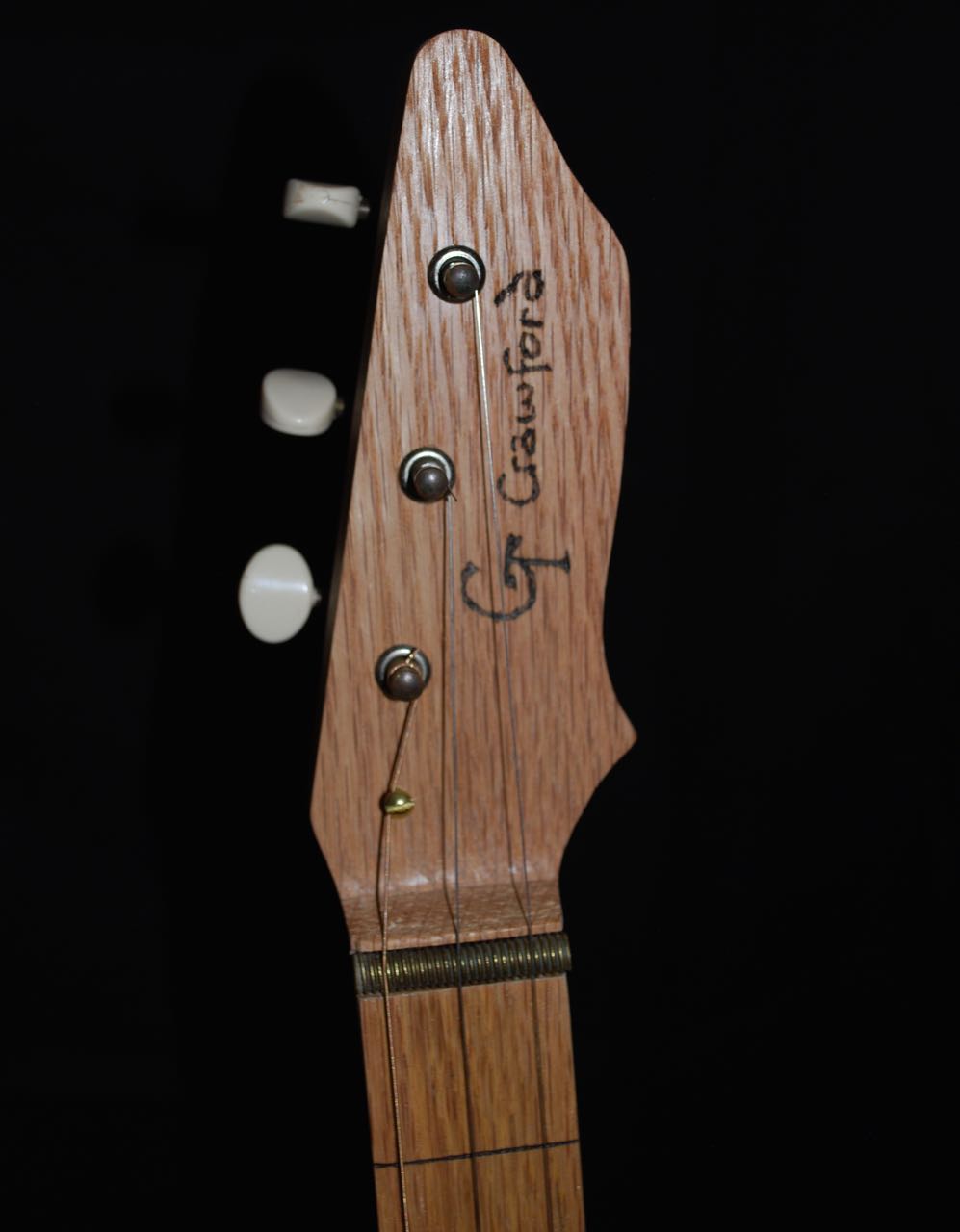
The rusty old machine tuners cleaned up well and suit it perfectly.The head stock is reinforced with a slab of hickory as a bit of insurance.Fancy brass nut was cut from a toilet tank bolt.
A few coats of tung oil later, and she’s up and playing. I’ll update this as I get familiar with my new toy. YouTube is full of instructional videos about playing a three and four string guitar. Mine works well in an open G tuning. Very bluesy and surprisingly bright and clear.
Looking at my junk craft piles around the house I believe I easily have the makings for three or four more. My next one is already rattling around my head and I think it will be fretted for added versatility.
I cannot even express how much this speaks to me. I have been reprimanded for not being willing to make extensive working drawings of furniture for a lazy half-wit on more than one occasion. My Vardo building pages have been attacked by the entitled internet Anons for not being able to state in exact measures how many fasteners will need to be purchased to build their own project. I was loudly scolded for not making an exact dimensional cutting list for the thousands pf pieces that make up the project, and so on and on and on.
“Close your mouth, open your mind, get off your ass and put a little effort into life. You will be amazed at what you can accomplish” says it all.
In the past few days there has been a, lets call it lively, discussion over on Paul Sellers’ Woodworking Masterclasses forum. Generally speaking, the entire thing centered on two complaints voiced by a single member.
The first complaint was that the when and why of which joinery to employ was not being directly addressed. The second complaint was that the woodworking instruction was not directly addressing how to design a piece of furniture. While these issues are technically correct, all of the information is there in Mr. Sellers’ videos and blogs for those willing to observe, think and extrapolate for themselves.
For some reason society in general has shifted to an absolute literal way of thinking. Every step and element of a process must be spelled out in order for people to understand and perform that process. Here is an example from my workplace:
“What are ears? What is Time? that this particular series of sounds called a strain of music, … can be wafted down through the centuries from Homer to me, and he have been conversant with that same aerial and mysterious charm which now so tingles my ears? What a fine communication from age to age, of the fairest and noblest of thoughts, the aspirations of ancient men, even such as were never communicated by speech!” Henry David Thoreau.
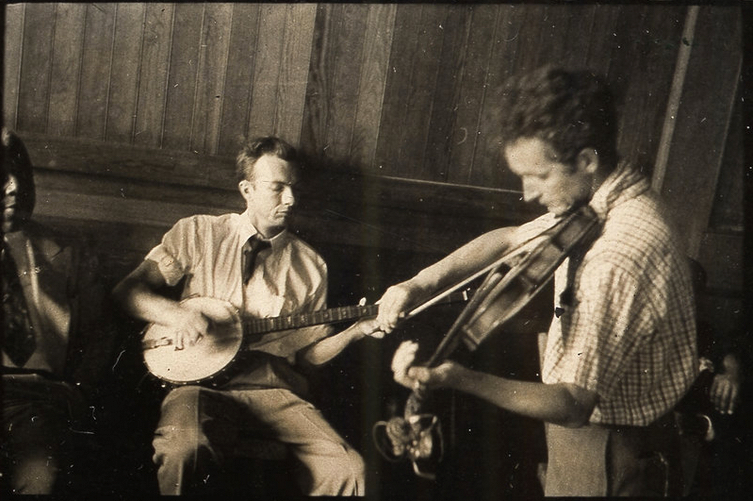
One of Woody Guthrie’s final performances before the onset of Huntington’s Chorea. Back to his fiddling roots. Photographs by Leonard Rosenberg.






















 Preindustrial Craftsmanship