I just found this guy on Tumblr and hope to see more great updates from him in the near future. Maybe we’ll caravan together somewhere down the road.
From his blog:
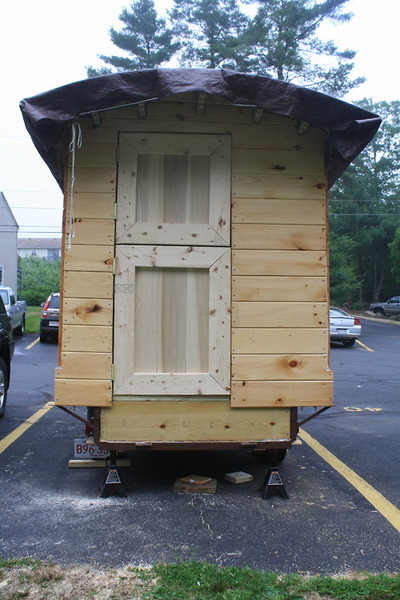
“Cappy’s Caravan will have 120 and 12v power like a traditional RV with a hybrid RV distribution Panel. Because I Plan on taking this off-grid I will also be Equipping it with a large battery storage with multiple deep cycle batteries serried together. Ideally CC will have 400 watts solar to help charge the batteries off grid.”
Classis Dutch door, curved roof, ledge style wagon. I hope it works out well for him.
Sounds like he had a real deadline and I sympathize with his lack of indoor workshop. He started in an apartment. Have a look at his Tumblr Blog here.
Life Tools & Accessories – 33 items, including my car, guitar, books, hairbrush, toothbrush, etc.
Consumables – 5 groups of items, including food, cleaning supplies, hygiene supplies, office supplies and paper goods
Kitchen Items – 19 items, including pots, pans, utensils, coffeemaker, toaster, oven mitt, etc.
Bathroom Items – 6 items, including my bathroom scale, rugs, trash can, shower caddy, etc.
Electronics – 10 items, including my BlackBerry, MacBook, Printer, iPod, etc.
Furniture – 18 items, including my bed, couch, coffee table, desk, chairs, etc.
Decorations – 14 items, including decorative plants, artwork, digital picture frames, wall clock, etc.
Clothes (Miscellaneous) – 58 items, including shoes, socks, underwear, belts, gym shorts, coats, etc.
Casual Clothes – 79 items, including jeans, hoodies, T-shirts, button-down shirts, etc.
Dress Clothes – 50 items, including suits, ties, dress shirts, etc.
“That’s everything I own. 288 things. Count them if you’d like. The nicest thing about creating this list is that I actually use everything I own. There is not a kitchen item or a piece of furniture or an article of clothing that I do not use regularly. It’s an amazing feeling.” Click here to read the full text of his excellent essay.
Next time: my move toward Minimalism and the search for balance.
More Historic Minimalists – religious wanderers from the East
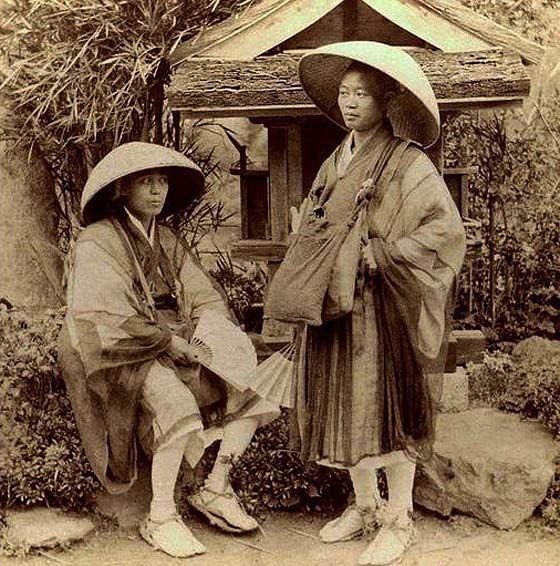
Wandering Monks part 1 – The Buddhist monks that travel much of the year throughout Asia are about as minimalist as one can reasonably get. Early Buddhist monks were instructed to own, as based on the Pali Canon, a very simple set of eight items. Things have, of course, changed over time and religious wanderers have changed with it.
outer robe
inner robe
thick double robe for winter
alms bowl for gathering food and eating
razor for shaving
needle and thread for repairs
belt
water strainer for removing impurities from drinking water
Everything thing else was communal or gifted to them, including food.
Wandering Buddhist Monks part 2 – Things have changes in the past 2,500 years and the natural hardships of a traveler’s life warranted a few additions to an allowable kit of possessions. A revised and more modernized version adds a few more necessities (not everyone is up to the task of living in real poverty or misery; also, the communities of non-mendicants have some expectations about cleanliness, etc.). So in addition to the above eight possessions, the monks carry:
Bowl
Three robes, inner, outer, and warm
Bathing cloth
Umbrella, some sects mention a small tent as well
Mosquito net
Kettle for water
Water filter
Razor
Sandals
Small candles
Candle lantern
It should be remembered, these monks were part of a Sangha (intentional community of Buddhists) so there were communal objects for the rainy season when they weren’t traveling and there is a long tradition of charity towards holy men that we no longer practice in the West (other than tax exemption for churches and the National Football League).
Wandering Buddhist Monks part 3 – Of course, the world changes and the esoteric lifestyle adapts with it. Modern Buddhist mendicant monks might carry a few extra things in order to live reasonably within the modern world. This becomes a very realistic list for the modern traveler. Over many centuries, it became apparent that being acceptable and able to fit into society in general was an important thing. Good appearance, cleanliness, and preparedness helps one not be a burden on the community. I understand the need to fit-in and remain incognito when appropriate. After all, isn’t that what our daily costumes achieve?
Later realists again modified the kit of the wandering Buddhist mendicants in eighttypes of personal utensils or belongings (adapted, in part from RAHU website, Singapore). There are a total of 8 necessary requisites of the Buddhist monk garments and utensils. I big part of the teachings of the Buddha are concerned with an intentional, non-harmful, and simple life.
Mantle Robe – Traditionally made by the acolyte himself, but may also be a gift.
Sarong (Sabong) – This is a simple, unadorned under garment and is worn 24 hours a day.
Cotton Belt or Girdle
Shoulder Scarf – It is a long thick brownish-yellow scarf and regarded as a monk’s multipurpose cloth and is generally large enough to use as a blanket in winter. During a long trip or visit, this thick Sangkati can be folded and used as a cushion.
Black Alms Bowl with Lid
Razor
Needle and Thread
Water-strainer
In addition the initial eight things, some items have been added, not just for survival, but for the comfort and convenience as monks might find themselves as guests in a temple, in major cities, suburban settings, or the wilderness.
Three amenities are added for convenience: undershirt, a small bathing loincloth for modesty, and a bath towel. One cannot be filthy in a tight, modern setting.
Bedding – Still considered luxury items for the monk: grass mat, pillow, blanket, mosquito net, and a cushion for sitting.
Necessities for the traveler: hand bag (for carrying all this stuff), handkerchief, knitted hat, palm leaf fan, umbrella (for sun as much as rain), and sandals.
Eating utensils: Dish, Bowl, Spoon & Fork, Hand Towel, A set of Food Trays containing plates and bowls, Tiffin Carrier.
Hygiene and cooking – Drinking water must be cleansed of dirt and germs. This is critical for good health. Water is the only thing a monk can freely ask for or take as needed. In that vein, several other tools are allowed and encouraged: stove, pot for boiling water, mug for hot water/tea, water glass, water jug/bottle, tea kettle, Thermos bottle for ice or hot water as needed.
Toiletries – Buddhist monks should be clean and have pleasant personalities. They need some necessary objects, the same as other people water container, soap, soap container, tooth brush, tooth paste, body towel, tissues, spittoon, medicinals.
Domestic Objects: These items should be available to help monks in case of emergency. lantern or electric lamp, flash light, alarm clock or watch.
The latter list is a very complete list of real essentials. Having a codified list to pack from can be comforting, just like the lists the Boy Scouts still make for High Adventure programs. Looking at a little knowledge gained by our predecessors goes a long way.
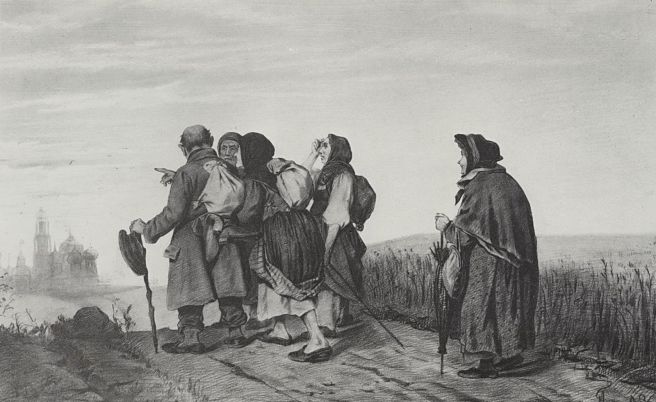
Pilgrims on Pilgrimage – Vasily Perov (1834-1882)
Why did I choose the Buddhists specifically for this example? Europeans have our own traditions, just without as much documentation. We’re a free-form lot. These folks certainly can sleep rough as need arose on a holy pilgrimage and don’t appear to be overburdened with stuff.
Matthew, Mark, and Luke all report that Jesus taught his disciples; “If you wish to be complete, go and sell your possessions and give to the poor, and you will have treasure in heaven”.
Some Historic Minimalists – tried and true formulas for survival
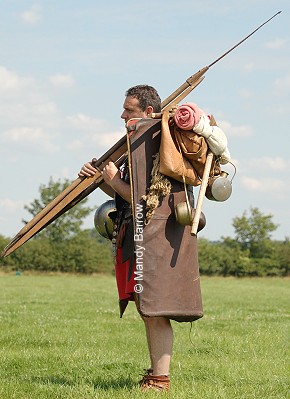
Roman Legionary – Let’s go back to the beginning of the modern military. As militaries go, Rome had a pretty successful run. After their first couple centuries being beaten up by the Celts they certainly learned a thing or two about fielding an army. More importantly, when wars were no longer fought to defend one’s home things had to change. Expansionist politics meant a paid, professional military (i.e., a mercenary army like we have today).
Without delving into a long history of the Roman military, here’s the pertinent synopsis for our purposes. In order to make the army fully mobile (not tied to a wagon or mule train and to rid itself of non-combatant lackeys), it was determined that the individual soldier should be responsible for more than just showing up, sword and shield in hand (for some historical references, see: Scipio Aemilianus Africanus and later, Marius’ reformations). In order to get rid of as much support staff as possible, and remove the competition in out-gearing each other, each soldier was issued (this was a new idea) a set of gear, including a full sarcina (marching pack) which included the essentials of daily living. The fact that they wrote about this and portrayed it in art gives us a pretty good idea of what equipment was used in the field.
Archaeological/historical side note: this, in-turn, led to the first systematic recycling program we know of; collecting the old stuff and remaking, re-tooling, and re-issuing gear. Metal is especially recyclable. Roman Loculus. Personal kit bag or haversack for a deployed soldier ca. 300 B.C. – 300 A.D. and beyond. A shoulder bag or haversack like this was the common unit for an individual traveler through the Middle Ages and into the modern Colonial Period. Essentially what we call a messenger bag today.
The sarcina (marching pack) of a Legionary soldier is about as pared down as one can get yet still travel in comfort:
Clothes –
Tunic: normally made of wool. The style changed over time, but essentially a longish, heavy shirt of wool.
Subucula: A simple thin wool t-shirt underneath the tunic.
Subligaria: underpants.
Focale: neck scarf, just like a cowboy or a boy scout neckerchief.
Balteus: sword belt. It’s implied that other belts with hooks were employed in large numbers to secure gear, just like today.
Basket – used for foraging, moving dirt for ramparts, and probably many other things.
Pole – (furca) with a cross staff to carry everything hobo-style. This could be used for a tent pole, stretcher half, or combined to construct larger structures.
I created the above list from several sources and it covers a period of about 5 1/2 centuries but the essentials don’t really change. This list of course, doesn’t include arms and armor or specialized things like saws, mattocks, hatchets, axes, etc. that were also carried. Various contemporaries state that soldiers carried between 3 and 14 days of food when on the march in a haversack.
Overall, this isn’t a bad list of essentials and looks a bit like my packing list for a camping trip. For a modern traveler, or someone looking to completely pare down their life, this might be a good starting point.
Curiously, there is no mention of a fire kit and they are rare archaeological finds in general. When I was in graduate school, I recall this being noted and it has been surmised that either (a) fire was everywhere in a settled continent and easy to come by if necessary, (b) coals were carried in the luggage and simply re-lit as needed, or (c) fire making was so common that it is not even worth mentioning in ancient texts or depictions.
Next time: Wandering monks of Asia…systematic, codified minimalism we can all learn from. On to Part 3.
Learning a thing or two from the past…Part 1, 21st century americans are not the first to minimalize.
How much stuff do we really need to lug through life?
This is a lengthy ramble. So long in fact, that I have broken it into several posts to be trickled out over the coming days, weeks, or months. Skip on to the fun stuff if you aren’t interested in Minimalist* philosophy. There’s a lot of recent talk about Minimalism as a social movement. Not long ago, it was associated with artists and aesthetes, wanderers, mystics, and philosophers. That is to say, the fringe element, outsiders, and weirdos. These things come in cycles and I think, as a backlash against generations of sell-out philosophy and the creation of a professional consumer class, many people are reaching for something new.
We come to learn that everything old is new again.
I’ve been looking into history and prehistory on a full-time basis for many decades now. As hard to believe as it may be, I even get paid a salary to do it. One of my professional interests involves tools, tool-kits, and strategies for surviving that various people have come up with for dealing with the world. As a primitive skills-survival instructor and full-time frugalist I think it important to not reinvent a lifeway when we have millennia of ancestors who dealt with most of the same issues we do today.
A San bushman demonstrating fire-making. Ostrich egg canteen in the foreground.
For most humans, for most of our history, owning too much stuff has never really been an issue. We had what we needed and either made what we needed or did without the things we didn’t have. It brings a smile to my face to know that more than 2,400 years ago, well-to-do people in China, India, and the Middle East were contemplating the nature and evils of acquiring Stuff; even writing about it. That’s not to say that I have immediate plans to become a wandering mendicant like a medieval friar (as appealing as that might sound to some) but I do have an interest in lightening my material load and some very specific goals for the coming year.
My foundation as a minimalist – I have been thinking about what stuff a person needs to survive since I was a teenager. Like virtually every young boy, I had grand ideas of escaping the family and traveling unhindered across the world. I devoured Jack London and Mark Twain stories as a kid. I loved the extensive and well-thought out gear lists provided in the Boy Scout Handbook, the Explorer’s Handbook, and the Philmont Guides. I read Larry Dean Olsen’s great book of Outdoor Survival Skills and Colin Fletcher’s The Complete Walker. I read about the mountain men of the fur trade, and always, took note of what they carried or didn’t seem to need. I would copy lists into a notebook and ponder them while sitting in some boring high school class, making my own lists of what I have, what I need, and what I want. This thinking encouraged me to work and save money to buy a better knife, backpack, or stove. I was probably the only kid I knew who wanted, and got, a file and whetstone for Christmas one year (my grandpa was good that way). My friends and I spent our teens and early twenties hiking and camping year round, mostly in the woods of the Ozarks in southern Missouri testing our mettle at that time in life time when all teenagers know they are invincible. Some of us even made it to Europe, Asia, Africa, and beyond.
In a modern sense of survivalist, many people look to the military or the loonies of teh mainstream media. Often, military service is the time when young men and women are introduced to such things for the first and only time. Realistically however, the military itself acknowledges it’s shortcomings on a personal basis as (with the exception of a few special operations units) its entire system is dependent on lengthy and complex supply lines, support chains, and de-emphasis of the individual and personal decision making. Military survival is therefore, approached as a means of keeping alive until help arrives. Great for fighting a war, but not always so good when you are turned loose into the world.
* here are a few links to modern Minimalists of various ilks and philosophical merit. A journey through these links will hint at the breadth and depth of people on different paths but moving in the same direction.
More great thoughts from Henry David Thoreau on simplifying.
“I do believe in simplicity. It is astonishing as well as sad, how many trivial affairs even the wisest thinks he must attend to in a day; how singular an affair he thinks he must omit. When the mathematician would solve a difficult problem, he first frees the equation of all incumbrances, and reduces it to its simplest terms. So simplify the problem of life, distinguish the necessary and the real. Probe the earth to see where your main roots run.”
— Henry David Thoreau to H.G.O. Blake, March 27th, 1848
For thousands of years, great minds have warned us against the acquisition of “Stuff”. The more stuff we have, the more we’re obsessed with newer, better, more interesting stuff. For about six or seven years now, I have been eliminating extraneous possessions; since before I had even heard of the Minimalist philosophy. Long ago, I realized that possession and the grasping for possessions is a serious root of much of the world’s evil. Greed drives our government. Greed drives the whole crazy idea of banking; not the idea of doing something good or worthwhile, or even making ourselves happy or free. Making money, buying junk, and paying to be entertained. This unholy trinity is the basis for most people’s lives and I don’t want to participate in that.
By most American’s standards, I own very little, but the next few months will see a serious change and a move toward absolute minimalism. I’m posting this here to maybe inspire a few others to think about their possessions, what holds you down, and what makes you happy. Every possession is an anchor.
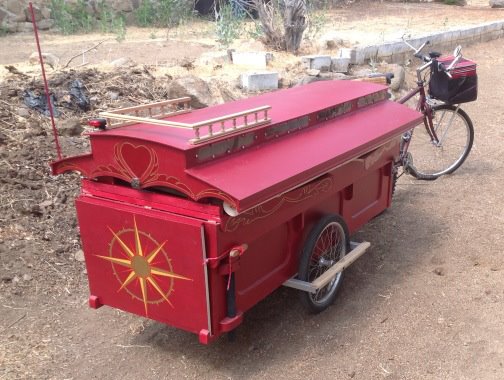
A very interesting vardo build by artist Barry Howard. He created a guest post on Tiny House Talk earlier this summer to discuss his ultra-light, fold-down, micro vardo to tow behind his bike. It provides about 12 square feet (1.1 square meters) which is about the minimum needed for an average size human or two to sleep. As an artist, he uses it for carrying art supplies, transporting his finished paintings, and as a bedroom. With a fold down table inside, it provides a place out of the weather and a table outside to cook on.
I’ll bet he gets even more gawkers than us gas powered travelers.
Note the standard mounted bottle opener. No self respecting vardo traveler is without one.
Great details in the paint, and even a stained glass window. I wish I had these skills myself.
I love the mini mollycroft. It gives it a very classy look.
Creating a folding box like this adds a real degree of difficulty, especially while keeping it lightweight. He seems to have manged it beautifully.
Folded, it presents a low profile for less wind resistance and a low center of gravity.
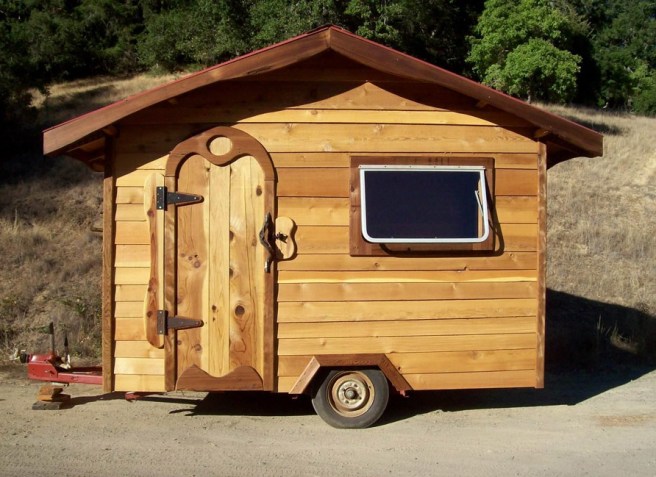
It appears to be made of upcycled parts and wood and is said to be made on a refurbished trailer. Found on Tiny House Swoon. It’s a kindred spirit for sure.
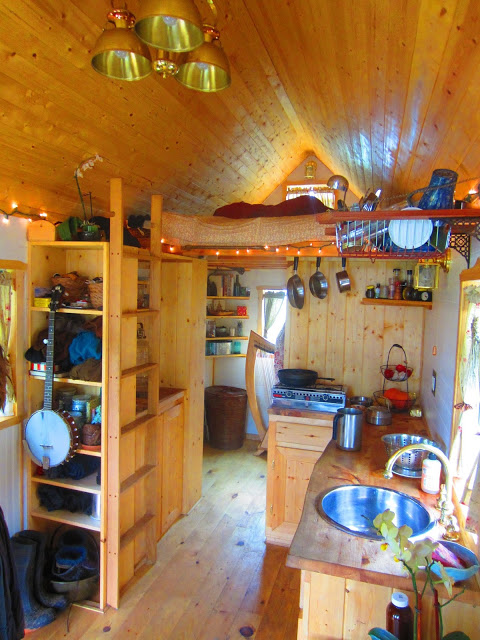
Deek has featured another fine home with some great photos. I particularly like this set as the house doesn’t appear to be “staged” but is actually lived in.
I can’t wait to see more as promised.
See the rest of the photos HERE or just cruise the rest of the Relaxshacks site if you have some serious time on your hands.

 From his blog:
 Sounds like he had a real deadline and I sympathize with his lack of indoor workshop. He started in an apartment. Have a look at his Tumblr Blog here.

 Roman Legionary – Let’s go back to the beginning of the modern military. As militaries go, Rome had a pretty successful run. After their first couple centuries being beaten up by the Celts they certainly learned a thing or two about fielding an army. More importantly, when wars were no longer fought to defend one’s home things had to change. Expansionist politics meant a paid, professional military (i.e., a mercenary army like we have today).





 Preindustrial Craftsmanship