A Quiver

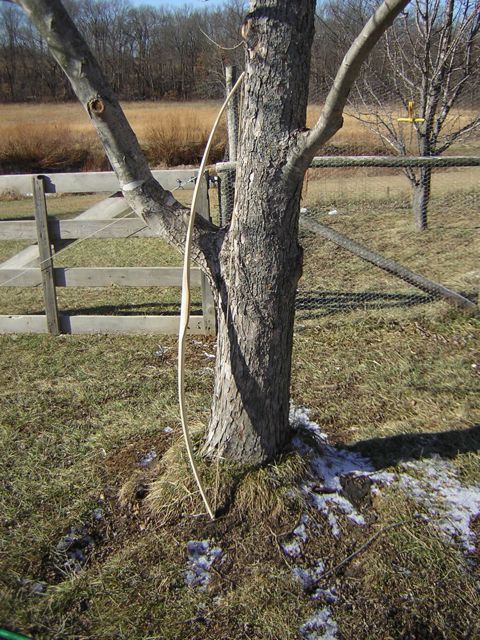
My new quiver.  Re-worked from one I made earlier in the winter but was just not quite right.  I like it a lot now.  It’s a little smaller, hangs either vertically (Medieval style) or from a shoulder strap which is removable.  Made from oak tanned leather and so far, just washed down with yellow saddle soap.

It’s a simple and not very interesting design really but suits me well.

Travel Shutters

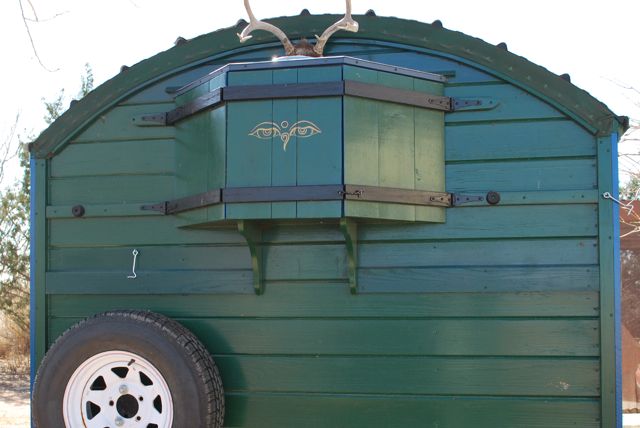
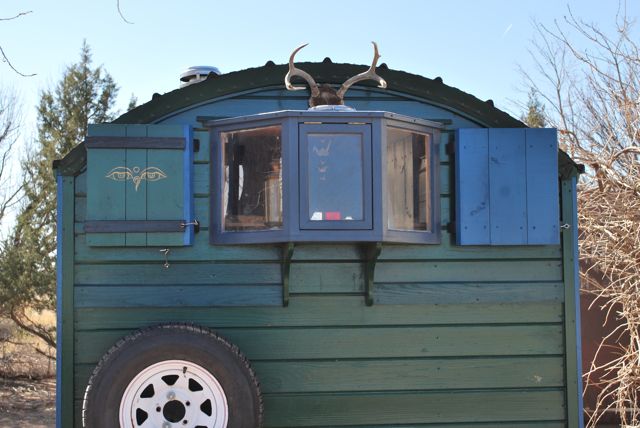
I wanted to put up photos of the travel shutters.  As the windows face forward, they take a real beating on the road.  After solving the issue of covering three sides, the construction was pretty simple.  Being small, I was able to knock these together from scraps around the barn.

Simple but effective. These should protect the windows from most flying debris.
Normal open position. There are rubber bumpers behind each to prevent the bumping sound in high winds.

Leatherworker’s Tool Tote

Updated: Last weekend I finally finished the leatherworker’s tool tote.  It took time to figure out what needed to be included and handy.  Since the leather straps are fairly specific to the tool they hold, it pays to get it right.  The original post is here: https://paleotool.wordpress.com/2011/10/26/tool-tote/

It may not look exciting but it is a great boon to have handy, easy to access tools.

A fun and useful project.

More Vardos

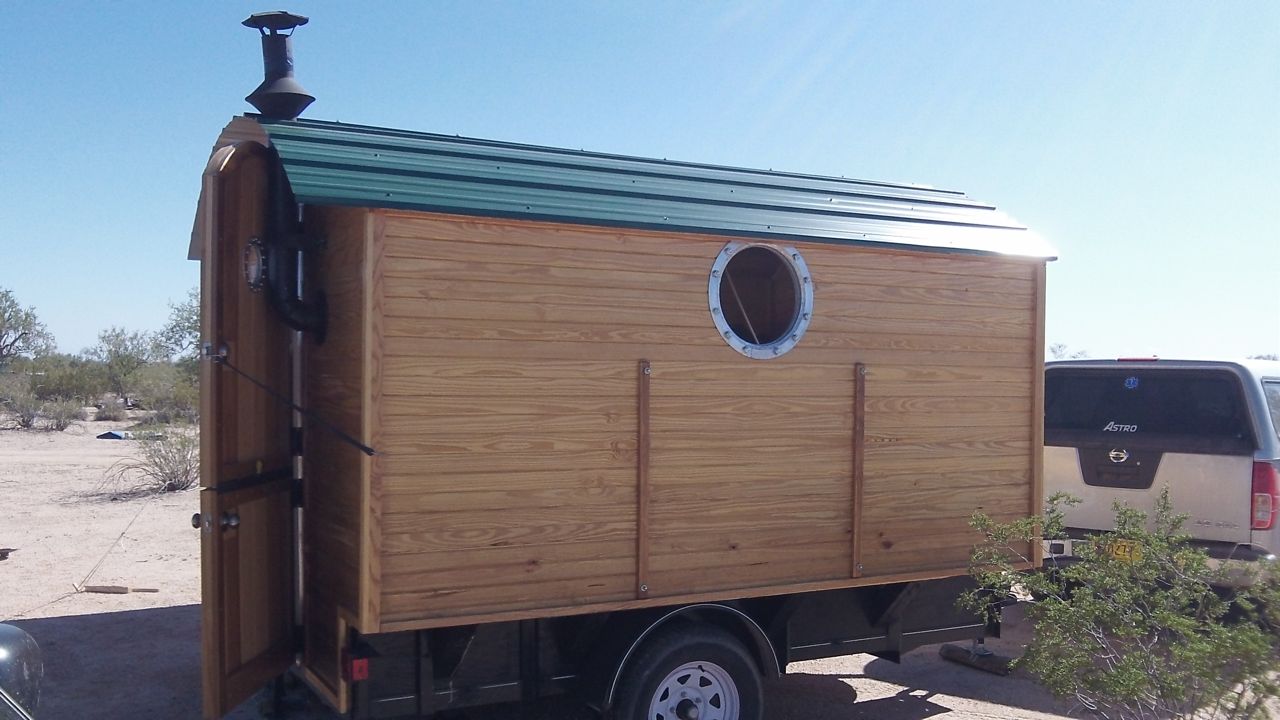
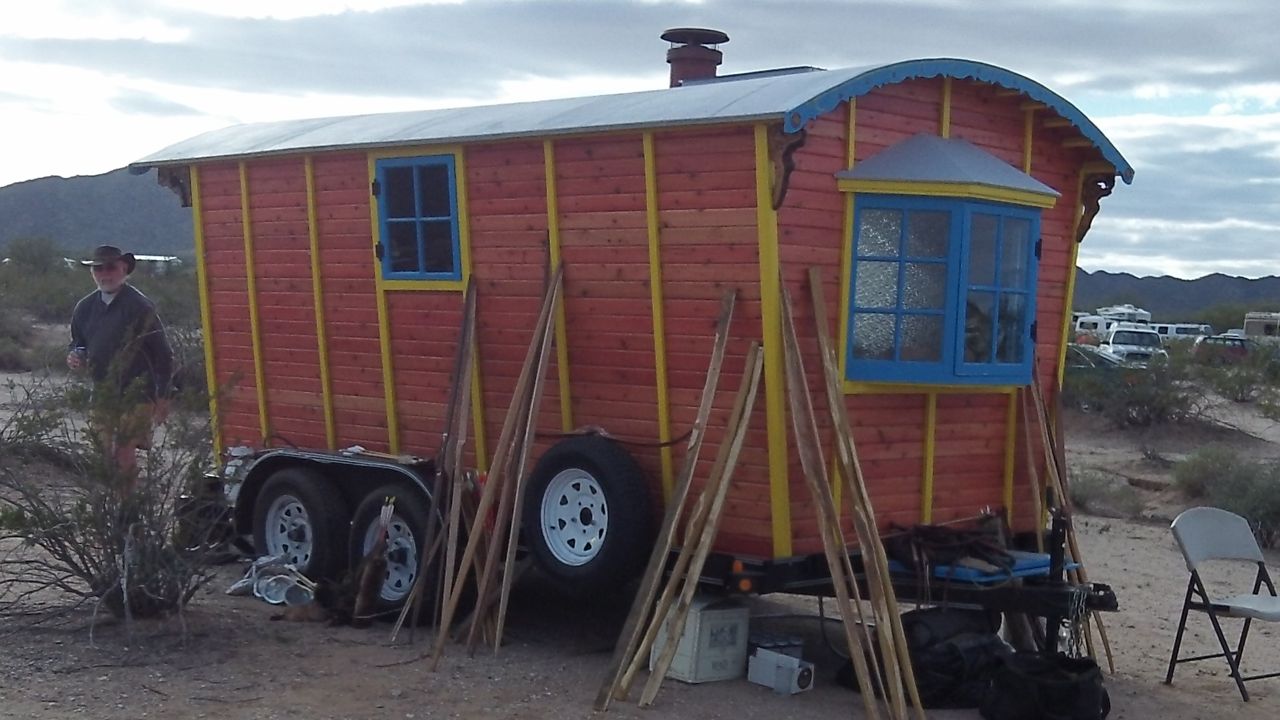
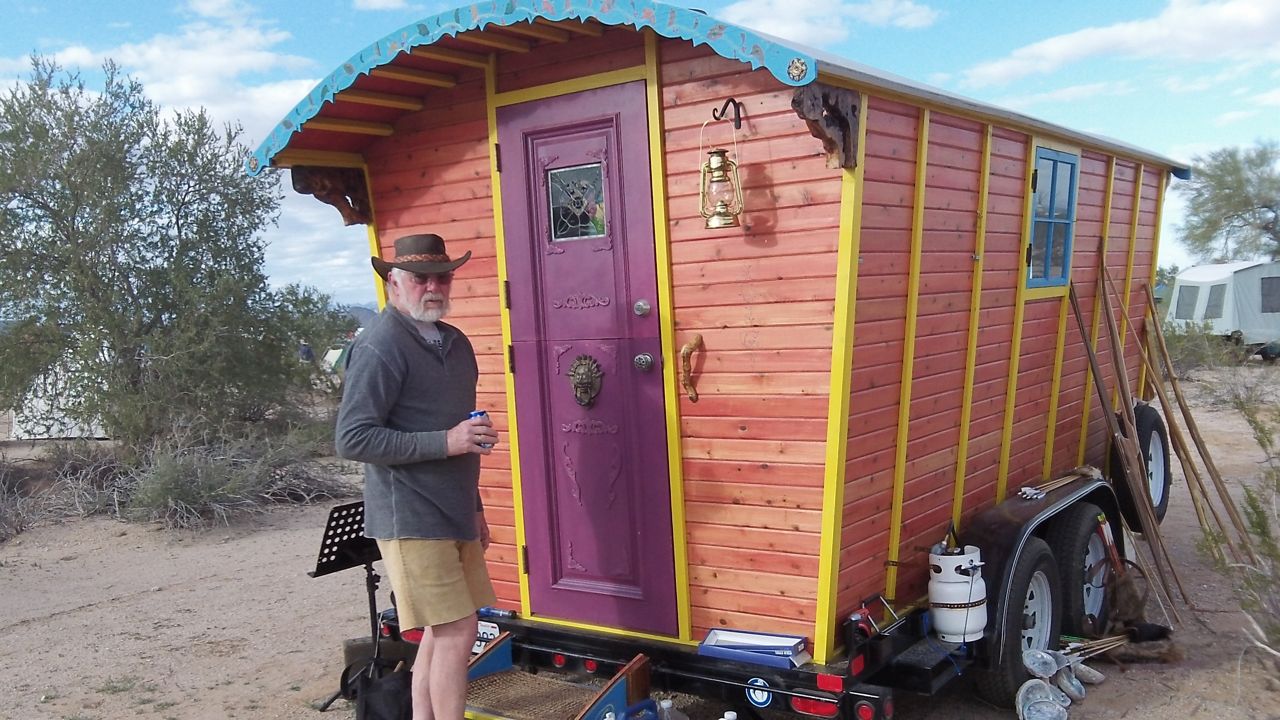
Here are a couple new Vardos found in the Arizona desert this February.

Jack’s wagon, nearly complete inside.  I helped him build the main structure in my driveway last summer and he has been trimming it out ever since.  It essentially the same design as mine (with a few logical improvements) and lengthened by two feet.

The portholes were purchased from a ship salvage company and add a cool nautical look.  This one is ten feet long (3 m) and feels very spacious inside.

Paul’s wagon is a beauty but I suspect weighs quite a bit.  The tandem trailer alone might outweigh my little rig.  This one is 14 feet (4.25 m) long and could host a small dance party inside.

The color scheme and interesting details really make this one stand out in the crowd.

Free food

Sitting on the couch late in the evening, drowsiness coming on when a nearby gunshot pierces the air.  The dogs go on alert and I am up on my feet.  Probably neighbor poachers, but I need to have a look around anyway.  My nearest neighbor is more than half mile away.  The road is several hundred yards from the house, so I don’t get a lot of extraneous noise.  Walking out onto the front porch I see the lights from three police cars lined up along the highway about 100 yards apart.  Spotlights and flashlights were scanning the area, both toward and away from me. Weird stuff happens and I seem to be a magnet for crazy so my first thought was some sort of manhunt.  Very awake now, I drive up the driveway toward the police.  It would normally be a walk but I didn’t think it wise to come out of the dark toward a bunch of cops in the grass.

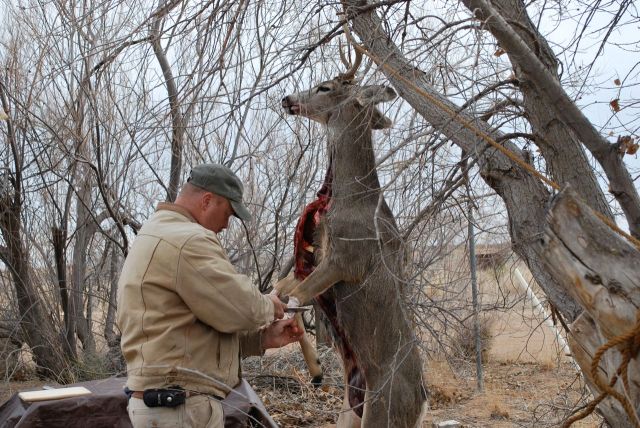
Luckily, I was completely wrong.  It turned out that two cars traveling in the same direction simultaneously hit two bucks crossing the highway.  The gunshot I heard was an injured buck being put down.  The spotlights and police were looking for other possible injured deer.  When I got to the road, one of the officers recognized me and said the magic words, “would you like one of these deer?”  The only right answer is “hell yes, let me get a knife.”  I was tired, it was late, but even a damaged deer is a gift of food.

I don’t like to butcher beat up meat.  And this was the first road kill I did on my own.  A cleanly killed animal is much easier to disassemble as you don’t have to work around bruising and broken bones.  That stuff is edible but not very good.  Survival food only for me.

However, dogs aren’t picky.  They like it nasty.  Good dog food is expensive so I decided to harvest as much meat that I couldn’t butcher cleanly into stew meat for the dogs.  They love me.

Click the image to see more of the processing.

Now the bad part was that I had to work my day job and the light is still a bit short this time of year.  I worked as I could, letting the carcass hang about 15 hours before butchering.  In the end, we maybe got 30 good pounds of human food including two beautiful tenderloins, a few small roasts, and a lot of stew meat.  As a bonus, the hide was in excellent condition and I was able to pull it off with only a few small cuts at the neck, legs, and tail.  Although not large, the antlers are beautiful so I sawed off the top of the skull to deal with them later.

I am of the school of thought that it is everyone’s right to make his or her best effort to feed themselves and family.  Due to many reasons, including the stupid human factor, this needs to be regulated in the modern world.  This makes it difficult to hunt, especially in places like New Mexico with less than easy hunting regulations.  After living on either home-grown cow or wild game for quite some time, the last few years have been a let down, having to buy commercial meat.  I’ve seen the feed lots and I don’t want to contribute to those companies any more.  Luckily, some free food came our way last week.

Hickory Bow part 2

The winds slowed, the killer dust settled and I was able to get back to the bow.  A few minutes with the power planer took the rough shape down to a nearly finished product.  The calipers are useful and can save a lot of guesswork when making the same style bow over and over.

Above, the bow seen in its near-final form.

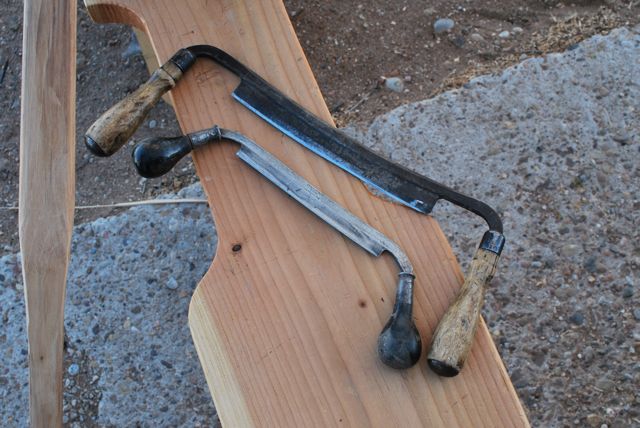
Despite the great labor savings that come from the power tools, wood is very organic and has character therefore need some finer, more controllable tools.  These are the two draw knives I use the most.

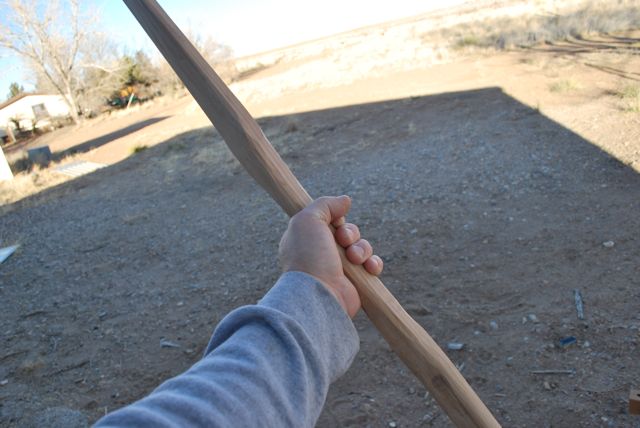
I took the limbs down til there was some little flexibility.  Probably in the 100 pound range but still too sketchy to put a string on.  As the day was drawing late I decided to rough out the grip and central riser area.  Surprisingly, this takes quite a bit of time as it needs to fit the hand well, and look pleasing.  It is difficult to get it “just right” in all dimensions as a tiny variance takes away from the symmetry of the piece.  This part is purely about looks.

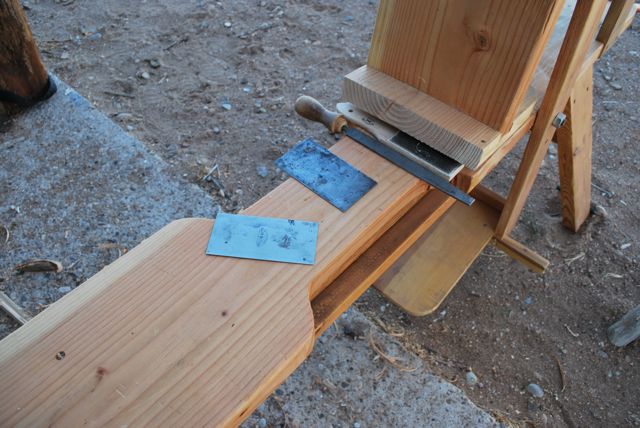
Once the knife work is done, its time to move to the cabinet scraper.  Here are the two I use.  To keep a good sharp edge I switch between the two as one dulls.  The larger one is a standard Stanley cabinet scraper and the smaller is a Garlick of England.  The English one is much harder steel but more difficult to get a good edge when sharpening.  With them are the bastard file and file brush used to touch up the edge.

I hope to find time for the finish tillering sometime this week.

Hickory Bow

The next hickory bow.  I have a barn full of aged staves languishing that need to be made into bows.  Today the weather was good and I had some free time so I jumped on the opportunity to get back into production.  Over the last three years I’ve only made about one bow per year as commissions.  That’s the result of abstract (albeit interesting) work cutting into an honest living.
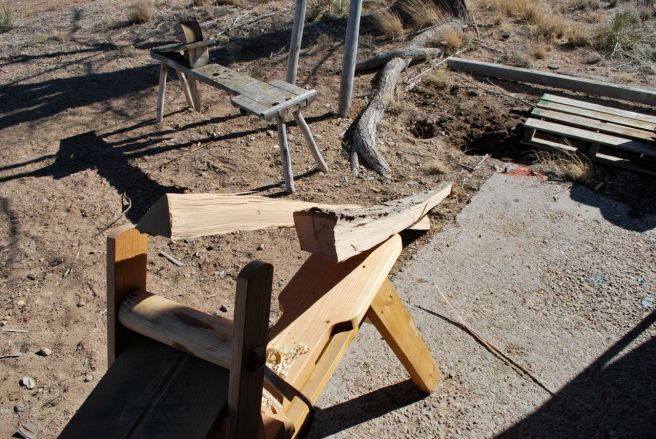
Above are a couple hickory staves cut from the old tree farm in Missouri.  This tree was as near perfect as possible so I intend to get bows from both inner and outer portions of the trunk.  The few bows made from this tree already are fine shooters so my hopes are high.

Although I will be using power tools for much of the roughing out, old-fashioned methods are at least as fast at this stage.  The froe is a handy tool that any green wood worker should have.

This stage is a bit of a break from tradition for me.  This bow is sort of a test in speed and efficiency as I don’t have a lot of leisure time in my week currently.  This stave was split from a larger piece and, as consequently there is some tear-out between growth rings.  The rough back is the cross-over between rings that will need to be smoothed to a single, perfect growth ring before finishing.  As it was very close to perfect, I skipped this normal step and began to roughly mark out some landmarks of the final bow such as the center of the bow, handle, limb width, etc.

The lath I use to mark a clear center line.  I have markings and distances marked for various length bows.  I find a flexible lath and a good eyeball to work better than a chalk line on the curved and undulating surface of rough wood.  This stave is an excellent teaching example as it has almost perfectly straight grain.  The sketch on the bow back is an idealized version of the finished product.  During the shaping process, knots, wavy grain, and twists are taken into account.

It is apparent here that the bow has progressed.  To speed the process, I sawed away much of the excess down to an approximate shape for the finished bow.  Final shaping a tillering commence.  Most of this will be done with a draw knife, spoke shave, scraper, and rasps.

This hickory has been air dried on the high plains of New Mexico for much of the last seven years (damn I’m old) and is extremely hard and dense.  Sharp tools are essential at this point for precision and control.

Lots of shavings like the one above will be generated tomorrow as I ran out of light today.

A note on the the bow itself.  The design is a classic flat bow with consistently tapered limbs.  Although, like many bowyers before me, I experimented and tried many designs over the years, I am returning to basics for the present and a design that has worked for thousands of years. More to follow tomorrow.

In the mean time, here are a few other more recent bows I’ve made.  Most of these are are probably posted around the site already.

Tiny Homes: Simple Shelter

I received an advance copy of Tiny Homes: Simple Shelter when I went to my post office box today.  I have been thumbing through it all all evening, looking at the photos and pondering the meaning of Shelter.

Maybe the tides of change are subtle in the beginning.  But I never thought I would be part of a movement when I began to sketch out plans for a tiny, mobile shelter for myself almost ten years ago.  I am honored to be included amongst these great constructions in Lloyd Khan’s newest book about Tiny Homes.  I am awed and inspired by so many great approaches to scaling back from the obnoxious sprawling but soulless houses of the last few decades.

The photos are beautiful and the layout is very well thought out.  Like all the Shelter Publications, it will become an important and classic work to those of us outside the mainstream.  Tiny Houses my be the flavor of the month to the media at the moment but will always be important to real people in need of real shelter.

And to keep up-to-date on interesting architecture, skateboarding, good music, and a host of other interesting topics, check in to Lloyd’s Blog from time-to-time.

Inspiring Plans, pt 1

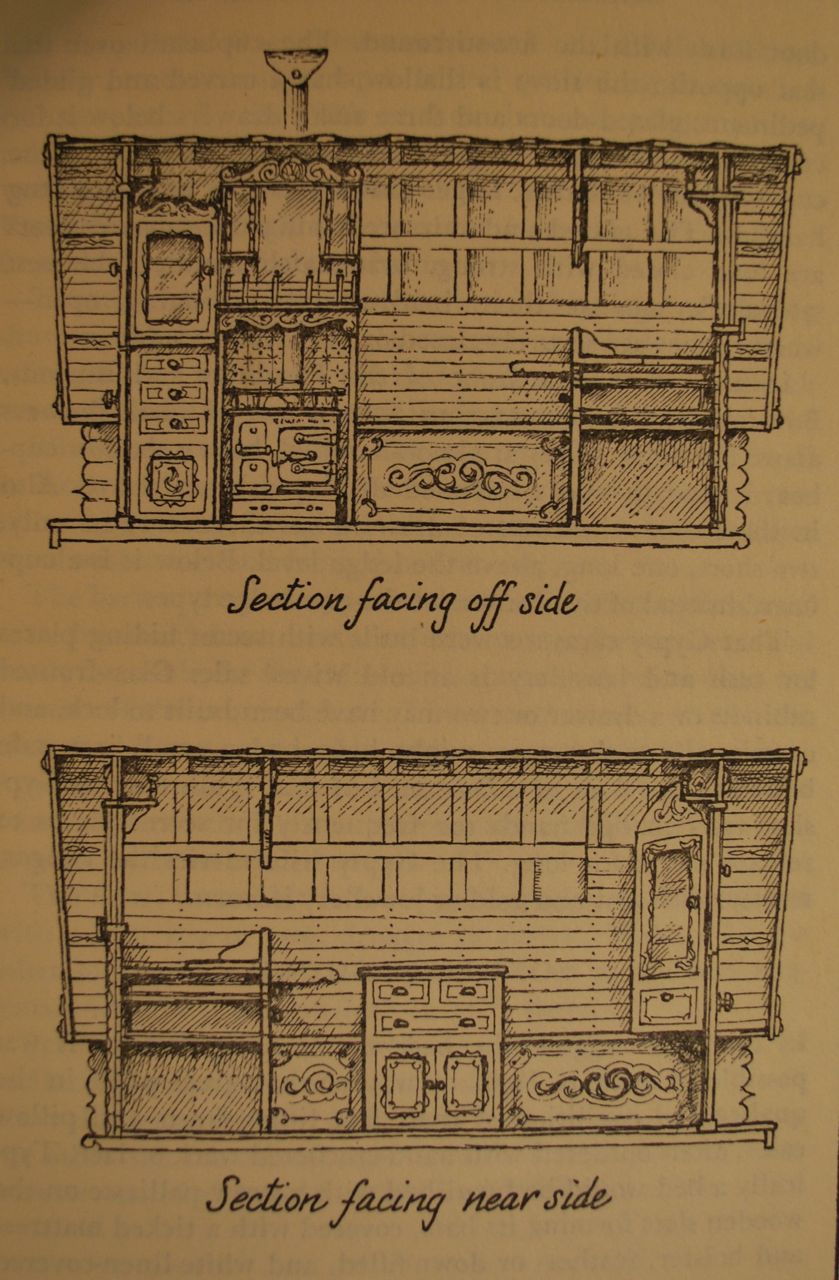
The following are plans from The English Gypsy Caravan.  This book taught me a lot about layout in such a small space.  There is rarely anything new under the sun and the early builders thought through the process quite thoroughly.

Figure 20.

The figure numbers on the images are from the book.  The above is a classic “Open Lot”.  Essentially the simplest of the caravan designs.  More sturdy than something like an American Conestoga as the walls are at least partially wood lined and there are a couple built-in cabinets.  This could suit a couple people fairly well.

Figure 18.

The “Bow Top” is a more sophisticated version of the Open Lot.  More cabinetry, a small cook stove, and some shelving.  Notice the corner cabinets to use the vertical space in both the above plans.

Figure 16.

Finally, the famous Reading Wagon.  This is what most people envision when they think of the gypsy caravan or wagon.  Kite-shaped from the end-view, this wagon has a lot of useful indoor space.  Cupboards and underseat storage are integrated and these generally have substantial chest-of-drawers built in.  The later roofs had mollycrofts to allow more light and the walls were decked out with mirrors to give the illusion of spaciousness.  Straight wooden walls lend themselves to hooks, pictures, or small shelves everywhere.  At about ten feet long, this was and is the epitome of traveling luxury.

The best laid plans …

Everything has to begin with a plan, whether its in your head or on paper depends on the complexity and steps required.  While going through some old notebooks from the last few years I came across some early sketches of the vardo in progress.

I know it’s not a great sketch and didn’t scan particularly well but gives an idea of an early stage in the evolution of the caravan as it is now.  I kept some very strict size constraints but definitely increased the height from the early incarnations.  I did not waste the time making an exact blueprint of the caravan as I didn’t see a need.  I also wanted to keep the design flexible and open to change along the way after getting a feel for the space.

Click the image to access more sketches or link here.