I’m a sucker for ancient monuments.

Adventures of an Imperfect Man In Search of a Handmade Life

I’m a sucker for ancient monuments.
Despite what many of us were taught while learning the trades of the cultural resource management world, archaeological imaging does not have to be dull, drab, or black-and-white.

Ken Williams’ photography, as seen on ShadowsandStone.com, highlights some amazing stoneworks of prehistoric western Europe with an eye for emphasizing the beauty, alignments, and surroundings of these structures in brilliant colors and contrast. He also highlights some photos of actual archaeological work in progress and this interest my cartographic side greatly.
 They are performing a 360° scan, collecting about 500,000 data points per second.

Also, check out his blog here: http://blog.shadowsandstone.com/
I am very interested in the European Upper Paleolithic. There are many amazing artifacts of antler and bone known from good archaeological contexts. Having lugged a load of antler and bones around over the last several years, it seemed to be time to make some new goodies. I went through a phase 15-20 years ago cutting and shaping using only purely traditional means, so I know it can be a long, slow process. For these tools I used steel saws, files, and sandpaper to speed up the process but even with these conveniences there are many hours in these points.

I’ve always liked the look of these points and it seems clear to me why these were effective weapons used from 25,000-30,000 years ago across Eurasia to almost present day in parts of the Arctic. However, until I made a few, I didn’t really appreciate how deadly and functional these points are. As each barb is carved and sharpened, there becomes nowhere to hold the point safely while working without wrapping it in buckskin. Not just a thrusting weapon, harpoon, or spear; I can imaging thrusting this into a rodent or badger den, using the barbs to pull out a good meal.
 The plastic nature of antler will give these tools long life and resistance to breakage and can be re-sharpened many times.
 The scraps are becoming arrow points like the one above. Some will be made to modern legal specifications so that they may be used for hunting in the coming seasons.
 Summer before last, the girl decided to branch out from just turning our yuccas into cordage. After being inspired to make natural clothes by constructing a cattail hat, she decided to make a yucca skirt roughly modeled on the elderberry skirt example in Paul Campbell’s book Survival Skills of Native California.

The completed skirt. The buckskin shirt isn’t usually tucked in but is here show the top of the skirt.
In the past we have cleaned the fibers both by retting and by cooking. The cooking is far faster so she spent a couple days stewing and cleaning the leaves for the project. The resulting skirt was from a single large narrow-leaf yucca. To make it fuller, it would take about twice this much fiber. This is an excellent project that I think would translate well into other materials and could result in a cape, blanket, or even shelter.
To top it off, here are a pair of yucca fiber sandals to complete the outfit.
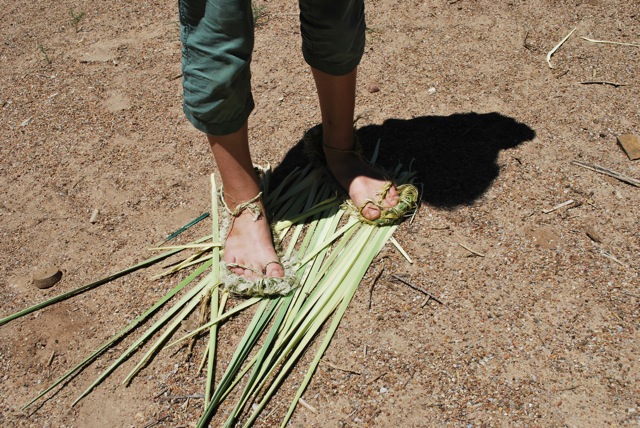 These aren’t the fanciest pair but were quick and easy. One pair can take almost as much fiber as a skirt. Next time, I’ll try to document the process in a “how to” format.
National Geographic reports a remarkable find of Roman shoes in Camelon, Scotland. I hope to see the report.

 Bone fish hooks made in the last week. I have made a few in the past but NEVER fished with them. They are plentiful in Village contexts along the Missouri River, all over Europe, and many other contexts. It seems to have taken several millennia in some areas to add barbs or drilled ends. I will make a couple more styles and various sizes and hope to try out my kit sometime when I get back to water. The cord is a two-strand agave made from only four individual elements.
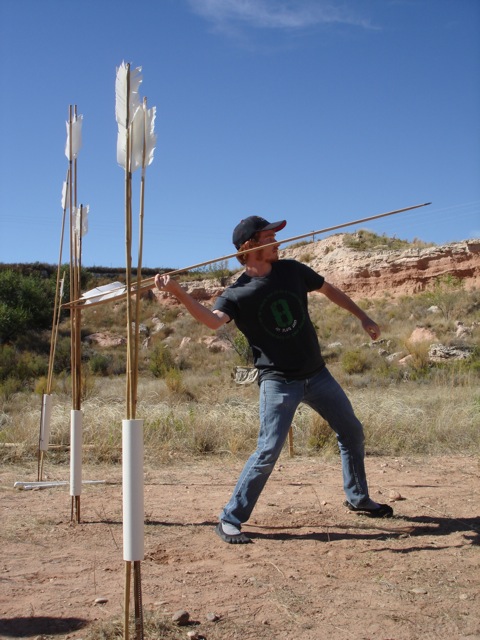 Photos from the October 2010 Atlatl Competition are up. Windy weather added a new level of difficulty to the target throws. The turnout was excellent with participants traveling from as far as Roswell, northern New Mexico, and Austin to take part in our event. Thanks to everyone who came.
 Some new Winter Count photos available here:
https://paleotool.wordpress.com/primitive-gatherings/winter-count-2010/
I am double posting this from my professional blog because I think it is really remarkable. A cave find from southeast New Mexico.
From time to time, we receive donations from private individuals. After a few phone calls back and forth, I arranged to meet with someone who wanted to show me a dart she had found in a cave when she was young. We have agreed to accept this remarkable find and intend to display it in the near future. The preservation is beautiful, although it has apparently been handled over many years. There was apparently a spear-thrower (atlatl) found with the dart but it was unfortunately lost in a house fire.


The foreshaft/point is hardwood and fits into a socket. the hind shaft is split in order to contract when seized with sinew (still attached. The barb is lashed on with more sinew. I will put more description and better photos when I get time.
These are sandals constructed from the narrow-leaf yucca. These designs are based on specimens preserved in caves. These might not be much to look at but they are remarkably impervious to the many sines, spikes, and other poky things found in the deserts of the west. These are two and four warp designs and the yucca is only slightly processed. The leaves should be dried prior to use and then re-wetted just before weaving. This prevents the normal loosening associated with shrinkage during drying.
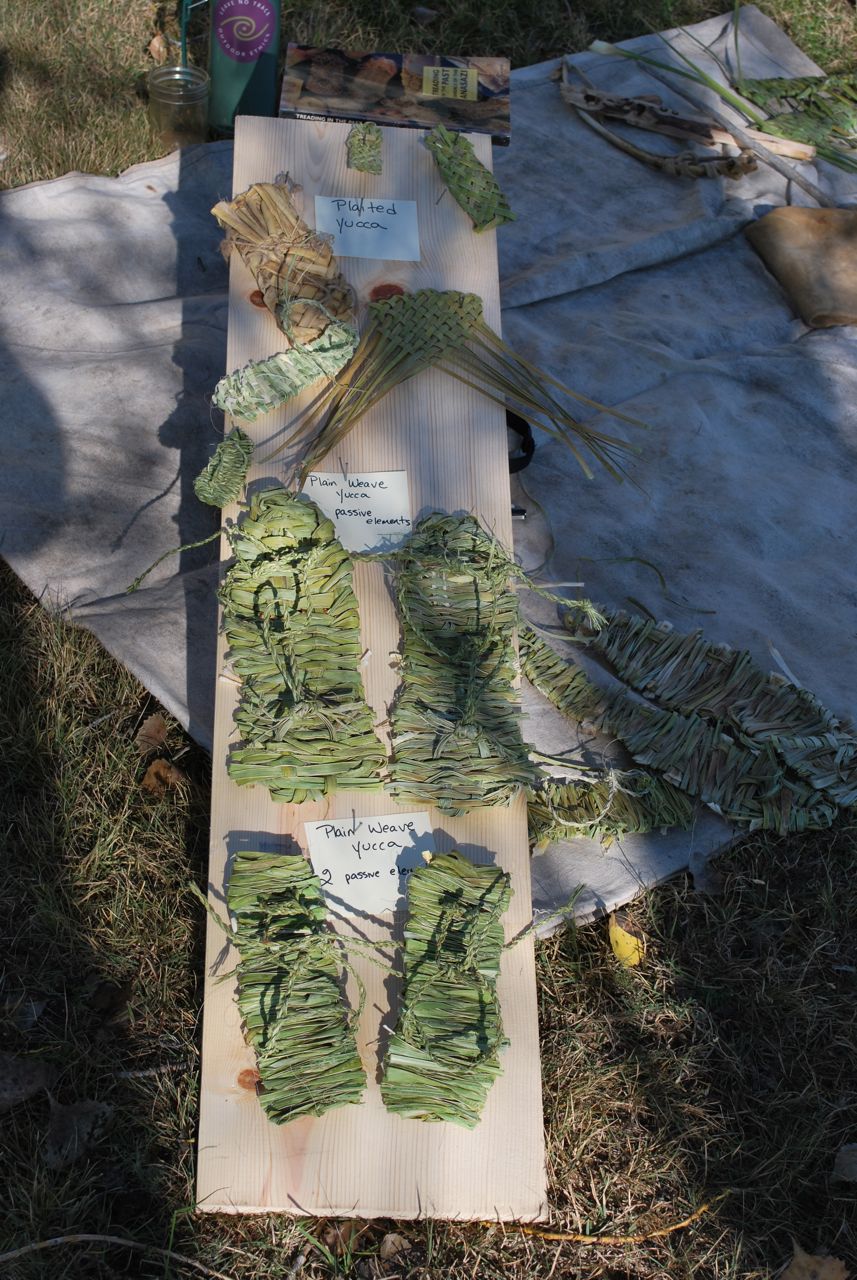
These are being diplayed at the Blackwater Draw atlatl and Primitive Technology day 2008.

I intend to continue to research these and will try to compare types through use.

 Preindustrial Craftsmanship