Caravan Design: The Open-Lot

An ongoing series of caravan designs to aide the modern builder.  A little history goes a long way to solve our design problems. 

The Open Lot is about the simplest of the true living wagons (properly “waggons”) of the 19th century.  Of course any covered wagon or cargo trailer can suffice when necessary but once these become real homes, some forethought in design goes a long way.  It is worth remembering that the caravans we know and love evolved in the cool, temperate region of northwest Europe and this influenced their design.  If these had originated, as we know them now, in hot, windy deserts or steamy jungles of southeast Asia, other considerations would have prevailed.  For instance, the near universal inclusion of a wood stove would not have occurred.  Better ventilation would have certainly been key.

OpenLotFloor
Illustration by Denis E. Harvey in The English Gypsy Caravan, by Cyril Henry Ward-Jackson.

Some of the earliest truly purpose-built living wagons in our lineage are the Open Lots.  Essentially and early covered wagon with closed ends and built-in furniture.  To maximize living space, the bed slides out for sleeping.  There is ample floor space, a built-in chest of drawers, cupboards and under-bed storage.  The massive cabinet under the base of the bed was used for storage or for children, as need arose.  The example above is essentially the pinnacle of this design whereas some were far simpler.
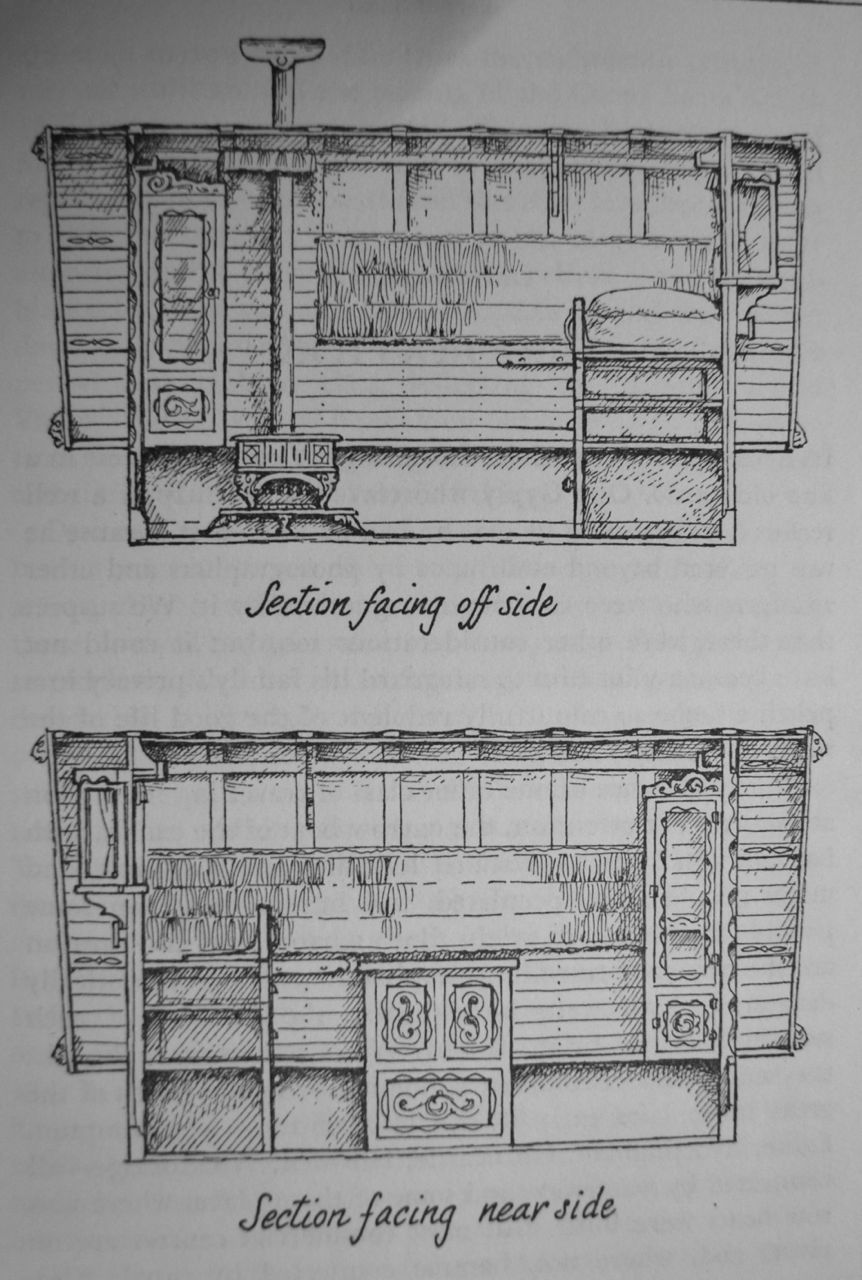
OpenLotCross
Illustration by Denis E. Harvey in The English Gypsy Caravan, by Cyril Henry Ward-Jackson.

The Open Lot is almost the blank canvas for later designers to expand upon and improve.  On possible drawback to this design was and is the curved walls, limiting the ability to build upon and essentially eliminating the possibility of side windows.  The positive feature of this design was it’s light weight.  Note that even in this era, side walls were built up, out of normal reach from outside for safety and security.

From Gypsies and Gentlemen by Nerissa Wilson.

The Open Lot remained the base-level caravan and saw wide popularity until recent times amongst horse powered travellers in Britain and Ireland.

Låg arbeidsbenk på Sogn Folkemuseum

I think I may have found a portable bench design that works for me and the small bench top I’ve been saving. (Pardon the poor translation; it is a mix of Google translator and my best effort).

The Heiberg Collections – Sogn Folk Museum has a very rich collection of objects related to various crafts.  They have a beautiful display of carpenter’s tools that have been displayed to resemble a workshop with workbench and tools. In addition, they have much of this collection in the collection.  In this book I came across a workbench that woke my interest.  The bench has registration number DHS.3884. The bench is at a height so  to sit on, 46 cm high (18 inches) and about 1.5 meters (60 inches) long.  In one end there is a vise and the other end there is a screw clamp with crank.

I will start drawing up plans when I get a chance.

Roald Renmælmo's avatarHøvelbenk

De Heibergske Samlinger – Sogn Folkemuseum har ei veldig rik samling av gjenstandar knytt til ulike handverk. Dei har ei flott utstilling av snikkarverktøy som er lagt til rette som ein verkstad med arbeidsbenkar og verktøy. I tillegg har dei mykje av samlinga si i gjenstandsmagasin. I dette magasinet kom eg over ein arbeidsbenk som vekte mi interesse. Benken har registreringsnummer DHS.3884.  Benken er i høgd slik at han er til å sitje på, 46 cm høg og ca 1,5 meter lang. I eine enden er det ei baktang og i andre enden er det ei skruklemme med sveiv.

Arbeidsbenken slik han står på magasinet på museet. Foto: Roald Renmælmo Arbeidsbenken slik han står på magasinet på museet. Foto: Roald Renmælmo

View original post

Early Worker Vans; Predecessor to the Caravan

WorkVanEarly work vans were designed to house manual laborers when on the job.  Great for highway and railroad crews.  These caravans were noted for poor ventilation and their spartan interior.  Three to six workmen were often housed in these wagons.

FowlerAll the necessities for living with none of the comforts of home.  Cheaper than regular housing and mobile too.  One can see how this evolved into the later caravan.  These were expensive and not as well thought-out as later ‘vans.

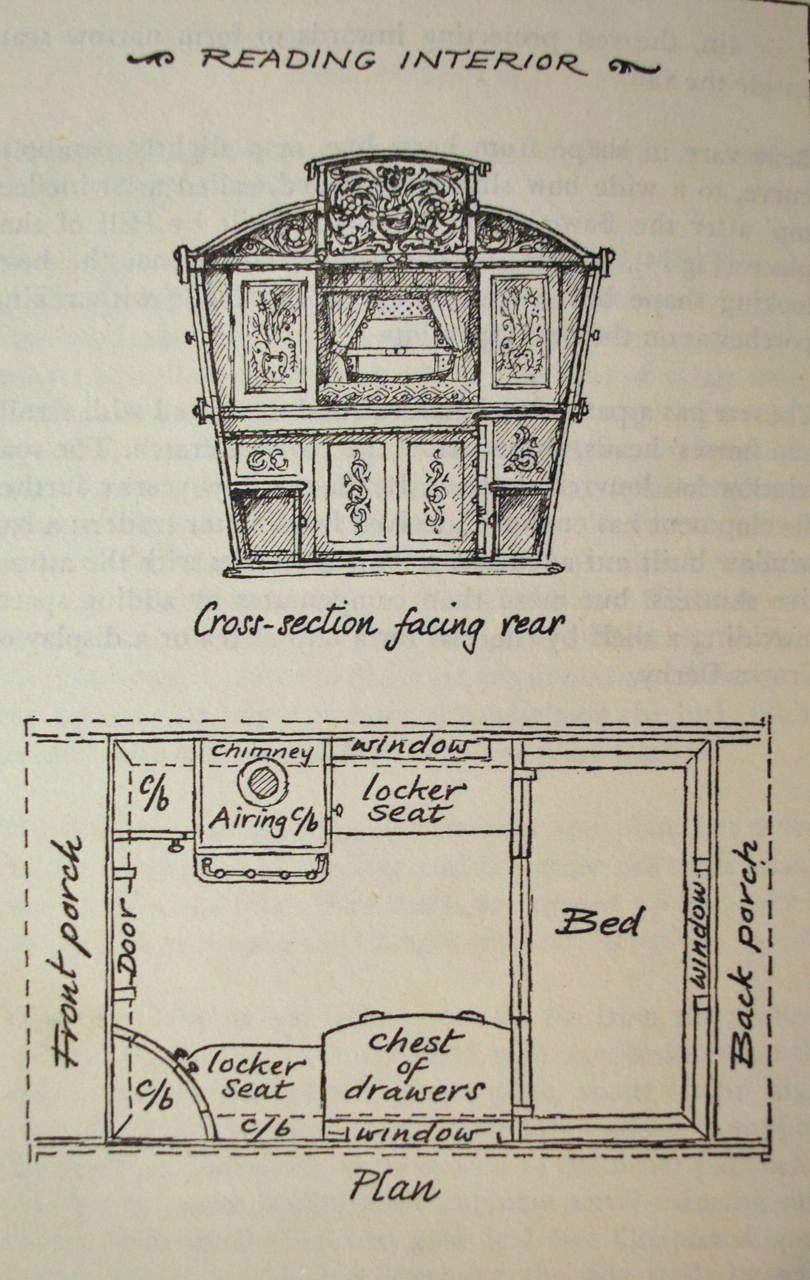
Vardo Plans: Reading Caravan

Many considerations concerning floor plans and general layout have come my way over the years.  I am compiling as many as possible to post here.  To start things off, here is the iconic Reading Waggon by Dunton’s (note: two “g’s” in the older British spelling).

ReadingExtThis design is truly the classic.  When one sees this, it cries of the open road and Gypsy Wagons.  It is Henry David Thoreau’s Walden cabin on wheels.  The wide rear axle and narrow front carriage was the best of compromise for agility, weight, and worthiness on and off road.  This design is worth a potential builder scrutinizing in detail for it’s perfection of design.  A mollycroft roof, high clearance, well-proportioned windows, and solid design make this ideal for the rolling home.

DSC_0197On the downside, kite walls (out-sloping) add some difficulty when working on interior shelves and cabinets.  Also, as noted for over a hundred years, the mollycroft can weaken the roof and ultimately increase the chance of leaks.  A small price to pay maybe but something to keep in consideration.

ReadingFloorThe classic caravan at this period included a full chest of drawers and a fairly large stove, limiting seating to a largish space on the stove side and a small dressing seat next to the dresser.  Although we read of dozens of children being born and raise in this design, the real layout seems to be based on the couple.  Kids will make due.

All images above are taken from The English Gypsy Caravan, currently out of print.

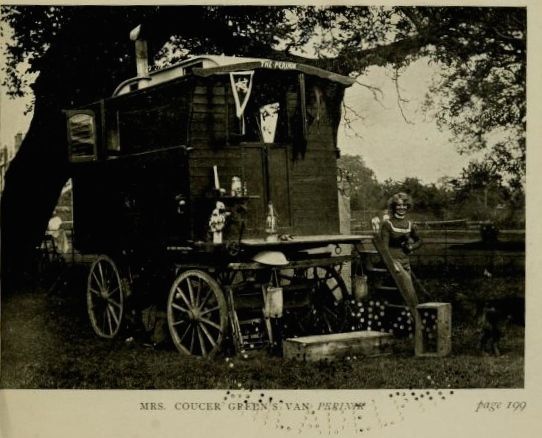
Mrs. Coucer Green and Other Great Old Photos

MrsCoucer
The PERINIK. A beautiful living van.

Three great and rare books have come to me in the very recent past.  Each has it’s own merits and is full of great stuff.  I am scanning, reading, and summing up some excellent stuff and will get it out as soon as I can.  In the mean time, enjoy these great photos ca. 1911-1914 the Golden Age of Caravanning.

LadyMore and better details on the way, including plans and historic photos that have lots to show us about design.

Another way to create an elliptical 1/2 (or 1/4) plan

Interesting to learn more of the sacred geometry all the time. Compass and rule work was my favorite bits in high school geometry class. I can’t wait to add this to my layout repertoire!

D.B. Laney's avatarA Woodworker's Musings

A true ellipsis is, in my opinion, is one of the most beautiful shapes in the universe.  Unlike an oval that is drawn with two mirrored radii (or three in the case of a true “egg” shape), the radii of the ellipsis continually change.  It’s incredibly strong shape in structural terms and it’s one of the best shapes for table tops.  There are many ways to draw an ellipsis.  But here’s an old method that you don’t often see referred to these days.  It’s simple and can be extraordinarily precise.  This method can also be very helpful if you’re creating domed framing for any type of construction.

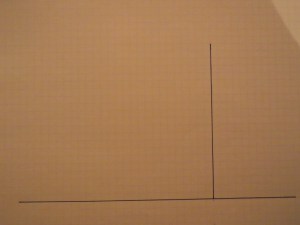
First, establish a horizontal base line then raise a vertical line.

002

Swing a semi-circle with a diameter based on the minor axis of the ellipsis.

003

Next, open the compass to the length of the major axis and strike a point to the base…

View original post 206 more words

Topper Update

Here are a few images to clarify some questions about the wooden topper.  It is not a work of art.  It was to be used for a single field project last summer but now I really like it so it will be a permanent part of the rolling home.

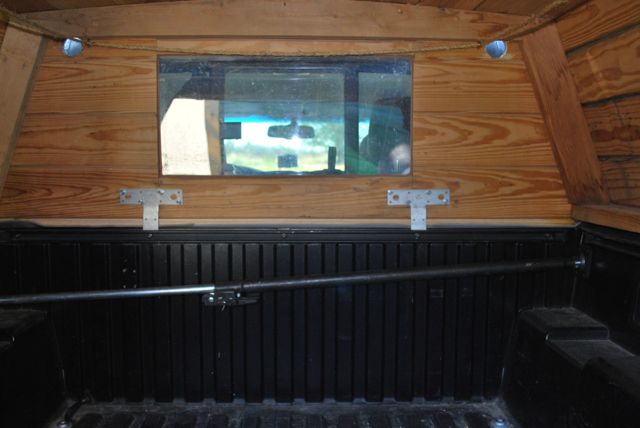
topper1Here’s the overview sans roof rack.  It has received about five more coats of spar varnish after a good sanding.  It is built from recycled lumber so there is some small shrinkage checking and a little discoloration from some mold or fungus but it hardly visible.

topper2Tacomas really suck for attaching racks and toppers for a couple reasons.  The top rails of the bed are plastic over some fairly unsubstantial metal and there are no stake holes.  There is however, the nifty rail system inside the bed that is secure.  To attach this topper, I used some construction straps from the Big Box Store which are screwed in behind the rails.  This is the forward view, blemishes and all.  The rope is for hanging up wet stuff like towels, swimsuits, etc.

topper3Here is another strap at the aft end utilizing one of the bed bolts in a reenforced spot.

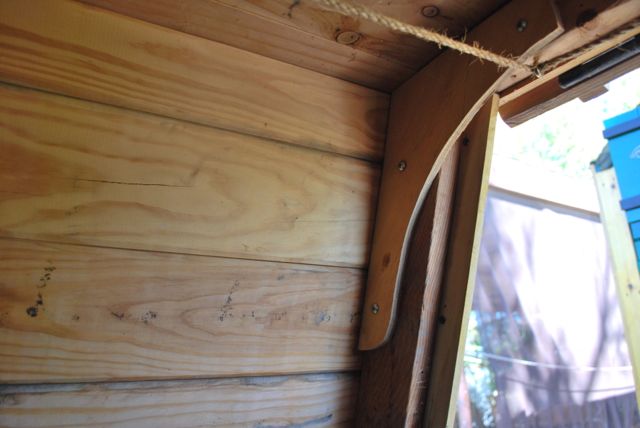
topper4And finally, here is an image of one of the knee braces that are screwed and glued to the frame to strengthen the door area.  I hope this helps if someone else wants to construct something like this.

Vardo – Topper Makeover

Because there’s always room for improvement.  In my case, a lot of improvement. snail2
Rehung siding, new paint, fresh varnish, little fixes, and lots of cleaning.  We’re hooked up to get out of town for a bit.

snail1Dietz lanterns, Kelly kettle, fuel, and lamp oil packed away in the pan box.  The steel disk serves as a heat shield to minimize ground scarring under the fire.

snail8A view from the bed.  Still more to pack up but things are looking good and nearly ready to go.

snail7The new windows are great and really perk the place up.  Bright and airy makes for a pleasant space.

snail3Still, the little Snail is far from perfect; made on a shoestring budget during snatches of time between work and bad weather.  Although I don’t live in it full-time currently I have come to see this as my home.