These are nearly the same type I make. A frame saw is a useful and simple introduction to woodworking and tool-making. If you are interested in woodworking, Paul Seller’s blog has a lot to offer.
From Paul Seller’s:
If you have not yet made one of these you should. They are quick and simple to make and give you the European push and pull stroke saw in a single saw which is useful depending on where you want to…
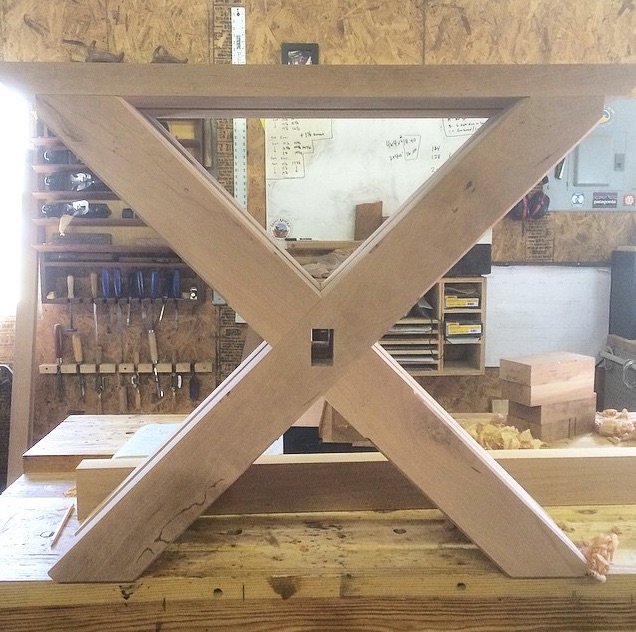
Here’s a beautiful trestle table coming together in Andy Rawls’ studio; spotted on his Tumblr this morning.
Seeing this makes me realize I can’t wait to get some projects done over the three day weekend. It makes me a little sad to say something like that. Choosing a job for pay instead of a love for what you do every day. Of course, the grass always looks greener…
This will be one solid table and will last for ages if treated well. This kind of craftsmanship has slipped away from most of our daily lives. You won’t find this at a big chain furniture store. Have a look at more of his remarkable work by clicking the link below.
I have been working on a bow-making tutorial for quite a long time now. Trying to be as explicit as possible while not dumbing everything down is a tricky narrative to follow. Just gathering the appropriate images of the process is time-consuming and difficult but truly, a good image is worth a thousand words.
As usual, an interesting old find posted on the Lost Arts Press. It’s worth a read.
“It is doubtless the timidity of woman which restrains her mending instincts. She dreads the saw and the chisel as treacherous tools that inevitably inflict wounds on the user… Moreover, she can never grasp the difference between a nail and a screw, and regards the latter as an absurd variety of nail which can not be driven with a hammer unless the wielder of the hammer has the muscles of a man.”
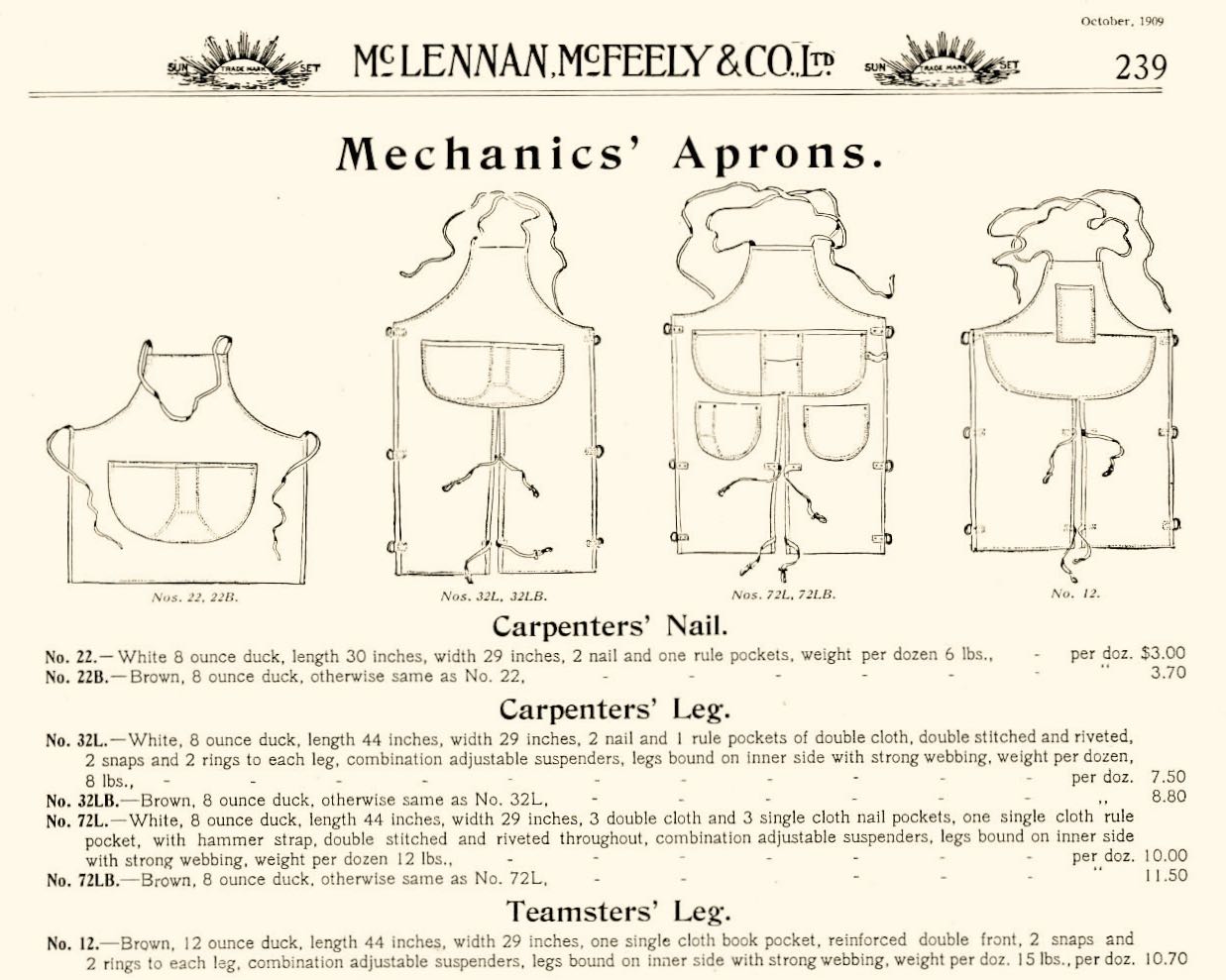
Shop aprons are not as widely used as in the past. I believe this is related to our modern view on clothing and how it has changed over the past century. Not only are we training less in the trades, our clothes are ridiculously cheap in the modern world. Low prices and availability keeps our incentive to protect them pretty low. As I have reduced my quantity of clothing I have grown to appreciate the humble shop apron more than ever. In the past, my only incentive was for protection when grinding metal or welding but now I begin to understand the real role a good apron can play in the shop.
A good shop apron can cost quite a bit of money ($40 – $100 or more) so I present the above catalog page as a starting point for construction. Heavy canvas or leather are the obvious choices for material. Although heavier, I prefer leather as is it is fireproof and offers some protection against cuts. As for protection, here’s an image I found when looking for designs. It’s from a Navy singlestick exercise. Somehow the design seems familiar.
Thank you Paul Sellers for stating an obvious but nearly lost truth. There are far too many needless and complicated gizmos, devices, and “new technologies” for a 2,500 year old task. Clever marketers have figured out that we can blame our laziness and impatience on our tools and not ourselves.
Maybe I am speaking out of turn as my tools are always for from perfect.
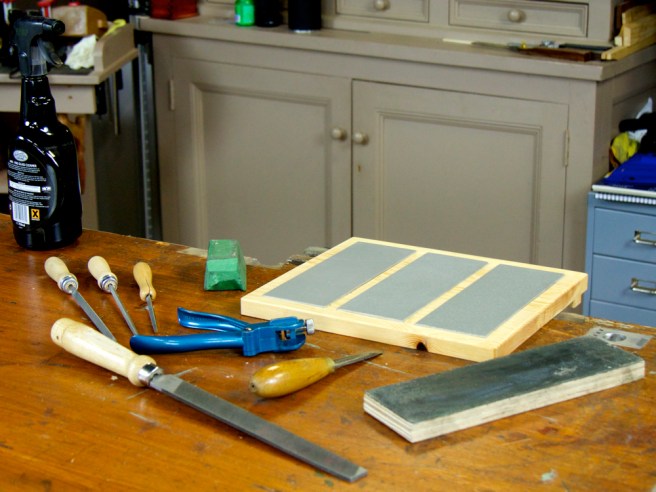
Catalogs are full of overpriced specialty devices designed to do the seemingly impossible; polish a sharp edge onto a piece of steel. I realize now that I was very fortunate. I learned to use a file and whetstone as a very young child. I even learned about setting saw teeth and how to use the hard straight razor stone. Before there were special stones to resurface a stone, we simpletons used a hard, sandy, and flat concrete surface before graduating on to sandpaper stuck to a sheet of glass.
Some of the best sharpeners I know still do virtually everything with Arkansas whetstones and some very-fine emery paper. One thing to remember though; you have to actually do it. If you don’t regularly keep things sharp, it only becomes more of a chore and takes more time. I think the old idea of spending a few minutes before you begin work of sharpening and stropping is a wise idea.
If you use tools, consider a real pair of Arkansas whetstones. Here’s a couple of sources to try:
In the mean time, head over to Paul Sellers’ excellent as usual blog for his take on sharpening as well. Notice his very simple set-up.
“I believe I was fitted by nature to become a woodworker, and had my father been a wagonmaker or millwright, a carpenter or cooper, I would have been taught by my father the trade that he knew. He saw that I would whittle something, for when I was even smaller and lived in the woods I would ask for his knife whenever he came home. He always demurred, saying, “You will cut your fingers,” for a woodworker’s knife is always sharp.
I would tease until he would hand it out with the remark, “Now you will cut yourself.” I invariably did, and it was generally the fore finger of my left hand. That finger is just covered with small scars of every possible shape. I was bound to whittle something. Father knew it, so he calculated to give me a trade where I could whittle away and bring in a little money thereby.”
Chris Weeks
Wood Craft – December 1905
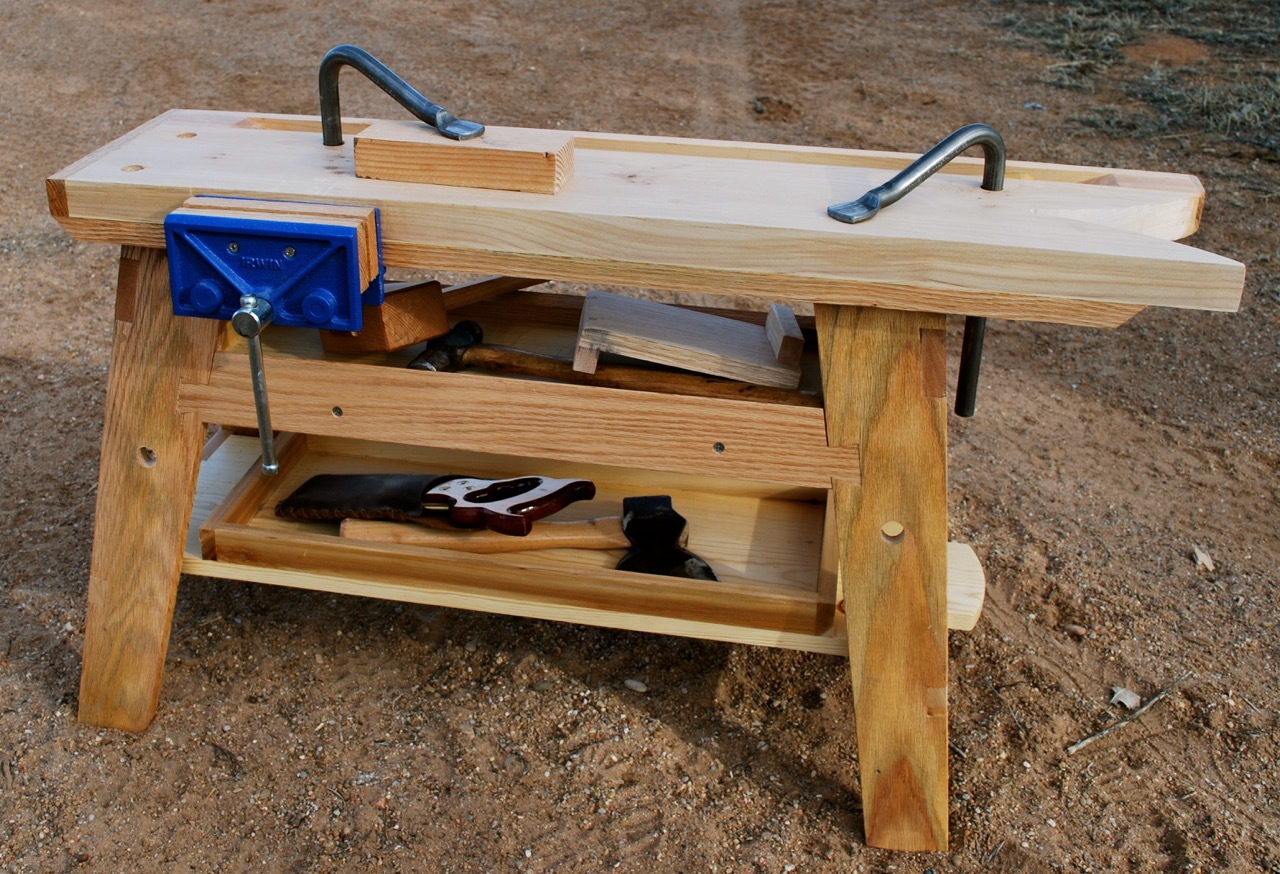
A little more done on the saw bench this weekend. It is clearly going to serve as my go-to portable workstation. I have several jigs in mind to add as regular features but, for now, I’ve started by making a brand new bench hook.
The bench’s small size will allow it to pack easily into the truck, even holding items in the tills.
I brought it out into the driveway this afternoon to get a few photographs before it’s all scuffed up and broken in.
The holdfasts are stored out-of-the-way by drilling a couple of holes in the legs. I placed them low enough that I can rotate them up to hold a board should the need ever arise.
I know this cannot replace a proper bench but I am very pleased right now. This will serve many functions, not the least of which is for bow and arrow making and as a leather work bench.
The holdfasts in place, holding nothing in particular.
This, in conjunction with the shave horse and folding x-leg table (below), will need to serve as my portable workshop for the foreseeable future I’m afraid.
Connection from leg assembly to the top.As for connecting the top, I used lag bolts with fender washers to provide a secure connection that could also be easily removed when the top is worn out.
This, in conjunction with the shave horse and folding x-leg table (below), will need to serve as my portable workshop for the foreseeable future I’m afraid.
The little table has many miles on it now and doesn’t look this pretty at all. I’m actually in the midst of refinishing it and will post pictures sometime soon.Bench hook on the bench.
This bench hook is oak, glued with Titebond 2, and pegged with Osage orange dowels for added strength. The dowels aren’t visible in the fence as they are half-blind and stop just short of the surface. A bench hook, shooting board, mitre box, and other small jigs make great use of scrap that might otherwise end up in the wood stove.








 Preindustrial Craftsmanship