Here is an update on the most recent possibles bag I have been working on:
The buffed leather reflects a lot more than I realized while photographing.
Sorry the photos aren’t so great but here is the description: Made from 7 oz (~3 mm) Hermann-Oak full-grain harness leather top dyed and antiqued Fiebings medium brown with a single patch pocket inside. It still needs a little edge detailing, waxing and buffing before it is truly done but that will happen later today.
The interior is natural but will darken with use and waxing.
Rustic, laced construction, unlined, 18th century “English-style” bag. The main pocket is 8 x 8 inches (1.5 litre in volume), while the overall body length is about 12 inches.
The edges are all burnished for a smooth and comfortable feel in hand. The thick oak-tanned will soften with time and use.
The eared shape is to keep the bag from riding around to the front or back of the torso during use. This leather will age nicely and will last longer than any of us with normal rugged use.
All sewing is double needle free-hand saddle stitch.
1 1/4″-wide strap extends to about 56″ to fit the most well-padded or heavily coated hunter. Going out for trade in the next couple days.
Several years ago, I made a shoulder bag that I still often carry today. It is the perfect size for a small field bag or hunting pouch. It was a lot fun looking at various designs, mostly from the 18th century to try and come up with something that would fit my needs.
My bag, several years and many miles later.
When I first joined Boy Scouts at about age eleven, I envisioned myself as a mountain man-explorer who was going to learn to live off the land. The first merit badge book I bought with my little money was Wilderness Survival and it spoke of the possibles bag that early explorers carried that kept everything they needed to live off the land and cover every emergency. At least, that’s how I remember it. Later, as a an actual wilderness explorer, traveler, and archaeologist, I learned to appreciate the “kit” bag on a more realistic level, and how this bag transforms for different purposes and places one travels. It is the unsealed* survival kit to be used and replenished as needed based on the situation. My current favorites, though too big for general daily wear, are the Mountainsmith Approach pack and my Filson Medium Field Bag. I can live out of either almost indefinitely and both make handsome weekender bags.
On to the Shoulder Bag
After much deliberation and review of mostly 18th century gear I decided I wanted a small outside pocket, a small inside pocket, a larger, closable outside pocket for important things like a compass, and main compartment large enough to hold a notebook and daily essentials. I decided to make the main flap in a stitched-down style so that it would keep things in, even if it wasn’t buckled shut.
In the end, I went with a fairly standard English-American shooting bag style as seen above. It works well for me and after using it for several years now, I don’t believe I would change anything about it.
Large external pocket with button.
Outside open-top pocket
Closed for travel.
Dimensions: the body of the bag is 9 x 10″ with a gusset exposed at 1″. Reinforced ears, riveted for strength. All stitching is two needle saddle stitch, except the body, which is laced. Three pockets, and a 1 1/4″ shoulder strap, adjustable by about 12″.
All the parts of the body except the main gusset.
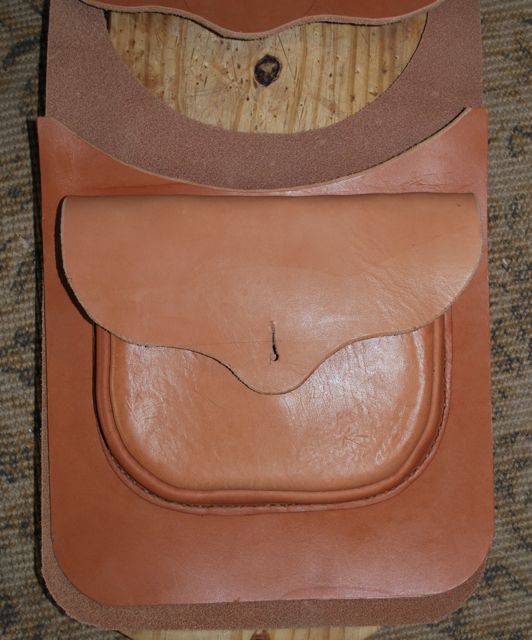
When laying out a complex sewing project like this, you need to decide in what order to begin the assembly. The back wall of the bag has an internal and external pocket that were sewn down first (beginning with the smaller one inside).
Outer pocket attached.
The outer pocket has a gusset that was sewn inside-out before being sewn down to the front wall of the bag. You’ll probably notice that the edges of the flaps are raw but if I were using thinner leather I would bind them with a soft buckskin or something similar. The raw edges were smoothed and burnished to create a nicer look than just a sharp cut edge.
The assembled bag.
Finished! It’s hard to gauge work time but since that is generally the first thing anyone asks I will estimate about eight hours of stitching and assembly for this project. There is one inside patch pocket, an outside rear pocket, and a gusseted pocket under the flap. Eleven pieces plus the strap (four pieces). Hardware includes a one inch bridle buckle, a 5/8″ buckle, and two solid one inch “D” rings.
The back-side with simple pocket.
Internal pocket just showing.
Now, what to keep in it…
*The modern sealed survival kit was developed for conscripted soldiers and airmen to keep them from rifling through and using up the goods and having nothing when they truly need it. This has carried over into survival-skills-for-morons programs world-wide and creates a product to be sold and consumed by the inept. If you cannot trust yourself to update, change, use, and modify the contents of your personal survival kit, by all means make or buy one and seal it up, awaiting the day it will come in handy. If nothing else, you can enjoy all the surprises you will find while you wait for someone to rescue you. ~GTC
Some of my real-life camping gear mostly inspired by the period from 1745-1812, prior to major industrialization.
Starting in the upper left and moving more-or-less clockwise: small tomahawk, portmanteau, stoneware jug, braided buckskin cord, patch knife, buckskin bag for brass sundial compass, wool bonnet (tam o’shanter), trade bead necklace, small gourd for salt, pewter beer mug (could possibly hold water too), canteen gourd, Knife River flint blades, needle case and bone needles, strike-a-light and char-cloth box, wooden bowl and spoon, buckskin bag, bone handled eating knife, waterproofed leather bag, bark tanned belt pouch, buckskin neck bag containing spare fire kit, net shuttle holding hemp line, sewing kit in buckskin bag, wooden needle case with needles, argillite pipe with buckskin bag, fine hemp line, extra blanket pin, belt, pampooties (ghillie shoes), bamboo container containing larger bone awls and other bone tools, in the center, shoulder bag.




 Preindustrial Craftsmanship