A Story of an Old Time Sheepherder

It was a lonely life on the range.  “Even if a herder does not particularly care for reading, he will be driven to it in self-defense.”  I wanted to re-share a good story about sheepherding life.  Gilfillan was a shepherd for 20 years and went on to become a well-known humorist, author, and speaker.

Archie Gilfillan was South Dakota’s sagebrush philosopher. His prairie wit en­tertained people in the ranching areas of Montana, North Dakota, Wyoming and South Dakota through the Great Depression.”

As to why he never married,

“You profess sincere and unbounded admiration for the beauties of the opposite sex and you practically lay your heart at their collective feet; and then you meet some individual who combines the poorer qualities of a mama wildcat and a bitch wolf, with a voice like a buzz saw, the temper of a slapped hornet, and a dis­position that would curdle the milk in four adjoining counties. And then you have to revise your opinion of the sex all over again –– and downward.” In short, he never met a woman he liked who would have him as a husband.

The full article can be found here in South Dakota magazine.


A Fine Old Sheepherder Wagon

I love these the old sheepherder camps.  I’ve seen quite a few parked on ranches from Colorado to Idaho and even a few in Arizona.  I know they aren’t highway capable but it seems they could provide a real housing alternative for low-income minimalists who have access to land.  Far better than a housing complex or apartment for sure if you can deal with a small footprint.

Originally designed on a narrow wagon box, the builders took advantage of every square inch of space.  Since weight wasn’t really an issue, many have large stoves like the one above for heating and cooking.  As most of these wagons were homes for ranch workers in the western U.S., they needed to be prepared for extreme cold and windy environments.  When I was building my vardo, I took a fair amount of design inspiration from these wagons, adding their vibe to the more European designs I was ingesting.  My stove is small and I envy this one above; at least the cook top.

Off-the-shelf or build it yourself?  It’s the details of hand-built structures that make them stand out and this chimney cap is no exception.  This looks far more interesting to me than the local hardware store option.

The photos are from Ken Griswold’s Tiny House Blog.  If you haven’t figured it out yet, I’ve been a fan of his site for a long time now and recommend it for anyone with an interest in Tiny Homes.  Here’s a link to the full article about Lorna’s wagon.

Save

Exploring Old Caravan Images

There are quite a few images from the Golden Age of the Gypsy Caravan* floating around the web, many without appellation.  Still, they have much to offer the potential traveler or yearning nomad today.

Vardos

I quite like seeing the nearly universal items one needs for living on the move such as the folding tables, water coolers, wash basins, buckets, and lanterns.  If I were to guess, I’d say this one was taken in some muddy side-alley in southern England around the beginning of the 20th century.

https://i.pinimg.com/736x/03/bd/64/03bd64a272dcfe524ea4320d22f825fe--gypsy-wagon-gypsy-caravan.jpg

And let’s not forget that a large market for the high-end and custom wagons was for professional showmen, another group living on the road.  I have kept the above image in my stock because I really like the awning over the door.

Appleby caravans
Click for a larger image.

I think one of the appealing aspects of these wagons is their almost timeless flavor.  An image from the 1950s at the Appleby Fair looks much the same as one from 1985 or 1895 with the addition of an occasional automobile.  The Open-Lot design above is out of favor with the modern American crowd due to the lack of security but I can see the advantages on a warm summer day.

*”Gypsy” has fallen out of use due to the pejorative overtones when applied to the people known as the Roma or other Travellers (sic).  In terms of describing the living accommodations it is kept here for historical purposes, for the time being, for lack of a better universal term.

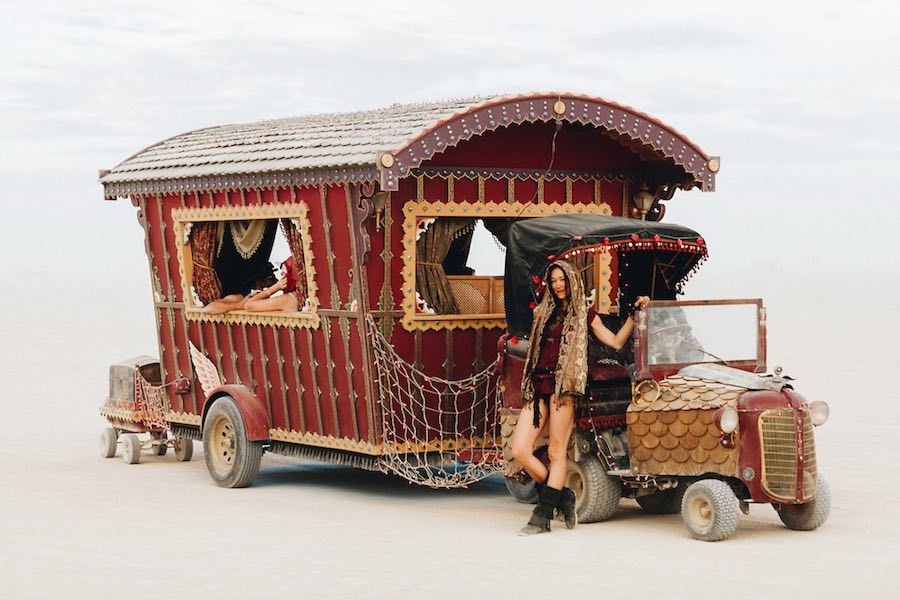
A Slow Moving Beauty

Reported from Burning Man 2016.

I don’t really know anything about this beautiful rig but I like what I see.  A converted mower in front as a tow vehicle and it’s pulling a little trailer of it’s own behind.  If anyone knows any more about this one please let me know!  I found it on Tumblr but was able to image search it back to this source:

http://www.archipanic.com/burning-man-exploring-black-rock-city/

Save

Kevin’s Vardo

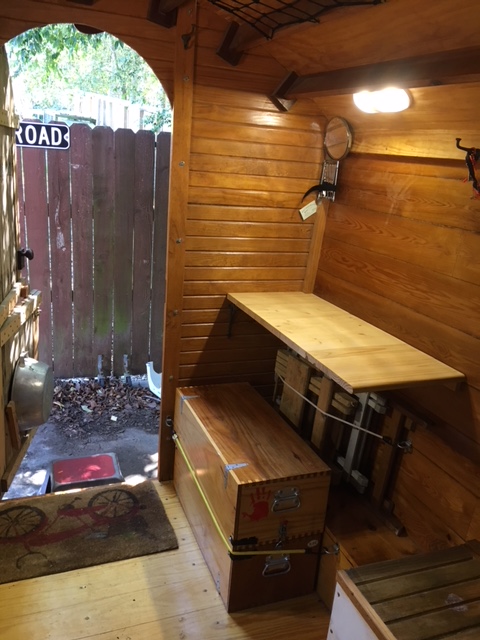
I always enjoy hearing from others who have built their own caravans, especially when accompanied by photos and descriptions.  If you follow this blog you probably saw Kevin’s original photos here recently with a short post about his build.  If not, you can read about it HERE.

The promised follow-up is finally here as I have posted the images and text he sent.  Honestly, this is my favorite kind of living wagon where old and new technologies are melded into a practical, yet affordable dwelling whether for long-term living or just overnight luxury travel.  As shown here, there is a great use of fine woodworking and joinery combined with modern materials and hardware to create a rugged and practical living space that is road (and off-road) worthy.

Here is the rest of Kevin’s mighty fine vardo project (his original text in italics).
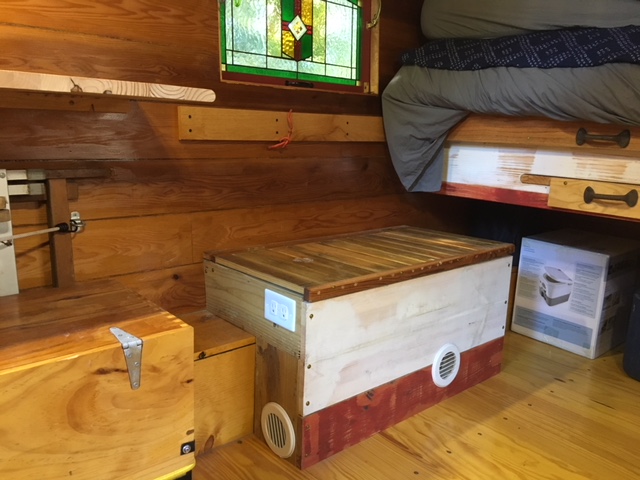
This shot offers a view of the short bench with built-in AC/Heat ducts, one for cooled/heated air (right), and one for return air (left). As well as accommodating air circulation, the bench provides handy storage. Also shown is a 110 volt outlet that provides power to the interior when the Vardo is attached to the generator or some other power supply. There are three interior outlets (the other two are hid pretty well), and three exterior outlets on the camper. There are also 12 volt power plugs inside the camper that are tied to the vardo’s battery. These are great for charging phones and running fans at night. It gets pretty hot along the Texas/Mexican border.

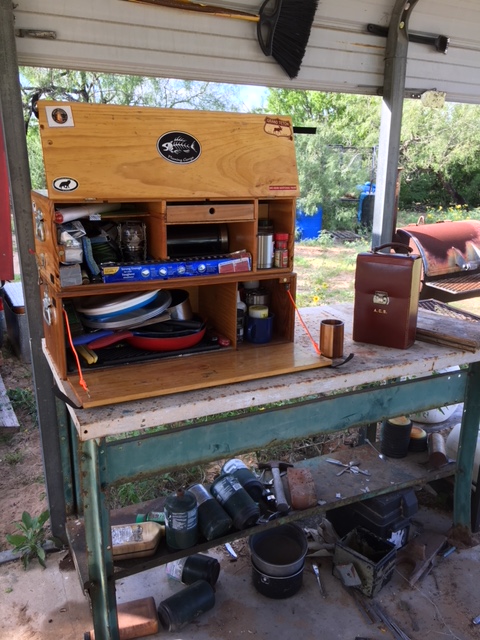
You can see a top view of the access doors to the under-bench storage provided in the long bench. You can also see the flip up section that turns this bench into a single bed. On the side of the door, if you look hard, you can see the hinged corbel that provides some of the support for the flip-up section. At the top of the photo you can catch a glimpse of the bungee net that provides overhead gear storage. This works very nice for carrying fishing poles and a broom.This is how the “chuck box” (cooking box) is stowed when traveling, or when not in use. The small counter top is very handy when brushing your teeth and emptying your pockets at bed time. Underneath, as can be seen, typically is stored a pickers stool, a larger folding camp table, and a folding chair.This wagon can haul a whole mess of Hunting gear. A trip to the desert requires a lot of ice and water. Everything is packed for travel, keeping the weight forward and the trailer stable on the road.A photo of our south Texas hunting camp, with the Vardo set-up. We always get a bunch of comments and compliments along the way. The wagon provides comfortable accommodations for 1-3 hunters.The chuck box gets unloaded and set up for use in camp.
This vardo looks very familiar to me and I think I’d be right at home in it.  Thanks so much for sharing this with us and the community.

Save

Save

Save

Save

Yet Another Sheepherder…

(from the Paleotool vault)

I love these things.  I saw quite a few parked on ranches from Colorado to Idaho last week.  I know they aren’t highway capable but it seems they could provide a real housing alternative for low-income minimalists.  Way better than a housing complex or apartment for sure.  The photos link to Ken Griswold’s Tiny House Blog.  If you haven’t figured it out yet, I’m a fan of his site.

I took a fair amount of design inspiration from these wagons but added a bit of class along the way.  I wouldn’t mind having a cook stove like this one though.

Off-the-shelf or build it yourself?  I love these details in hand-built structures.  This looks way better to me than the local hardware store option.

Have a look at Lorna’s old wagon here.

Save

Save

A Guest Vardo

I always appreciate getting mail and comments on the blog; especially when someone is able to take information away and create something of their own.  I recently received some fine photos from Kevin with his own Vardo build.  I emailed back for more information but haven’t heard anything yet.

The wagon is a lovely and familiar design and it’s great to see it out in public alongside the more normal modern camp setting.Kevin also builds beautiful coolers that I hope to see more of in the near future.  One is visible next to the vardo in the image above. Here’s the email I received and I hope to hear (and see) more from Kevin soon:

George:
Hello.  I have been following your blog for a few years.  I’m writing to you directly as I want to share some photos of the Vardo that I built, using yours (and a few others) for much of the inspiration.  I wasn’t sure how to go about posting the photos to your blog, so I figured I would send them directly to you.
I live near Houston and own property in Buffalo Wyoming, home to a historical population of Basque sheepherders, and many currently rolling sheep wagons.  Living in two extremes, I have had some issues with changes in humidity affecting the performance of the wagon and would likely do a few things differently, if I were to do it all over again (but wouldn’t we all).
I haven’t seen any updates on your Vardo-make-over in quite a while.  Hopefully there’s more coming.  I know the work on mine is never done.  There are always items hanging around on the list of future improvements.
Let me know if you have any questions about the construction and performance of the wagon.  I’m happy to carry on a discussion if your interested, and willing to send more photos if you request. You’ll notice in the photos some glimpses of one of my hand made coolers.  They’re marine fiberglass coated wood on the inside, and out; built sort of like a cedar strip canoe. I built the chuck-box in the first photo as well.  It travels in the rear of the wagon to be set out for camp cooking. I figured these were both items that might interest you.
Kevin

It looks great Kevin.  I can’t wait to see more.

~GTC

Save

A Sheepherder in South Dakota Magazine…

(from the Paleotool vault)

A lonely life on the range.  “Even if a herder does not particularly care for reading, he will be driven to it in self-defense”.  This is a good story about sheepherding life.  Gilfillan was a shepherd for 20 years and went on to become a humorist, author, and speaker.

“Archie Gilfillan was South Dakota’s sagebrush philosopher. His prairie wit en­tertained people in the ranching areas of Montana, North Dakota, Wyoming and South Dakota through the Great Depression.”  The full article can be found here.


Save

Growing Up on the Range…

(from the Paleotool vault)

Here’s a great story I read years ago about being raised in a family of six in a sheep camp measuring about 7 x 8′! (I think that’s the floor space).  I recently relocated the article in Mother Earth News.

Nice layout sketch of a sheep camp.

Here’s an excerpt:

“The canvas-covered sheep wagon was roughly about seven feet wide by eight feet long. On the front end a door opened out of the middle and you stepped down onto the wagon tongue and thence to the ground. From the inside looking out, the stove was on the left of the door. On the right was a small wash stand with several wooden drawers for storage of linens, towels and socks. A bucket of water and washbasin were on the oil cloth covered top and a small mirror hung above the basin for shaving. Soap, toothbrush, razor and essentials rested on top of the stand when in location or were stowed in a drawer when moving.”

Read more here: http://www.motherearthnews.com/nature-community/sheepherders-wagon-zmaz70mjzkin.aspx

Save

Wyoming Sheepherders Again

 (from the Paleotool vault)

Sheep camps from Wyoming from the Wyoming Tales and Trails webpage.  Great photos and some good information concerning everything “western.”

I could spend much of my life like this!

A self-contained base camp in a sheep wagon provides a cozy home on the prairie.

A beautiful culmination of cultures a innovations created this iconic American living arrangement.  We can learn a lot from these designs today.

The Wyoming Tails and Trails website contains a lot of other information about western history along with more than 100 photos.  Have a look around and get a feel for the old west.

http://www.wyomingtalesandtrails.com/

Save