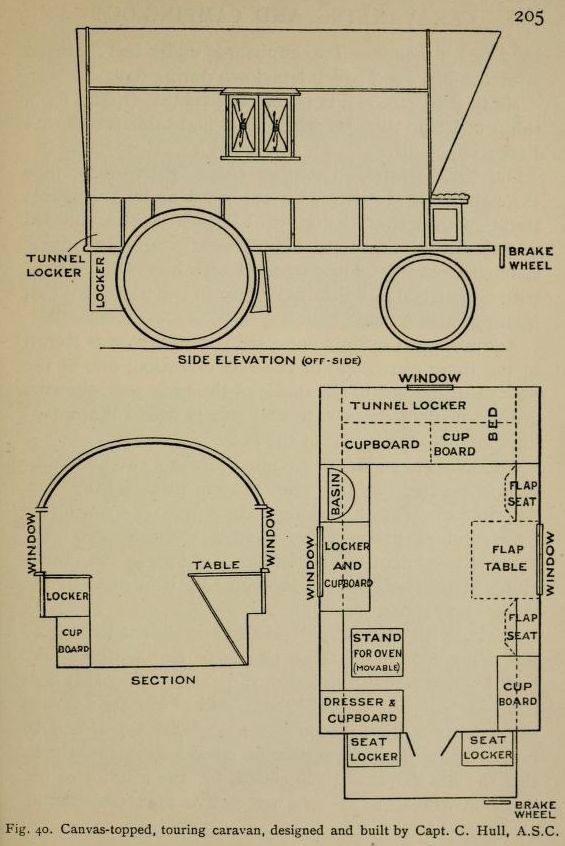
From Caravanning and Camping-Out by J. Harris Stone 1914.
Here’s a great design from the late nineteenth century. I could not find an associated photo for the finished caravan but there are a couple of innovations I will want to include in the future. I believe this wagon was about 12 feet long overall and is a nice setup for 1-2 people. The flap table makes for added floorspace when needed and there is ample storage both inside and out. The tunnel locker under the bed is also a great idea that I thought was a recent invention.
A caravan with the ubiquitous storage tent.
This isn’t the same caravan but similar in size and design. I really like the enormous opening at the front for ventilation. Another innovation for the future. Also, it’s good to keep in mind that there were normally a tent or two pitched with the van when parked for storage, dogs, kids, etc. I thought this was a cop-out of mine but it seems I’m not the first to notice the extra space is a godsend on extended trips with more than one person.
An ongoing series of caravan designs to aide the modern builder. A little history goes a long way to solve our design problems.
The Open Lot is about the simplest of the true living wagons (properly “waggons”) of the 19th century. Of course any covered wagon or cargo trailer can suffice when necessary but once these become real homes, some forethought in design goes a long way. It is worth remembering that the caravans we know and love evolved in the cool, temperate region of northwest Europe and this influenced their design. If these had originated, as we know them now, in hot, windy deserts or steamy jungles of southeast Asia, other considerations would have prevailed. For instance, the near universal inclusion of a wood stove would not have occurred. Better ventilation would have certainly been key.
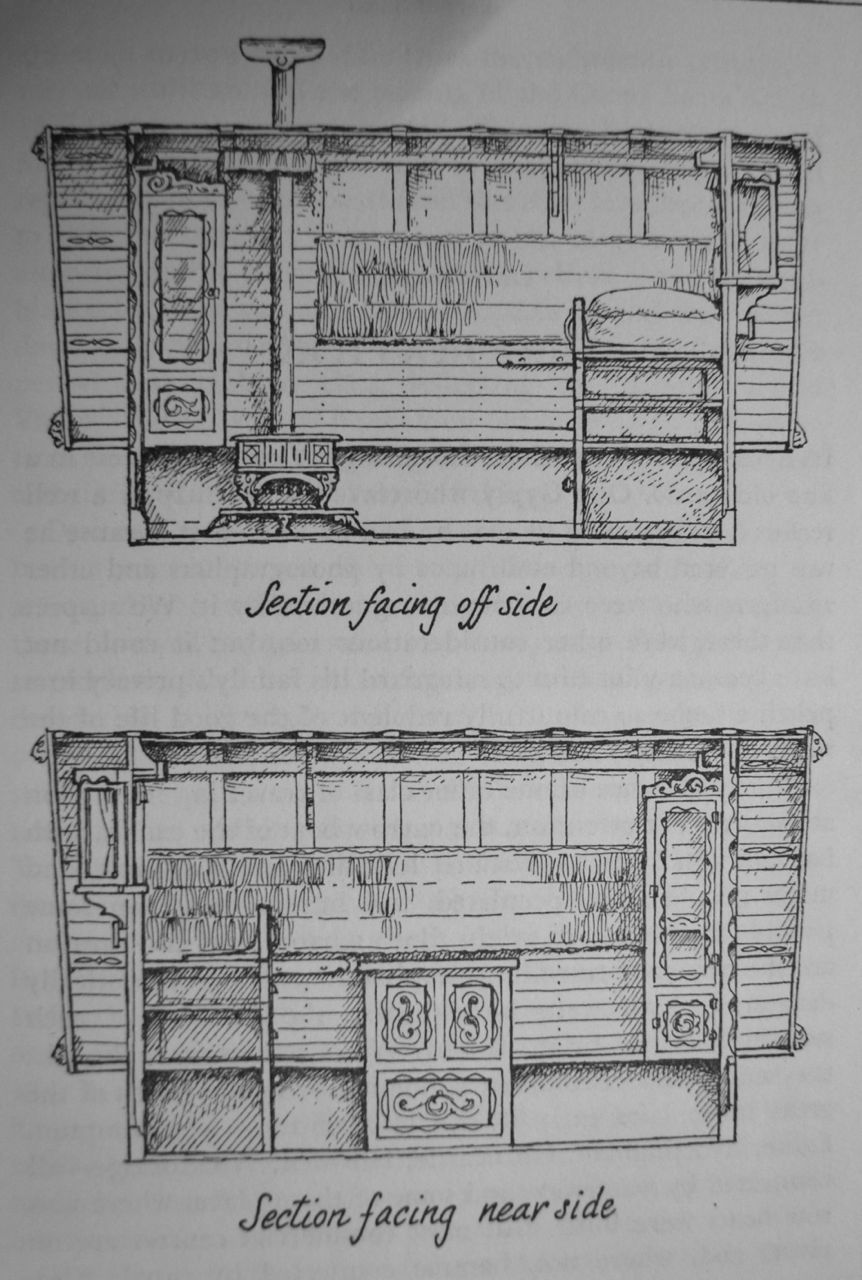
Illustration by Denis E. Harvey in The English Gypsy Caravan, by Cyril Henry Ward-Jackson.
Some of the earliest truly purpose-built living wagons in our lineage are the Open Lots. Essentially and early covered wagon with closed ends and built-in furniture. To maximize living space, the bed slides out for sleeping. There is ample floor space, a built-in chest of drawers, cupboards and under-bed storage. The massive cabinet under the base of the bed was used for storage or for children, as need arose. The example above is essentially the pinnacle of this design whereas some were far simpler.
Illustration by Denis E. Harvey in The English Gypsy Caravan, by Cyril Henry Ward-Jackson.
The Open Lot is almost the blank canvas for later designers to expand upon and improve. On possible drawback to this design was and is the curved walls, limiting the ability to build upon and essentially eliminating the possibility of side windows. The positive feature of this design was it’s light weight. Note that even in this era, side walls were built up, out of normal reach from outside for safety and security.
From Gypsies and Gentlemen by Nerissa Wilson.
The Open Lot remained the base-level caravan and saw wide popularity until recent times amongst horse powered travellers in Britain and Ireland.
Here’s a recent conversation I had, as best I can recall, of creating disappointment and maybe using the wrong words when describing the Vardo.
A woman in a grocery store parking lot jogs up to the vardo while I’m making a sandwich shouting, “Oh my gosh! That is so cool! Wow! Is that a Tiny House like on TV? Can I have a look inside?”
“Yes, of course. You can look inside.” So far, it’s progressing just like a hundred other conversations I’ve had over the years.
“Is it like the little TV houses? You know, like on that show?”
“I don’t know the show but it’s actually a little camping caravan.”
“It’s not a Tiny House? Oh, never mind then,” turning on her heel she walked away without a backward glance. Then to another gentleman walking towards us she shouts, “It’s nothing. It’s not like the Tiny House Show” shaking her head in disappointment. The gentleman and I proceeded to to tour the little wagon and had a merry talk about the Vardo and having it as a traveling companion.
The Vancott, moveable cottage designed to solve housing problems for working families in England. From J. Harris Stone, 1914.
A Clarification – Something I find myself explaining on the road when pulling the little caravan is the difference between a Tiny House and a true caravan or vardo. A Tiny House is just that; a very small house. Because of codes and strong laws about housing in the Industrial Nations, Tiny Homes are usually placed on a trailer for legal and logistic reasons. This doesn’t mean that most Tiny Houses should or could be dragged all over the country. That’s not really the point. They are generally too heavily built (rightly so) and use materials like factory-built house widows and normal pitched roofs. While these make for a nicer living structure they are not designed for the sustained tornado-like conditions and severe jarring that come from over-the-road travel.
Late 19th Century-style Showman’s Van, Arguably the first true stand-alone caravan for full-time living. From J. Harris Stone, 1914.
When the world moved a little slower, some of these issues were not as important, such as real glass windows and hurricane-proof roofs, but now, we certainly don’t want parts to fly off at 70 miles per hours on the highway, or to show up in camp with shattered glass on the bed.
Definitions:
Tiny House – Very small home often mounted on a trailer frame. Designed to be towed to a final location or towed for occasional moving.
Vardo or Caravan – Small dwelling designed to be regularly towed to new location.
“Do you ever Hunt? Fish? Paddle a Canoe? Explore? Prospect? Climb Hills or Sail on a Yacht?” Such was the opening line on an 1899 advertisement for Primus stoves. That covers just about anybody of worth that I know. Of course you need a stove. Buck up and buy one (that means you Jim). The ad goes on to say “It cures all ills that campers are heir to. It is the one thing needful to make camp life a dream of Elysium.” You just can’t ask for more than that.
Improving the Primus Stove experience began early on. Putting the stove in a tin case, disassembled, made for easier packing and kept the parts together. And of course, a toaster rack that works while the tea kettle is heating on top would become indispensable.
Unlike what was taught in the Boy Scouts, Primus highly encourage its use inside tents; going so far as to suggest drying clothing and bedding. I’m not sure my old Scoutmasters would approve but really, it’s nearly the twentieth century, right? Seriously though, some of the better information concerns the economy. One quart (0.95 litres) will burn for 5 hours, or as one prospectors testimony claims “A quart of kerosene lasts a week and cooks three meals a day for us.”
Now I just need to find the right tin box and the remarkable flatiron griddle shown in the upper right of the second ad.
I have started a separate Blog Page to house the caravan, vardo, Rom, Gypsy, Traveller, and nomad art from my collections. Any contribution links are welcome as are comments.
Early work vans were designed to house manual laborers when on the job. Great for highway and railroad crews. These caravans were noted for poor ventilation and their spartan interior. Three to six workmen were often housed in these wagons.
All the necessities for living with none of the comforts of home. Cheaper than regular housing and mobile too. One can see how this evolved into the later caravan. These were expensive and not as well thought-out as later ‘vans.
At the end of the first decade of the twentieth century, the young artist Frances Jennings became a semi-invalid and was advised by her doctor to spend as much time as she could in the open air. Being a Victorian lady at loose ends, the obvious choice was to take to the open road. Her simple rig and a good spirit served her well. As described by J. Harris Stone:
She is extremely delicate, partially paralysed, and her doctor told her that she should practically live in the open air. Being of an active and practical mind she set to work to see how she could, within her means, carry out the drastic requirements of her medical adviser. She joined the Caravan Club, and all the assistance, in the way of pitches and introductions, was of course afforded her. Her desire was to take to the road and live altogether in the open air in rural parts of the country. Her cart—it can scarcely be called a caravan—she describes as “strange and happy-looking.” It is four-wheeled, rather like a trolley, and painted bright blue, with a yellow oilskin hood—something like a brewer’s dray in shape.
Beauty in a caravan is in the eye of the beholder.
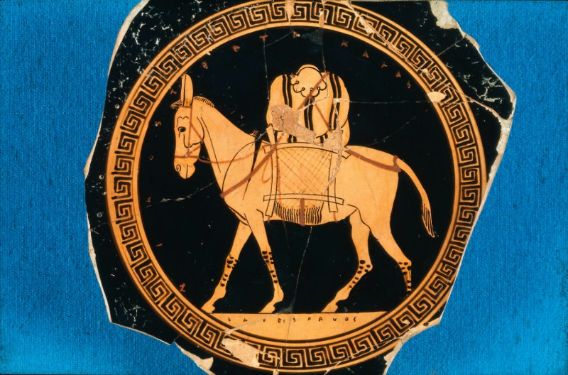
“I carry,” she tells me in one of her letters from a pitch in a most out-of-the-way spot in rural Gloucestershire, ”a hamper of food, and one of soap and brushes and tools, etc., and a box of books, a small faggot of wood for emergencies and a gallon can of water. I have a covering of sheepskins with the wool on them, and a sack of oats, bran, chaff, hay, or something to feed my little ass upon. Also I keep in a sack the donkey’s brush and comb and chain, etc., and the harness when not in use. I do not generally travel after dark, but if overtaken by dusk I hang out my candle lantern.”
Cooking over a campfire with the ubiquitous fire hook.
“…I build immense fires. That constitutes a great happiness to me. I have a kettle-hook and hanging pot, and I buy food in the villages. At the farms I find a plentiful supply of milk, fruit, honey, nuts and fresh vegetables. I build the fire just by the cart, with the donkey near at hand.”
Described in her first year on the road, she “sleeps in the covered cart, and she carries a few straight rods with her to drive into the ground on her pitch, on which she hangs squares of sacking across as a screen to keep off the gaze of curious watchers when she wants to sit by the fire ” and dream, and not be the object of their gaze.”
In her own Walden experience, things were not always easy or perfect. “I find great excitement, in the winter, in hearing the storms raving around me in the black of night… I feel my present outfit and way of getting along is very far short of perfection!… at present it is rather by the skin of my teeth that I manage to exist amid the elements of wind and rain and cold and space.”
Speaking of her time with the more traditional travellers, she says: “They have spoken like poets, worn silver rings on their copper hands and rosy beads around their necks; and their babies have round little twigs of hazel-nuts in their red hands. And perhaps the roof of their cart has been on the sea—the sail of a ship.”
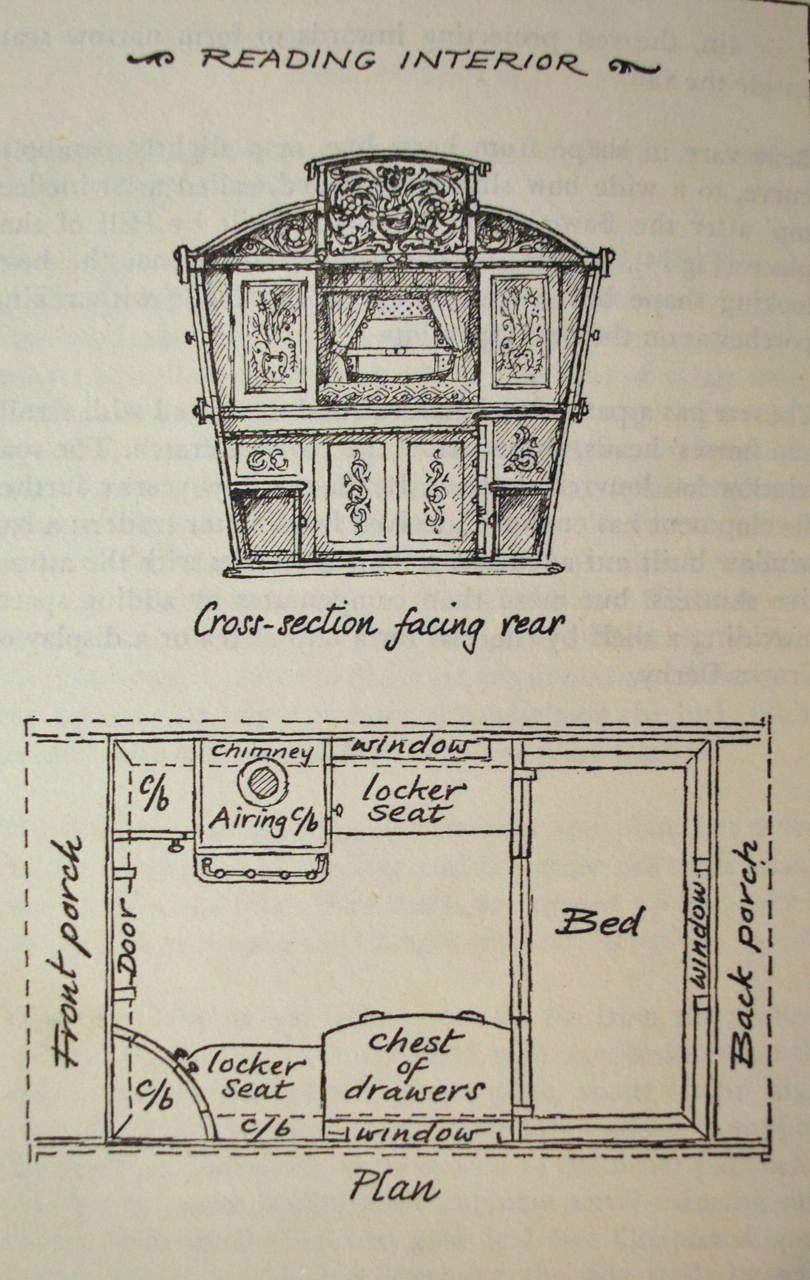
Many considerations concerning floor plans and general layout have come my way over the years. I am compiling as many as possible to post here. To start things off, here is the iconic Reading Waggon by Dunton’s (note: two “g’s” in the older British spelling).
This design is truly the classic. When one sees this, it cries of the open road and Gypsy Wagons. It is Henry David Thoreau’s Walden cabin on wheels. The wide rear axle and narrow front carriage was the best of compromise for agility, weight, and worthiness on and off road. This design is worth a potential builder scrutinizing in detail for it’s perfection of design. A mollycroft roof, high clearance, well-proportioned windows, and solid design make this ideal for the rolling home.
On the downside, kite walls (out-sloping) add some difficulty when working on interior shelves and cabinets. Also, as noted for over a hundred years, the mollycroft can weaken the roof and ultimately increase the chance of leaks. A small price to pay maybe but something to keep in consideration.
The classic caravan at this period included a full chest of drawers and a fairly large stove, limiting seating to a largish space on the stove side and a small dressing seat next to the dresser. Although we read of dozens of children being born and raise in this design, the real layout seems to be based on the couple. Kids will make due.
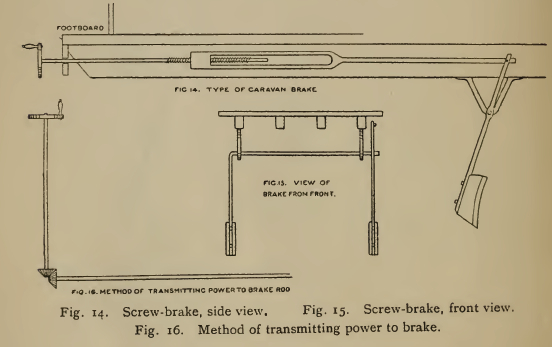
In response to the inquiry about the little wheel on all the old wagons. They also had a drag brake to connect when going up hill to prevent back sliding. The precursor to the auto handbrake.
Here’s a guide to the basic parts of the Reading wagon. Borrowed from The English Gypsy Caravan. Sadly, long out of print.







 Preindustrial Craftsmanship