Still gathering old images of tools, occupations, and craftsmen. Now I just need time to edit and post them in a sensible way. To kick off this series, it’s a wood turner and his lathe from the early 15th century (German). I think the artist may have neglected to show the tool rest here.
This one goes out to Kiko, Mick, and Veloja for their recent enthusiasm for the foot-powered lathe.
Bridgette and I worked on some willow basketry last week at the Echoes in Time gathering in Champoeg, Oregon. We spent the week with our friend Mick and his family with his fantastic vardo.
I have wanted a new pack basket for quite a while and the great Oregon basketmakers provided some excellent materials for the class. I only had eight students for the frame-saw class I was teaching so I was able to work in some baskets around the teaching schedule. I would have loved to document the whole process but I am such a novice that it would have taken three times as long and disrupted the flow of the basket in ways I wasn’t prepared to deal with.
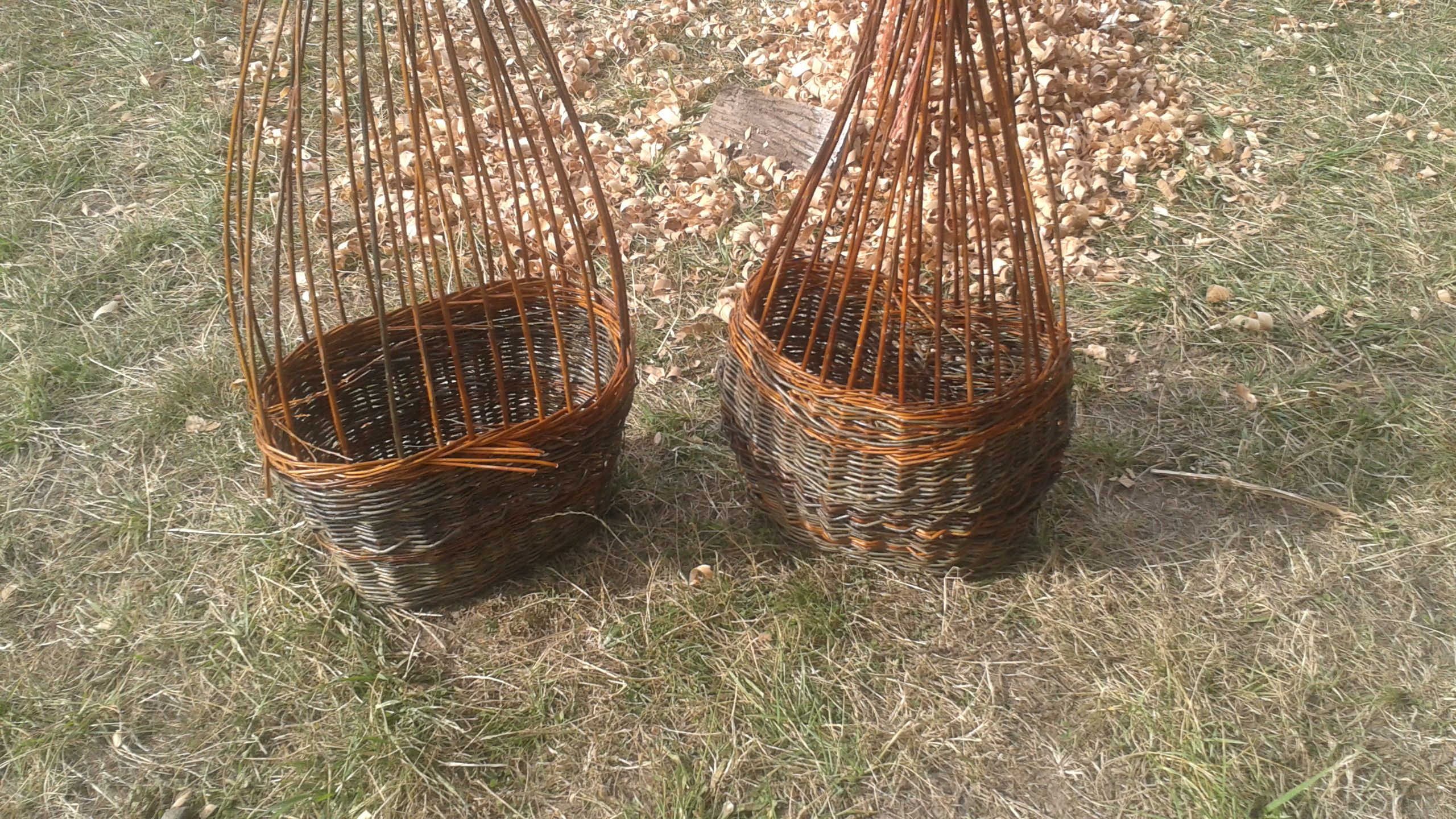
Here is the first round of basket making including the base, addition of spokes, and working with weavers. The various colors come from the different willows harvested at different times. For those truly interested in the weave, this basket consists primarily of wales and rands with the addition of a rim and a foot to protect the bottom.
I’ve made a few other basketry projects under good instructors but this is, by far, my biggest effort to date. I really hope to dive into this craft more deeply sometime in the future. Enough for now, back to Making stuff (right after my nap).
Something to keep in mind when learning a new skill.
A Primitive Technology Disclaimer.
I firmly believe that in Preindustrial Societies, the onus of learning was on the pupil. Anyone who wants to succeed will find a way to learn.
Real learning is an active endeavor. We learn best by carefully observing and doing. There will be failures. There will be frustration and tears. Not everything will be obvious nor will the reason for every step be readily apparent. It is not the duty of the teacher to drag every unwilling pupil along nor argue every point to their satisfaction every step of the way. Failure is not something to fear but is something to learn from. If you don’t like the teacher or the methods, either suck it up or find another teacher.
Continuing my search for backpacks and rucksacks throughout history, I keep coming across various types of boxes and baskets strapped to people’s backs. While querying the web today for variations of the Asian pack box, I saw this nifty solution. Cheap, easy to construct and extremely functional.
I can imagine this as an excellent platform for a street performer or busker. Solidly built, this can be a table or a seat and provides a high degree of protection for the contents. This one is very simply built and harkens back to a medieval concept but note the sweet dovetails holding it together. I just want a peek inside. I would be sorely tempted to fill it with compartments.
“A good meal ought to begin with hunger.” French Proverb.
All animals need to eat. All the time. As humans, we eat every day if we are lucky. An average Westerner will have about 275,000 meals in a lifetime, not including snacks, munchies, and other nibbles. Once upon a time, we all caught, gathered, and ultimately made food for ourselves and our families. If we had some extra, we might have provided for the needy, the unlucky, or even the lazy. If we were entrepreneurial, we might have even exchanged our food for other stuff or services we needed. We cook our food to release nutrients, to make it easier to digest, and ultimately, to make it more delicious. After all, “A clever cook can make good meat of a whetstone” Erasmus.
…or so they say.
Throughout our evolution here on Earth, food never came from an assembly line or even a grocery store. As time went on, we could choose to put some effort into our cooking and make delicious stuff. For this we developed cooking apparatus beyond the simple fire and we adapted just about every food into some sort of cooked dish. As true meat-loving omnivores, humans eat just about anything. “If it has four legs and is not a table, eat it!” Cantonese proverb.
Enough digression, on to some minimalist cooking!
Every cowboy, Boy Scout, and classic camper in North America knows the amazing versatility of the cast iron Dutch Oven. Why “Dutch” you say? Well, those clever craftsmen from the Netherlands perfected sand casting for vessels such as this in the 17th Century and by the first decade of the 18th Century the English copied them perfectly and the name stuck (at least in England and America).
This was not even remotely a new design for cookware, just a new material. A heavy thermal barrier to spread heat and hold a high temperature without drying out the food is a useful innovation. Moving farther afield you can find kindred spirits around the globe serving the same purpose including the Bedourie, the potjiekos, Sač oven, and theNabemono.
The clibanus or Roman clay Dutch oven.
Over on the British Museum Blog Sally Grainger has been writing about her experiments with, among other things, the Roman clibanus (a.k.a. clay Dutch oven). I had no idea that the rimmed lid for holding coals was such an ancient innovation but, of course, it makes perfect sense. Our ancestors were cooking on coals every day after all. There seem to be many variants on this design but the example here is something of an inverted version of our modern oven. The entire lid lifts off to expose the tray or shallow bowl lower portion. This makes for a serving vessel as part of the cooking apparatus.
Just like it’s modern counterpart, an oven like this can be used to cook a wide variety of dishes, from meats, to stews, to breads.
The descendents of this style oven may be seen in the tajine and it’s cousins found all around the Mediterranean, especially in North Africa.
And finally, a relatively simple project for the primitive camp.
A simple, slab-built portable grill could be a useful addition to one’s camp kitchen. Perfect for cooking a Mediterranean meal of shish kebabs and perfect for simple meals anywhere. Recent archaeological work has brought this back to light.
Replicated souvlaki pan from Mycenae ca. 3,500 B.P.
These are a relatively recent discovery in that their use is finally understood. Experimental archaeology is a great thing. Sometimes we can readily predict the answer we know to be correct, but sometimes the process teaches us something and clears up misconceptions lost to time. In this case, a type of artifact called a souvlaki tray of ancient Mycenae (Crete). These date to a period from over 3,200 years ago. These are rectangular ceramic pans that sat underneath skewers of meat, and are generally discovered in fragments. Prior to experimentation, archaeologists were not sure exactly how these were used, whether placed directly over a fire, catching fat drippings from the meat, or if the pans would have held hot coals like a portable barbeque pit. Attempting to cook on them directly over a fire proved useless, as the clay was too thick to allow efficient heat transfer, however, placing coals in the pan made an efficient hibachi-like portable grill.
C. Grocock, and S. Grainger 2006. Apicius: a Critical Edition with Introduction and English Translation. Totnes: Prospect Books. Grainger, S. 1999 Cato’s roman cheesecakes: the baking techniques, Milk: beyond the dairy, Proceedings of the Oxford Symposium on food and cookery, Prospect books Totnes, pp.168-178.
Online:
The Medieval Spanish Chef – Looking for a perfect peacock recipe or interesting ways to cook a horse? Have a few extra rabbit hearts and don’t know what to do with them? Check out Suey on her blog for some really interesting, well-researched Medieval recipes.
Ancientfoods – Exploring the origins and history of food&drink around the world.
Back to the beginnings. Larry Kinsella is a great flint knapper and an all-around talented guy who, amongst other things, recreates stone-age technologies from his home near Cahokia Mounds State Historic Site (one of the great cities of the prehistoric world) in Illinois.
A 6.35 kilogram (14 US pound) nodule of Burlington chert.
Back in 2008, Larry, prompted by Tim Baumann, created a great lithic experiment for a Missouri Archaeology Month poster.
On May 28th,2008, Larry received an e-mail from Dr. Tim Baumann:Larry, “I still need your help with the Missouri Archaeology Month Poster.The theme for 2008 is prehistoric lithic resources in Missouri. The back of the poster will have unmodified samples of chert and other lithic resources used by Native Americans in Missouri. I am working with Jack Ray and utilizing his new book on Ozarks lithic resources. Jack is also organizing the fall symposium on this same topic, which will be held on Saturday, Sept.27 at Meramec State Park in Sullivan, MO. If you would like to give a presentation at this event, please contact Jack.
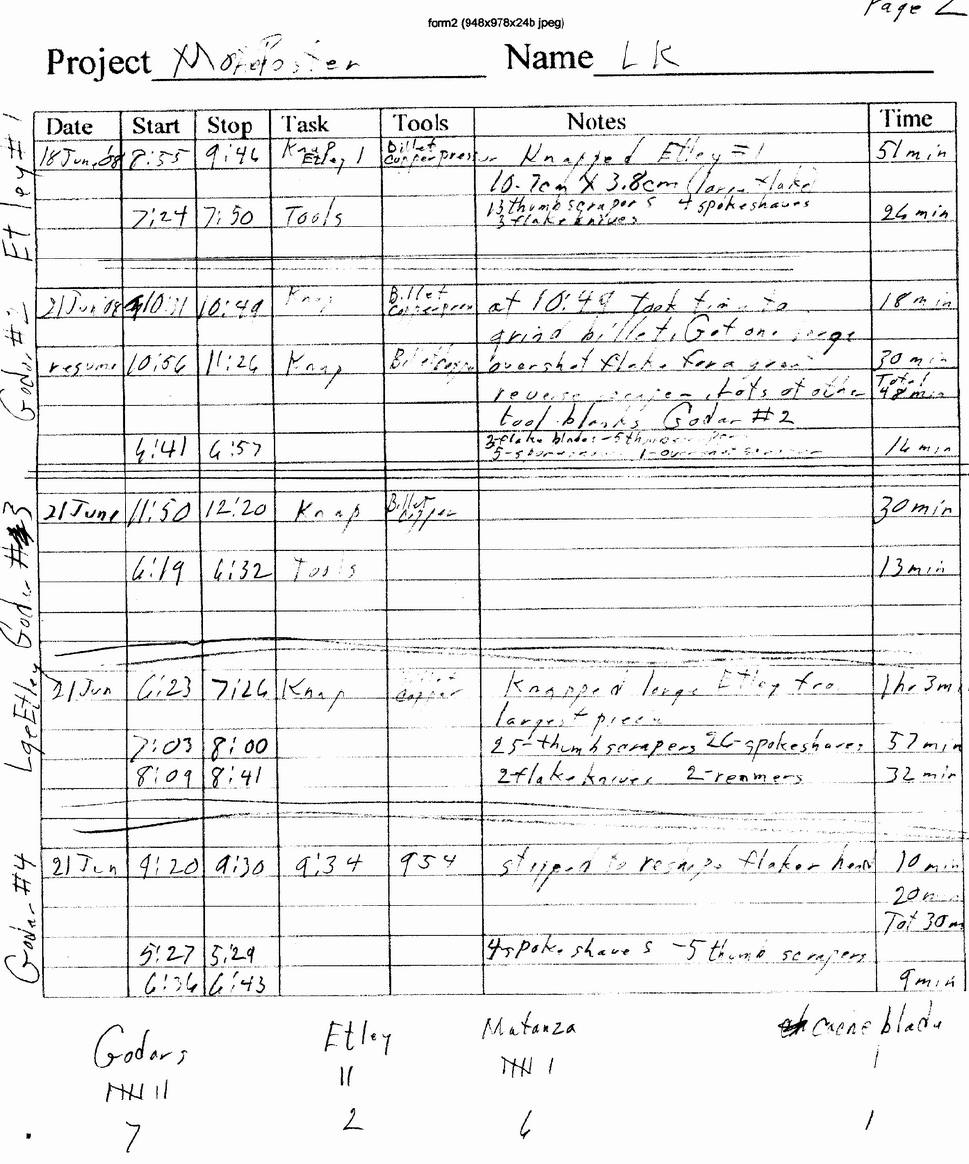
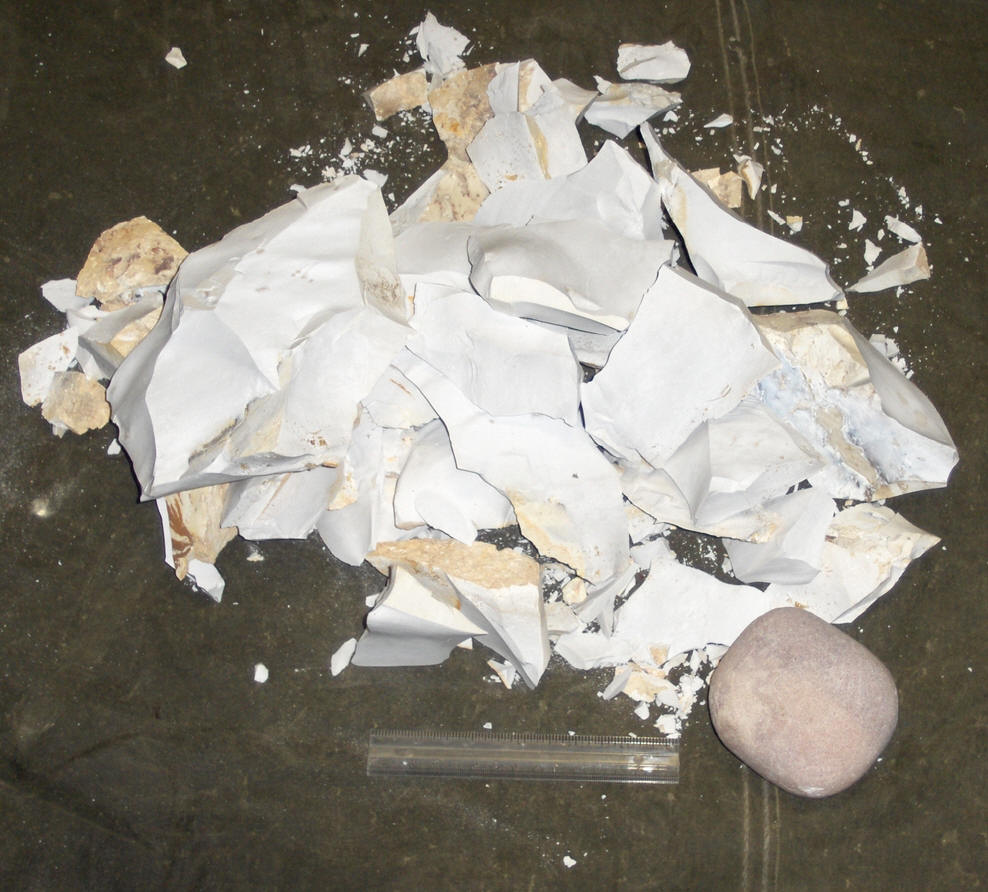
For the front of the poster, I would like to show the entire assemblage of lithic debitage and tools made from a single Burlington chert cobble or similar light colored chert. I was hoping that you and/or some of your friends at the Devil’s hole knap-in would be willing to supply the raw material and muscle to create this assemblage. I will then take the debitage and tools and arrange them with a computer design program into a spiral pattern with a background of obsidian or another dark colored lithic source.”Since this original contact, a few things were changed. Pete Bostrom was asked to do the layout and photography, for one.As with any project, unexpected hurdles arise and it’s up to the participants to modify their strategies and adapt to those hurdles.First: After Larry blanked out the nodule, it became apparent that he was producing much more debitage and many more tools than he had anticipated. That’s when he decided to stick with only a Late Archaic Assemblage. The wide variability in point sizes, shapes, and chert, along with the occurrence of many different types of chert tools, during the Late Archaic, seemed to gravitate toward that time period. Also, the tools could have been heat-treated if the stone had not worked as well as it did.Second: It also became apparent that this project presented a unique opportunity to try to understand the amount of material needed to produce certain point types. So, after the initial photograph of the raw nodule was taken by Pete Bostrom, and at the suggestion of Dr. Baumann, Larry saved all debitage, from all the point-making attempts, separately. This provided the opportunity to not only see what type of point could be made from a single spall but also, the other tools could be isolated to their specific spalls.Third:The sheer amount of material produced during the project, presented Pete Bostrom with problems too. How could he possibly display all that material and make it interesting to the general public? After all, that’s what the poster’s supposed to do, get the general public interested in archaeology.So:1) It was decided to keep all debitage, from each spall, separate.2) Keep separate notes and times on each spall using Larry’s pre-printed forms. Like this: 3) Photograph the resulting point types with their debitage.4) Use the debitage from each point to make additional tools.5) Photograph each point type, its additional tools, and debitage, together.6) Screen all debitage, from each spall, through window screen, to determine how much chert grit would have been available to do core-drilling for other projects, such as, drilling bannerstones.7) Weigh all materials. (Dr. Bauman weighed all the material, in Larry’s absence, due to surgery).8) Present Pete Bostrom with all the material so he could lay out and take the photographs for the poster.9) Present the photos to the printer so the posters could be made.Initial reduction from core to useful materials.
After reduction, each piece took it own trajectory and became a projectile point, other tool, or was cast away as debitage. Students of archaeology (and some professionals I know) can learn much from this type of experiment by examining the range and number of flaking debris generated in a single reduction episode.
After Pete received the materials, he created this excellent poster which is a remarkable work of art in its own right. Have a look at Larry’s pages explaining the process and learn something of the universal human technology that put us, for better or worse, in the place we are today.
Definitely watch this if you believe in a real handcrafted lifestyle. He has obviously been given the right encouragement and access to knowledge. Many parents would scoff at these things or actively discourage some of these activities. I’m glad to know there are other parents out there with an open mind and encouraging this thirst for knowledge. It’s a fire waiting to be fanned.
This is not furniture worthy of the great builders like Peter Follansbee, Chris Schwartz, or Chris Hall. However, it is a piece of functional furniture created from nearly all recycled materials and will hopefully be with me for the rest of my life. I’ve wanted a sea chest for about as long as I’ve known they exist. These are the unit of personal possessions of the old mariners during the heyday of wooden ships and work well as a low table. I’ve put off building one for many years now as I’m fairly lazy at heart (and intimidated by the huge number of dovetails and other joinery involved). But I’m also a schemer and a planner…
When I took up my current post it had a fairly rocky start and I prepared for the worst. Instead of filling my small house with bulky furniture, I built nearly everything from dimensional lumber, primarily 1 x 12″ pine as it is ultimately recyclable. While rearranging the house over the winter I decided to remove a large set of shelves that were not being used very well. This left me with a hefty pile of very dry, aged pine that now needed a purpose. I decided these would just about serve to make a trunk of some sort and convinced myself to knock up a sea chest.
Being a 21st century guy without huge swaths of time for fine woodworking, I built this fancy box without any complex joinery, just stainless steel fasteners and wood glue. The only purchased materials were the hinges, hasp, and Cabot’s Wood Finish (color: Midnight). So, for a few bucks, a few weekends and evenings, and a little labor, I now have a sea chest to hold my coveted earthly possessions.
The chest is based on several 18th and 19th century sea chests I have seen with a lift out tray and a solid box for small objects. The outer dimensions of the chest are 34 1/2″ x 19″ deep x 18″ high giving an internal volume of nearly 8700 cubic inches or a little over 5 cubic feet. That is about two large backpacks worth of space for possessions. Not too bad.
I should note that some scraps from the barn were added to complete the project. The strakes that hold the handles are oak and the floor of the chest is made from tongue-and-groove yellow pine, left over from previous projects. At the time of this post, I consider the chest about 90% complete. The 5/8″ manilla handles will soon be covered with leather, and the lid support will be replaced with something a little nicer (it is just black para-cord at the moment). Also, the interior needs a finish, probably shellac, to avoid the off-gassing of regular varnish.
I hope this motivates someone else to forgo garbage, mass-produce, pressboard furniture. It is more than possible to make something worthwhile and lasting from the poor end of the lumber yard.

 Still gathering old images of tools, occupations, and craftsmen. Now I just need time to edit and post them in a sensible way. To kick off this series, it’s a wood turner and his lathe from the early 15th century (German). I think the artist may have neglected to show the tool rest here.




 Preindustrial Craftsmanship