Weekend Sawbench

A Saw horse or a full-size workbench, for Hobbits?

Baumeister_-_Holzschnitt_von_Jost_Amman_-_1536.svgLiving where I do, without a proper workshop, I have moved to a more portable setup.  Along with this, I have pared down by letting go a number of cumbersome tools.  However, a flat, solid surface is sorely missed.

shaving-horse
A less messy version of my current shop.

I find myself working on the seat of the shave-horse or on top of saw horses quite a bit with my small table-saw serving as a layout table (when the project is small enough).  And yes, I do miss the full-size table saw for ripping long boards.
75-Amb-2-317-21-r.tif
Here’s a recent photo of me in my make-shift workshop.

A little over a year ago I began scheming for a small, pre-industrial-style setup.  Something an itinerant carpenter or bodger would be likely to use.  It needed to be easy to move and store but provide a solid clamping and layout surface.  I wanted it at the same height as my shave-horse so that they will work in concert for large projects.  So, when my friend Mick gave me a thick, rough-sawn maple board last summer, I decided it was to become the top of a new saw bench.

First, before the mail comes flooding in;

there is no perfect formula for a saw bench!  For thoughts about height, look here: “A Proper Saw Horse.”

There are some wrong and right things to do, but all in all, there are as many combinations as there are woodworkers.  Much depends on what you make and how you work.  I am 6’1″ and after much changing and experimentation, I use 22″ tall benches for hand work.

“Off-side” of the saw bench under construction.


For what it’s worth, here is the bench I came up with last weekend.  It maybe grew a little too much, trying to more than a saw horse, but still not a Roubo.
roubogermanbench
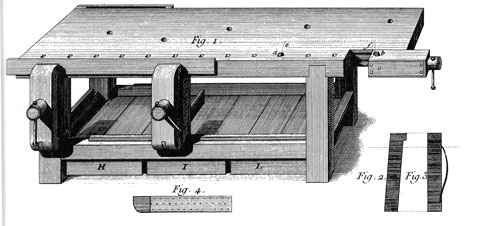
Roubo’s bench.

Materials: All of the materials for this project, other than lag bolts and a few stainless steel screws, came from the scrap pile; all recycled lumber except the top which came from Mick.  Legs and bracing are constructed from oak while the till bottom is dimensional pine from an old shelf.  The legs are splayed at 12 degrees in both dimensions.  Dog holes for stops and holdfasts will be added soon.  The little vise was a last minute addition as it’s never a bad thing to have too many ways to hold things.  This increased the project price to just over $20 US.

DSC_0001
A work in progress, but coming together.

Had I considered the vise sooner I probably would have positioned the legs to place it closer to the left end but this will due.  The little hardware till on the top will hold those wily drill bits and pesky chisels looking for an escape as well as corralling screws, pencils, and marking knife.  More work will be done, and I’m considering a second till near the bottom of the legs to store the shooting board and bench hook as well as a safe place to set a saw while working outdoors.

Comments and criticisms are certainly welcome and more information about this project will be forthcoming in the near future.

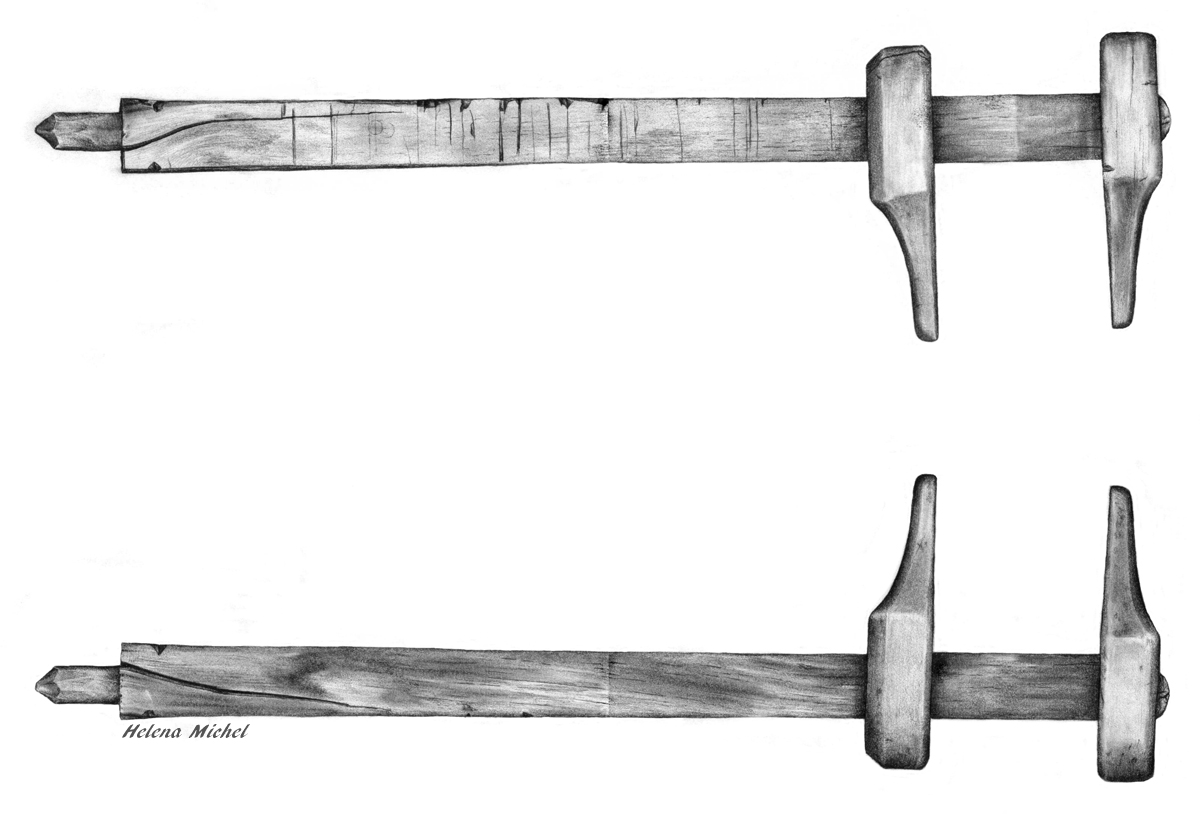
Medieval Caliper

I believe this is my new favorite blog.  A remarkable archaeological illustrator with some very interesting artifacts.  I never even considered the antiquity of sliding calipers.  I hope she puts more illustrations up sometime!

helenamichel's avatararchaeological illustrations

Late medieval wooden artefact: caliper, found in latrine in Gdansk, Poland. Hand drawing by Helena Michel, pencil on paper technique.

Ilustracja archeologiczna późnośredniowiecznej drewnianej suwmiarki, znalezionej w latrynie podczas wykopalisk na terenie Centrum Dominikańskiego w Gdańsku. Rysunek odręczy na papierze, autor: Helena Michel

archeological illustration

archeological illustration by Helena Michel

archaeological medieval artefact

View original post

Yucca Fiber Skirt

A great yucca fiber project. Check this out and more good stuff on UncommonCate.

uncommoncate's avatarUncommonCate

Yucca fiber processing is an ancient art. I first became interested in yucca fiber in my time at The Clovis Site (an important archaeological site on the high plains of New Mexico). People have used yucca for ages past in every form. From raw leaves, to finely spun yucca yarn, the leaves have been used in every form. The book Treading in the Past: Sandals of the Anasazi showcases many excellent examples of yucca fiber in all forms as used in sandals. Yucca is also used for cordage, bags, nets, and really anything fiber related.

yuccaskirt4yuccaskirt5

I start by chopping down a yucca plant. I happen to have access to narrow leaf yucca. All I use is an ax. The difficulty with yucca is the pointed tips, so I begin by gathering the leaves up, holding them up with one hand, leaving the base of the plant exposed. With the other…

View original post 355 more words

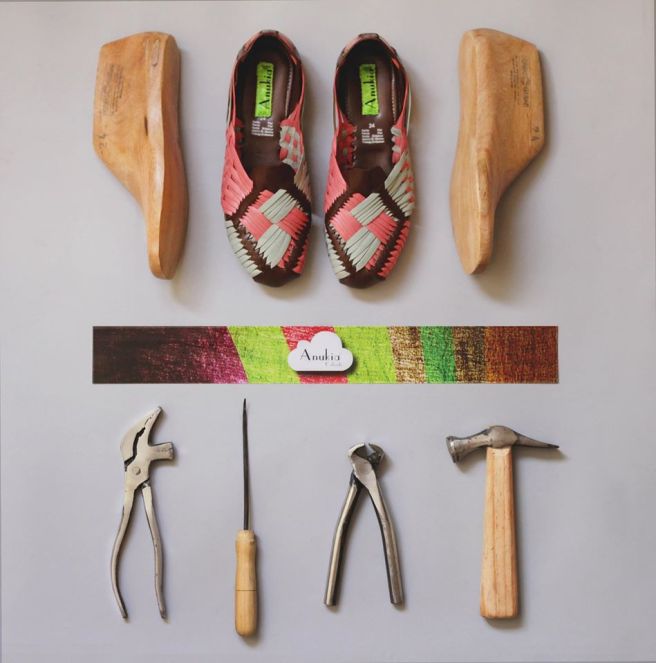
Mid-Cut Huaraches From Tuxpan, Jalisco

These are beauties.

huaracheblog's avatarHuarache Blog

Tuxpan in Southern Jalisco is a small town well known for its Tacos “Tuxpenos” and less known for its unique Mid-Cut Huarache style.

That being nowadays said their is so little demand for the Tuxpan Huarache “Tejido con Talonera Alta” that it can only be made on to order by the only remaining Huarachero in Tuxpan, Armando Ortiz, whose other styles can also be seen in The Huarache Directory HERE

tuxpan side 34

tuxpan back 34

tuxpan multiview  Huaracheria Ortiz

View original post

Medieval Tinsmith

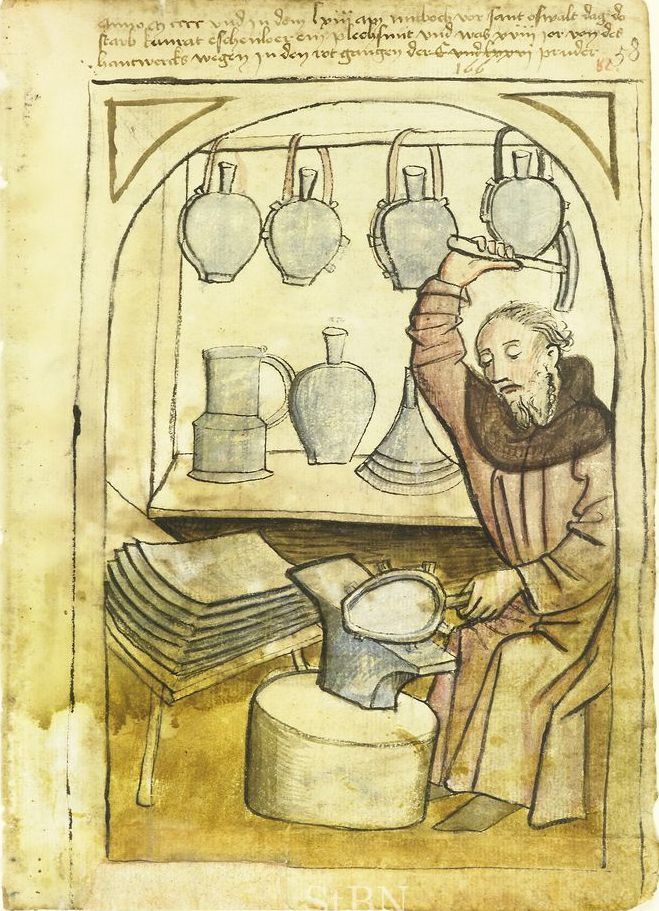
Tinsmiths were the sheet metal workers of the preindustrial days in Europe, the Middle East, and Asia.  This almost certainly includes Africa as well but I haven’t been able to find any depictions yet.  These craftsmen created many everyday objects and mended all sorts of metal.

75-Amb-2-317-82-r.tifHere we see a smith creating a flask.  I doubt he would be whacking it from that height but old images of carpenters and smiths use this convention to show the movement.  Behind him are some of his wares including a pitcher, something shaped like a bottle, and a pile of funnels.  A stack of prepared metal sheets sits on a table next to him.

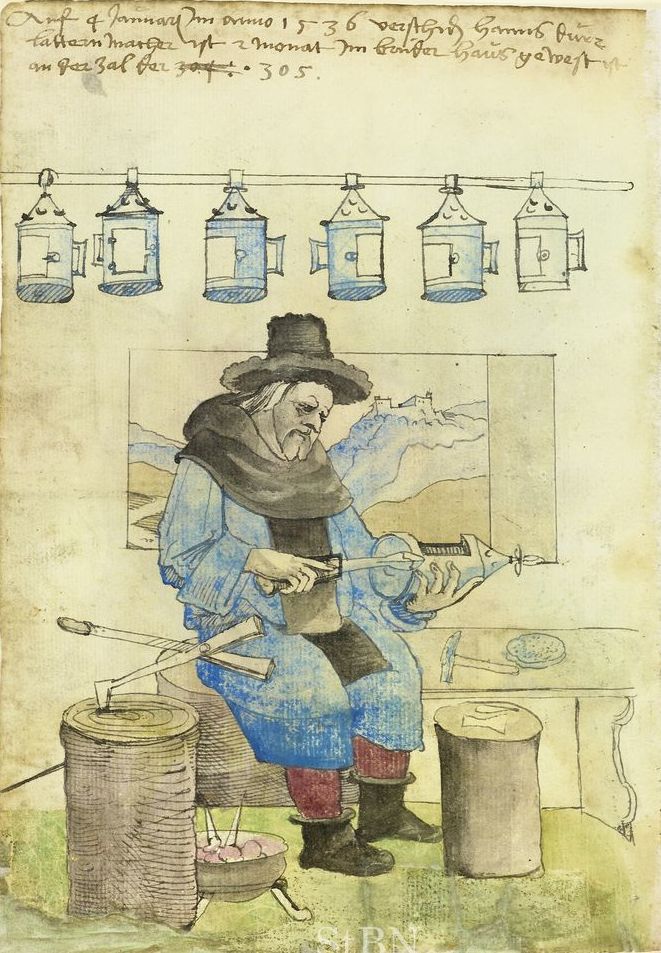
75-Amb-2-317-155-v.tifThe lantern maker has more great tools.  He is set up in front of the window for light.  His work surfaces are stumps but his bench is a fancy trestle type, not the typical tenon leg affair one normally sees from this period of history.  In this image, the smith is in the act of soldering the base onto the lantern.  This is the oldest image I have found, so far, of a soldering iron in use.  The little three-legged pot on the floor is a brazier, holding coals to heat the iron and he has a pretty nifty stake tool on the bench.  I think it’s a shears but please correct me if I’m wrong on that one.

A Couple More Medieval Tools

When I say Medieval…

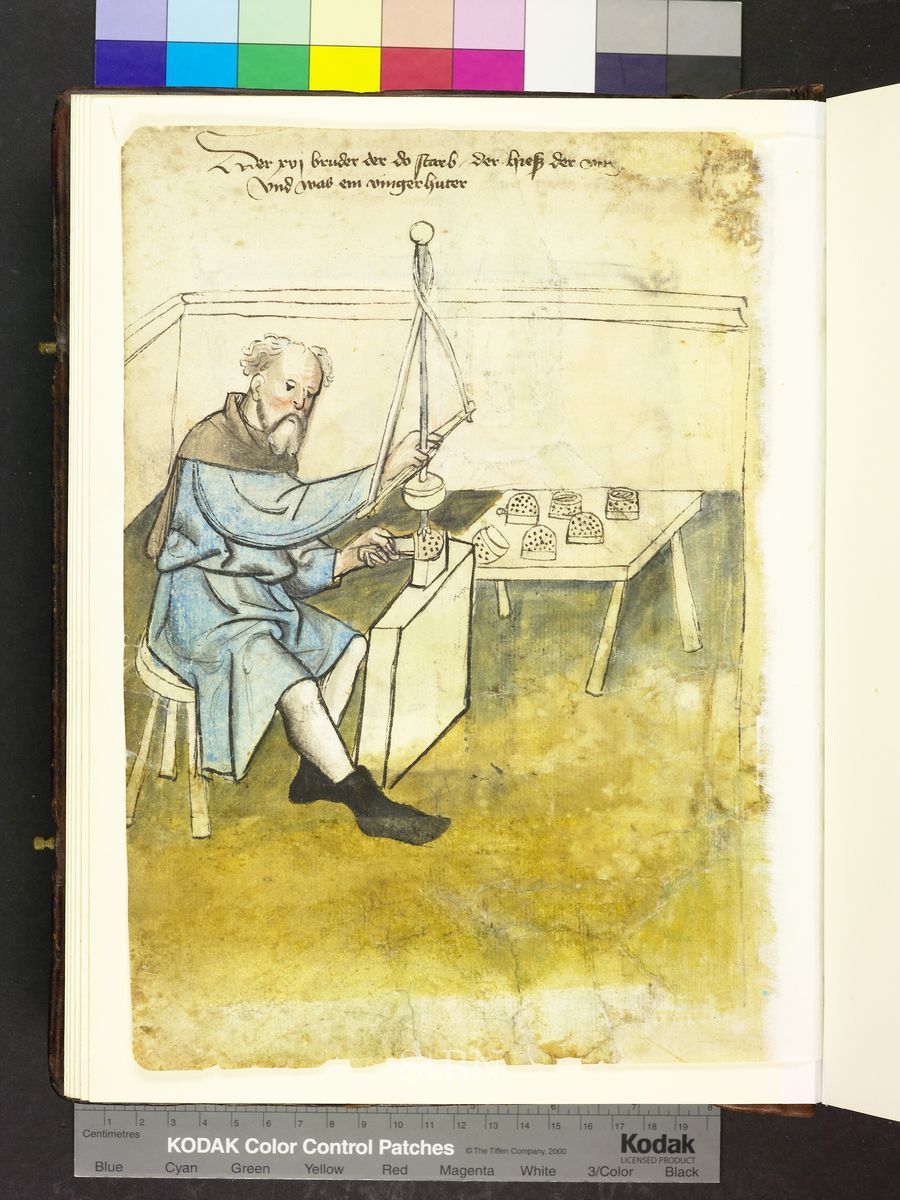
The pump drill goes way back in time.  At least into Dynastic Egypt and probably well beyond.  Drills like these are made from perishable materials so we only have the drill bits and generally do not know to what they were attached.  From and archaeological point of view, it’s a bit like trying to decipher a battle by looking at the spent bullets.

75-Amb-2-317-5-v.tifAgain, this one is from 1425.  The caption says he is a vingerhuter which I think would now mean thimble-maker.  Any help with this will be appreciated.  These things look more like wine strainers or little colanders to me.  Anyway, the important part to see is the awesome pump-drill and the small block on which he is working.

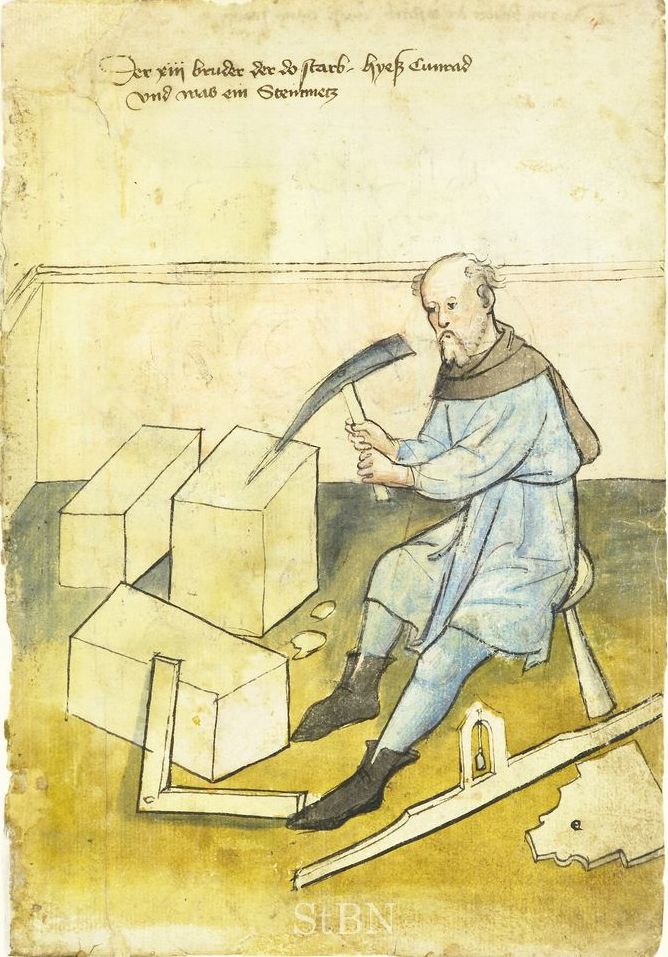
The next image is a stone mason at work.  I’m not a stone worker myself but I’m intrigued by a couple of his tools.

75-Amb-2-317-4-r.tifNot only does he have nice square and template but is sitting near his sighting level.  In the days before spirit levels, this involved a little plummet hung in an arc on a straight edge.  A bit like a sophisticated winding stick.  Oddly enough, no dividers are visible to round out the trio of masonic symbolism.

Carpenter, 15th-16th Century

Prior to power sawmills and corporate lumber production, much of the carpenter’s project time was filled with simply making trees into boards. Most illustrations I have found of preindustrial carpenters feature someone hewing, planing, or chiseling with the occasional scene of sawing a board to length or width.

An image is just as much about what is chosen for inclusion as that is left out.

I love to ponder the details of old illustrations and paintings to really see what the artist was trying to show us. These images are no doubt biased in what they choose to show; and for good reason. There is a semiotic tradition in Medieval illustration to choose certain symbols to denote specific trades or historical characters and it should be remembered that the illustrators are not necessarily experts with the trade they are depicting.

75-Amb-2-317-21-r.tif
If I were to let my hair and beard grow out a bit, I think I could pass for this guy.

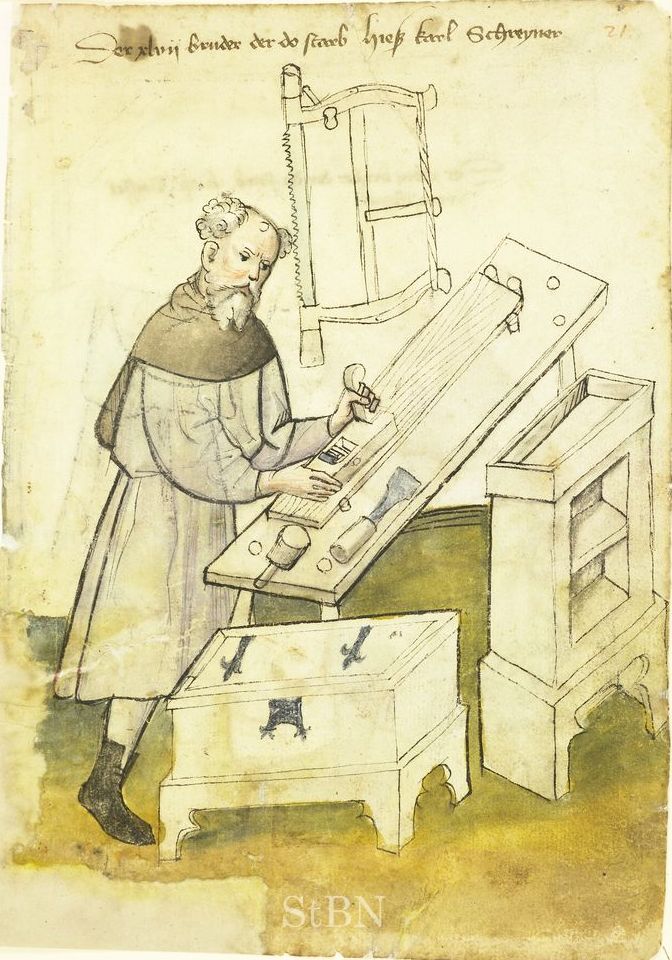
Here we have the same carpenter from a previous post dated to around 1414.

The foreground holds a familiar skirted six-board chest with iron hinges and an escutcheon plate around the presumed locking mechanism. Either he is building these or perhaps it holds his tools. Beside it is a nice little cabinet of similar construction. He is working on a simple European bench with through-tenon legs, popular since the later Iron Age. His board is secured simply by four bench dogs.

Only four hand tools are shown. The frame saw, plane, chisel, and mallet. No doubt his dividers, straight edge, and winding sticks are in the box.

75-Amb-2-279-12-v.tif

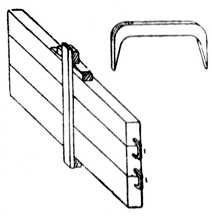
Just for fun, here’s another carpenter from about a hundred years later hewing a board to size with a bearded broad-axe. The work sits on a pair of saw horses with the typical tenon legs. Also, note the iron dogs used to secure the board to the horses. Living in the era of screw clamps, we don’t use these as much but they are still occasionally found holding boards while being glued like so:

clamping dogs

And finally, a late 16th century carpenter cross-cutting a plank. I like this image as it depicts more tools, though in less detail. Chisels, hammers, and a square hang on the wall, a plane sits in the background, and the broad-axe sits on the floor next to the hewing stump. The frame saw hasn’t changed at all. I don’t know if the supprt under the board is unique but it appears to be stepped to hold planks at graduated levels. Pretty nifty if you ask me. And finally, a couple of details about the clothes; I love the sagging stockings and the patched elbow of his shirt. Definitely dressed for work.

75-Amb-2-317b-50-r.tif

Looking Back at the Horse

Tools and work benches always create lots of discussion and bring out opinions.  I am re-posting a couple pictures that feature my bodger horse as it has created a few new comments.  This horse has been slightly modified over the years but is essentially the same as when it was made 5 or 6 years ago.  For most of what I do, this tool is just about perfect.  Comments are always welcome.

h1When I built this one, I had a full-size, long-bed truck.  Now, driving a smaller vehicle, I am considering re-engineering the whole thing to break down for packing.  If I stayed in one place regularly, this wouldn’t be a problem but I use it for teaching and demonstrations and is a little gangly to pack as is.  She traveled over 4000 miles with me this summer to a reenactment/demonstration and helped me teach a small woodworking class for a week.

h2Even though this one is just fine and went together quickly, the next time I build one I intend to fancy it up with some fancy joinery.

DSC_0126A work horse like this becomes the center of the portable workshop and can serve many purposes.

bodger15As I make modifications, I will update on this page as information on shaving horses is limited, even in the age of the internet.


Save