A Happy Accident

Stopping by the Bois D’Arc Knap-in recently I got to see some remarkable works of art and a few natural wonders as well.  My friend Regan showed my a little treat he discovered in a Burlington Chert core he was reducing to make some stone tools.  There was obviously a band of crystals crossing the stone but little did he know that while removing this imperfection he would find a real gem inside.  A Mississippian-age brachiopod was hidden inside for 325,000,000+ years!  This makes him the first mammal to ever see it.  I enjoy that kind of perspective on the universe as we sometimes forget the significance of the little things.
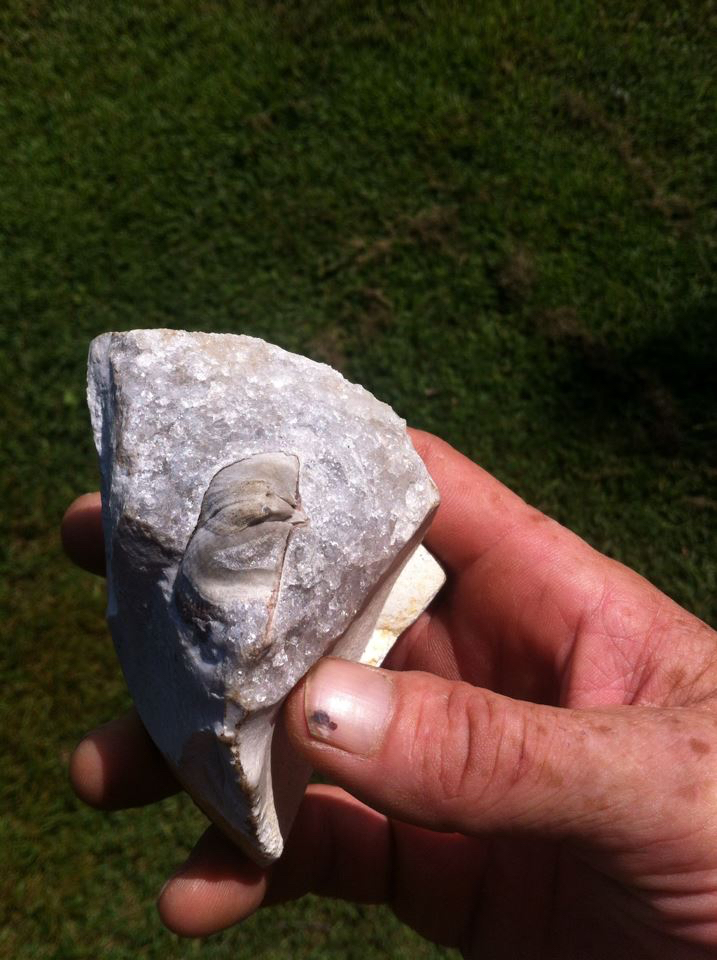
I was a little distracted the day Regan showed this to me so I didn't photograph it. He was kind enough to send along this photo.
I was a little distracted the day Regan showed this to me so I didn’t photograph it. He was kind enough to send along this photo.

Here’s a little more information about this sort of life-form from the Illinois State Geological Survey:

Click the image to go to the Brachiopod web page.


Rancho La Brea Photo Album

George Crawford's avatarTHE ACCIDENTAL ARCHAEOLOGIST

I was invited to give some talks in southern California and my spare time allowed for an exciting visit to one of my favorite sites in the Los Angeles area, the Page Museum at the La Brea Tar Pits.  Now in their one hundredth year of excavation, the site has yielded over 600 species to date with a NISP of over 3.5 million (not counting over 200 species of bacteria).  It’s a remarkable place and I feel privileged to to have been given an excellent personal tour by none other than Dr. John Harris and Curator/Collections Manager Gary Takeuchi.  Tar still bubbles and oozes and excavations continue, thanks in part to continuing growth of this highly urbanized area.

Although most of the tar seeps are closed off for safety, a couple can still be accessed with a guide.  The surface is just as deceptive as it is described…

View original post 245 more words

30,000 year old mammoth

A couple of months ago, Yevgeny Salinder, an 11 year old Russian boy, discovered a 30,000 year old mammoth thawing from the permafrost in the arctic Krasnoyarsk region. I have been hoping to hear more about this remarkable find but, of course, these things take time.

Image

There is already some important information coming out about this find, including the discovery of large fat storage in the form of a hump on the mammoth’s back, confirming images from the Pleistocene depicting the humped back.  Previously the hump in the art work was attributed to large thoracic spines but now it seems to be more camel-like soft tissue.  Intact organs should tell us more about the animal and it’s environment than we have known.  As the Arctic ice recedes, it seems we will find more and more of these specimens being exposed.

Links to this story can be found here:

http://english.pravda.ru/science/earth/04-10-2012/122353-mammoth_remains_found-0/

http://themoscownews.com/russia/20121004/190314709.html

http://www.huffingtonpost.com/2012/10/04/zhenya-mammoth-find-russia_n_1940791.html?utm_hp_ref=unearthed