A nice bowtop wagon from Traveller Dave’s website. There are many “real” living wagons and rolling homes there in case you are in need of inspiration.
 I like the window but the builder in me sees it as a sure source of leaks.
Adventures of an Imperfect Man In Search of a Handmade Life

A nice bowtop wagon from Traveller Dave’s website. There are many “real” living wagons and rolling homes there in case you are in need of inspiration.
I like the window but the builder in me sees it as a sure source of leaks.
…and Some Other Nice Work

Daphne at Daphne’s Caravans has been busy this summer and appears to have another beautiful wagon nearly ready to sell. Her description is “all cedar, with a roof like a cedar strip canoe. 7′ long, 6′ wide at the ledge, and 6′ high in the centre.” I presume the roof will be epoxied over glass or there will be a covering over the entire thing. If you’ve wanted your very own mini caravan but don’t have the time, tools, or inclination, this might be one for you.
Below is another creation of hers from earlier this summer. Click the photo to see more at her website.

If I lived in Britain or France, I would want to live aboard a narrowboat. Like the name suggests, these small ships are long and narrow, designed to navigate the extensive canal system throughout much of country.

At about seven feet wide, interior design is obviously very linear but there is little to constrain length, other than the size of the locks connecting the waterways. Often brightly painted, these floating homes have a real appeal for someone with a nomadic heart.
While looking for images of narrowboats, I found a short piece by Shelley Davis recently posted on Kent Griswold’s Tiny House Blog.
 The waterways have real appeal to me. Growing up near the Mississippi River gave me dreams of Huck Finn and Tom Sawyer adventures. As a kid it was a dream to have a little boat and float all the way from the creek in my back yard to New Orleans and into the Gulf of Mexico.


The above photos are from the Tiny House Blog article. As can be seen from this micro kitchen, efficiency is paramount in a tiny home. There are a lot of good ideas and inspiration to be gleaned from these amazing structures.

Early in the planning stage while designing my ‘van, I encountered this painting by Vincent van Gogh. Painted in the late 19th Century, it is, to me, a great image of what is now a bygone era in Europe. Who knows, if the economy collapses, and the disparity between the rich and poor increases, maybe this will become a common sight again.
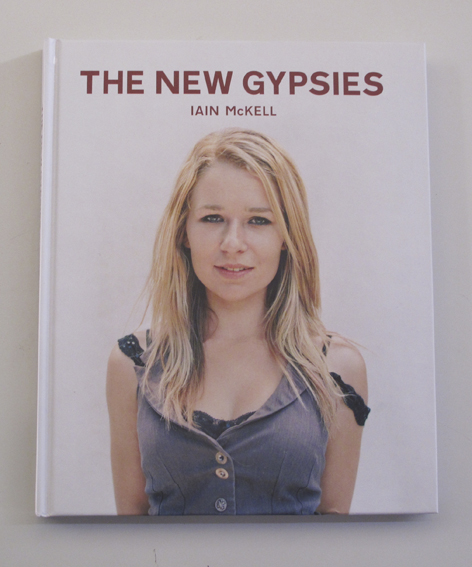
I have seen photos from this book around the web for a while now. A fair number of “hippie” Brits are living mobile, a difficult thing to do in the U.S. Iain McKell has done a wonderful job of photo-documenting the unique, beautiful, sometime spartan accommodations used by these folks on the move. If I get back to Britain I will try to track these people down.
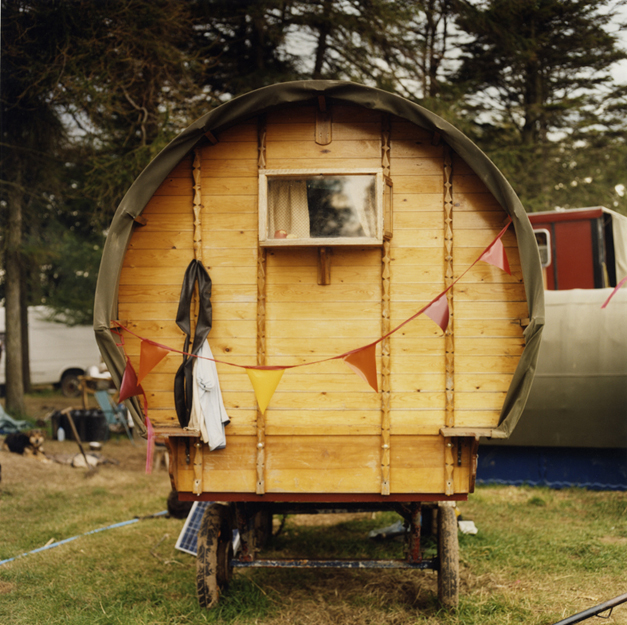
I have to admit, I’m mainly in it for the wagons. None of these look like high-speed movers, but who really needs that when it is home?
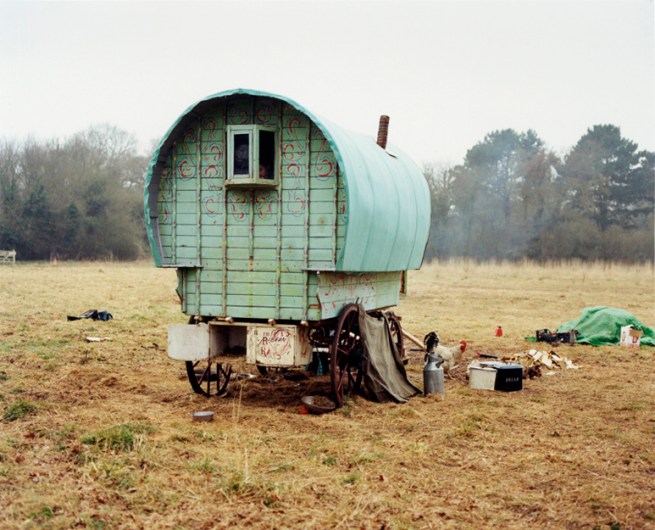
Most of these clearly appear to be restored (more or less) original horse-drawn wagons. Bow Tops, Open Lots, a Showman or two, but others look to be a bit more home-grown.
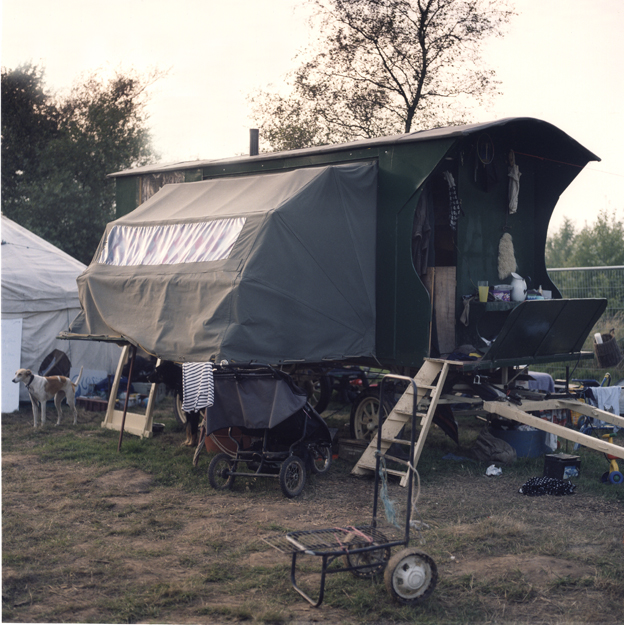
A close examination of the photos show some interesting clues to life on the road. I particularly like the “tip out” on the above wagon. I suspect it is for sleeping more people but I can imagine an outside space protected like this for cooking or storage. Hmmm, next project?
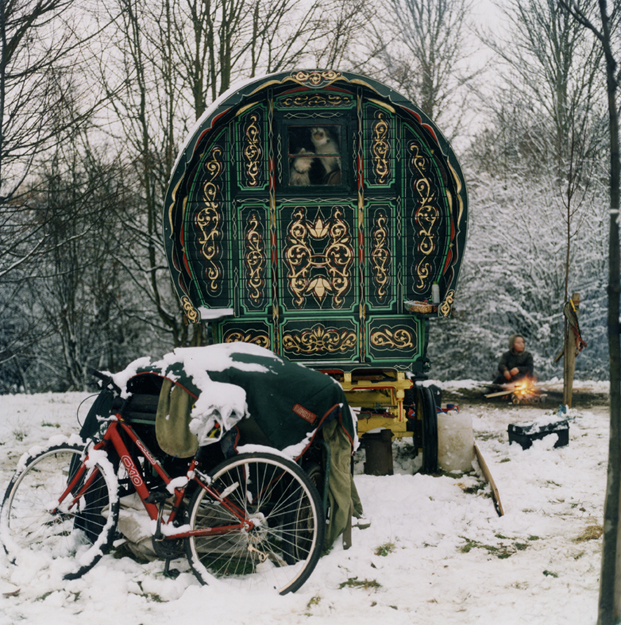
In my opinion, wagons like this are a great alternative for the modern nomad, as long as one can find a safe place to settle for the night or week or month. As with the Romani gypsies, modern travelers, living outside the norm of the greater social group are likely always to face fear and suspicion from the mainstream culture. Unfortunately, this will probably always be the way of the world.
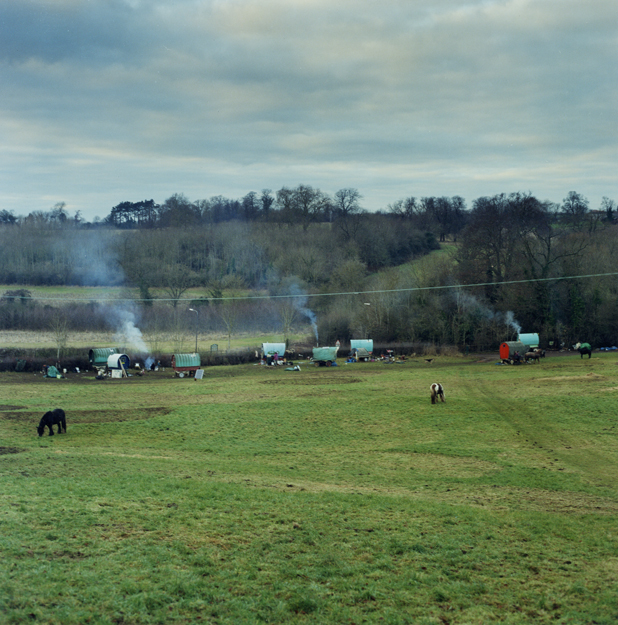
I think there will always be some of us who are okay existing outside the “normal”, expected behaviors of our peers. In a case such as this, or other fringe social groups (e.g., the Society of Primitive Technology) we can find kindred spirits who may understand our outlook in ways not found in more mainstream lifestyles.
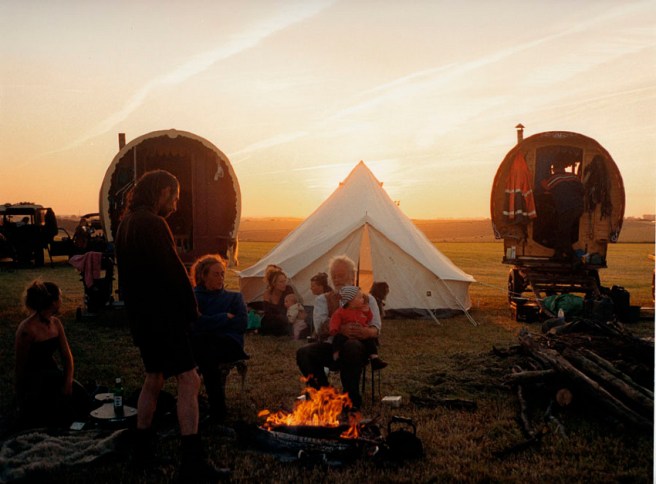
Please have a look at the art of Iain McKell and be sure to scroll down the left side of links to see more of his photos, including some fine shots of traveler’s wagons.
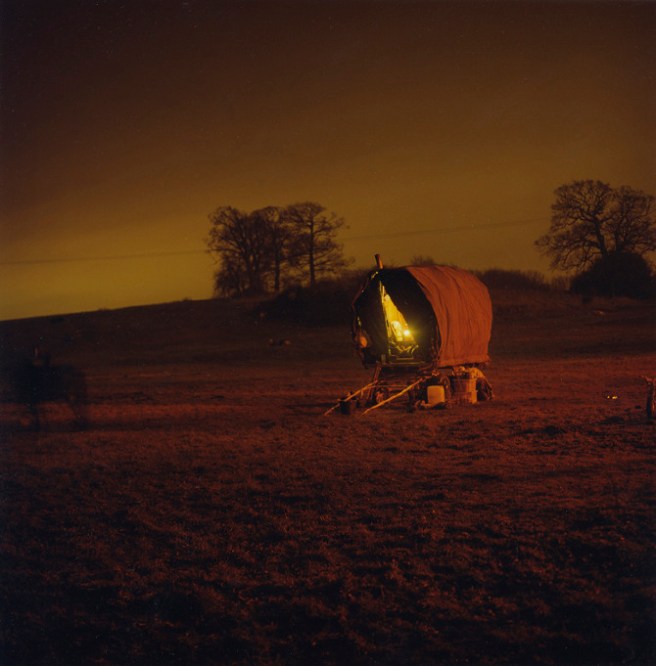
The following are plans from The English Gypsy Caravan. This book taught me a lot about layout in such a small space. There is rarely anything new under the sun and the early builders thought through the process quite thoroughly.

The figure numbers on the images are from the book. The above is a classic “Open Lot”. Essentially the simplest of the caravan designs. More sturdy than something like an American Conestoga as the walls are at least partially wood lined and there are a couple built-in cabinets. This could suit a couple people fairly well.
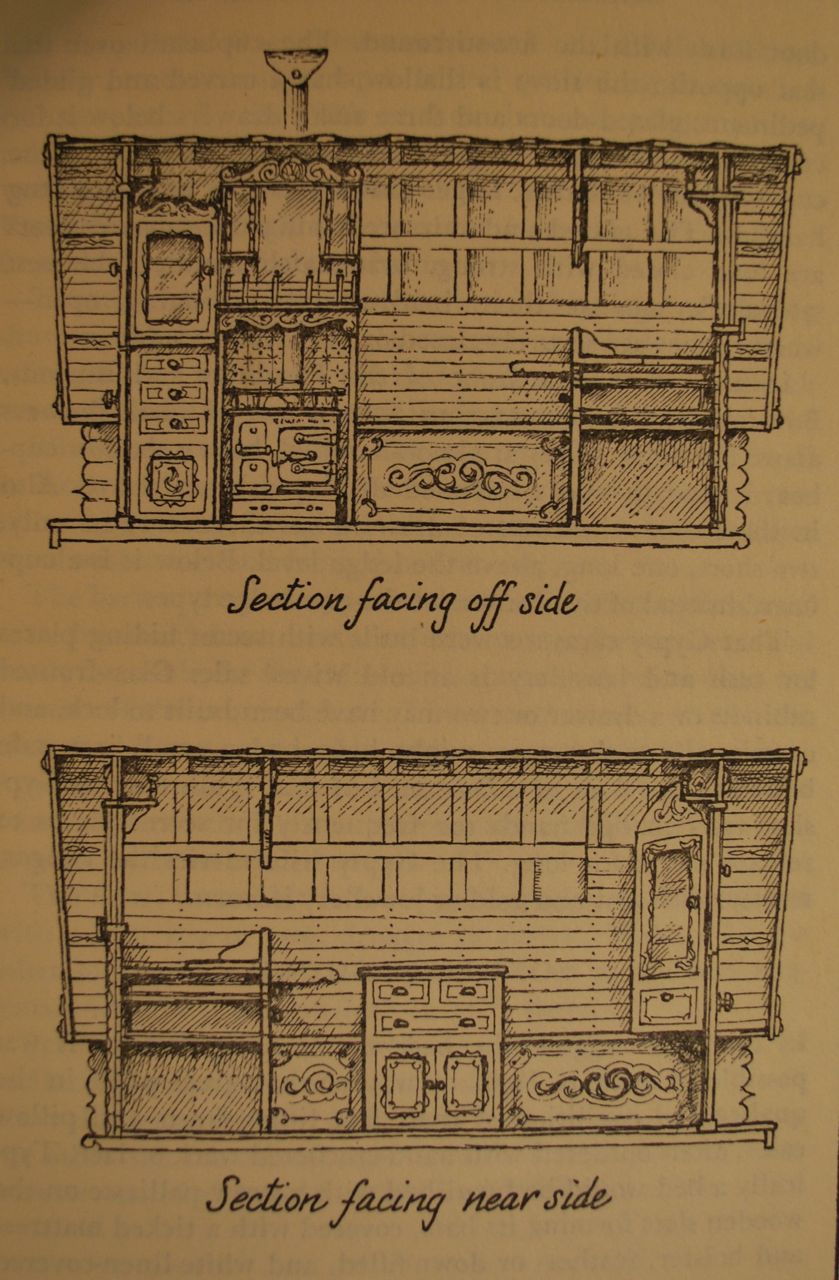
The “Bow Top” is a more sophisticated version of the Open Lot. More cabinetry, a small cook stove, and some shelving. Notice the corner cabinets to use the vertical space in both the above plans.

Finally, the famous Reading Wagon. This is what most people envision when they think of the gypsy caravan or wagon. Kite-shaped from the end-view, this wagon has a lot of useful indoor space. Cupboards and underseat storage are integrated and these generally have substantial chest-of-drawers built in. The later roofs had mollycrofts to allow more light and the walls were decked out with mirrors to give the illusion of spaciousness. Straight wooden walls lend themselves to hooks, pictures, or small shelves everywhere. At about ten feet long, this was and is the epitome of traveling luxury.
The door is nearly done and the new window is installed. I am loving it and with a few more tweaks, it will be done. I finally put a good coat of Valspar paint on it and really like the new color.


A new design for the vardo world with the folding bow-top. It has a great design as it will be light-weight yet roomy.

Excellent details so far. I can’t wait to see it in person when we can “circle the wagons”. Click the photo or the link below to see more.
A photo of the new “porch”. I didn’t really need more sticking out in the back but it will serve as a bumper and handy surface I’m sure.

And a drying rack over the stove area. The hooks will be useful for lanterns, tools, cookware, and wet socks.
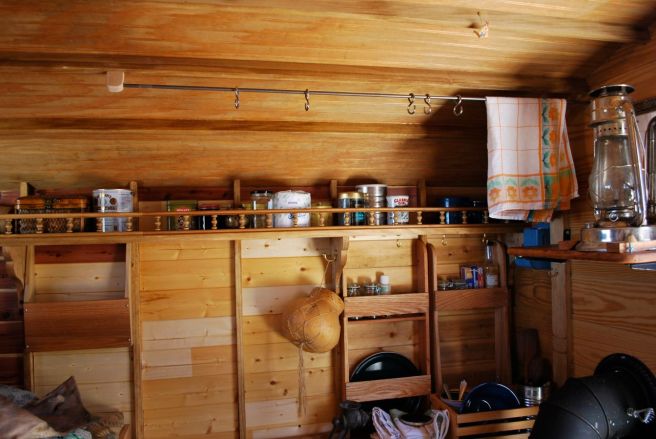 With such limited space (about 50 sq. ft.) pegs, hooks, and little storage bins tucked away in all the furniture make all the difference. Click either photo to get to the rest of the vardo photos.


 Preindustrial Craftsmanship