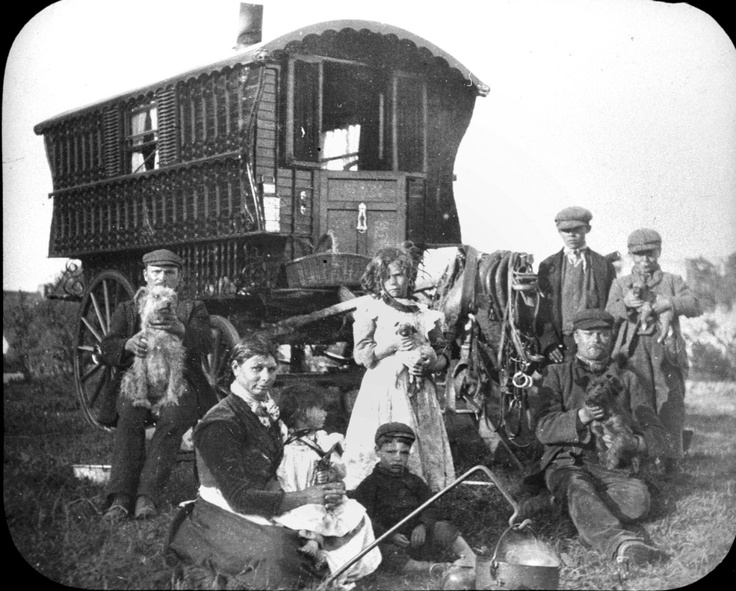
Travellers….
Adventures of an Imperfect Man In Search of a Handmade Life


“That’s everything I own. 288 things. Count them if you’d like. The nicest thing about creating this list is that I actually use everything I own. There is not a kitchen item or a piece of furniture or an article of clothing that I do not use regularly. It’s an amazing feeling.” Click here to read the full text of his excellent essay.
Next time: my move toward Minimalism and the search for balance.
As unveiled at Winter Count 2014 near Maricopa, Arizona.
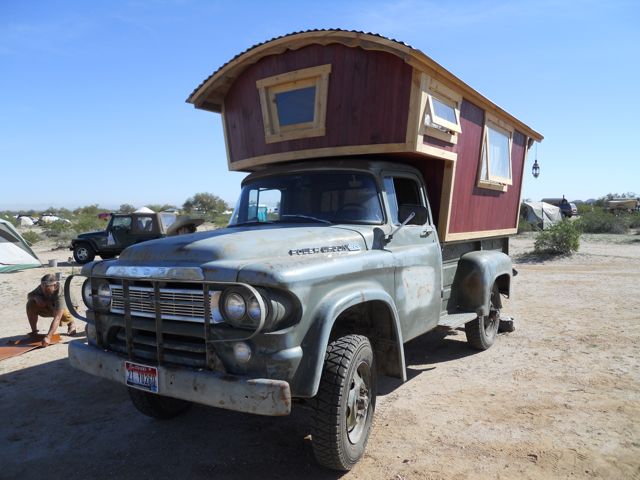
 This classic kite shaped beauty is built into the bed of an old Dodge Power Wagon. Like all projects of this nature, she’s a work in progress but is already and awe-inspiring thing of beauty.
 The layout is a traditional elevated cross-bed with a kitchen down one side with additional storage and seating down the other. A clever table is concealed under the counter and pulls out to be utilized from side-by-side seating.
 The tail gate porch is an excellent addition to the space.

 Best of luck to both Jed and Hilary in their future adventures.
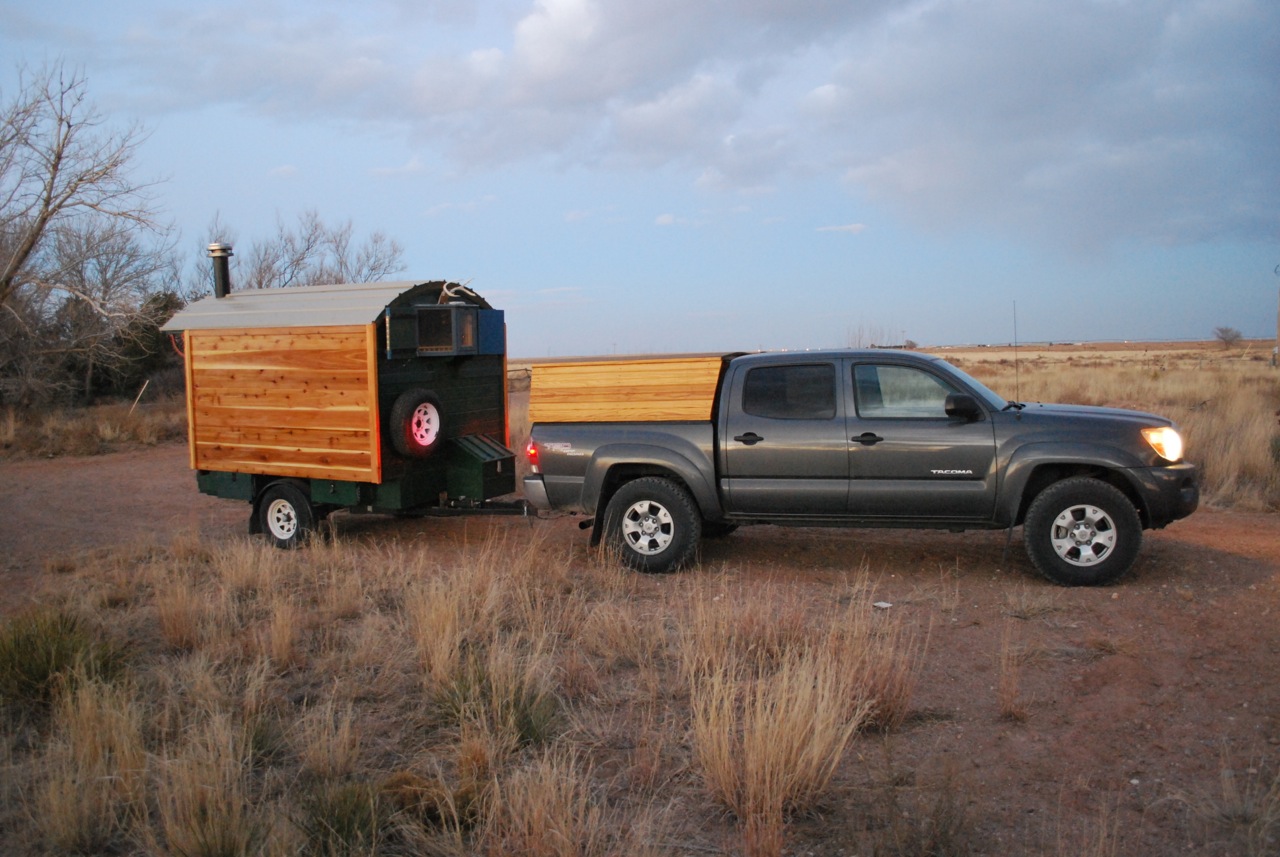
For those who know the Snail, you might notice something different. I’m making a little post about the new look but I just loved the sunset picture from today after work. I have a very short window of light at the end of the work day but try to use it best I can. More changes to come in the very near future.
I am hating my job so much right now I’m ready to jump in and run away. Bad people can really ruin your day no matter how much you try to make things better.
I’ll get more pictures up soon.
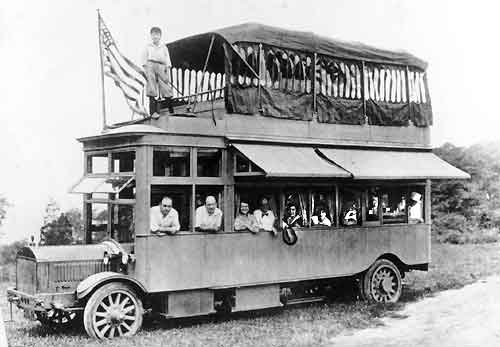 Roland and Mary Conklin of Huntington, N.Y., made house-car travel a family experience. Their bus factory built the Gypsy Van, shown above, and in the summer of 1915, the Conklin family set out to see America.
Photo & caption courtesy of the Smithsonian Institution,
the Huntington Historical Society (New York),
and Home on the Road: The Motor Home in America,
a book by Roger White
From the Flying Tortoise:

from Pinterest:

 Wandering Monks part 1 – The Buddhist monks that travel much of the year throughout Asia are about as minimalist as one can reasonably get. Early Buddhist monks were instructed to own, as based on the Pali Canon, a very simple set of eight items. Things have, of course, changed over time and religious wanderers have changed with it.
Everything thing else was communal or gifted to them, including food.
 Wandering Buddhist Monks part 2 – Things have changes in the past 2,500 years and the natural hardships of a traveler’s life warranted a few additions to an allowable kit of possessions. A revised and more modernized version adds a few more necessities (not everyone is up to the task of living in real poverty or misery; also, the communities of non-mendicants have some expectations about cleanliness, etc.). So in addition to the above eight possessions, the monks carry:
It should be remembered, these monks were part of a Sangha (intentional community of Buddhists) so there were communal objects for the rainy season when they weren’t traveling and there is a long tradition of charity towards holy men that we no longer practice in the West (other than tax exemption for churches and the National Football League).
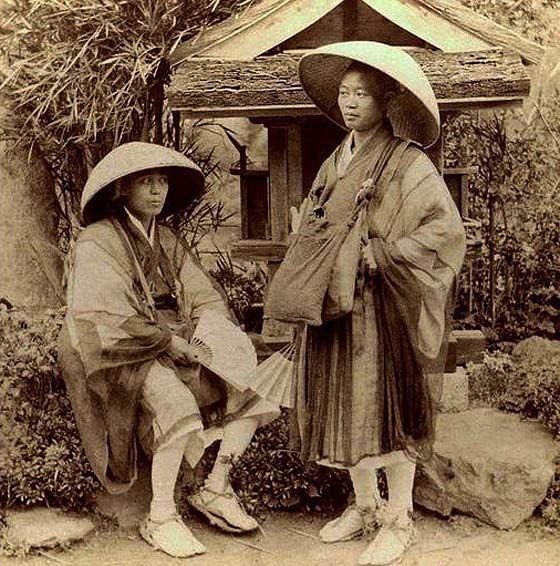 Wandering Buddhist Monks part 3 – Of course, the world changes and the esoteric lifestyle adapts with it. Modern Buddhist mendicant monks might carry a few extra things in order to live reasonably within the modern world. This becomes a very realistic list for the modern traveler. Over many centuries, it became apparent that being acceptable and able to fit into society in general was an important thing. Good appearance, cleanliness, and preparedness helps one not be a burden on the community. I understand the need to fit-in and remain incognito when appropriate. After all, isn’t that what our daily costumes achieve?
Later realists again modified the kit of the wandering Buddhist mendicants in eight types of personal utensils or belongings (adapted, in part from RAHU website, Singapore). There are a total of 8 necessary requisites of the Buddhist monk garments and utensils. I big part of the teachings of the Buddha are concerned with an intentional, non-harmful, and simple life.
In addition the initial eight things, some items have been added, not just for survival, but for the comfort and convenience as monks might find themselves as guests in a temple, in major cities, suburban settings, or the wilderness.
The latter list is a very complete list of real essentials. Having a codified list to pack from can be comforting, just like the lists the Boy Scouts still make for High Adventure programs. Looking at a little knowledge gained by our predecessors goes a long way.
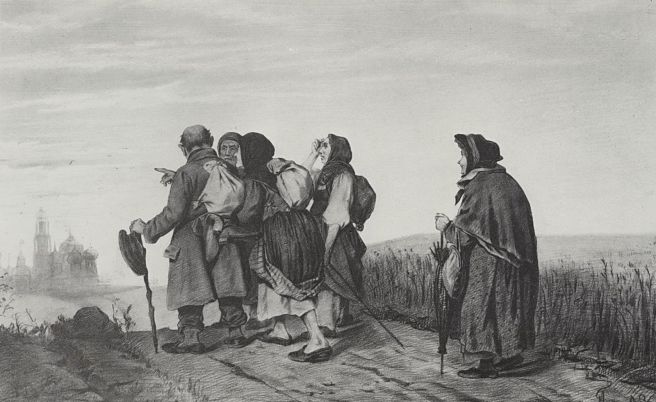
Why did I choose the Buddhists specifically for this example? Europeans have our own traditions, just without as much documentation. We’re a free-form lot. These folks certainly can sleep rough as need arose on a holy pilgrimage and don’t appear to be overburdened with stuff.
Matthew, Mark, and Luke all report that Jesus taught his disciples; “If you wish to be complete, go and sell your possessions and give to the poor, and you will have treasure in heaven”.
Coming next – Ultra Minimalists, Part 4 – Modern Minimalism – a re-blog from Joshua Fields Millburn.
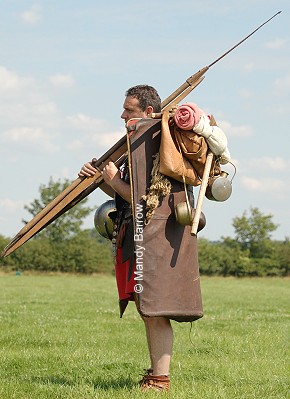 Roman Legionary – Let’s go back to the beginning of the modern military. As militaries go, Rome had a pretty successful run. After their first couple centuries being beaten up by the Celts they certainly learned a thing or two about fielding an army. More importantly, when wars were no longer fought to defend one’s home things had to change. Expansionist politics meant a paid, professional military (i.e., a mercenary army like we have today).
Without delving into a long history of the Roman military, here’s the pertinent synopsis for our purposes. In order to make the army fully mobile (not tied to a wagon or mule train and to rid itself of non-combatant lackeys), it was determined that the individual soldier should be responsible for more than just showing up, sword and shield in hand (for some historical references, see: Scipio Aemilianus Africanus and later, Marius’ reformations). In order to get rid of as much support staff as possible, and remove the competition in out-gearing each other, each soldier was issued (this was a new idea) a set of gear, including a full sarcina (marching pack) which included the essentials of daily living. The fact that they wrote about this and portrayed it in art gives us a pretty good idea of what equipment was used in the field.
Archaeological/historical side note: this, in-turn, led to the first systematic recycling program we know of; collecting the old stuff and remaking, re-tooling, and re-issuing gear. Metal is especially recyclable.
The sarcina (marching pack) of a Legionary soldier is about as pared down as one can get yet still travel in comfort:
I created the above list from several sources and it covers a period of about 5 1/2 centuries but the essentials don’t really change. This list of course, doesn’t include arms and armor or specialized things like saws, mattocks, hatchets, axes, etc. that were also carried. Various contemporaries state that soldiers carried between 3 and 14 days of food when on the march in a haversack.
Overall, this isn’t a bad list of essentials and looks a bit like my packing list for a camping trip. For a modern traveler, or someone looking to completely pare down their life, this might be a good starting point.
Curiously, there is no mention of a fire kit and they are rare archaeological finds in general. When I was in graduate school, I recall this being noted and it has been surmised that either (a) fire was everywhere in a settled continent and easy to come by if necessary, (b) coals were carried in the luggage and simply re-lit as needed, or (c) fire making was so common that it is not even worth mentioning in ancient texts or depictions.

Next time: Wandering monks of Asia…systematic, codified minimalism we can all learn from. On to Part 3.
 Preindustrial Craftsmanship