
To start the week off right, Clifton Hicks – Hills of Mexico
Tag: music
Bagpipes Gone Baroque
As if traditional bagpiping weren’t enough, here are the Royal Scots Dragoon Guards going all Pachelbel for your listening enjoyment.
A view of the amazing Scottish country of Scotland. All these photo’s were taken by friends on the Isle Of Skye.
Accompanied by the music Canon by The Royal Scots Dragoon Guards.
Music Available @itunes.
Distracted and Sidetracked More Than Usual

As if I didn’t have enough irons in the fire…
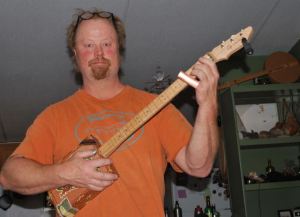
I decided to make (and learn) a new instrument this summer; a three-string cigar box guitar. It took a few weekends to get it right; figure out the design, apply a finish, and re-work a few details in the setup before I was pleased with the action, feel, and sound. It’s fretless so I am also learning a lot about the slide as well. It’s got a great, bluesy sound and maybe I’ll post a few riffs when I’m feeling up to snuff.

There are plenty of web and print resources for making a Cigar Box Guitar (CBG) so I leave the detailed instructional stuff to the pros. However, Cigar Box Nation is a great starting place if you are interested in homemade musical instruments and I’d suggest starting there if you have no other experience. You can even buy an inexpensive kit if you don’t know where to start but, in the spirit of the cigar box instrument movement, I decided to wing it for the first one. I did however, have to find a cigar box so I picked up one from C.B. Gitty for a very reasonable price. While there, I bought some parts for some other instruments in the planning stages and some very affordable strings to boot.

So how do you make a Cigar Box Guitar?
What follows is my brief overview of making a CBG from mostly found materials. As a side note, you are certainly not limited to cigar boxes for a resonator. A quick look around the internet will reveal some fairly ingenious sound boxes from oil cans, wine boxes, and gourds. I was tempted to save the few dollars and just knock up a box myself but decided that for my first specimen I would stick to the traditional model.
So what do you need to make a functional guitar?
There are essentially only three parts to this ancient style instrument; the neck, the resonator, and the strings. Yes, it’s a little more complicated than that but looking at the essentials helps simplify the construction.

Neck
The neck is any straight piece of hardwood about 35 inches (100 cm) long, about 1.5 inches (3.8 cm) wide, and approximately 3/4 inch (2 cm) thick. Mine was made from a less-than-perfect recycled oak scrap out of my wood pile. While strings can actually be harvested from the steel radials in tires, these make for some pretty limited and primitive sounds. I just used a set of guitar strings I had around for the setup and strung it properly when complete with a set of open G tuning strings from C.B. Gitty.

Resonator
The resonator in this case is a wooden cigar box. Depending on how you decide to put it all together, the cigar boxes may need to be reinforced and modified to hold the neck. They are only intended to hold cigars so the pieces may need glued tight to avoid rattles.

Strings
The string assembly needs a few things to keep them under tension and control their length (for tuning). Starting from the bottom of the instrument you will need something to firmly attach the strings to; tacks, screws, or some sort of tail piece. I had a very cool hinge without anything to do so I used it. The screw holes are just small enough to hold the ball ends of standard guitar strings. Next, you will need a bridge. This is simply a bar with grooves to hold the strings in place at an even spacing. This should be something dense like bone, very hard wood, or even a screw laid on it’s side. At the far end of the neck the strings will need to pass over a nut which is essentially another bridge at the other end. Finally, the strings attached to some sort of tuning peg or geared machine to change tension (and tone).
Put it Together
Here is the construction in a nutshell. Cut out the neck and peg head shape. If the neck passes through the body of the box (as opposed to laying over the top) it should be dished out where it would touch the top. The notches are where is will join with the box.

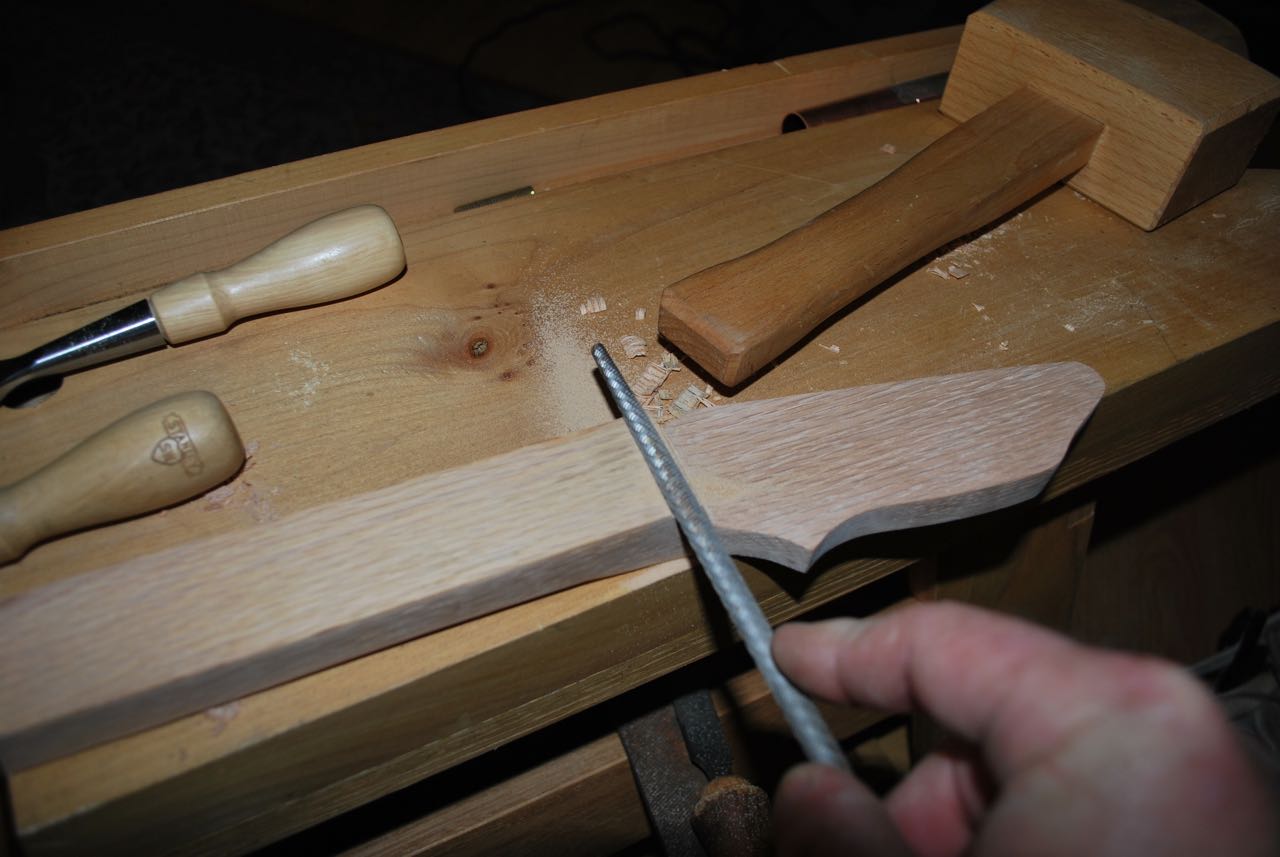 A groove was cut with a rasp to hole the 1/4″ bolt that serves as nut.
 Cut this notch deeper than 1/8″ so the action won’t be too high.
 The peg head can either be set back as above or angled back like a traditional guitar. This allows the strings to be pulled down over the nut. As this left the peg head a bit thin for my taste I laminated a piece of hickory on the back for strength.
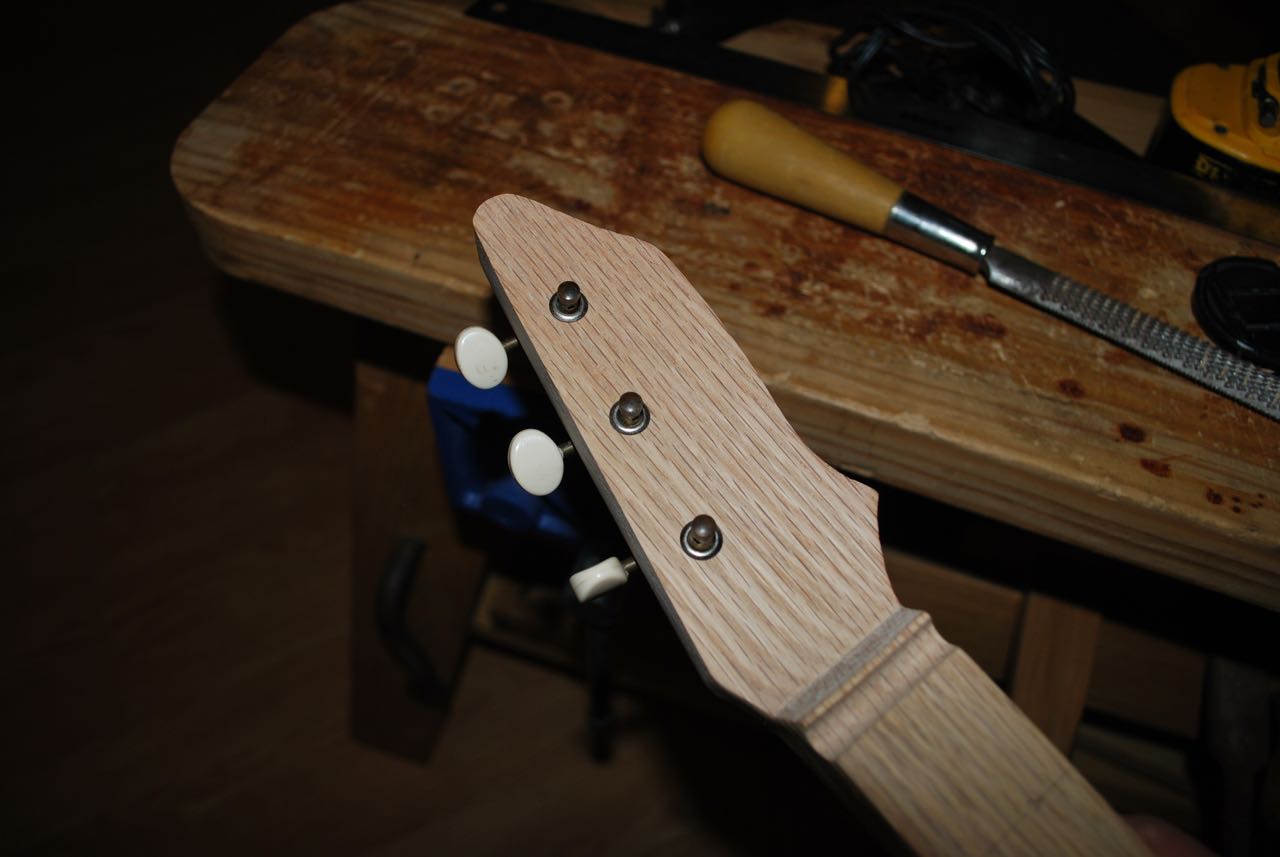 Drill holes for the machine tuners. Mine were recycled from an old Harmony guitar (a garage sale gimme) and served perfectly.
 Here you can begin to see the carving of the neck. I rounded mine fairly traditionally but this is up to the maker/player. The rest of the shaping will wait until the neck is fit to the resonator.
 Once the neck location was determined, an appropriate corresponding notch was created in the box.
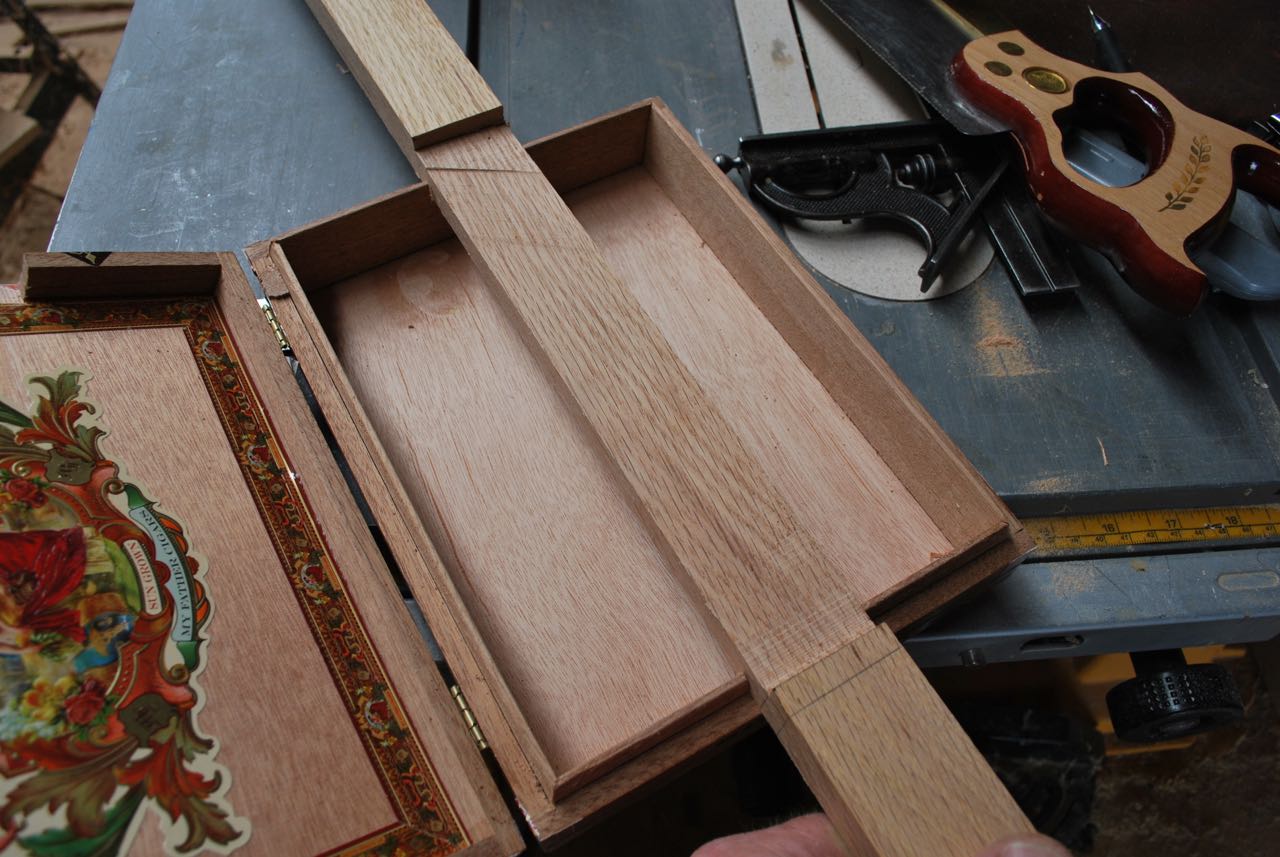 Test fitting the neck. You can see the wasted area that was removed to make sure there was no interference with the sound board (the box top).
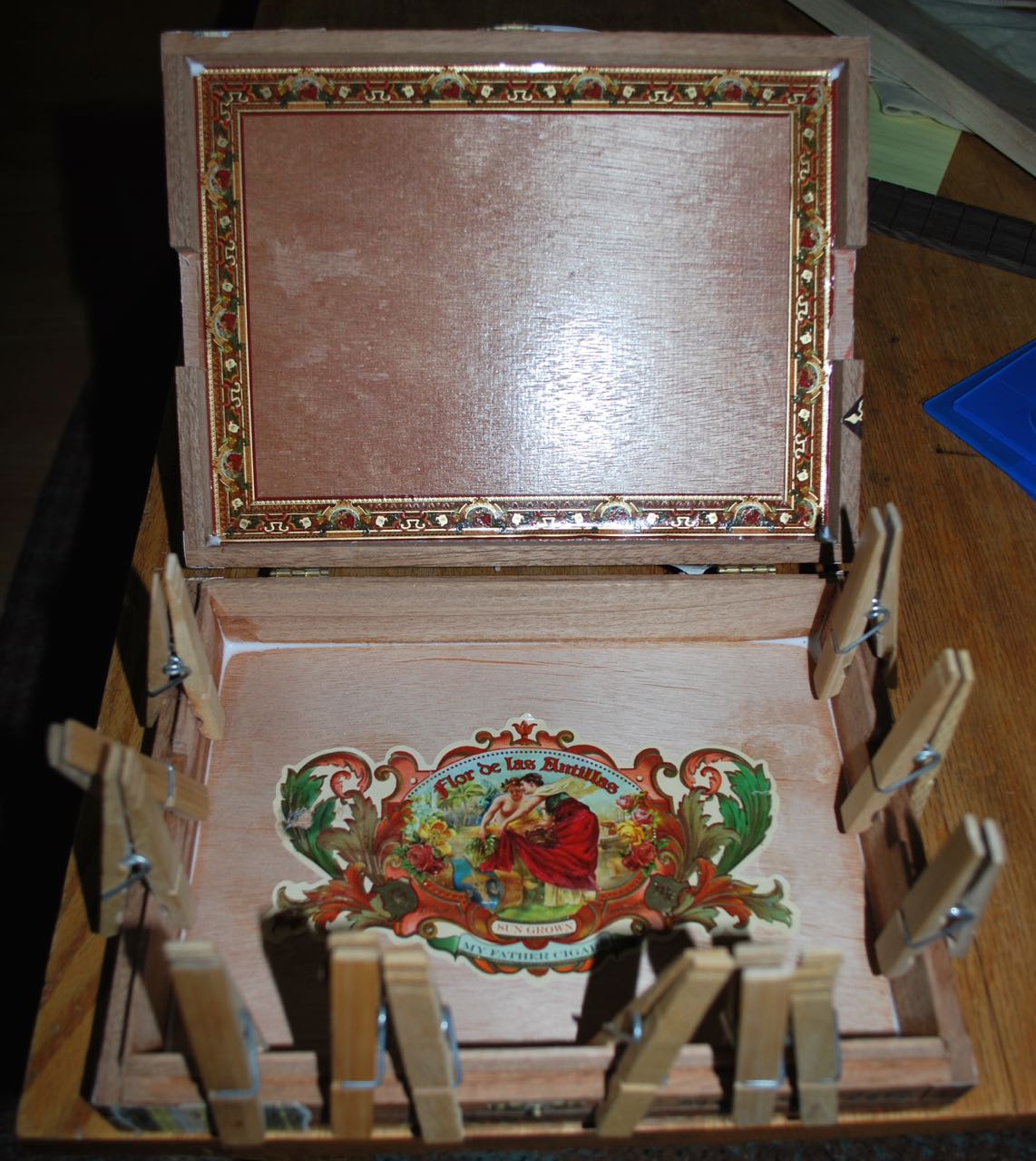 The box wasn’t too sturdy and had a bit of a rattle upon “tap testing.” All joints were glued up for strength. Note I moved the interior lid sticker to the inside back where it can be seen through the sound holes.
 The resonator is dry fitted into place. After this, it was just a matter of removing the leftover bit of neck, glue the box in place, glue the lid shut, and attach the hinge that serves as tail piece.

 This nifty hinge served perfectly and suited my mental need for brass or bronze fittings where possible. I didn’t like my first experiments with a bolt for a bridge so I whittled a simple one from a scrap of ebony. I played it “in the white” and made the few adjustments necessary before finishing up.
 Fret positions were measured out and marked with a wood burner.
 With a parallel-sided neck this is a simple process.
 Piloting for screws with a gimlet.
 Attaching the tuning machines permanently.


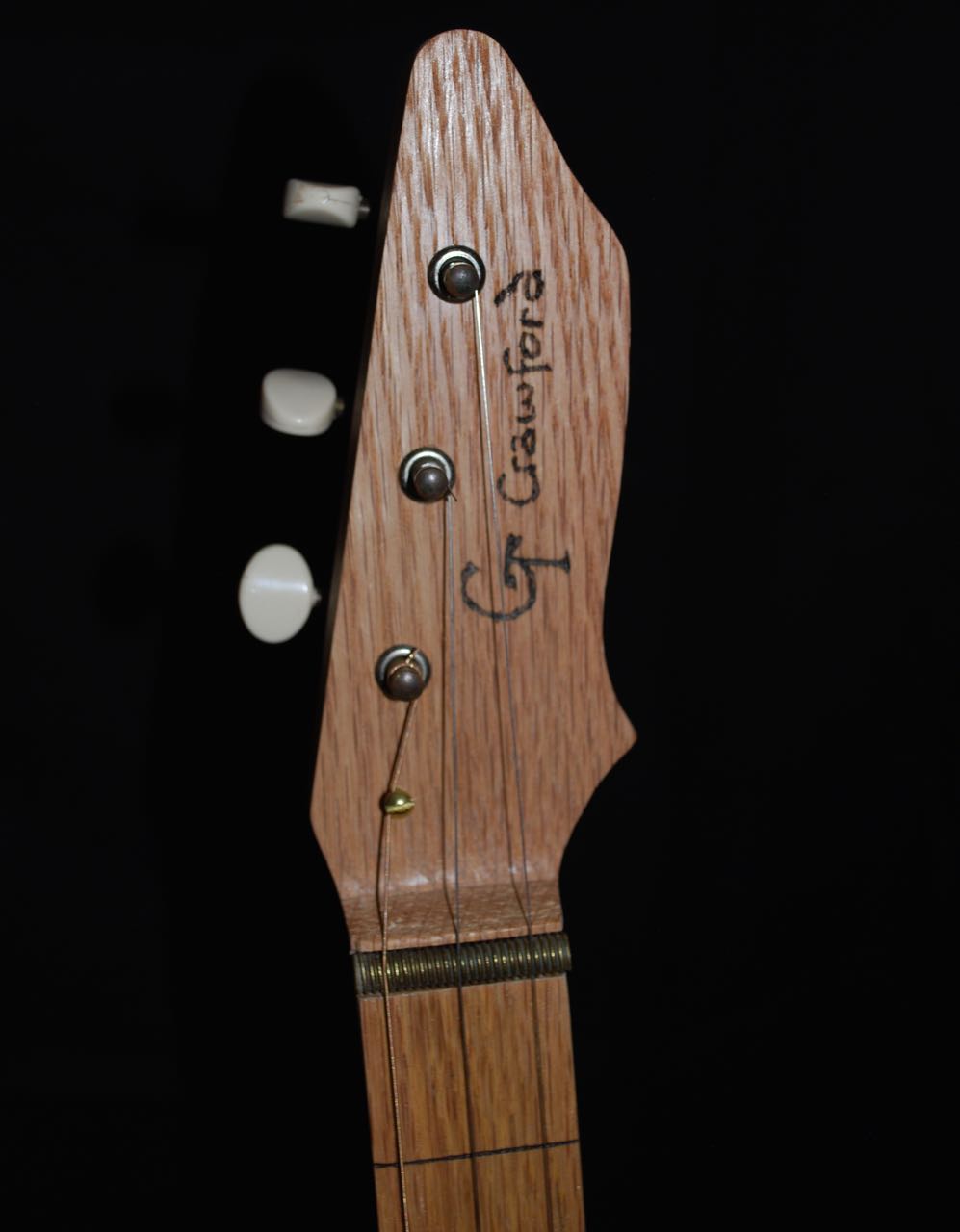
A few coats of tung oil later, and she’s up and playing. I’ll update this as I get familiar with my new toy. YouTube is full of instructional videos about playing a three and four string guitar. Mine works well in an open G tuning. Very bluesy and surprisingly bright and clear.
Looking at my junk craft piles around the house I believe I easily have the makings for three or four more. My next one is already rattling around my head and I think it will be fretted for added versatility.
Come back soon…
George
Sunday Music
A beautiful and sentimental song by Dougie MacLean, a Scottish artist. If you’ve never heard of him you probably know at least one of his tunes. MacLean’s most famous piece is probably “The Gael”, from his 1990 album The Search, which was adapted by Trevor Jones as the main theme to The Last of the Mohicans. You know: dumm dumdum dumm dumdum dum dum dumm, dumm dumdum dumm dumdum dum dum dumm … anyway, you get the point. Enjoy.
Home Grown Music
As an undaunted woodworker I have made most of my musical instruments over the years. I could never justify purchasing a high-end, high-quality instrument but I could make a reasonable proxy. My interest has been rekindled in the last couple years, making my third banjo for myself and reviving one of the mountain dulcimers as my partner has decided to take an interest in it.

Bodhrans.

Bodhrans.

Cocobolo finger board.

Flame maple neck, walnut rim.

Mountain dulcimer.

Early banjo.

Cherry and walnut peg head.

Cherry and walnut banjo with hickory laminates.
I find that there is never enough time to play an instrument properly with a regular day job, a relationship, and other interests. It seems that it’s time for a change in the schedule to put music back into the center of life.
Appalachian Mountain Dulcimer
A bit of beauty for starting the weekend. Wendy Songe plays the King of the Fairies on the mountain dulcimer. Enjoy!
A Tale in Open G; have a look at this cigar box guitar
For the love of home-made music. Click the link below the image for the story.

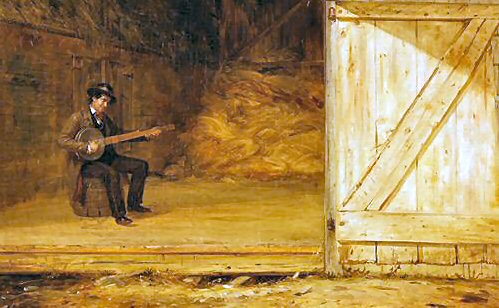
Early Banjo
A little historical banjo for a musical Monday. Nothing comes from nothing. The banjo is truly American with roots in Africa, the mother of us all.



The Blind Fiddler

“An itinerant fiddler is playing for a humble country family. David Wilkie focuses on the listeners’ different expressions. Only two people seem to respond to the music: the baby and the boy on the right, who is imitating the fiddler by playing the bellows.When this picture was exhibited at the Royal Academy some critics thought the bust on the shelf represented a dissenting minister, and concluded that the family were nonconformists. The power of music to stir the passions of those supposedly suspicious of pleasure was thought to add to the painting’s subtlety.” From the Tate website 2007.
So many historic details in this painting: basket, copper work, cookware, walking stick, spinning wheel, stools, hats, dog, pipe, key, cup, and shovel. A snapshot of late 18th – early 19th century rural life.
Music is Magic

 Preindustrial Craftsmanship