Wooden Packframe – The Final Draft

Expanding on Lessons Learned

In 2012 I decided to build a wooden packframe.  What started out as a Sunday afternoon project led me down many paths, from Iron-Age Europe to 21st Century military designs and it took about a year of stewing around before I actually got around to building something. It was fortuitous for me that Markus at 74 FOOTWEAR DESIGN CONSULTING wrote and excellent little history of frame packs at almost exactly the same time I began researching them myself.  Shortly thereafter, I discovered Steve Watts and Dave Wescott were delving into the same subject (great minds think alike I guess).  After collecting many photos and drawings I dove in, and using human measurements as much as possible, I built the frame below.
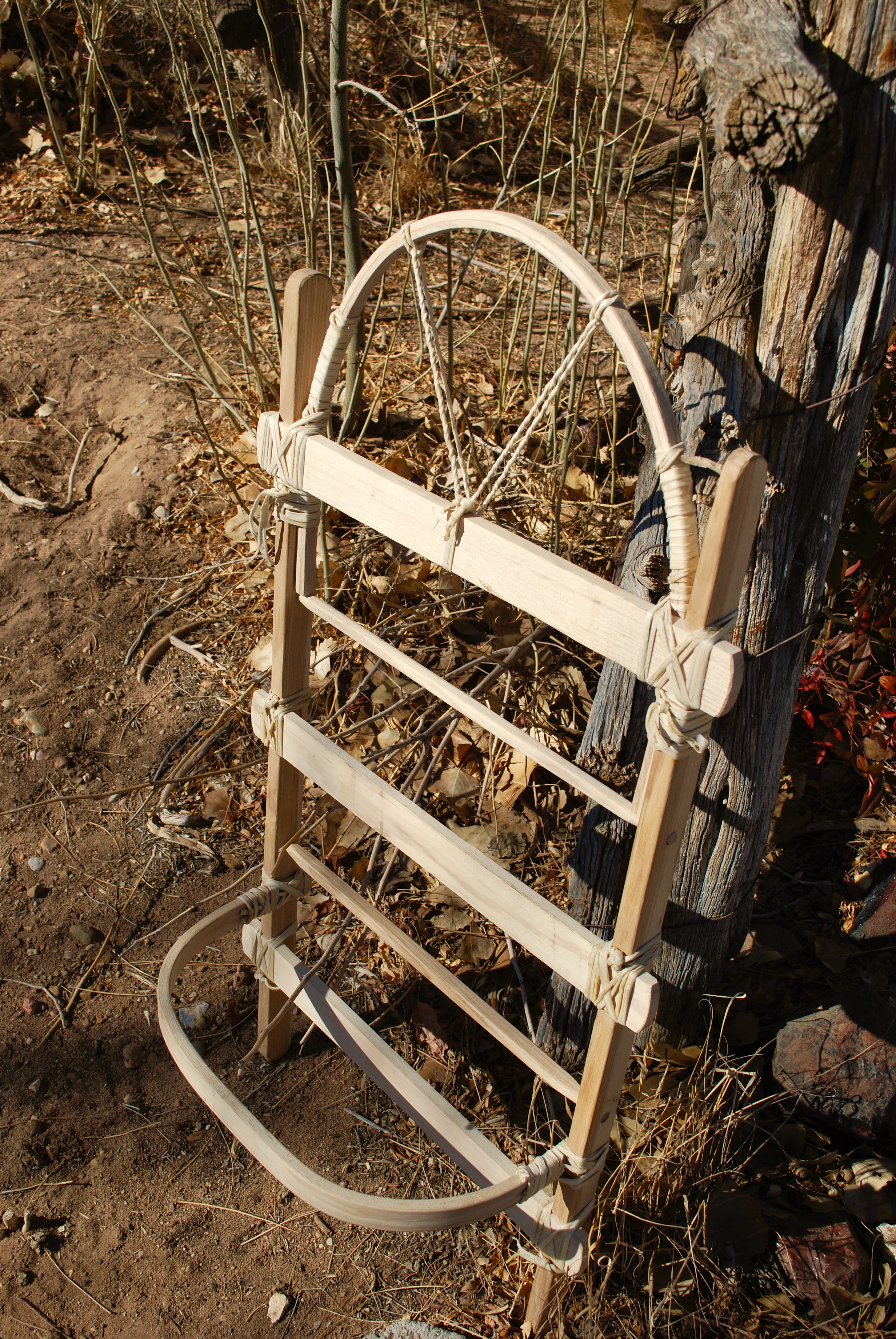
A few hickory boards and some simple steam bending created a design I liked.

I decided against metal fasteners for the original project so everything was pegged and tied with rawhide.

It didn’t take long to build and tying it all up with rawhide was a simple evening job. The next step was to create some sort of support to keep the frame from my back and attach shoulder straps.  This wasn’t as easy as it sounded since comfort and strength had to be combined while keeping possible chafing to an absolute minimum.
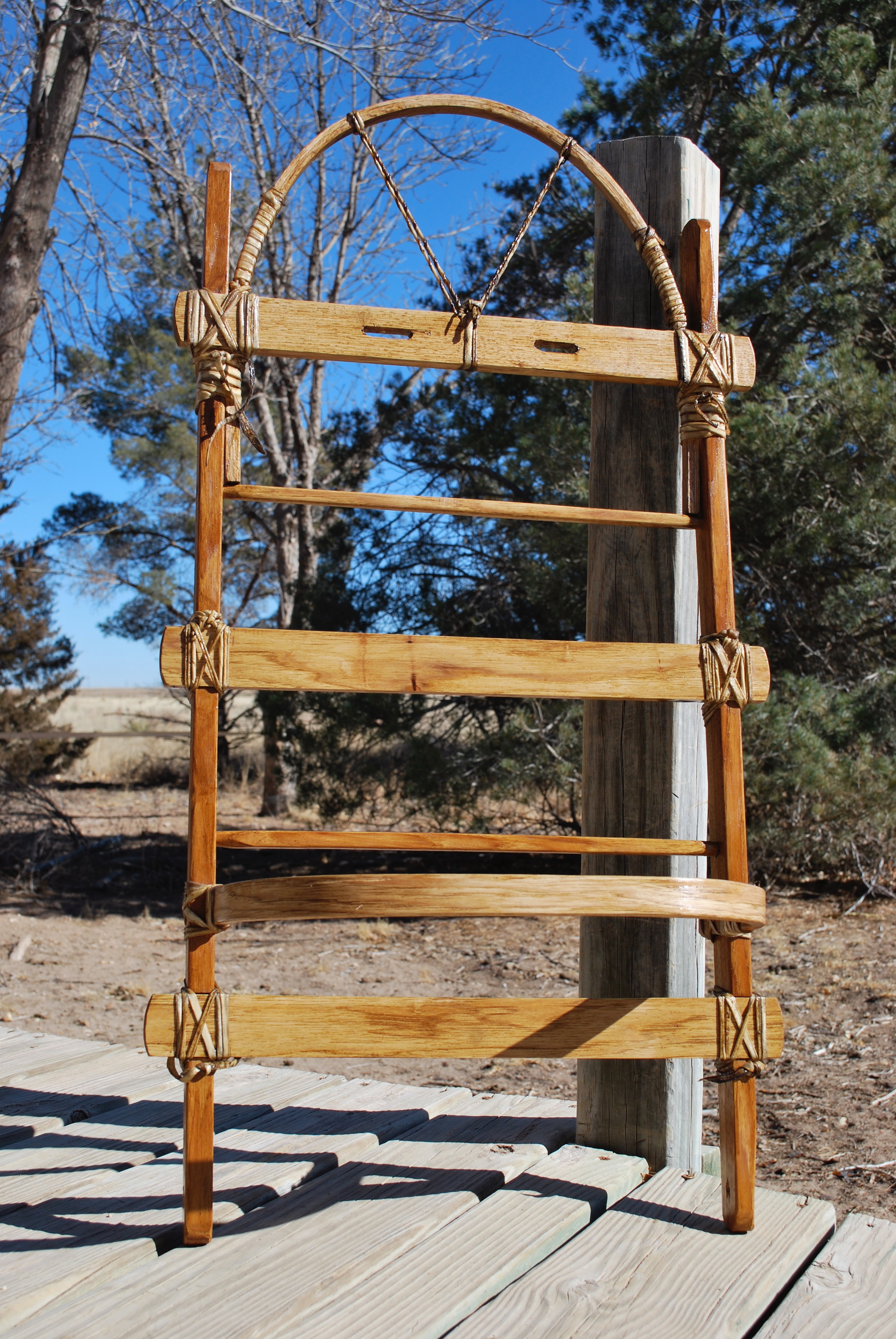
The two horizontal rods keep the uprights from converging under tension and the three cross-strakes are stabilized by being set in grooves on the uprights. The steam bent support and top bar add to the overall sturdiness of the frame.
I decided that simple was best so I used heavy leather, stretched tight, across the back kept the straps fairly straight-forward.
Several people asked about the need for a curved top bar; well why not? I like curves and I think it reminiscent of the Otzi-style simple frame.


An Otzi reconstruction. Click the image to see the article there.

Was it good enough?

The answer is probably.  It was mostly used to pack gear in for demonstrations and spent most of its time as a show-piece.  Honestly, over the years I owned it, it only went on one real backpacking trip, and that was even a fairly short one.  However, I learned some things along the way.  I like the shape, it was fairly comfortable, it was certainly sturdy enough,and it carried a heavy load without much difficulty or discomfort.  So the design was more-or-less right for me.

On problem was that I didn’t like the tensioning of the leather back straps as it was difficult to draw them tight enough.  That’s how packframe number 2 came to be.  I began by deciding to improve the back padding system but with a few other minor changes in mind, this happened.

A bunch of new parts generated themselves on my workbench one lazy afternoon.

Parts –

Recycled fir for the uprights came from a 125 year old door frame, some planks for the cross-bars came from the scrap pile, and a couple pieces were pulled from the first packframe.  Before I knew it, I was bending a thicker and better arch for the top piece and construction began.  Since I wasn’t working from a plan and there is no real standard for this type frame I pondered the whole thing for a couple days to decide how to fasten the parts (pegs, lashings, screws, or glue) and began assembly a few nights later.  I have gathered quite a few old screws of various sizes over the last couple years in my housing restoration so I decided to use those for the basic construction.
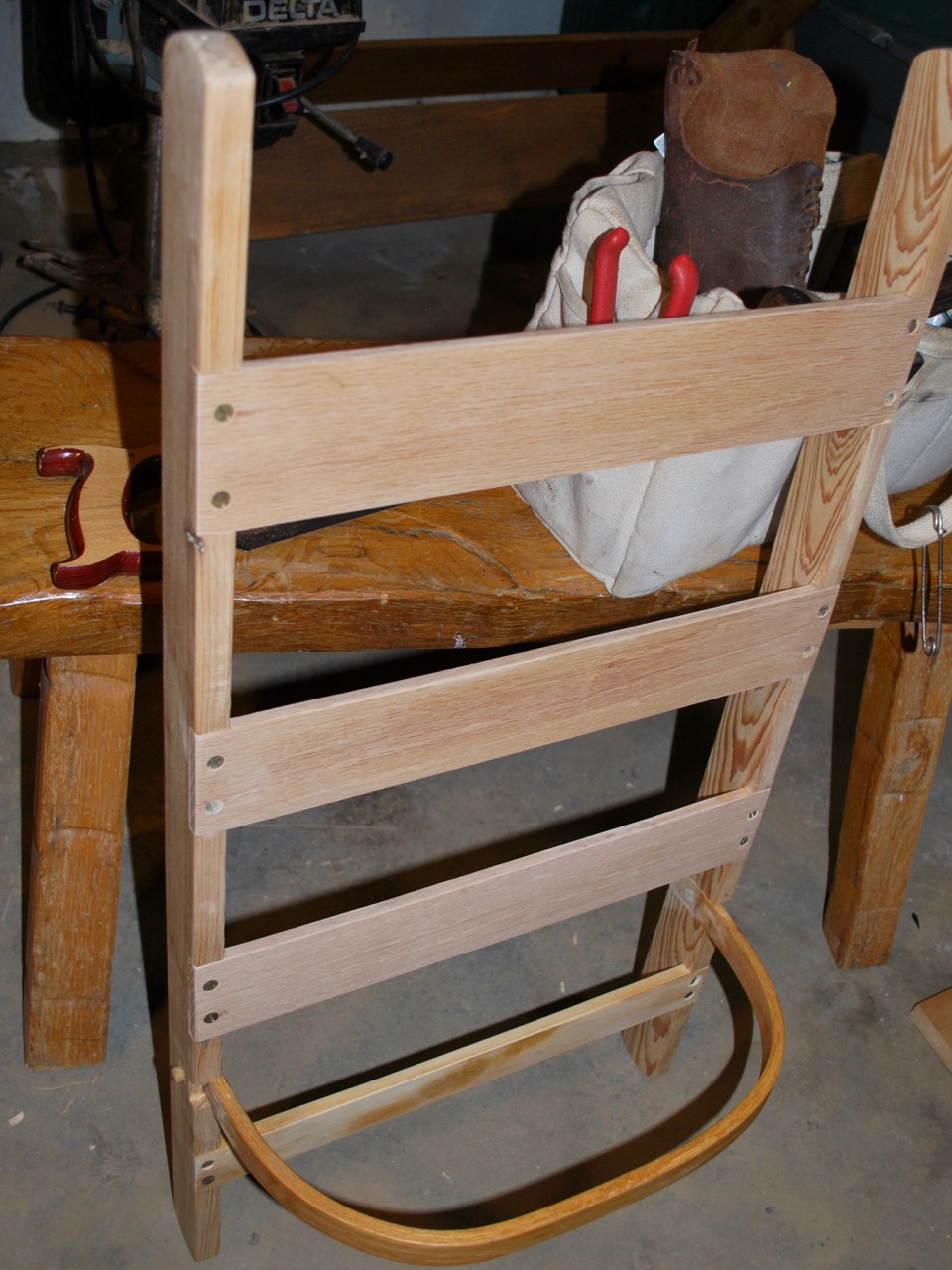
After too long a mental debate, construction went pretty quickly.

Construction technique –

As can be seen in the images, the cross-bars are let into the uprights in a simple lap joint for strength and racking stability and fastened with reclaimed brass screws.  The platform support is lapped and pegged with wooden dowels.

Side view showing lap joints and side supports.

I added a small oak angle brace to further support the platform support which is also lapped and pegged.  The small missing piece visible here is operator error.  When I was cutting the laps I was in such a groove that I cut the low one on the wrong plane.  I’ll probably fill the gap with a small wood piece, but for now, I live with the hideous disfigurement.  Also visible here are the walnut caps I pegged to the bottom of the uprights.  Old Douglas fir is a fine wood but can be very brittle and the end grain would probably not fare very well under hard use on rocky terrain.
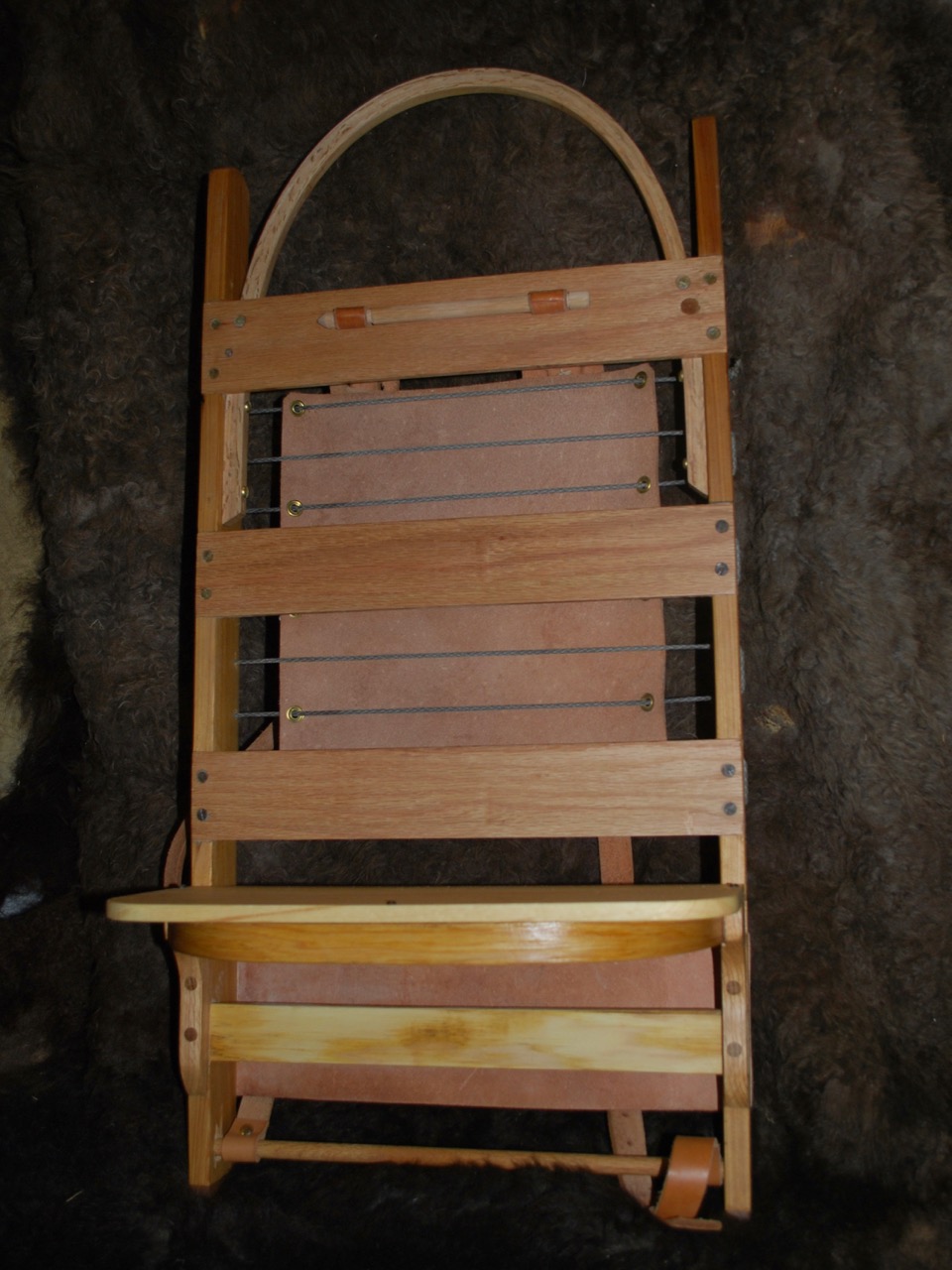
The frame in all its glory, waiting to be packed and carried off into the sunset.

Straps and Suspension –

I chose 12 oz Hermann Oak leather for the lower pad stretched tight and permanently fastened to the frame with brass screws and finishing washers.  The essential suspension depends solely on the cordage being strung tight while the leather pad distributes to stress across a smooth and wide surface. I think it will be quite comfortable.
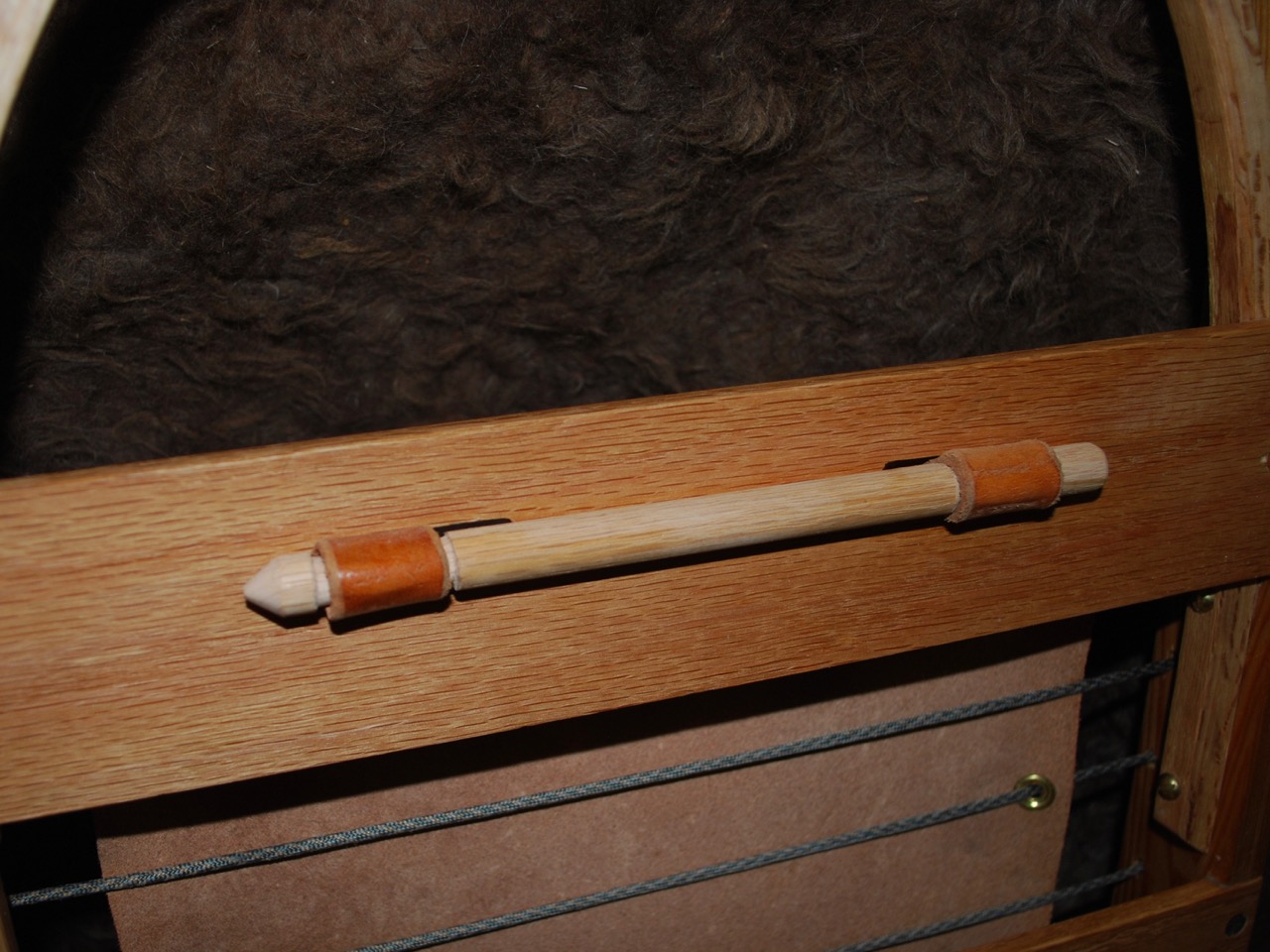
Shoulder strap connection, a whittled oak dowel that is easily removed.

I would like to make a removable rucksack for this frame and would like to be able to utilize the straps either so making them easily removable was a must.

Waist support, 12 oz harness leather. 6-7 oz leather was used for the back pad.

As for hip belts; I’m still undecided at this time but I suspect that sometime soon I will be constructing one.

A better view of the top arc and the overall harness.

I’ll continue to update the progress here and try to remember to take more photos along the way.  It really hinders work to have to think about documenting yourself along the way but I know people appreciate seeing the steps.

Walk in peace…

GTC
Eating Spoon

Just a short show-and-tell today because I needed a new eating spoon.  I lost my old favorite a few weeks ago and as near as I can remember, it was about 20 years old.  I remember this because it was cut from the end of a bow stave of a bow I love.  Here is the new one made from Walnut harvested in southeast Missouri.

The growth rings helped determine the sweep to the handle.

It is satisfying to use something you create yourself, even if it isn’t perfect.

Maybe not as dense as Osage orange (Maclura pomifera) but walnut will hold up well and darken with time.

The board this came from was quite variable in density and color.  This spoon comes from the lighter-colored part.

For me, function comes first for a tool like this but grace and beauty should not be left out of the equation.

After it was finished, the whole spoon was rubbed down with walnut oil and it will be treated again in a couple of days to help protect the wood from soaking up flavors.

Dép lốp or “Ho Chi Min” Sandals

I was looking up a link for someone and rediscovered the video today showing how to make tough and durable sandals from discarded tires.  This style is well-known in Southeast Asia, particularly in poorer areas.

https://photos.travelblog.org/Photos/20411/111103/f/749561-viet-cong-made-sandals-from-truck-tyres-1.jpg

If you are interested in sandal-making, you can hardly go wrong with this design if you have access to old tires.  I suggest watching the video if only for the remarkably sharp knife this maker is using.  Using tire material is a little heavy but will truly last a lifetime.  The straps fit purely by friction so they are continuously adjustable while the waterproofness of the material makes them perfect for the wetlands and jungle.

I understand this style was created in the 1940s when old tires became abundant and some creative shoemaker had a Eureka moment.  There is also a short write-up on this style on the always interesting Huarache Blog if you are seeking more information about this shoe.

Another step toward self-sufficiency and off-grid knowledge for the Mayhem Shoe Collective.

Thoughts About Minimalism and Survival

Learning a thing or two from the past…Part 1, 21st century Westerners are not the first to minimalize.

kylixdonkey
How much stuff do we really need to lug through life?

“The things you own end up owning you.” Chuck Palahniuk, Fight Club

There’s a lot of recent talk about Minimalism as a social movement and this fits well with my personal philosophy and my interests in preindustrial technology and survival.  Not long ago, minimalism was mostly associated with artists, aesthetes, wanderers, mystics, and philosophers.  That is to say, the fringe element, outsiders, and weirdos.  These things come in cycles and I think, as a backlash against generations of sell-out philosophy and the creation of a professional consumer class, many people are reaching for something new.

We come to learn that everything old is new again.

I’ve been pondering history and prehistory on a full-time professional basis for several decades now.  As hard to believe as it may be, I even get paid a salary to do it.  One of my professional interests involves the tools, tool-kits, and strategies for surviving that various people have come up with for dealing with the world.  As a sometimes primitive skills-survival instructor and full-time frugalist I think it important to not reinvent a lifeway when we have millennia of ancestors who dealt with most of the same issues we do today.

San
A San bushman demonstrating fire-making.  Ostrich egg canteen in the foreground. These people probably resemble our ancestral way of life and have very few possessions, even in their harsh environment.

For most humans, for most of our history, owning too much stuff has never really been an issue.  We had what we needed and either made what we needed or did without the things we didn’t have.  It brings a smile to my face to know that more than 2,500 years ago, various thinkers people in China, India, Greece, and the Middle East were contemplating the nature and evils of acquiring stuff; some were even writing about it.  That’s not to say that I have immediate plans to become a wandering mendicant like a medieval friar (as appealing as that might sound to some) but I do have an interest in lightening my material load and some very specific goals for the coming year.

mendicant
Medieval European mendicants represented by a pilgrim and a friar.

My foundation as a minimalist (and I may not be very good at it)-

I have been thinking about what stuff a person needs to survive since I was a teenager who enjoyed backpacking and travel.  Like virtually every young boy, I had grand ideas of escaping the family and traveling unhindered across the world.  My family weren’t exactly readers but I devoured Jack London and Mark Twain stories as a kid.  I loved the extensive and well-thought out gear lists provided in the Boy Scout Handbook, the Explorer’s Handbook, and the Philmont Guides.  I read Larry Dean Olsen’s great book of Outdoor Survival Skills and Colin Fletcher’s The Complete Walker again and again.  I read about the mountain men of the fur trade, and always, took note of what they carried or didn’t seem to need.  I would copy lists into a notebook and revise them while sitting in some boring high school class, making my own lists of what I have, what I need, and what I want.  This thinking encouraged me to work and save money to buy a better knife, backpack, or camping stove.  I was probably the only kid I knew who wanted, and got, a file and whetstone for Christmas one year (my grandpa was good that way).  My friends and I spent our teens and early twenties hiking and camping year round, mostly in the woods of the Ozarks in southern Missouri testing our mettle at that time in life time when all teenagers know they are invincible.  Some of us even made it to Europe, Asia, Africa, and beyond.

Books
A few of the many books I ended up possessing on a quest toward fewer possessions.

In a modern sense of survivalist, many people look to the military or the loonies of the social media.  Often, military service is the time when young men and women are introduced to such things for the first and only time in their lives.  Realistically however, the military itself acknowledges it’s shortcomings on a personal basis as (with the exception of a few special operations units) its entire system is dependent on lengthy and complex supply lines, support chains, and de-emphasis of the individual and personal decision making.  Military survival is generally approached as a means of keeping alive until help arrives.  Great for fighting a war, but not always so good when you are turned loose into the world.  This sort of survival strays from our point here anyway.

More (and less) to come soon.


* here are a few links to modern Minimalists of various ilks and philosophical merit.  A journey through these links will hint at the breadth and depth of people on different paths but moving in the same direction.

Read, research, think, and enjoy!

Scout Staff Hiking Stick

Sometimes I wish carrying a walking stick was more acceptable in daily life. Maybe it’s just my yeoman heritage or my fondness for the old ways…

A review of Scouts, Calgary 1915.

To do so now, you tend to either look like a hoodlum or the walking wounded.  Living for so long in wild country I found that a staff was a handy tool that lends some confidence when encountering a wild hog, a rutting elk, or dog.  In my professional work as a field scientist it isn’t common to carry one either due mostly to the logistics of carrying a map, notebook, compass, GPG unit, pin flags and the like.  The reality is, you only have two hands.

The author with his antler-fork walking stick and his dog begging for a walk.

However, in the perfect world of semi-fantasy that I inhabit, I tend to keep a walking stick nearby and have several on-hand at any given time.  I’ve wavered over the years as to whether or not the extra burden is worthwhile and the truth I have settled upon is “yes, mostly.”  Other than the confidence it gives in an unwanted encounter, a staff really helps a walker crossing a stream or other rough terrains when heavily loaded.

As the great traveler Colin Fletcher wrote many years ago,it converts me when I am heavily laden from an insecure biped into a confident tripedThe Complete Walker.

The staff instills confidence and provides stability for the walker.

Here are a few other ideas for a walking stick and its many uses found around the Web. I’ll post a few more pictures of my own in upcoming posts.

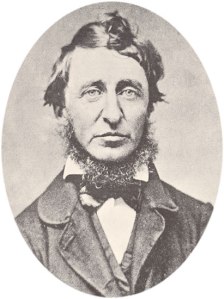
In the mean time, if you are contemplating becoming a walker yourself, or already are, you may enjoy Henry David Thoreau’s short essay on the subject.  It’s a favorite of mine from a surveyor and philosopher who spent much time walking in the woods.

Walking, 1862

Save

Three Men in a Boat (a book of subtle humor and deep philosophy)

“Let your boat of life be light, packed with only what you need—a homely home and simple pleasures, one or two friends, worth the name, someone to love and someone to love you, a cat, a dog, and a pipe or two, enough to eat and enough to wear, and a little more than enough to drink; for thirst is a dangerous thing.”

~ Jerome K. Jerome. “Three Men in a Boat.”

I highly recommend this little book as an English classic about three young and idle gentlemen in need of a holiday; filled with good humor, philosophy, and observations about life.

Raised With Wilderness Skills

Don’t leave the kids out of the things you find important…

Nota bene! The following ramble was written at three in the morning and may contain sentiment, ramblings, and a bit of opinion. I don’t want this to sound preachy.  What was intended as a few childhood pictures from primitive technology events ran away with itself in the dark hours between sleeps.  ~G


Learning to shoot at an early age. Skills like this build coordination, confidence, and an understanding of the greater things in life.

There is a certain amount of balance that can become of the unique skills we gain along the path of our lives.  Some people come to events, take classes, and return to the ‘normal’ life at the end of the week relatively unscathed by the learning they paid for and the time spent.

The first brain-tanned shirt and wearing it with pride. It was a hand-me-down from a friend’s daughter.

To closely paraphrase a linguistic anthropologist I knew long ago,

“Some things we love are embraced the way most people embrace their religion, they take away some message, feel strongly about it, but leave it for Sundays. When we find the thing that is our passion, we embrace it like a lover; it encompasses all our thoughts and becomes our entire life.”  ~L.F.

This is how I feel about primitive skills, wilderness living, and pre-industrial craftsmanship.  Without consciously trying, it just became a part of life growing ever stronger from teenage into full adulthood.  While living in the consumer world, this alternative floated in the background of the mind and continued to influence activities when our child came along.

We were not perfect parents.  Far from it.  But we were consciously better than our own.  We really tried.  We learned.  I sometimes wish I had it to do all over again.  Overall, I think we did pretty well and were lucky in many ways.  We encouraged exploration, learning, and self-reliance.  By not child-proofing everything or creating needless prohibitions, we were forced to be more aware and in the present.  Yes, it is probably more work and yes, it can be exhausting but children should learn their most valuable lessons at home from family, whatever ‘family’ may mean to you and yours.

Every kid and every family is different.  They aren’t robots and it is clear to any observer that they have a mind and ideas of their own from a very early age.  We can only steer them as best we can, present them with our ideas and beliefs, and provide the types of opportunities we think will give them a good grounding for their future lives before setting them free to try their skills in the world.

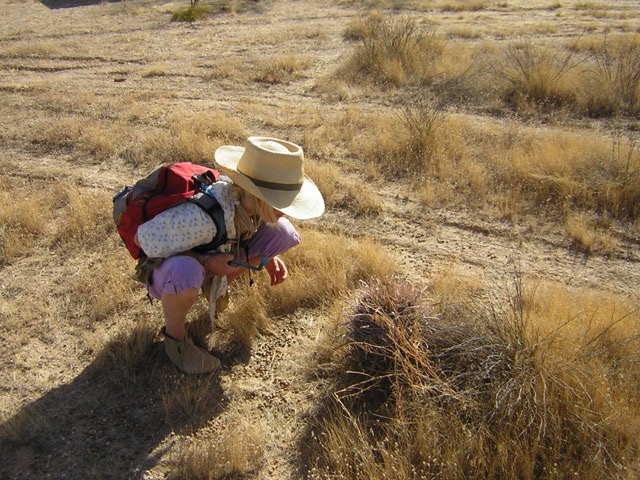
Examining a fish-hook cactus in the Sonoran desert.

It makes me sad hear or to read in social media that parents that I actually know are so down on the next generation.  Complaining that they don’t go outdoors, have useful lifeskills, proudly hitting them, or even ridiculing them for using the technology they themselves provided.  If that is the case, the blame is only ours!  We cannot place the blame on media and movies and video games, schools, government or a general millennial malaise.  It is not anyone else’s job to raise our children well.  We are, to a large degree, culpable.  When I hear a parent complain that their kid watches too much TV, or plays too many video games, I am baffled.

None of us are perfect, but we can give the following generations the values and ideals we may only cherish in the abstract.

DSCN2530
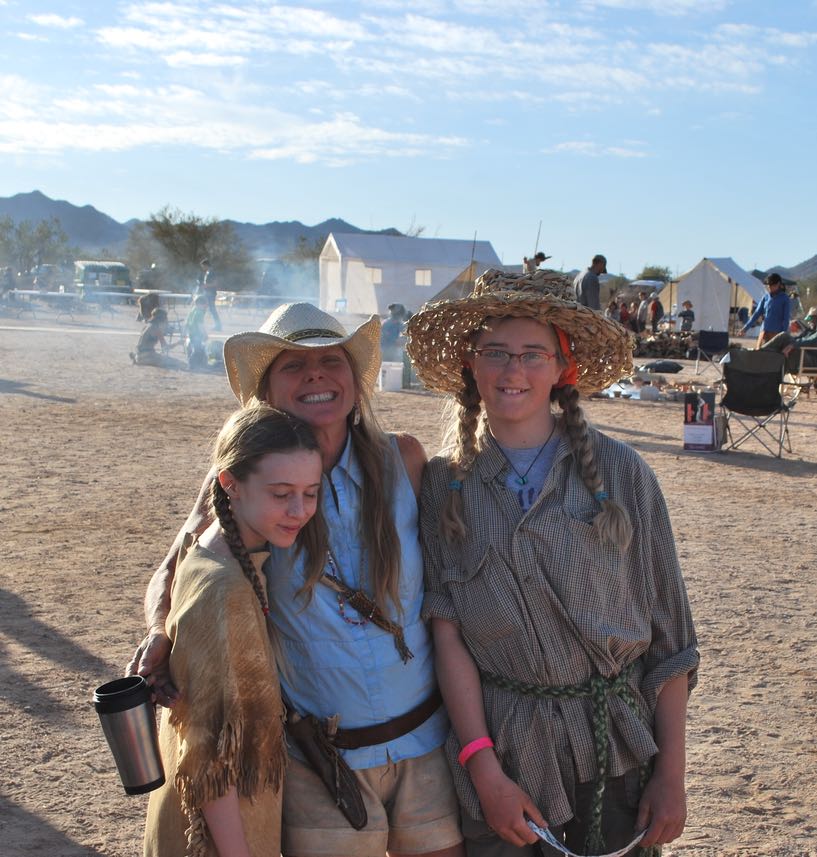
Modelling the yucca fiber skirt with her buckskin shirt.  A monumental amount of yucca processing.

The intended descriptions have strayed into a hopelessly sentimental post, but anyway, enjoy some of my favorite photos I dug out recently.

Winter Count 2009 - 67
Making fire in the Arizona desert 2009.

I leave you with this broad paraphrasing of Edward Abbey:

Give them the skills and encouragement to get out there and hunt and fish and mess around with friends.  Let them ramble out yonder and explore the forests, climb the mountains, bag the peaks, run the rivers, breathe deep of that yet sweet and lucid air.   And at the end of the day, sit quietly for a while with them and contemplate the precious stillness, the lovely, mysterious, and awesome space we call earth.

We are fed by those that surround us. Choose wisely.
Blacksmithing her first knife.

I hope to see a few of you in the great outdoors very soon.  And don’t forget to bring the family if you can.

Save

Save