Here’s another small project happening amidst all the “real work” that needs to get done during this quarantine.


I want to keep this one but after inquiries rolling in, it may go into the shop (or another just like it).
Be Safe!

Adventures of an Imperfect Man In Search of a Handmade Life

Here’s another small project happening amidst all the “real work” that needs to get done during this quarantine.
I want to keep this one but after inquiries rolling in, it may go into the shop (or another just like it).
Be Safe!
I’m happy to say that I will be heading to the annual primitive skills gathering known as Winter Count down in the Sonoran Desert. Thankfully, it has moved to a more remote location further into the desert and far away from the Phoenix sprawl.
I will be teaching a course that I have been doing for some time now; Constructing the Ancient Frame Saw. I say “ancient” because this style saw goes back to the very beginning of metal working. It is a way to create an extreme amount of tension, and thereby stiffness, on a very small piece of metal; saving on a very precious resource.


Coming soon to the blog; New plans for a packable frame saw.

In the mean time, check out the link to my older post about making a frame saw from 5 years ago.

These are nearly the same type I make. A frame saw is a useful and simple introduction to woodworking and tool-making. If you are interested in woodworking, Paul Seller’s blog has a lot to offer.
From Paul Seller’s:
If you have not yet made one of these you should. They are quick and simple to make and give you the European push and pull stroke saw in a single saw which is useful depending on where you want to…
Source: Making a frame saw

Advertisement from 1913.
These saws are an excellent and handy way to cross-cut large logs quickly. the design is over 2,500 years old solving the problem of keeping a stiff blade with a minimum amount of metal. This style come in at about 4 1/2 pounds giving enough heft to aid in cutting. Teeth cut both ways and the blades tend to be made from excellent steel. Perfect for re-use if you can find one mouldering in the corner of a flea market. I picked on up several years ago in “like new” condition and it has given great service ever since. Limbs can be simply replaced if they become rotted or otherwise damaged. These are the chainsaws of our forebears.

Bucksaws, bowsaws, and other frame saws are often lumped together into a single category in modern American or British English (unless you happen to be a traditional hand woodworker of course). And why should anyone care anyway? Bucksaws are replaced by chainsaws, bowsaws have become cheap, pot-metal, throw away abominations, and turning saws are replaced by band saws, scroll saws, saber saws, or even cheap coping saws.
The firewood bucksaw is the biggest of this family and one I’m glad to have in my toolkit. Yes, I still own a chainsaw but find I use it less and less in favor of the quiet bucksaw that takes no petroleum and spews out no noxious fumes. I have read that most homes kept a big bucksaw handy as the easiest means of creating firewood and I can certainly understand why this would rank above the axe for cutting logs to length.

Skipping even the practicality of being able to make your own excellent tools for a few dollars (or less if you are energetic), there is a great beauty and practicality in this ancient design that our ancestors hit upon a couple thousand years ago. The basic premise of this design is to create a structure that will put a very thin strip of serrated metal under immense tension to simulate the stiffness of a much thicker material.
I regret that we’ve come to a point in our history where making a tool is odd, yet making something with our tools is not (yet). Where working for hours at some other thing, we get tokens of cash to purchase something we could have made ourselves in far less time and probably less energy spent. I believe Thoreau was on to this sort of thinking.

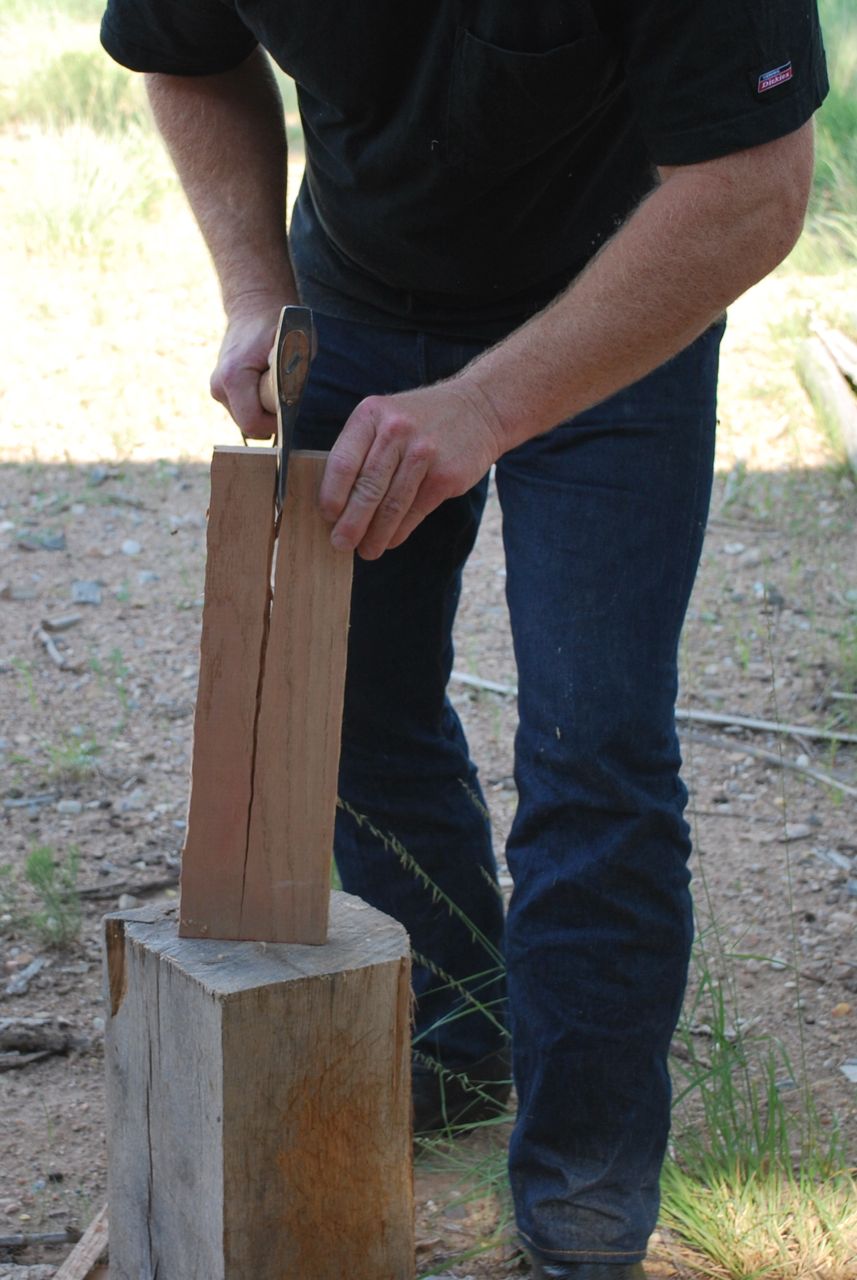
Choosing a length of straight-grained oak in this case, an axe is, by far, the fastest method of reducing it into the constituent pieces for the saw parts. This is far faster and better than sawing, creates no noise or dust, and ensures that each part is exactly in alignment with the grain.

For a quick and dirty saw, these could be worked almost instantly into the mortice and tenon. However, as we always intend to make a tool we will cherish and pass on, some shaping is in order with an eye for form and comfort.

I have a file of templates I keep from past projects so I don’t have to continually reinvent these things and I highly recommend this. I find it helpful to write the details on the card stock, as well as label and date them (the notes on the one above are on the underside). Now comes the somewhat tedious task of shaping the arms for which I didn’t take a photo (maybe I’ll remember next time). I saved a few minutes by using the belt sander to taper the upper portions of the arms to save on shaping later.

After marking up the arms, I cut the mortices with a bench chisel. These are easier than many people think but do take a very sharp chisel and a little practice.

I used a 5/16″ doweling bit for this as it leaves a very clean, precise hole for the 1/4″ brass rod to run through and turn freely.

Cutting the tenon is very easy if the lumber is split precisely with the grain as opposed to sawn out on a table saw (ignoring the natural grain). After the cheeks are cut, its a quick matter to pop off the waste with a sharp chisel.

I used a spare file handle for the primary handle. A 1/4″ hole is augured about 1 1/2″ deep for the 1/4” brass rod that will become the connection for the blade.
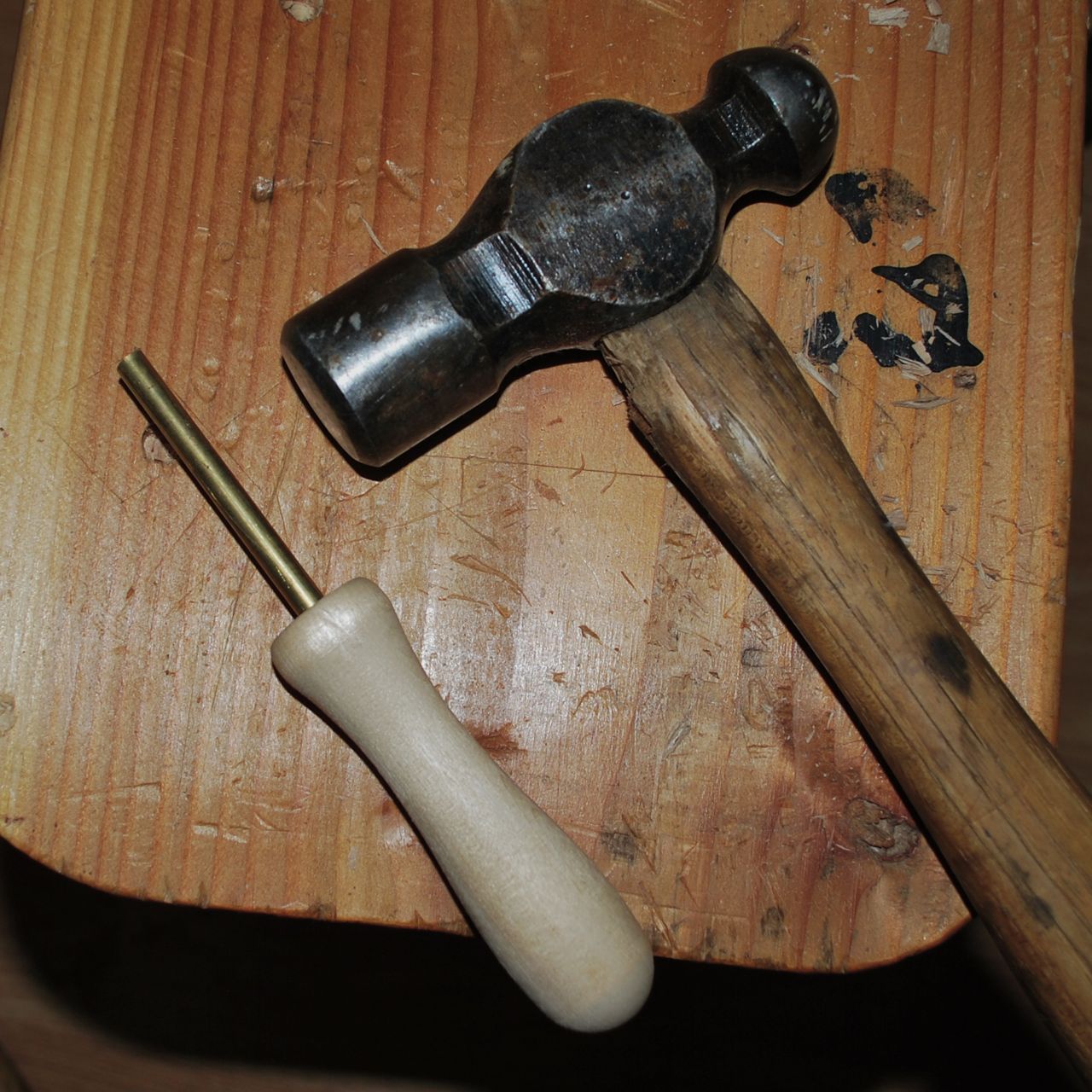
The rod is driven into the handle and will be cross-pinned for security.
Come back for Part 2.
I know I’ve been on a big kick of old gear and tools from the late nineteenth and early twentieth century lately but its good to see the range and availability of these essential items. I find it interesting though, how poor the descriptions are and the arrangement of the catalog. It’s like they just invented this whole idea…
 Above you can get an anvil, axe, and workbench on the same page as an Alpine climbing rope, Alpine belt, and a wrist sling (in case the Alpine rope breaks I presume). I would really like the upper “foreign” work bench.
 Fretsaws, forges, and blacksmiths’ tools oh my.
 I know people who would give almost any left appendage for this nice selection of planes.
 The woodcutters’ frame saw isn’t even pictured (too common most likely) but I would be happy with a few others from this page. In all the tools I’ve ever used or seen, I have never come across a “walking stick pruning saw.” German invention, of course.
 I think I own that very same “saw set” as pictured above. When I was given by my grandfather I was warned I’d probably do more harm than good if I didn’t know how to use it. Of course, I was probably ten years old at the time.
And in the middle of the page, voila! The very frame saw I plan to make this weekend, and hopefully make a good instruction set to give out or post. Known as a turning saw, frame saw, or nowadays, a coping saw, this design goes back a couple thousand years. Maybe this will be a nice class project for Rabbitstick this year.

 Preindustrial Craftsmanship