The Chart of Hand Tools

I rarely (I mean almost never) go out of my way to endorse a product of any kind but while considering the upcoming holidays I came across this link I saved a while back.  I think it would be perfect for the workshop and is a work of art in its own right.

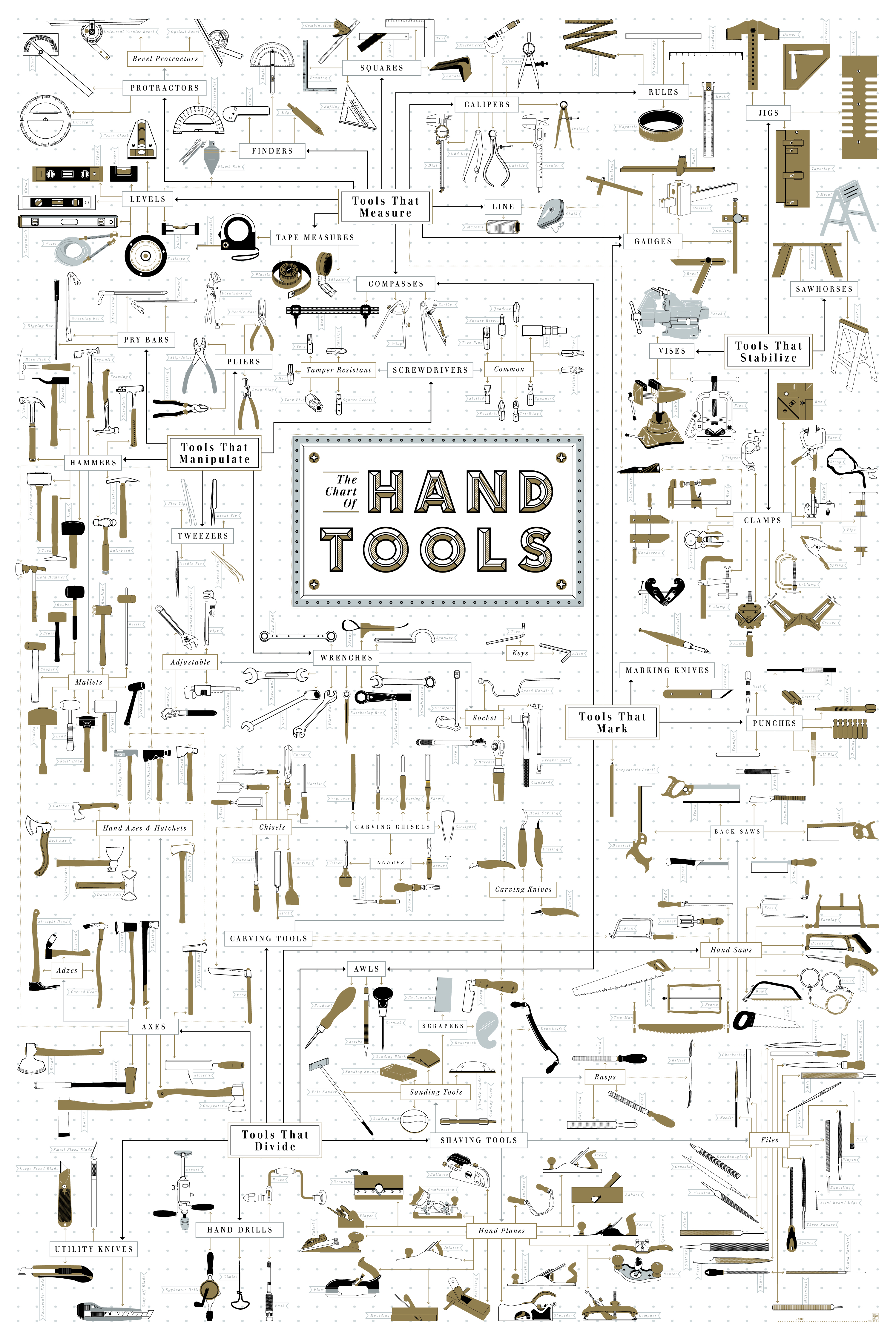
I can imagine it over my new workspace or even hanging on the wall in the den to be pondered while dreaming of building something worthwhile.  It’s called the Chart of Hand Tools from the Pop Chart Lab, “printed using 100 lb archival recycled stock certified by The Forest Stewardship Council, this poster is pressed on an offset lithographic press in Flatlands, Brooklyn.”  Sounds good so far and I love how they are actually grouped in logical sets by basic function.  That satisfies the analyst in me.
HandTools
Click the image for a larger version or the link to get yours today (or to send me one!).

Here’s some information from Pop Chart Lab’s website:

With over 300 meticulously illustrated tools this chart celebrates the tinkerers and the doers: those who build, repair, and create. Breaking down all manner of hand tools by their basic function, this sprawling print covers the most basic, such as the humble yet mighty hammer, to the most highly specialized, such as the 24 types of files depicted here. A hand-crafted compendium of ingenious and essential devices, this chart is a complete cut-list of the tools that empower makers and artisans. —And the chart is printed with brass and aluminum metallic inks to give it a shop-ready sheen.

Size 24″ x 36″

Each print is signed and numbered by the artists, and comes packaged in a Pop Chart Lab Test Tube. 

At $37 U.S. it seems like a great addition to any Maker’s house.  I hope my own Santa Claus or Krampus drops one off at the shop this winter.  I better start being good for the Yule-tide season.

Creating Every Day

Make something with your hands every day, some wisdom from Mahatma Gandhi.  It has been my goal for a long time now to follow this creed and it makes me happy nearly every day; even if it is something small, it is a small victory.

Its a tragedy of the first magnitude that millions of people have ceased to use their hands as hands. Nature has bestowed upon us this great gift which is our hands. If the craze for machinery methods continues, it is highly likely that a time will come when we shall be so incapacitated and weak that we shall begin to curse ourselves for having forgotten the use of the living machines given to us by God.”  ~ Mahatma Gandhi

Lest we forget what makes us human.

Photo Gallery

I’ve added a photo gallery in the sidebar to the right of the main blog feed.  I think nearly all these projects have been shared here over the years but this makes for easy viewing.  I’ll continue to add images and re-post some older work as I get time so please check back feel free to continue the feedback, and I hope you enjoy.

017 (1)
Or just click the image to get to the gallery.

Wintergatan – ex Machina

Wintergatan Music, Machines and Homemade Music Instruments from Sweden!

I have a fondness for Rube Goldberg machines and clever design.  If it is something that actually makes music as well, then I’m all for it.  After watching this video I felt a need to find out more so exploring I went.  It was a rabbit hole I fell into and am still learning and watching this amazing work.  Have a look and listen to their machine to see what I mean.  It has some genius engineering, is mechanically amazing, and even sounds great too.  This is the culmination of many trials and failures but is ultimately about the music.

Inspired by earlier mechanical musical instruments, especially those in the Speelklok Museum Martin and Wintergatan were determined to make this thing work.  Using CAD and a CNC cutting machine, they created this beautiful human-powered machine that can be “programmed” to play many musical pieces.

https://www.museumspeelklok.nl/wp-content/uploads/2018/07/MSP_logo.jpg

I was really fascinated by the way they dealt with time signatures on a program grid (playing triplets vs. 4/4 time for example) and he explains this all very clearly in the many videos.  The following video is just the tip of a very big iceberg but is a great overview of the machine and the work that went into it.

I cannot begin to describe what they have achieved so I suggest, if you have a look at their website (http://www.wintergatan.net/) and check out their videos on YouTube where they show that actual design and construction from prototypes to finished products.

This is truly a case of Deus ex Machina.

WintergatanEnjoy the ride with Martin and Wintergatan.

The Magic of Sinew

SINEW

DSC_0272
Elk leg sinews dried and ready for processing.

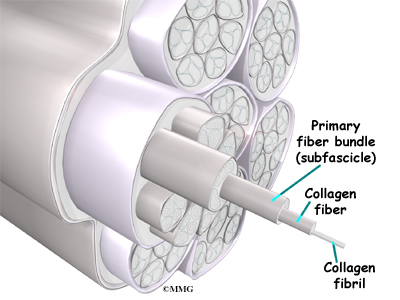
Sinew  is the term used to describe tendon or ligament in more formal English. It is the cord that connects muscle to bone or bone to bone in skeletal animals.  Like rope, it is made up of bundles of bundles of bundles as shown in this anatomical illustration.

Foot Anatomy

For our purposes, sinew is a true gift to the primitive technologist, survivalist, or low-tech hunter as it provides us with so many possibilities.  Sinew is the fiber stripped from animal tendons and used as a strong thread or it can be braided or plied together to make a stronger cord or rope.  It can be used to make bow strings, tie objects together permanently, backing and strengthening a bow, or lashing spear or arrow points onto their shafts.  It binds well with hide glue, having almost identical chemistry (collagen).  This causes it to act a lot like duct tape, binding and sticking to most surfaces.

It is also important to know that every human on Earth had access to and likely utilized sinew in the pre-modern world.  It is a gift of nature that aided our ancestors in the making of compound and composite tools.

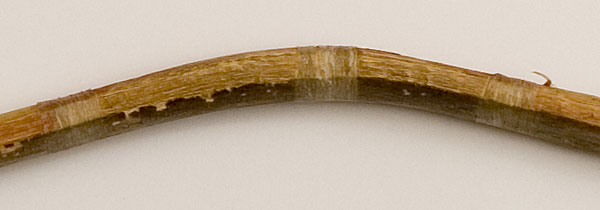
Here are two recently hafted spear points points.  If you haven’t worked with sinew, its difficult to convey just how amazing and useful this material is.  It has been called the “duct tape” of prehistory but it is even better than that.  It not only holds well and is remarkably strong, but shrinks and strengthens as it cures.  The points above were hafted (tied on) with sinew dipped in hide glue to create a solid  and tight hold on points.  This method holds up very well for throwing darts or spears and is nearly impossible to break.

https://www.nps.gov/museum/exhibits/nepe/exb/dailylife/FoodGathering/NEPE1796_Bow2.jpg
Sinew backing and binding on a Nez Perce bow. Courtesy of NPS.

If you hunt (or know someone who does), you can acquire this from the legs and back straps (the strap covering the tenderloins) of nearly any animal of size.  Elk, bison, and deer are obvious candidates for long pieces and are readily available in North America. Smaller animals such as rabbit can be used, but as in so may things, longer can really be better.  The main issue I have with the shorter sinews is that it is more difficult to work wet as it must be continually added while binding.

Plate LXIXThe more you know…

House Trucks from the Early 1970s

Rolling homes go back almost as far as rolling vehicles and the modern era of motor driven cars is not an exception.  If you have followed this blog at all you may have seen some great contraptions, especially from the 1920s and 30s.  The counter-culture of the 1960s lead to a generation of rolling home builders and dwellers ready to hit the road.

Luckily…

Photographer Paul Herzoff took a series of photos of some of the interesting, home-built, house trucks between 1971 and 1973 on the American West Coast. Many of these images are now housed at the Smithsonian American Art Museum. Since I save a LOT of reference images, I sometimes forget what is even there.  I picked a few from my files to share here since they gave me many ideas since I first encountered them many years ago.

1983.63.694_1.tif
Paul Byrd’s Old West-themed truck is among my favorites and has a lot of charm in the details. I hope it survives somewhere today.
1983.63.729_1.tif
This thing looks like a mid-century sheep wagon mated with and early Airstream (its descendant) and gave birth to a little COE camper. The giant drop down porch looks like a precursor of a modern day Toy Hauler camper.
1983.63.732_1.tif
The interior of Bob’s Bus. It appears to have a lot of great storage space and utilizes a loft for added room.  You have to love the plants as well.
1983.63.686_1.tif
This one is called “Cab, Craftsman’s Van.” Again, I just love the homeyness of the plants on board.
David
Not much information about this other than the title “David.” It is a very utilitarian door that appears to be made from a recycled packing crate and a re-purposed window. I wouldn’t put a hasp on the outside unless it could be locked in the open position. I think there would be too much chance of mischief.
1983.63.737_1.tif
Here’s another pragmatic interior with a guy named George. Small bed, maybe it folded out?
1983.63.739_1.tif
Here’s another bus interior decorated with recycled cloth. Very Bohemian.
1983.63.725_1.tif
Craig’s house truck really speaks to me. It has a great form with the compound curve of the roof and a mollycroft. You’ll notice the water barrel on top and the ever important stove pipe poking up.
Craig Inside
Another view of Craig’s home. Not only does it have a mollycroft, but it has a sunroof as well.
Housetruck
Here’s a pragmatic plywood beauty. Maybe not very aerodynamic but it sure looks spacious.
1983.63.730_1.tif
And finally, probably my favorite from the set. I suspect it is ridiculously heavy but I think this truck can handle it. There are a lot fine details to note with this one.

If you are preparing to build a rolling home, there has never been a better time to find pertinent examples to learn from on the web.  Enjoy the views.

Responsibility

Here are some good words about responsibility I would like to share from the Northwest Woodworking Studio.

Tool box detail

nwwstudio's avatarShavings

I had this crazy idea about the world and how I’d like to change it today.

Hear me out.

What if folks acted as if they were responsible for their actions? That whatever they did out in the world had a pond and ripple effect? That they are not alone on their computer, on a phone, in their world, entitled to more of everything at the expense of everyone else?

It would be like working at the bench if you will allow me. Where when you screw something up you are the one who did this. You are the one who has to fix it. You can’t turn to your neighbor, the car next to you or the bike rider, big business or the government, or your sad upbringing and history and blame them for it. You have to take responsibility for who you are and where you are in…

View original post 138 more words

Dép lốp or “Ho Chi Min” Sandals

I was looking up a link for someone and rediscovered the video today showing how to make tough and durable sandals from discarded tires.  This style is well-known in Southeast Asia, particularly in poorer areas.

https://photos.travelblog.org/Photos/20411/111103/f/749561-viet-cong-made-sandals-from-truck-tyres-1.jpg

If you are interested in sandal-making, you can hardly go wrong with this design if you have access to old tires.  I suggest watching the video if only for the remarkably sharp knife this maker is using.  Using tire material is a little heavy but will truly last a lifetime.  The straps fit purely by friction so they are continuously adjustable while the waterproofness of the material makes them perfect for the wetlands and jungle.

I understand this style was created in the 1940s when old tires became abundant and some creative shoemaker had a Eureka moment.  There is also a short write-up on this style on the always interesting Huarache Blog if you are seeking more information about this shoe.

Another step toward self-sufficiency and off-grid knowledge for the Mayhem Shoe Collective.

Making a Pack Basket

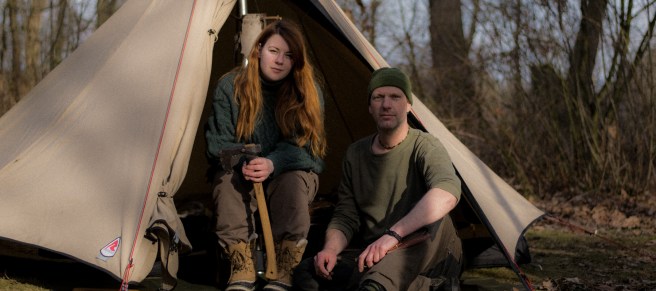
From one of my new favorite blogs Running With Sheep.  Johan and Sanne are a couple of remarkable outdoors – bushcraft – survival enthusiasts with more than a touch of philosophy thrown in.

bushcraft

Their most recent project shows how to convert a run-of-the-mill thrift store find into a functional pack basket.  From what I can tell, they are adept leather workers so their skill shows in this project.  Re-using found objects is an excellent way to economize both money and time, especially if it is something outside your skill set or craft specialty.

running-with-sheep-sheepbushcraft-basket-pack-how-to-diy-leather-apple-1

Pack baskets are light and strong and a perfect choice for hauling anything from food to dirt.  Prehistoric people used them for everything, and the solid structure makes them useful even when not carried on the back (most of the time).

running-with-sheep-sheepbushcraft-basket-pack-how-to-diy-leather-18

If you can cut a few straight lines, do some minimal sewing, and hammer a rivet, this project is for you.  For the complete post, head over to Running With Sheep to learn more.  I suspect you’ll want to stay a while and catch up on their other posts as well.

Enjoy!

DIY Pack Basket:

https://runningwithsheep.com/2018/04/16/diy-pack-basket/