From Cassell’s Carpentry and Joinery by Paul N. Hasluck, ed., 1907 edition, an excellent resource.
A selection of simple construction framing joints for building construction.
These are all really just mortises or forms of notching. These simple techniques can add a lot of value to your repertoire. The internet shows so much excitement when these things are seen in Japanese joinery but let’s not forget that this technology was world-wide common knowledge just a century ago.
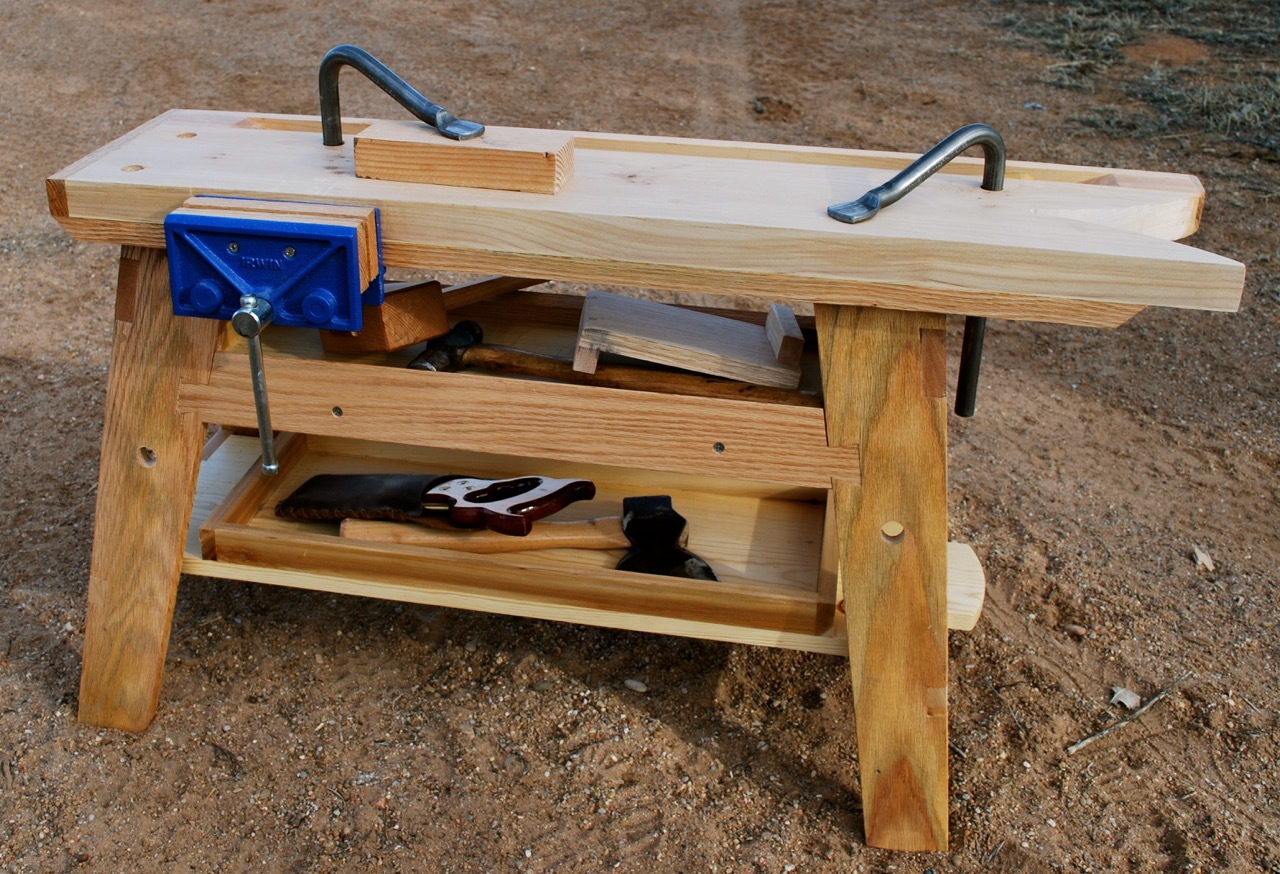
A little more done on the saw bench this weekend. It is clearly going to serve as my go-to portable workstation. I have several jigs in mind to add as regular features but, for now, I’ve started by making a brand new bench hook.
The bench’s small size will allow it to pack easily into the truck, even holding items in the tills.
I brought it out into the driveway this afternoon to get a few photographs before it’s all scuffed up and broken in.
The holdfasts are stored out-of-the-way by drilling a couple of holes in the legs. I placed them low enough that I can rotate them up to hold a board should the need ever arise.
I know this cannot replace a proper bench but I am very pleased right now. This will serve many functions, not the least of which is for bow and arrow making and as a leather work bench.
The holdfasts in place, holding nothing in particular.
This, in conjunction with the shave horse and folding x-leg table (below), will need to serve as my portable workshop for the foreseeable future I’m afraid.
Connection from leg assembly to the top.As for connecting the top, I used lag bolts with fender washers to provide a secure connection that could also be easily removed when the top is worn out.
This, in conjunction with the shave horse and folding x-leg table (below), will need to serve as my portable workshop for the foreseeable future I’m afraid.
The little table has many miles on it now and doesn’t look this pretty at all. I’m actually in the midst of refinishing it and will post pictures sometime soon.Bench hook on the bench.
This bench hook is oak, glued with Titebond 2, and pegged with Osage orange dowels for added strength. The dowels aren’t visible in the fence as they are half-blind and stop just short of the surface. A bench hook, shooting board, mitre box, and other small jigs make great use of scrap that might otherwise end up in the wood stove.
I’ve heard people say they have to put a piece of wood aside until the spirit hits them. That’s procrastination. Pick it up and work it – you’ll feel the spirit. No, I think it’s an advantage being self-taught.
A good post by Wesley from Wesleyworkswithwood. I like lists. I enjoy seeing tool lists that people think of as essential. I used to like the packing lists for backpacking that the Boy Scouts printed. I like the lists that traveling Buddhist monks put out as part of their order. Lists pare us down to the bare bones and make us think about what we have, what we need, and what we want. Head over to Wesley’s and get in on the discussion. It should be a grand old time.
Stanley No. 5 Jack plane, or non-Stanley equivalent
One 3/4″ chisel
One 1/4″ mortise chisel
A Mallet
Two holdfasts
Two to four wooden handscrew clamps
Two to four 4 foot long bar clamps
One pint wood glue
Cut nails, 1″ long
Cut nails, 1 1/4″ long
Flat head screws, 1 1/4″
Sandpaper in grits 100, 160, 180, 220
Sharpening stones in rough, medium, and fine grits
Knock off of an eclipse sharpening jig
12″ Combination Square
Marking Gauge
Marking Knife
24″ Straightedge
Tape measure
16 oz claw hammer
Set of screwdrivers
Drill with common bits in common sizes
This post got away from me. Here’s what I hope to get out of it: a conversation. Do you think someone could get started with what I’ve listed above? Can something be removed from that list?
I have been re-studying joinery, amongst other things, recently and am currently deep in Moxon’sThe Art of Joinery. I have built many structures in my life and documented quite a few for historic preservation. Last night, I made it through another oldie from the 1920s Woodwork Joints by William Fairham which really set my stagnant mind in motion.
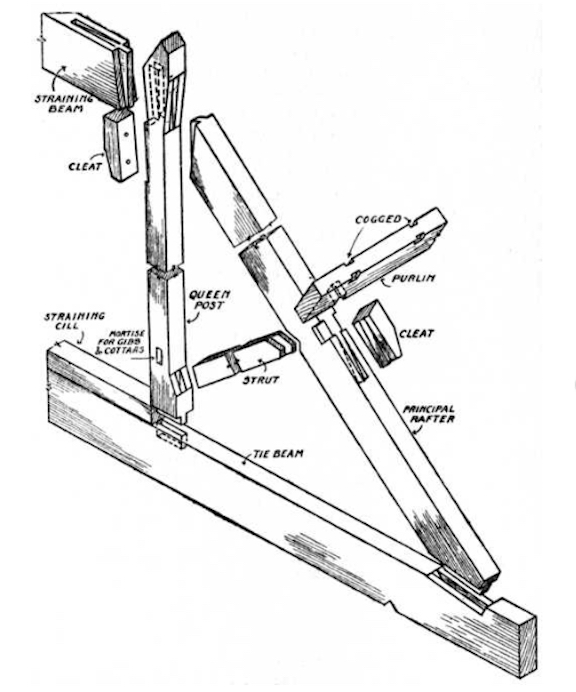
Queen Post Roof Truss schematic from William Fairham’s Woodwork Joints (1921, revised n.d.).
I know the image isn’t the sharpest but this, to me, shows the level of quality and craftsmanship we have lost in our pursuit of speed, simplicity, and the dumbing down of our trades. Nothing in this truss is complex in-and-of-itself but requires some layout skills with straight-edge and dividers, not to mention hand skills with saw and chisel. Few fasteners are required in this type of construction as it depends on the joinery locking the system together.
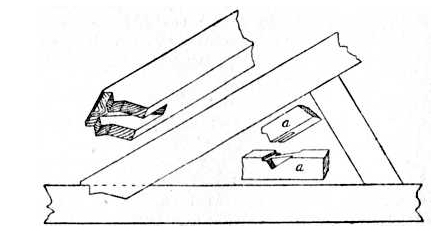
A compound-cut, stopped bridle joint used in roof truss construction. A common alternative to the above mortise joint. Not as complicated as it sounds but very solid indeed.
I have read several misguided web sites on woodworking recently lauding Japanese and other Asian-style building techniques for their use of joinery and lack of metal fasteners. Yes, they are remarkable, just not unique to Asia. This type of construction is the reason many centuries-old buildings still stand today.
“Japanese” tenon joint.
Very little under the sun is new technology. The above joint is a locking corner known as a Japanese corner tenon. I have no idea if this really filtered into western construction from Japan but it is a pretty neat looking joint.
Struts mortised to king post.
Rafters mortised to king post.
All the complicated joints are a lot of fun and interest, but in reality, learning the basic mortise and tenon (with the myriad variations) will allow for the creation of most building structures.
Half lapped top rails “through-pinned”.
Even simple half-lap joints are structurally sound with some thought towards design. The above pinned and half-lapped joint can be found in historic structures tying the top rails of simple buildings together and is also seen in a straight wall run, not just on corners. This simple timber joint is perfect for small outbuildings, sheds, and chicken coups.
Notching, used to tie purlins tight to rafters.
Cogging, an old-fashioned way of setting joists.
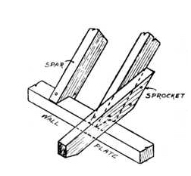
Finally, a few simple joints you may still see used are simple notching, cogging, and bird-mouth joints.
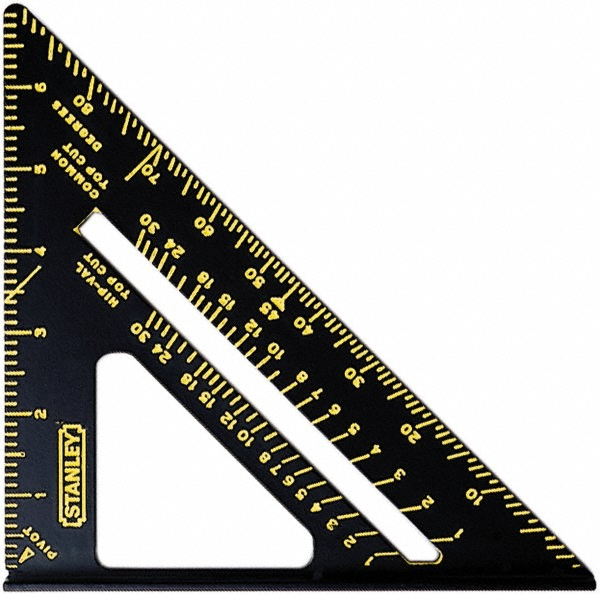
When I was a young laborer in high school and beyond, laying out and cutting accurate bird-mouths and rafter angles were the tests that separated “the men from the boys” as it were. Some people could never really get their heads around the angles, even with the ingenious, and simple layout square; many a builder’s best friend.
This post took a bit of a rambling turn but more on this subject will certainly follow for good or bad. I’m always learning, so bear with me as I work through the process on my keyboard and in my head.
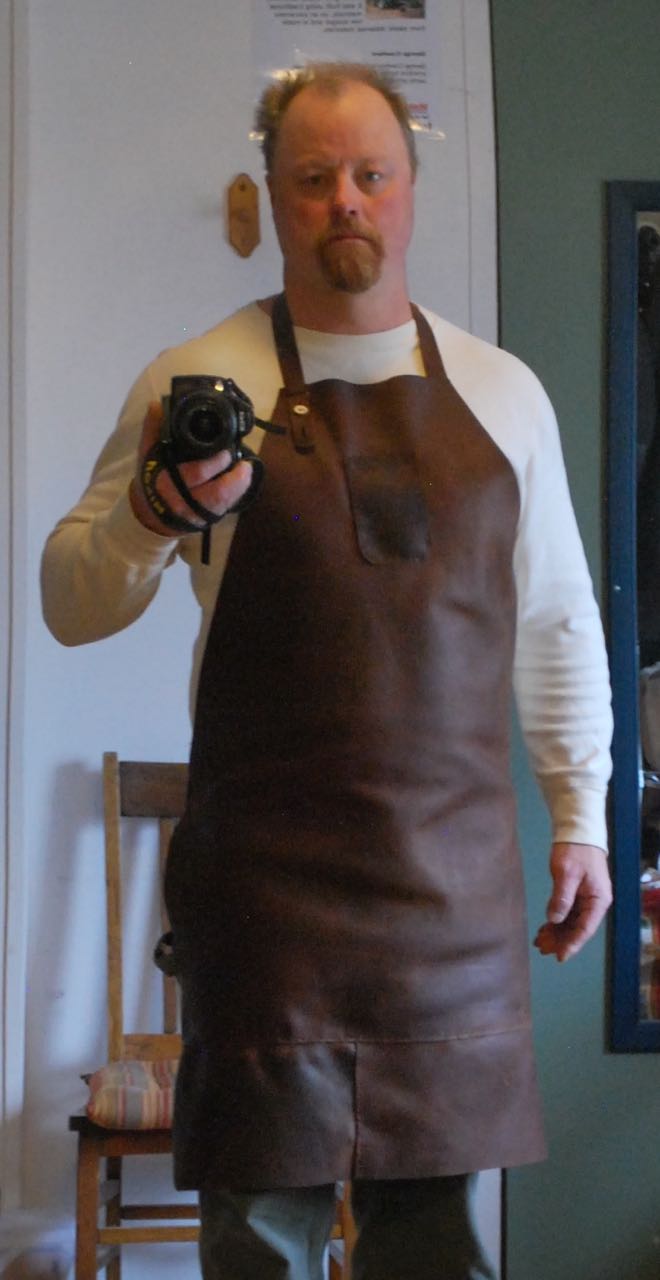
I finally got around to replacing my very old shop apron. It was the standard issue split-leather welder style and over many hard years had amassed large quantities of wood glue, grease, metal grime, blood and membrane (from brain tanning), and other unidentifiable smudges over most of it’s surface. It went into the trash a while back when an unexpected leak in my barn allowed it to saturate and subsequently get some very ugly mold patches in a funky tie-dye pattern. I expect it was fairly nutrient-rich and I wasn’t interested in trying to salvage it after all these years.
I had some fine oiled leather from a recent project (aprons take a lot of footage) so was able to cobble together a decent shop apron without too much difficulty. I expect this to last another 20 years or more; maybe the rest of my life.
The image is not great. Just a poorly lighted mirror shot “selfie.” Par for the internet I guess. And no, I’m not glaring. That’s just how I look. I guess I didn’t learn to smile well as a kid or it’s just not in the genes.
One of my favorite tools and one I have seen misused by too may people over the years. Often these are snatched up at auctions by antiquey people who want a wall hanging but quality ones can be found on places like Ebay. I have several styles and they each have their virtues.
My carriage maker model gets all the heavy work where the carpenter’s razor gets the other 80%. And let’s not forget the humble but beautiful cabinet scraper.
The common spokeshave has not changed much in over a century. The main types can be subdivided several ways but they are essentially, high or low angle with various shapes to the foot plate. I find this tool a great help when making bows, handles, or other spindle-shaped things. A flat shave will take you a long way but I get great use out of a rockered-style (convex front-to-back) for creating the complex shape of a bow handle.
These examples are from the very early 20th century and are all probably still in use from that era. I still have a boxwood low angle shave from my great-grandfather. The steel is remarkable.
From the issue of “Work” made available today by the good folks at Tools for Working Wood. Minimalist yet fairly ornate. It would sit well in a corner to get it out of the way when not needed.
Click the image to head over and have a look at this interesting resource from the 19th century.
While you are in the internet neighborhood, have a look in their store for some great and out of the ordinary stuff.












 Preindustrial Craftsmanship