After a little over a week traveling across the country in the new and improved vardo I want to share a few unedited and unstaged photos of life in the caravan.
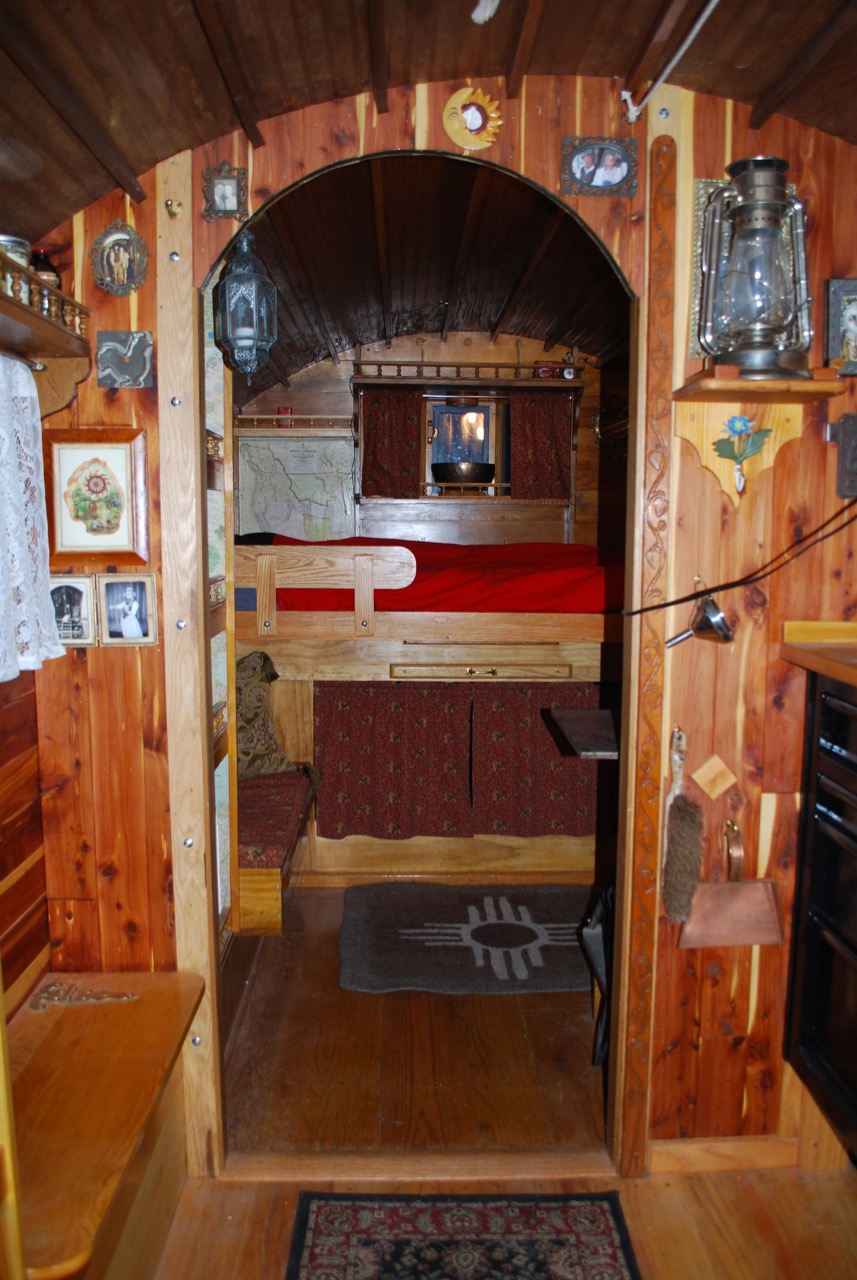
It took a couple tries to get a good area to set up in but eventually I risked parking in some low ground. I think it would have been an easy escape had we needed to pull out for rain.The ante-room serves as a staging area for cooking, working on projects, bathing, and other activities.The bed and bedroom are the essence of a vardo. The pared-down essentials of travel. This is the bed extended to full width.The washing up station is my favorite addition. The tank is a recycled Russian samovar and holds a little over a gallon of water. The copper sink provides a place to shave, wash, and brush your teeth.It is all the details and little fixes that happen over time that make the vardo so personal and cozy. I try to focus on the practical and little innovations that make our life easier on the road.In a small space, everything has to have its place. Everything fragile or dangerous also has to have a place to travel to avoid damage.It’s hard to escape an almost nautical feel to the vardo. Many of the same issues have to be overcome as those in a boat. Hence the railings on all the shelves.I owe much to my good friends who have given many of the finer bits and pieces that I use every day we travel.I also enjoy repurposing found objects for real use in the vardo. In this case, some hundred-year-old glass insulators serve as convenient rings to hold a clothesline.The large work counter serves many purposes. My beautiful copper water tank was made by the multi-talented fellow-traveller Mick Robins. The large overhead shelf is very handy for often used items.The slide out bed spends most of the day in this position, giving more floor space as needed. It’s still plenty wide for a single person to sleep on in this configuration.Just as with the 19th century living wagons, I try to use every square inch in a sensible way. Having a wood burning stove in such a small space presents its own set of problems and limitations.This awning arrangement is a new one for me and worked beautifully. The tarp is a fly that normally attaches to my wedge tent but this arrangement served well as a workshop and outdoor cook space for the week.
I am still pleased with almost every aspect of the Little Green Vardo, even after 29,000 miles.
More of my work can be found on my Instagram page.
At the end of the first decade of the twentieth century, the young artist Frances Jennings became a semi-invalid and was advised by her doctor to spend as much time as she could in the open air. Being a Victorian lady at loose ends, the obvious choice was to take to the open road. Her simple rig and a good spirit served her well. As described by J. Harris Stone:
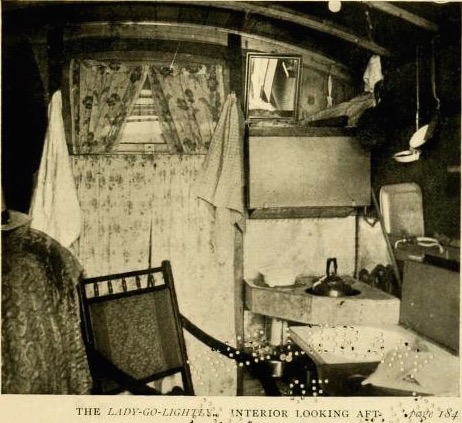
She is extremely delicate, partially paralysed, and her doctor told her that she should practically live in the open air. Being of an active and practical mind she set to work to see how she could, within her means, carry out the drastic requirements of her medical adviser. She joined the Caravan Club, and all the assistance, in the way of pitches and introductions, was of course afforded her. Her desire was to take to the road and live altogether in the open air in rural parts of the country. Her cart—it can scarcely be called a caravan—she describes as “strange and happy-looking.” It is four-wheeled, rather like a trolley, and painted bright blue, with a yellow oilskin hood—something like a brewer’s dray in shape.
Beauty in a caravan is in the eye of the beholder.
“I carry,” she tells me in one of her letters from a pitch in a most out-of-the-way spot in rural Gloucestershire, ”a hamper of food, and one of soap and brushes and tools, etc., and a box of books, a small faggot of wood for emergencies and a gallon can of water. I have a covering of sheepskins with the wool on them, and a sack of oats, bran, chaff, hay, or something to feed my little ass upon. Also I keep in a sack the donkey’s brush and comb and chain, etc., and the harness when not in use. I do not generally travel after dark, but if overtaken by dusk I hang out my candle lantern.”
Cooking over a campfire with the ubiquitous fire hook.
“…I build immense fires. That constitutes a great happiness to me. I have a kettle-hook and hanging pot, and I buy food in the villages. At the farms I find a plentiful supply of milk, fruit, honey, nuts and fresh vegetables. I build the fire just by the cart, with the donkey near at hand.”
Described in her first year on the road, she “sleeps in the covered cart, and she carries a few straight rods with her to drive into the ground on her pitch, on which she hangs squares of sacking across as a screen to keep off the gaze of curious watchers when she wants to sit by the fire ” and dream, and not be the object of their gaze.”
In her own Walden experience, things were not always easy or perfect. “I find great excitement, in the winter, in hearing the storms raving around me in the black of night… I feel my present outfit and way of getting along is very far short of perfection!… at present it is rather by the skin of my teeth that I manage to exist amid the elements of wind and rain and cold and space.”
Speaking of her time with the more traditional travellers, she says: “They have spoken like poets, worn silver rings on their copper hands and rosy beads around their necks; and their babies have round little twigs of hazel-nuts in their red hands. And perhaps the roof of their cart has been on the sea—the sail of a ship.”
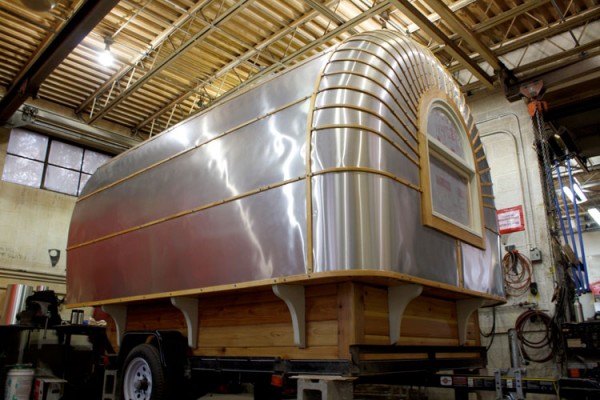
I want to re-share this camper I posted about back in 2010. I would still like to know more about it but love what I’ve seen so far.
I see some definite similarities to my own concept of a vardo but I really like to metal sheathing as a modern, low maintenance exterior. Also, the rounded front was a long consideration in my plans but in the end I chose a more “old-timey” look.
You can just about see the evolution of the Airstream design in this construction. They also have a nice Tiny House that’s worth checking out here: http://www.protohaus.moonfruit.com/
For those who don’t follow the Tiny House Blog, check out the ProtoStoga here:
I’m just going to stretch the imagination and say this is Clark Gable and Joan Crawford just prior to christening this little home (or maybe just after, he does look a little sweaty).
Here is a wonderful tiny home with Clark Gable and Joan Crawford eyeing each other up on the front porch. It appears to be strapped to a regular flatbed trailer, presumably for delivery to its final destination. There is nothing new under the sun.
Scenes of life on the road and around the campsites.
October 1951: Mrs Robert Matthew, an MP’s wife, campaigning at a gypsy encampment.Kids at the campsite.A classic image of Traveller children.Modern gypsies (Romany) in their simple accommodation.I really love these little bender tents.A fine caravan for a successful traveller.
This is part of a series of images, mostly Romany, Irish, and Scottish Travellers collected from around the internet. Many of these historic images found on the web are without citation. When a clear link to a source is found, I try to include it. If a source is known, please pass it on and I will gladly include it or remove it if necessary.
A tiny accommodation, side entry single horse style. It is documented that the adults with this style wagon generally slept outdoors except in very bad weather. It was a good way to confine the children and the valuables.
This is part of a series of images, mostly Romany, Irish and Scottish Travellers collected from around the internet. Many of these historic images found on the web are without citation. When a clear link to a source is found, I try to include it. If a source is known, please pass it on and I will gladly include it or remove it if necessary.
Wonderful rolling home.
This is part of a series of images, mostly Romany, Irish and Scottish Travellers collected from around the internet. Many of these historic images found on the web are without citation. When a clear link to a source is found, I try to include it. If a source is known, please pass it on and I will gladly include it or remove it if necessary.
This is an excellent idea, especially for a skilled willow weaver.
If you need a bicycle wagon and can get a lightweight frame built, this seems to be a great, eye-catching option. I suggest watching the short videos on their site as well. I find their site somewhat difficult to navigate, but who am I to talk with all the clutter around here?
Here is a quick link to the video about the Weaving Wagon:
Click here for their full post about the Weaving Wagon and I suggest looking around. They have some neat stuff going on.
I think I would really love to have something like this.
A somewhat dilapidated or damaged vardo in France 1920s – 1930s. People with no fixed address have always drawn suspicion while simultaneously their lifestyle is romanticized.






 I think I would really love to have something like this.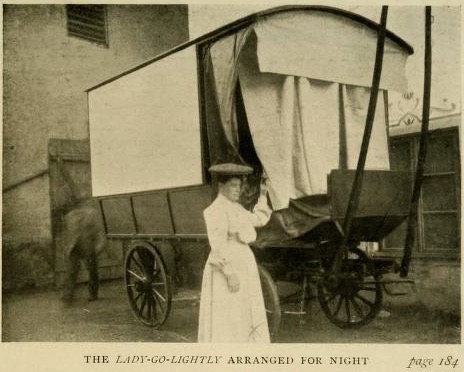

 Preindustrial Craftsmanship