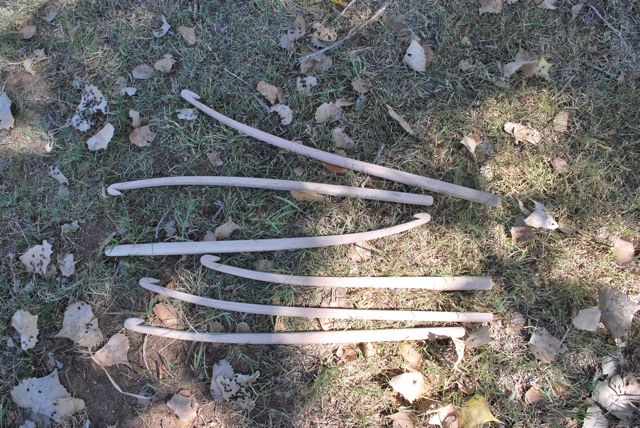
 A gaggle of new spear throwers in the Upper Paleolithic tradition. Not ivory, just oak. I have needed a bunch to use as loaners at demonstrations and events. Hopefully these will do the trick.
Adventures of an Imperfect Man In Search of a Handmade Life

A gaggle of new spear throwers in the Upper Paleolithic tradition. Not ivory, just oak. I have needed a bunch to use as loaners at demonstrations and events. Hopefully these will do the trick.
I am double posting this from my professional blog because I think it is really remarkable. A cave find from southeast New Mexico.
From time to time, we receive donations from private individuals. After a few phone calls back and forth, I arranged to meet with someone who wanted to show me a dart she had found in a cave when she was young. We have agreed to accept this remarkable find and intend to display it in the near future. The preservation is beautiful, although it has apparently been handled over many years. There was apparently a spear-thrower (atlatl) found with the dart but it was unfortunately lost in a house fire.


The foreshaft/point is hardwood and fits into a socket. the hind shaft is split in order to contract when seized with sinew (still attached. The barb is lashed on with more sinew. I will put more description and better photos when I get time.
These pictures capture the enormous flex that a dart undergoes during the throw. Not quite as evident is the flex in the atlatl itself. This one takes on a shallow “S” curve. This was an unfinished river cane shaft. It had been somewhat straightened but no forshaft or point were attached. If they were, there would probably be even greater flex due to the higher mass slowing the acceleration of the front end of the dart. I would call this shaft moderately stiff-spined and it flexed far more than could be seen with the naked eye.

This student was kind enough to allow me to photograph several throws to capture the right moment. This is about maximum flex.

This flex is vital to a powerful and accurate throw.
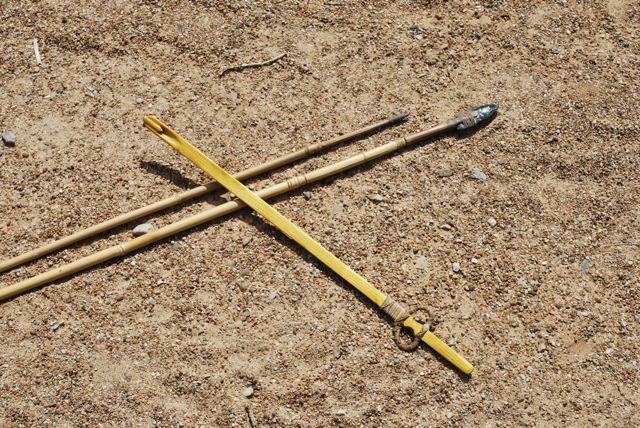
Below are a couple of darts with the new thrower.
 Preindustrial Craftsmanship