“About going where he likes, for instance? Are there not certain laws of the road that forbid the tarrying by the way of caravan folks, for a longer period than that necessary to water and feed a horse or look at his feet? By night, again, he may spy a delightfully retired common, with nothing thereon, perhaps, except a flock of gabbling geese and a superannuated cart-horse, and be tempted to draw up and on it, but may not some duty-bound police man stroll quietly up, and order him to put-to and “move on?”
Gordon Stables 1886.
The RV and traveling community owes a debt of gratitude to this fine rolling home. The Wanderer was the first true luxury Land Yacht, having been given that moniker by it’s owner, Dr W. Gordan Stables. There were some Romany-style and showman’s wagons in use on the roads, and the Salvation Army “barrows” (see Caravans for Christ) but Stables’ design expanded upon the basic plan as a luxurious moving home that well-to-do Victorians could understand.
A retired Royal Navy doctor, Stables commissioned the Wanderer to be built and began a 1300 mile tour in 1885. Prior to this, living wagons were mostly pragmatic affairs with few creature comforts, primarily employed for housing work crews. The base specifications for the Wanderer are 30 feet long (9.15 meters) and she weighed approximately 4000 pounds (1815 kilos). Two years on the road led Stables to conclude that “one about twelve feet long would serve every purpose, and be easily moved with one good horse. It would also be more easily drawn into meadows at night.”
The Wanderer. Image after Nerissa Wilson, Gypsies and Gentlemen 1986, pg 53.
Fortunately, the Wanderer was owned and loved by an avid writer so there is a lot of information about life in this beast. Dr Stables described in his writings several important amenities which we can benefit from today:
“Under the rear door the broad steps are shipped, and at each side is a little mahogany flap table to let down. These the valet finds very handy when washing up. Beneath each of these flaps and under the carriage is a drawer to contain tools, dusters, blacking-brushes, and many a little article, without which comfort on the road could hardly be secured.
Under the caravan are fastened by chain and padlock a light long ladder, a framework used in holding out our after-awning or tent, a spade, and the buckets. But there is also space enough here in which to hang a hammock.”
Gordon Stables. “The Cruise of the Land-Yacht “Wanderer”; or, Thirteen Hundred Miles in my Caravan.”
If I could only employ a valet to do the washing up!
Line drawing of the Wanderer’s floor plan.
As a career Naval officer, Dr Stables was clearly familiar with living in small spaces and understood that neatness and a place for everything was key to comfort. To explain the layout, Stables continues with a more detailed description of his little home:
“Entering from behind you may pass through A, the pantry or kitchen, into B, the saloon. Folding doors with nice curtains divide the caravan at pleasure into two compartments. C is the sofa, upholstered in strong blue railway repp. It is a sofa only by day. At night it forms the owner’s bed. There are lockers under, which contain the bedclothes, etc, when not in use, as well as my wardrobe. D is the table, over which is a dainty little bookcase, with at each side a beautiful lamp on brackets. E is the cupboard, or rather the cheffonière, both elegant and ornamental, with large looking-glass over and behind it. It will be noticed that it juts out and on to the coupé, and thus not only takes up no room in the saloon, but gives me an additional recess on top for glove-boxes, hanging baskets for handkerchiefs, and nicknacks.”
Illustration from Stable’s book about his 1300 mile journey in the Wanderer.
In this era of slow-moving traffic, regular furniture was used with few “built-in” units used, more like a normal Victorian parlour. I love the fact that music seems to have been very important to the good Doctor. He describes his “furniture” as:
“a piano-stool and tiny camp-chair, music-rack, footstool, dressing-case, a few artful cushions, pretty mirrors on the walls, with gilt brackets for coloured candles, a corner bracket with a clock, a guitar, a small harmonium, a violin, a navy sword, and a good revolver.”
The list seems very sound and familiar to me and shows preparedness for most contingencies on the road, from raucous music parties to a quiet evening in the saloon, with the ability to hold off highwaymen and marauders as necessary. I think he is definitely a kindred spirit. I guess I need to add a sword to my traveling accessories now.
Artist’s rendering of the Wanderer’s interior.
Above we see the valet hard at work, after Wilson 1986. Note the under seat/bed storage visible here. I became very curious about the tricycle and found that the good Doctor not only loved caravanning but promoted the new past time of cycling as an excellent and healthy way to tour Europe. Thinking like a Navy man, he thought of the bike as a “tender” to the caravan; a land dinghy of sorts.
The Wanderer’s flooring choice was a practical one. Linoleum was a relatively new product but had shown itself to wear well under difficult conditions and remain flexible (perfect for a rolling home). To further beautify the main room, Stables chose a Persian rug to overlay the Linoleum.
A filter much like that described in the Wanderer may be seen in the lower right of this advertisement.
On a practical note, the Wanderer was fitted with a carbon-silicated water filter as the general supply was still very poor in much of Britain. Hygene was attended to in the after cabin at the marble washstand with a small gravity-fed water system. The after cabin (really the domain of the valet) also contained a Rippingille cooking-range, a truly modern convenience in portable stoves of the time.
The Rippingille cook stove.Rippingilles Stoves Magazine Advert ca. 1910. Don’t they look happy?
“The Rippingille cooking-range is a great comfort. On cool days it can be used in the pantry, on hot days—or, at pleasure, on any day—it can be placed under our after-tent, and the chef’s work got through expeditiously with cleanliness and nicety. ” Stables 1886.
-Note to self: get a chef.
A brief stop for a meal. As with most caravans, the Wanderer carried tentage and awnings to extend the living space. The little Rippingille cooking-range can be seen next to the cook in the A-frame tent.
Dr Stables traveled in style, apparently employing a cook, coachman, and valet (it’s not clear to me if they are one-and-the-same) and had little monetary concern along the way between his pension and some success as a writer. He did, however, pave the way for the “gentleman caravanner” and helped start a trend that many of us are still emulating in our own way today. This style of off-beat living eschews the tin-can clones of the RV park and brings a level of style and class to living on the road, whether it be for a week or a year.
A couple of well-dressed Scotsmen; Stables (right) and unknown man (possibly his valet) stand in front of the Wanderer. That’s Bob the dog lying next to his master. You get a real sense of the scale of this caravan in this image.
Finally, what became of the Wanderer? A few years ago, she was safely ensconced in the Caravan Club’s site in the Costwolds, England. It seems that she never left safe hands and therefore didn’t suffer the rot and destruction that was the fate of most of the early caravans. She is still a sight to see and many are thrilled that the decision was made to display this piece of history instead of storing it in a less accessible facility.
Colin Elliott from the Caravan Club with The Wanderer. Click the image for a short article about the preservation.The Wanderer still looks immaculate inside with beautiful woodwork and attention to detail.
About the book, The Cruise of the Land Yacht Wanderer, Thirteen Hundred Miles in my Caravan. After the descriptions of the Wanderer itself, much of his book is simply a travelogue of late 19th Century Britain with encounters and minor adventures along the way. However, there are some great morsels of information hidden throughout and a delightful chapter about “Caravanning for Health” with his opinions as a career Medical Doctor. Also, he wraps up with some good advice for the traveling gentle-person about living in a small space on the road. It’s a great little read and I highly recommend it to the caravan set. If it cannot be found any other way you can read his book by downloading it from Project Gutenberg; The Cruise of the Land-Yacht “Wanderer”.
I began version one of my Vardo Caravan eleven years ago this month. As I published updates and details along the way people have for a detailed “how to” for building a vardo. Since everyone’s needs, skills, and resources are different, I will leave the task to others. My suggestions are this. Decide on your basic design wants. Traditional or modern construction? Consider size and weight (I went for the minimum of both). Consider materials. This will determine construction technique. As for traditional or modern? Go look at some used RVs for sale and see how flimsy they are built; not to mention probable issues from toxins in the plywood, pressboard, adhesives, plastic veneers, etc.
Drink in as many details as possible about other wagons. Are they for show or can they take the hammering of bad roads? How do you think they will hold together in a wreck? What kind of long-term maintenance are you prepared to perform? This is why modern RVs are covered in sheet metal or plastic. If you convince yourself that you want to use materials others don’t, then ask yourself why. Are you building an RV that looks “old fashioned” or are you deciding to build with traditional techniques? (Neither is bad, but it may not be practical to mix and match).
Final sketch that built the Vardo.
Above is the written plan I used to create the Vardo. This is obviously not exactly how it turned out as changes were made based upon availability of materials and constant reconsidering of different options. The essentials didn’t change. This is how the arc of the roof was calculated and overall dimensions worked out. I chose to use traditional techniques and plywood only in the ceiling (for ease of building and stiffening the structure). Although glue is used in some areas, the structure depends upon screws and bolts in all critical areas. I decided I was willing to maintain my wagon so the exterior finish is simple oil paint over wood.
Sketch, sheet 2.
The second sheet of the plan was mostly used as a way to gauge sizes, raw materials, and habitable space. I didn’t really build from the sheet.
Figuring it all out.
This is just one of many sketches used to figure out space and arrangements. I looked at Irish Open Lots, Vardos, Bow Tops, and Sheepherder wagons. With so much experience out there, the best arrangements have been worked out many times over. Here’s the link to the rest of the photos from the build: https://paleotool.wordpress.com/plans-projects-and-patterns/the-vardo/
Study and read as much as you can about what you want to build. Make many sketches and plans. Cut out little scale paper dolls to measure out spaces if it helps.
This is a requested repost of a series I did almost five years ago when I took my eight foot single-axle vardo caravan and reconstructed it into a 12 foot body on a robust tandem trailer.
After adding up the mileage from the log book I keep with the Vardo, I see we have clocked over 21,000 miles since she was first put to the road in February of 2010. I have, no doubt, missed some small side trips and there are excursions I know I forgot to record, but this is, more-or-less, where we stand. The trailer frame itself was high-mileage but well-maintained when I acquired it back around 2002 having first been owned by a university, then by a private individual before coming to me.
My “before” photo. Rated at 2,000 lb. gross vehicle weight. It was solid and well-built but already showing some signs of age and life in the salt air of the Pacific Coast.
The real beauty of this trailer is the square tube construction and heavy-duty hitch. Starting small was wise for me as it constrained the build and forced me to squeeze every inch out of the design.
On the way to becoming the “after” photo. The full box body nearly done.
I eventually replaced the original jack with a more heavy-duty model and replaced the jack wheel with a large foot for stability. For safety, the tires were replaced when the trailer was re-purposed due to age, not wear. If you missed it and want to read more about the construction of the micro house we call a vardo, GO HERE.
The Vardo; Where are we now? What do we want?
This little living wagon is great and serves it’s function well. It’s a little beat up and showing it’s miles; living and traveling in all weather, a lot like it’s owner. But still, it’s a little homey shelter from the elements, providing all the necessary comforts, and making travel a breeze. With about 49.5 square feet of living space inside (4.6 sq. meters) it is spacious for one and comfortable enough for two adults who do most of their activities outdoors. However, I have long pondered placing my vardo on a longer trailer, either to gain cargo space for tools and the like OR to extend our living space. Sticking with the Minimalist thinking, I decided long ago that 12 feet was about the maximum I want in a trailer. With a standard 4 foot hitch that makes for 16 feet (4.9 meters) dragging behind the truck or about the length of a second truck. I did the math on the new space and I liked it.
So back to it. What do we really need?
Thinking of the many scenarios we find ourselves in, some added amenities could be handy in certain situations. From wilderness areas in Utah to posh campgrounds in San Diego, highway rest areas in the Midwest and museum parking lots in Santa Fe, or even stealth camping on a city street, our needs are varied. Although the vardo was built as a wilderness base camp, sometimes it feels like a miniature fortress or space station or temple of solitude. When we’re camping in the remote west, beyond the confines of civilization and snooping gawkers, it’s not a problem spending most of our time outdoors, using a campfire or cook stove to fry up some bacon and boil some coffee, but try that in a grocery store parking lot in the city and you will only find trouble. But we still essentially live outdoors. We don’t need a dance floor inside.
Two thing we want that this space can supply:
A simple kitchen. By this I don’t mean a Martha Stewart style, butcher block countertop with rotating spice racks, dual ovens and a six burner ceramic-top range. We need a dedicated space to store our cookware and food, do some prep-work, and make simple meals in any weather, beyond the prying eyes of the local gendarmerie.
Secondly, we want more storage space for our personal belongings when we finally hit the long open road and don’t look back. Tools for making things and raw materials alone take up a lot of our space. Leather, wood, sewing supplies, fasteners, etc. all require more space than we have. On top of this, a large, flat work surface would be a nice addition indoors.
After several (many) sketches and mock-ups… Voila! I think we nailed it, the vardo formerly known as the Snail reborn as Nautilus 78. Even though we know that nothing comes from nothing, our minds like to think of things as having a beginning, middle, and end.
So in that sense, here’s to our new beginning.
The new foundation. Tandem wheels, brakes, breakaway safety system, LED lights and 7,000 GVWR. Let’s hope we’ll never need this much trailer.
Too many badges, certificates and insignia. Still, and excellent buy I think.
First things first. The heavy wooden floor must go.
During the heyday of Caravan living it is important to remember that these were rarely the dwelling of a loner. The Caravan was the hub of the nuclear family and groups of wagons represented larger, extended family groups and allies.
Every traveler has a campfire has the center of daily life. The hearth has been our home for 1.5 – 2 million years now. No wonder it fascinates us and brings so much comfort.
Nomads in a stationary culture are often tolerated at best and left only marginal space to congregate. This will probably never change.
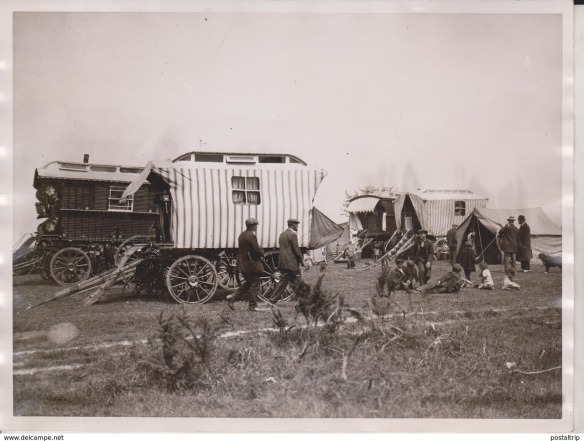
These high-end vardos with fancy covers are probably “gentlemen travelers,” the antecedents to modern RVers.
Yes, I know that Traveller has two Ls in our title but since we’re looking at Britain and the Continent that’s how we’re spelling it.
Well this is exciting. I got interviewed at winter count near Florence, Arizona back in February.
It’s heavily edited from a much longer discussion but I don’t think I sound too stupid here talking about the Vardo. The interview is very close-up and tight but you can get a feel for the interior layout. There is a lot of good stuff on the Cheap RV Living website and I’ve been a reader for a very long time. Check it out.
At the end of the first decade of the twentieth century, the young artist Frances Jennings became a semi-invalid and was advised by her doctor to spend as much time as she could in the open air. Being a Victorian lady at loose ends, the obvious choice was to take to the open road. Her simple rig and a good spirit served her well. As described by J. Harris Stone:
She is extremely delicate, partially paralysed, and her doctor told her that she should practically live in the open air. Being of an active and practical mind she set to work to see how she could, within her means, carry out the drastic requirements of her medical adviser. She joined the Caravan Club, and all the assistance, in the way of pitches and introductions, was of course afforded her. Her desire was to take to the road and live altogether in the open air in rural parts of the country. Her cart—it can scarcely be called a caravan—she describes as “strange and happy-looking.” It is four-wheeled, rather like a trolley, and painted bright blue, with a yellow oilskin hood—something like a brewer’s dray in shape.
Beauty in a caravan is in the eye of the beholder.
“I carry,” she tells me in one of her letters from a pitch in a most out-of-the-way spot in rural Gloucestershire, ”a hamper of food, and one of soap and brushes and tools, etc., and a box of books, a small faggot of wood for emergencies and a gallon can of water. I have a covering of sheepskins with the wool on them, and a sack of oats, bran, chaff, hay, or something to feed my little ass upon. Also I keep in a sack the donkey’s brush and comb and chain, etc., and the harness when not in use. I do not generally travel after dark, but if overtaken by dusk I hang out my candle lantern.”
Cooking over a campfire with the ubiquitous fire hook.
“…I build immense fires. That constitutes a great happiness to me. I have a kettle-hook and hanging pot, and I buy food in the villages. At the farms I find a plentiful supply of milk, fruit, honey, nuts and fresh vegetables. I build the fire just by the cart, with the donkey near at hand.”
Described in her first year on the road, she “sleeps in the covered cart, and she carries a few straight rods with her to drive into the ground on her pitch, on which she hangs squares of sacking across as a screen to keep off the gaze of curious watchers when she wants to sit by the fire ” and dream, and not be the object of their gaze.”
In her own Walden experience, things were not always easy or perfect. “I find great excitement, in the winter, in hearing the storms raving around me in the black of night… I feel my present outfit and way of getting along is very far short of perfection!… at present it is rather by the skin of my teeth that I manage to exist amid the elements of wind and rain and cold and space.”
Speaking of her time with the more traditional travellers, she says: “They have spoken like poets, worn silver rings on their copper hands and rosy beads around their necks; and their babies have round little twigs of hazel-nuts in their red hands. And perhaps the roof of their cart has been on the sea—the sail of a ship.”
I want to re-share this camper I posted about back in 2010. I would still like to know more about it but love what I’ve seen so far.
I see some definite similarities to my own concept of a vardo but I really like to metal sheathing as a modern, low maintenance exterior. Also, the rounded front was a long consideration in my plans but in the end I chose a more “old-timey” look.
You can just about see the evolution of the Airstream design in this construction. They also have a nice Tiny House that’s worth checking out here: http://www.protohaus.moonfruit.com/
For those who don’t follow the Tiny House Blog, check out the ProtoStoga here:
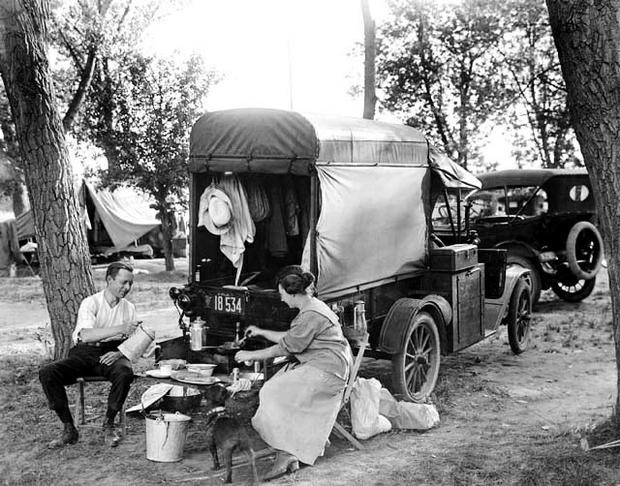
A little car camping in 1918. No attribution found.
In the heady days of 1918 while the German threat was being finished off in Europe Americans began to take leisure time in a new direction. Automobiles were almost commonplace and Yankee ingenuity was applying itself to this new platform of creativity. Patents were being filed to sell improvements on the original designs while pioneer camping technology was far from lost. Money was tight for the average person and the economy was devastated world-wide encouraging frugal holidays.
There is a little stove on the pull-out, a hurricane lamp on the side shelf, and just enough of the comforts of home under the wagon cover to make for an easy vacation.




 Preindustrial Craftsmanship