Cargo Trailer Conversion

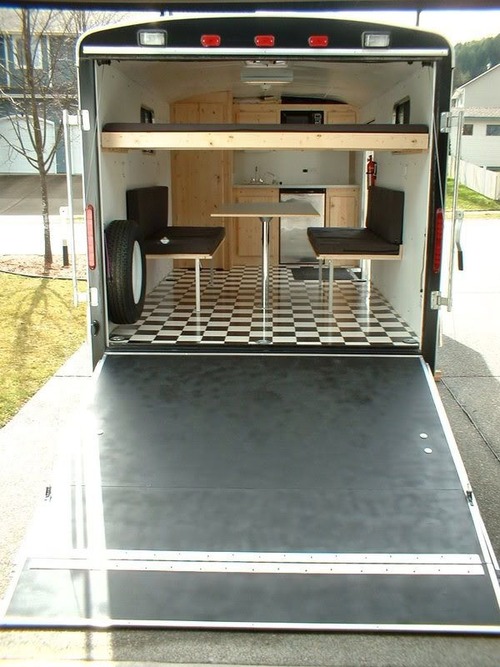
A cool conversion I saw on Tiny House America:

cargo1Virtually everything folds away and you still have a cargo trailer when needed.  This was my initial plan before building the vardo but, well, you-know, one thing led to another, the wood got out of control, plans were pulled out of old notebooks and the gypsy wagon as we know it was born.

cargo2Nice and clean look here but I’d miss my cozy interior.  This however, is a great, straight-forward design that could work for many people and is incognito from the outside.

Leather Dopp Kit

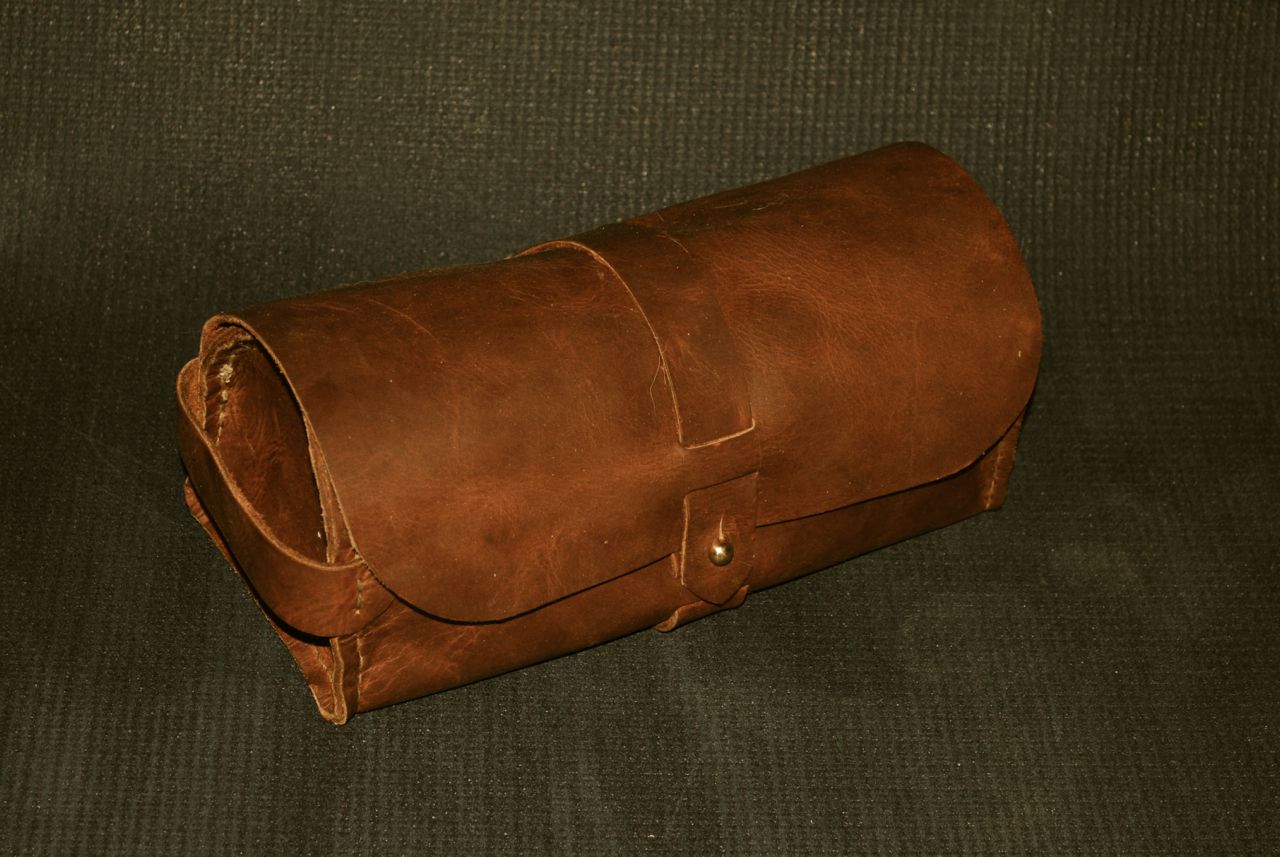
DSC_0040A small toiletries bag made from a wax-impregnated leather.  The design is essentially that of a very small 18th century portmanteau.  Included here are some of the basic tools-of-the-trade for scale and perspective.  I think leather work is appealing to me, in part, due to the honest simplicity and lack of power tools.  Most projects can be accomplished with a sharp knife, straight-edge, awl and some stitching needles.

DSC_0039This certainly is not anything fancy but it will do the trick.

Huarache Work in Progress

Markus's avatar74 FOOTWEAR DESIGN CONSULTING

Weaving Huaraches

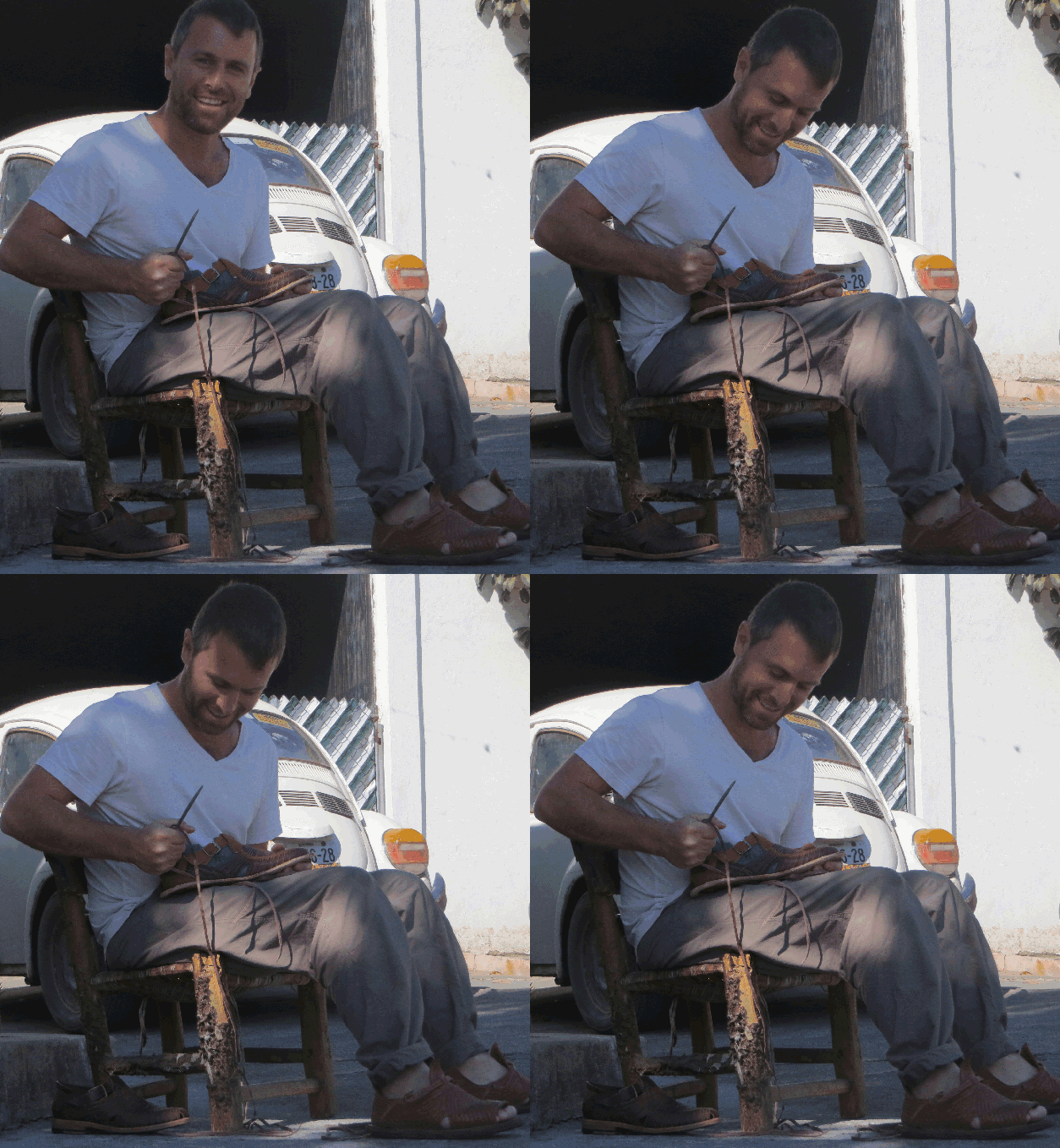
One of my latest projects is currently developing a line of Huarache footwear in deepest Mexico. Specifically in the state of Michoacan.

A small factory I’m also drawing the patterns, cutting and weaving most of the pull-overs myself..including those for the new last development. Its a little more time consuming that I had wished, but its also providing me with a better insight into the process and the difficulty of the various steps required to make the product I’m designing.

Experiencing the entire process first hand in the factory, you can also begin to realize that environmentally friendly design also includes the factory working conditions which are simply another environment that you design affects.  I’m noticing that the health and stress of factory employees can also determined by the construction process and materials (also) chosen by the designer.

Besides the fascinating sequential, almost algorithmic nature of woven Huarache footwear, I’ve…

View original post 89 more words

Romany Rai

Romano Rai (Romany Rye) (Traditional, English)

I’m a Romano Rai, just an old didikai,
I build all my temples beneath the blue sky,
I live in a tent and I don’t pay no rent,
and that’s why they call me the Romano Rai.

Didi-a-didi-a-didi-di-kai, chavves,
Tika-dika-tika-a-lai

Your Daddus tryin’ to sell a mush a kushto grai.
I’m a Romano rai, just an old didikai,
I live in a mansion beneath the blue sky,
I was born in a ditch, so I won’t ever grow rich,
But that’s why they call me the Romano Rai.

Tikka, tikka, didikai, tikka, tikka, didikai
That’s why they call him the Romano Rai

Tikka-tikka-didikai, tikka tikka, didikai,
That’s why they call him the Romani Rai.

I’m a Romano Rai, a true didikai,
My temple’s a mansion beneath the blue sky,
I’m a Romano Rai, a true didikai,
just campin’ around, on any ol’ ground,

But that’s why they call him the Romano Rai.


*Didikai is a term than Romanichal (British) call mixed-blood Romani.

Leather Laptop Case

DSC_0044I needed a new laptop case and had some nice shoulder leather left over from other projects.  It’s a fairly minimalist design but serves to protect the little Mac.  A small brass button closure is the only hardware.

DSC_0042After giving this some thought, I realize that a leather case like this should last at least 50 years, possibly more.  The lifespan of a computer is about five years so this might end it’s service life as a document holder of some sort.  It will make a great music case or something to hold a sketchbook somewhere down the road.

Wooden Truck Topper

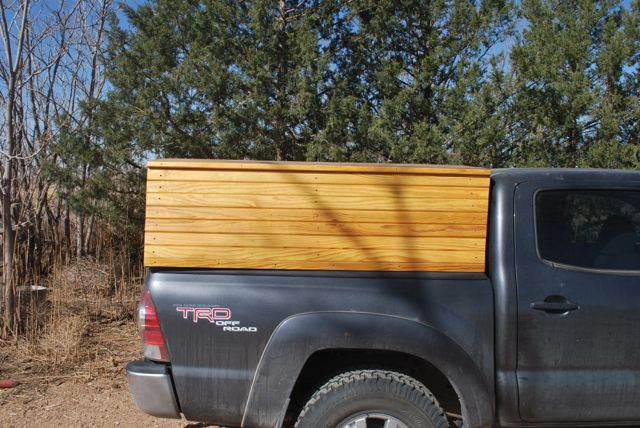
A couple recent inquiries prompt this quick post about a wooden truck topper.  The question that came up a few weeks ago was “why would you make a topper instead of just buying one?”  Well, I’m not wealthy and making something costs a lot less than buying it.  Also, if you are a woodworker, it’s easy to end up with surplus wood from projects.  Often, the next project is virtually free.  That’s what happened here.

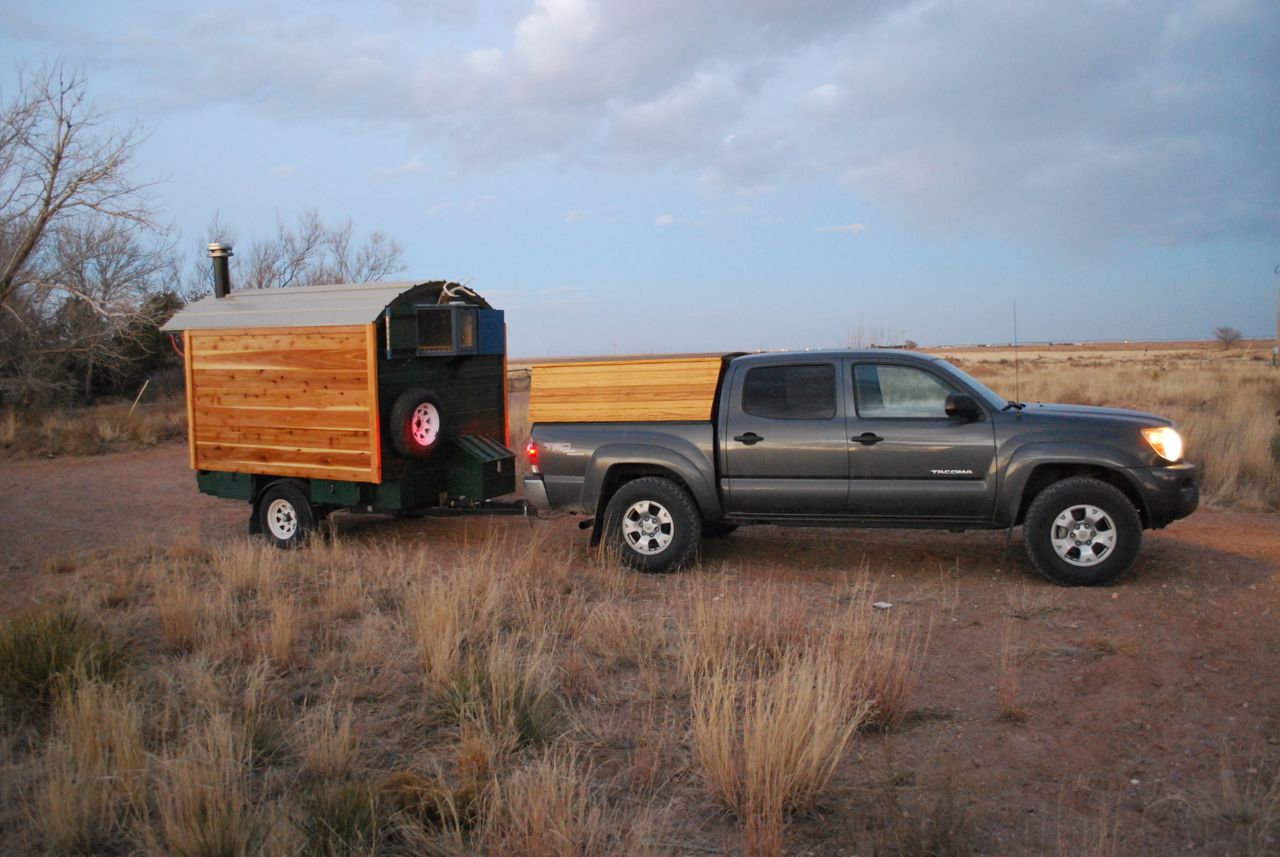
DSC_0028Sorry for the grime in this photo but I live on the southern Plains.  What can you do?  I tried to streamline it and match the curves of the pick-up but honestly, I didn’t put too much effort into any aspect of the topper.  I just needed something to get me through last summer but I’ve liked it enough that it is now a fairly permanent fixture.  The arc of the roof approximates the arc of the truck, created by eyeball and a pen on a board.  There is no better tool than the human eye in the creative process.

DSC_0027While making the shell, it became apparent that the Toyota bed tapers to the back.  I decided, upon reflection, to be lazy and just ignore this inconvenient truth and keep the shell square.  I did, however, match the front of the shell to the slope of the cab and allowed the back of the roof to overhang slightly.
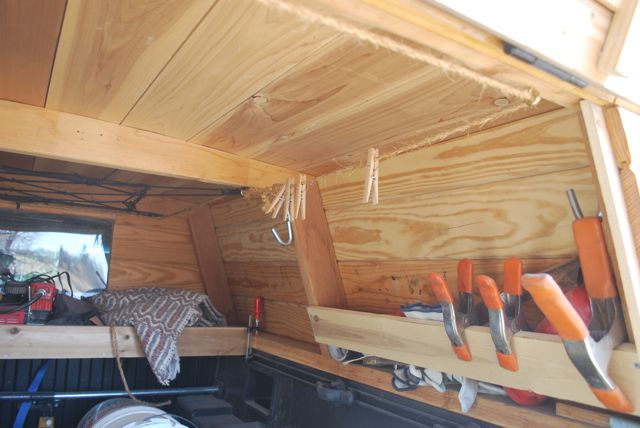
DSC_0026This interior shot shows the three frames and sill that are essentially, the skeleton of the whole thing.  Also, highlighted is the eternal mess in the back of a working truck.

DSC_0025Here’s the basic part list that I used: 2x4s for side and front sills, 2×4 frames, tongue and groove yellow pine for sides, front, and hatch, western red cedar roof.  Lexan front and rear windows, hinges, closures, and various fasteners to hold it all together.  For the roof exterior, 30# tar paper and a canvas truck tarp.  The whole thing is varnished with exterior spar varnish. I think the whole thing can be made for  a couple hundred dollars as opposed to a couple thousand from the store.
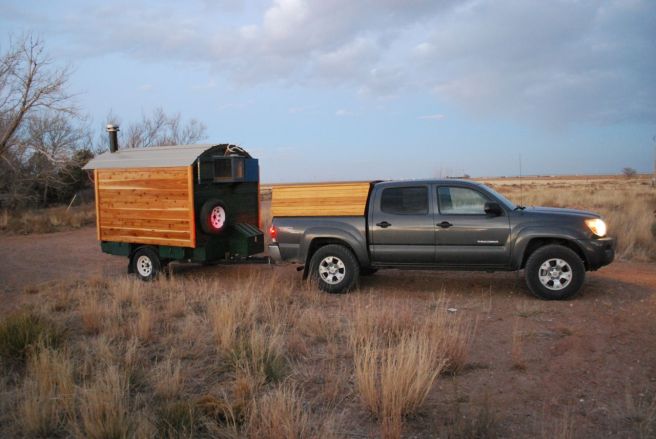
DSC_0519And besides, it matches the house…

Good luck!  Hope this helps somebody out there.
Making Tools

Back to the beginnings.  Larry Kinsella is a great flint knapper and an all-around talented guy who, amongst other things, recreates stone-age technologies from his home near Cahokia Mounds State Historic Site (one of the great cities of the prehistoric world) in Illinois.

archymo-2
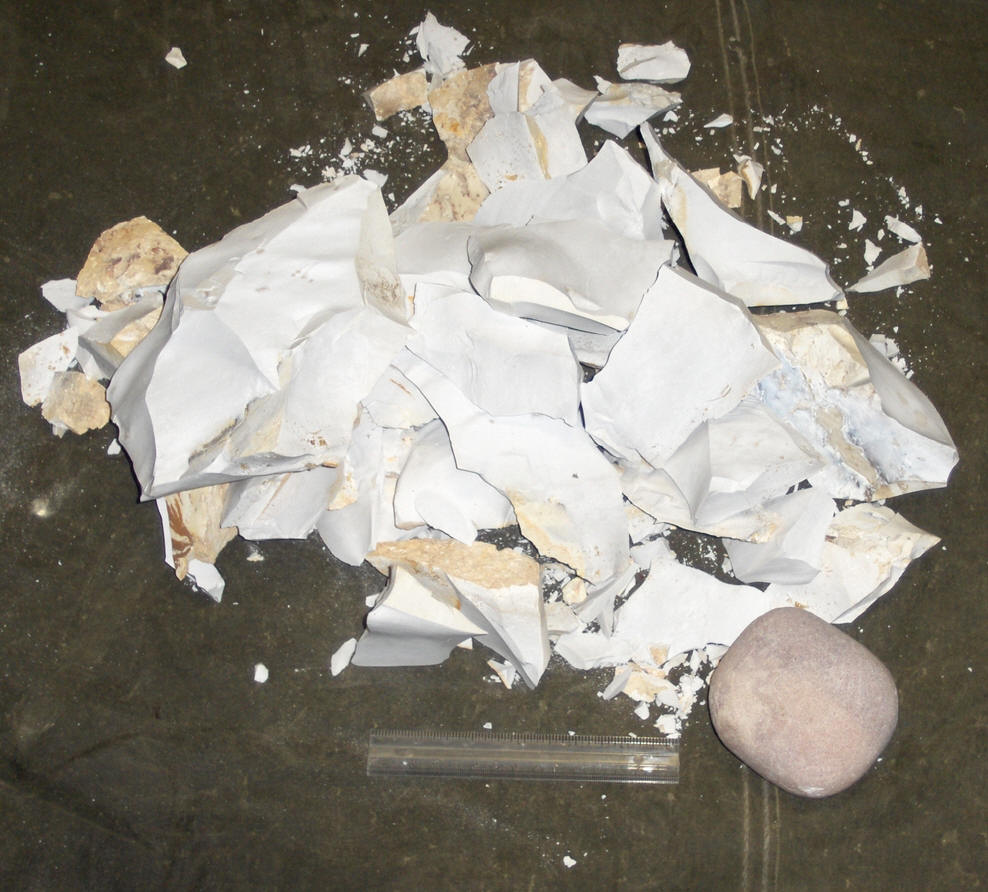
A 6.35 kilogram (14 US pound) nodule of Burlington chert.

Back in 2008, Larry, prompted by Tim Baumann, created a great lithic experiment for a Missouri Archaeology Month poster.

On May 28th,2008, Larry received an e-mail from Dr. Tim Baumann:
Larry, “I still need your help with the Missouri Archaeology Month Poster.
The theme for 2008 is prehistoric lithic resources in Missouri. The back of the poster will have unmodified samples of chert and other lithic resources used by Native Americans in Missouri. I am working with Jack Ray and utilizing his new book on Ozarks lithic resources. Jack is also organizing the fall symposium on this same topic, which will be held on Saturday, Sept.27 at Meramec State Park in Sullivan, MO. If you would like to give a presentation at this event, please contact Jack.

For the front of the poster, I would like to show the entire assemblage of lithic debitage and tools made from a single Burlington chert cobble or similar light colored chert. I was hoping that you and/or some of your friends at the Devil’s hole knap-in would be willing to supply the raw material and muscle to create this assemblage. I will then take the debitage and tools and arrange them with a computer design program into a spiral pattern with a background of obsidian or another dark colored lithic source.”
Since this original contact, a few things were changed. Pete Bostrom was asked to do the layout and photography, for one.
As with any project, unexpected hurdles arise and it’s up to the participants to modify their strategies and adapt to those hurdles.
 
First:
     After Larry blanked out the nodule, it became apparent that he was producing much more debitage and many more tools than he had anticipated. That’s when he decided to stick with only a Late Archaic Assemblage. The wide variability in point sizes, shapes, and chert, along with the occurrence of many different types of chert tools, during the Late Archaic, seemed to gravitate toward that time period. Also, the tools could have been heat-treated if the stone had not worked as well as it did.
Second:
   It also became apparent that this project presented a unique opportunity to try to understand the amount of material needed to produce certain point types. So, after the initial photograph of the raw nodule was taken by  Pete Bostrom, and at the suggestion of Dr. Baumann, Larry saved all debitage, from all the point-making attempts, separately. This provided the opportunity to not only see what type of point could be made from a single spall but also, the other tools could be isolated to their specific spalls.
Third:
The sheer amount of material produced during the project, presented Pete Bostrom with problems too. How could he possibly display all that material and make it interesting to the general public? After all,  that’s what the poster’s supposed to do, get the general public interested in archaeology.
So:
1) It was decided to keep all debitage, from each spall, separate.
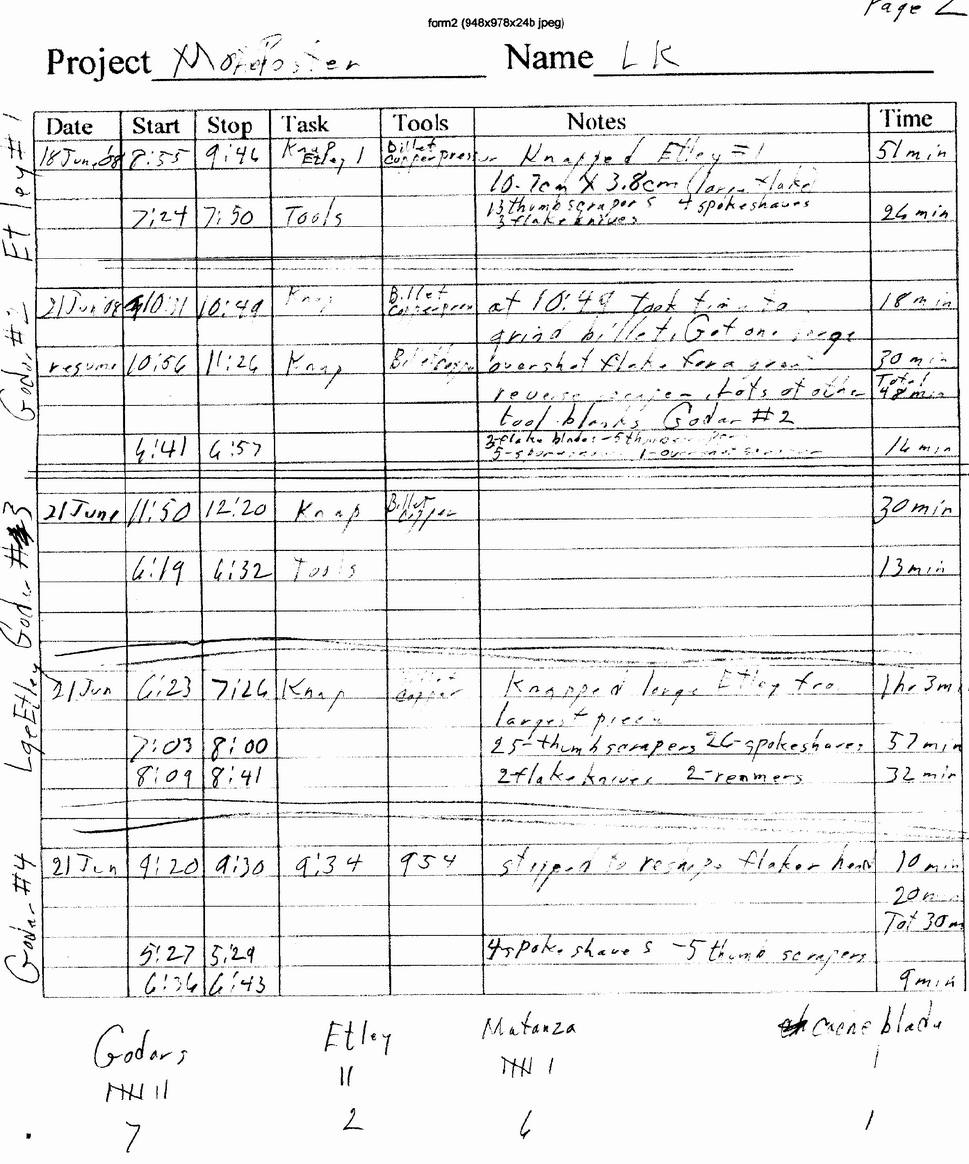
2) Keep separate notes and times on each spall using Larry’s pre-printed forms. Like this:
3) Photograph the resulting point types with their debitage.
4) Use the debitage from each point to make additional tools.
5) Photograph each point type, its additional tools, and debitage, together.
6) Screen all debitage, from each spall, through window screen, to determine how much chert grit would have been available to do core-drilling for other projects, such as, drilling bannerstones.
7) Weigh all materials. (Dr. Bauman weighed all the material, in Larry’s absence, due to surgery).
8) Present Pete Bostrom with all the material so he could lay out and take the photographs for the poster.
9) Present the photos to the printer so the posters could be made.
 
Moposter-1
Initial reduction from core to useful materials.

After reduction, each piece took it own trajectory and became a projectile point, other tool, or was cast away as debitage.  Students of archaeology (and some professionals I know) can learn much from this type of experiment by examining the range and number of flaking debris generated in a single reduction episode.

nodule14lbgrouplargeAfter Pete received the materials, he created this excellent poster which is a remarkable work of art in its own right.  Have a look at Larry’s pages explaining the process and learn something of the universal human technology that put us, for better or worse, in the place we are today.

Party Time

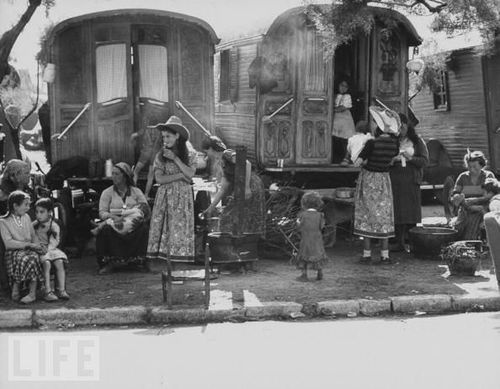
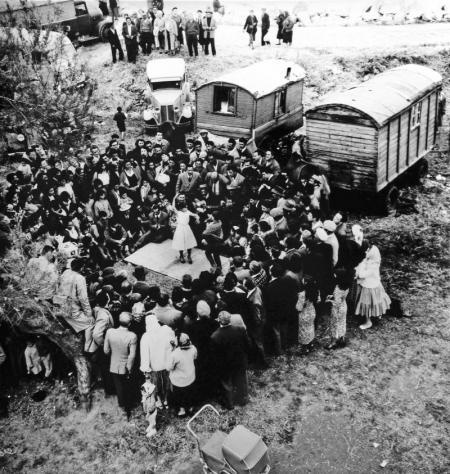
partytimeThis is part of a series of images, mostly Romany, Irish and Scottish Travellers collected from around the internet.  Many of these historic images found on the web are without citation.  When a clear link to a source is found, I try to include it.  If a source is known, please pass it on and I will gladly include it or remove it if necessary.