Vardo Plans: Reading Caravan

Many considerations concerning floor plans and general layout have come my way over the years.  I am compiling as many as possible to post here.  To start things off, here is the iconic Reading Waggon by Dunton’s (note: two “g’s” in the older British spelling).

ReadingExtThis design is truly the classic.  When one sees this, it cries of the open road and Gypsy Wagons.  It is Henry David Thoreau’s Walden cabin on wheels.  The wide rear axle and narrow front carriage was the best of compromise for agility, weight, and worthiness on and off road.  This design is worth a potential builder scrutinizing in detail for it’s perfection of design.  A mollycroft roof, high clearance, well-proportioned windows, and solid design make this ideal for the rolling home.

DSC_0197On the downside, kite walls (out-sloping) add some difficulty when working on interior shelves and cabinets.  Also, as noted for over a hundred years, the mollycroft can weaken the roof and ultimately increase the chance of leaks.  A small price to pay maybe but something to keep in consideration.
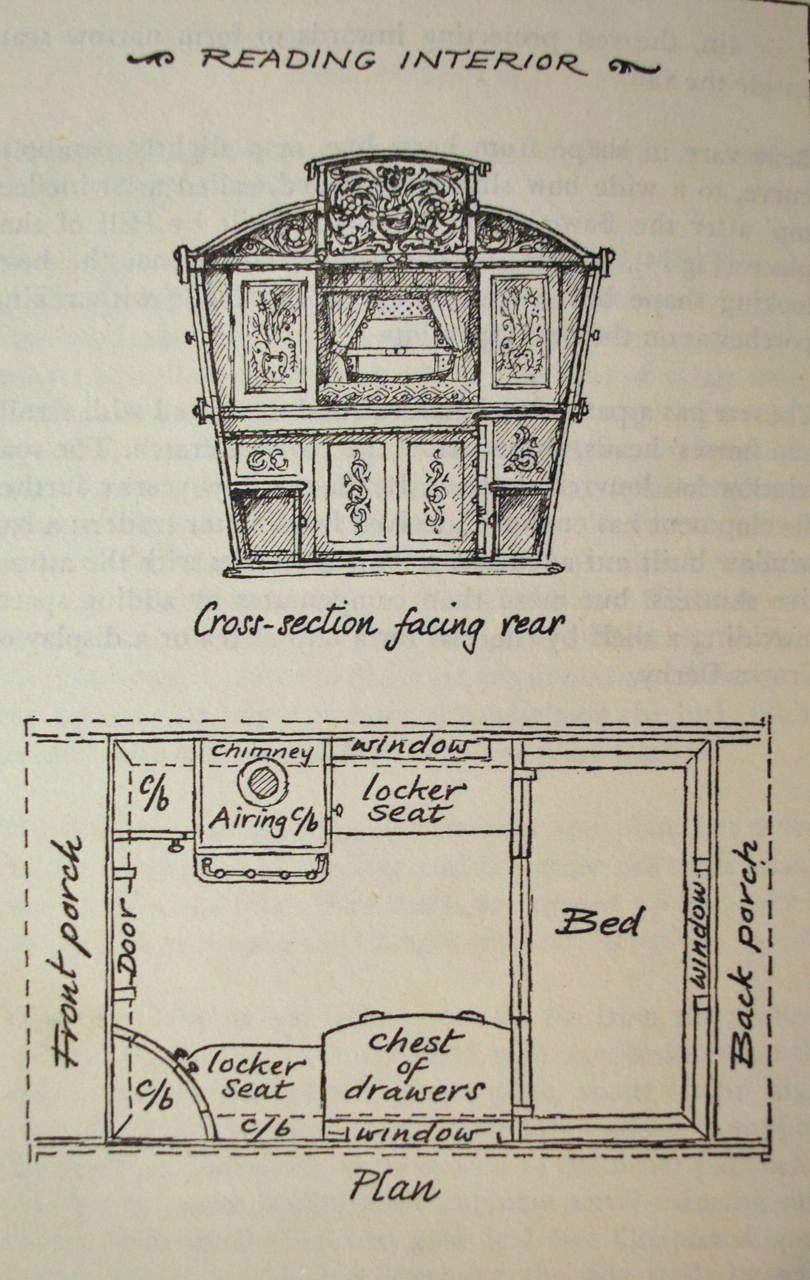
ReadingFloorThe classic caravan at this period included a full chest of drawers and a fairly large stove, limiting seating to a largish space on the stove side and a small dressing seat next to the dresser.  Although we read of dozens of children being born and raise in this design, the real layout seems to be based on the couple.  Kids will make due.

All images above are taken from The English Gypsy Caravan, currently out of print.
Ramblings

In an effort to make my mark, I’m working on a splash page image, a logo, and a flag.  Something catchy and symbolic, but not already taken. Simple, smart, and understandable.  This one about sums it up but I  think it may already be in use. compasssquarelevelMy personal image for the web page needs to be something as iconic as this pre-war “selfie” by J. Harris Stone.  A travelling man like myself.

CaravanningEx01Also, in the spirit of the early caravanners of a century ago, I am attempting to create a logo, without restricted use, for kindred spirits to fly from their rigs when on the road.  This idea struck me several years ago when seeing one of the simple logos from the Society of Primitive Technology on a car in the parking lot of a bookstore far from home.

rabbitstickI knew, when I saw it, there was likely a kindred spirit nearby.  Probably someone I know or have very few degrees of separations from.  In other words, a person I could probably trust in a pinch.wintercountThis was reinforced on me this year while I was driving a thousand miles from home, someone recognized my rig and had his young son hold up an image he knew I would recognize.  How cool is that?  Icons work to let us know, in this overpopulated yet disjointed world community, who belongs to our tribe.  Just as gang members have signs, symbols, and colors, so do law enforcement, military, and fraternal organizations.  I’m not saying this is necessarily good, just that it is.

We are tribal at heart for good or ill.  I want to put it to work for good.

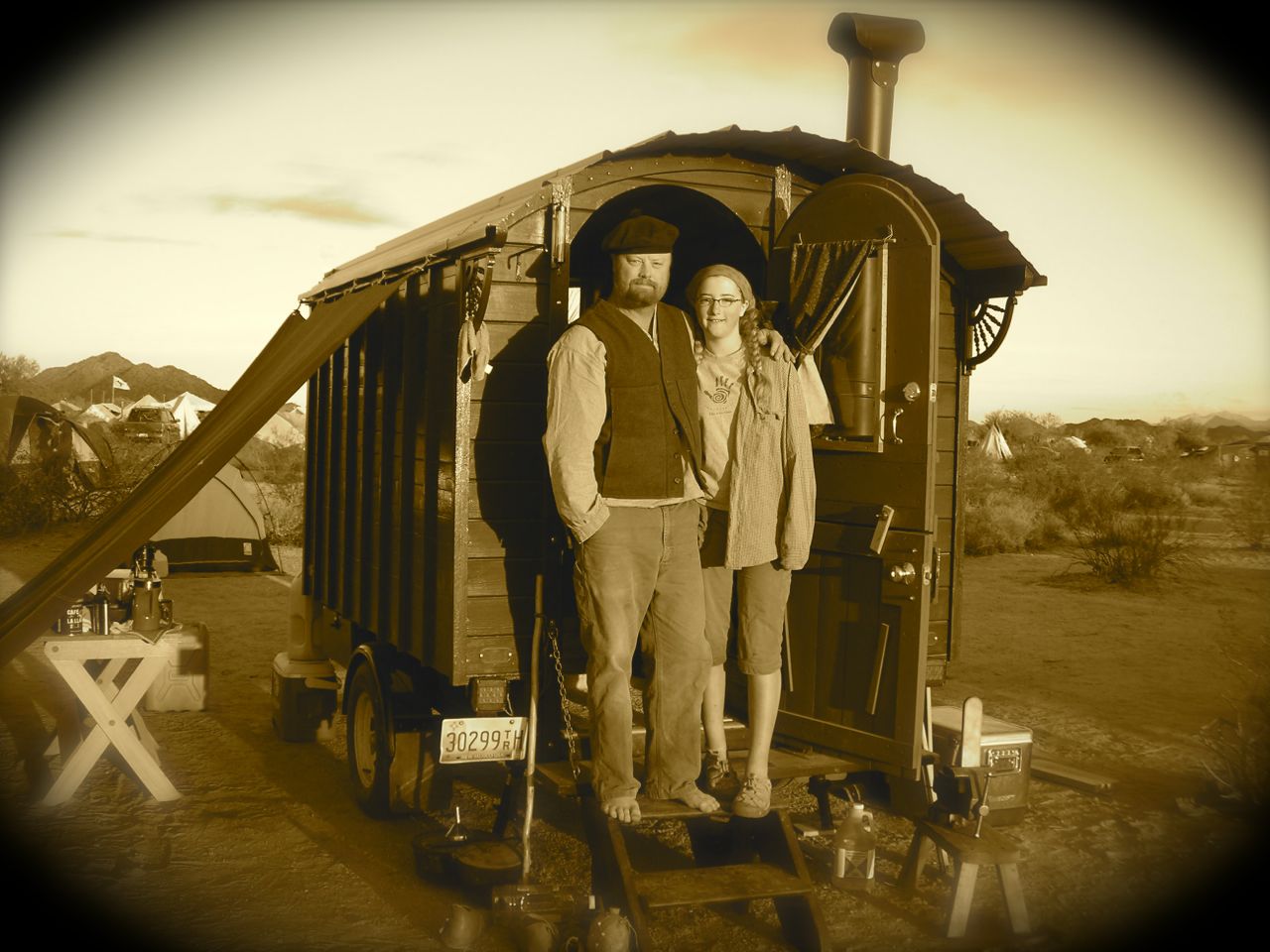
CoverontheroadThis photo dates back to a time prior to the completion of my caravan but far enough along to travel across the country.  Maybe not iconic, but a document in the life-history of my home.

As there are more and more of us in our circle of fellow travellers, sometimes we are readily recognized.

CoverWintercountVSometimes we are not.  Maybe we need a flag of our own to fly when we’re lost on the road and maybe not so recognizable.  Something like the pennon of the Caravan Club in Europe before the Great War.

CCVI welcome designs from fellow travellers but I hope to create something no matter what.  Or maybe it’s just the Saturday evening cocktail talking.

Baumeister_-_Holzschnitt_von_Jost_Amman_-_1536.svgAfter this ramble, it’s clearly time to get back to work on the bigger problems; seeking knowledge and trying to make my little world a better place.

Mrs. Coucer Green and Other Great Old Photos

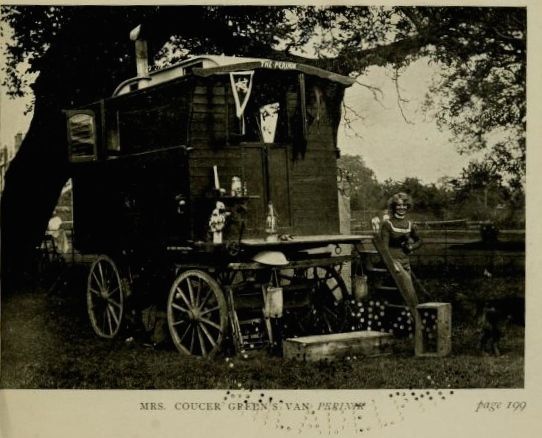
MrsCoucer
The PERINIK. A beautiful living van.

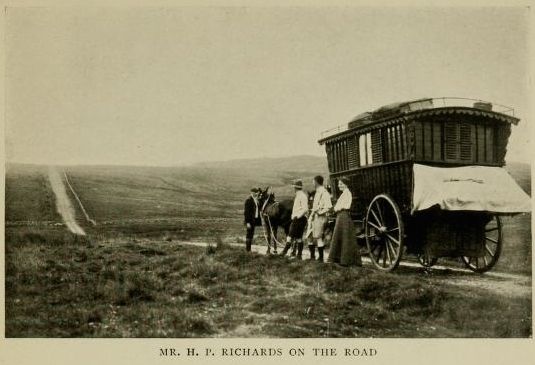
Three great and rare books have come to me in the very recent past.  Each has it’s own merits and is full of great stuff.  I am scanning, reading, and summing up some excellent stuff and will get it out as soon as I can.  In the mean time, enjoy these great photos ca. 1911-1914 the Golden Age of Caravanning.

LadyMore and better details on the way, including plans and historic photos that have lots to show us about design.

A little more about creating an elliptical plan

Following up on the ellipse.

D.B. Laney's avatarA Woodworker's Musings

Several folks wrote and said that they were having some difficulty getting their heads around this method.  Well don’t despair.  When I first read about this method, it took me a couple of days for it to sink in.  And, if you don’t have much experience with projective drawing, it’ll take a bit of cogitation.  Of course, at my age, everything takes a long time to sink in.  But it doesn’t necessarily stay “sunk in” for long.

But here’s a little more graphic information that might help.  First off, I elongated the major axis to make the model a little more easily understood.  So remember, A-B is the Minor axis, A-C is the Major axis.  I’ve divided the A-B line into equal segments (with a couple of little “cheater” segments at the ends.

001

Again, I extend the segments at right angles to the diagonal line and transfer the line measurements…

View original post 126 more words

Another way to create an elliptical 1/2 (or 1/4) plan

Interesting to learn more of the sacred geometry all the time. Compass and rule work was my favorite bits in high school geometry class. I can’t wait to add this to my layout repertoire!

D.B. Laney's avatarA Woodworker's Musings

A true ellipsis is, in my opinion, is one of the most beautiful shapes in the universe.  Unlike an oval that is drawn with two mirrored radii (or three in the case of a true “egg” shape), the radii of the ellipsis continually change.  It’s incredibly strong shape in structural terms and it’s one of the best shapes for table tops.  There are many ways to draw an ellipsis.  But here’s an old method that you don’t often see referred to these days.  It’s simple and can be extraordinarily precise.  This method can also be very helpful if you’re creating domed framing for any type of construction.

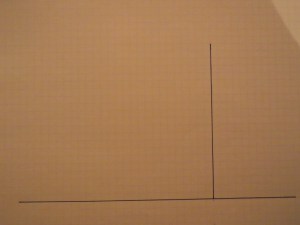
First, establish a horizontal base line then raise a vertical line.

002

Swing a semi-circle with a diameter based on the minor axis of the ellipsis.

003

Next, open the compass to the length of the major axis and strike a point to the base…

View original post 206 more words