“Do you ever Hunt? Fish? Paddle a Canoe? Explore? Prospect? Climb Hills or Sail on a Yacht?” Such was the opening line on an 1899 advertisement for Primus stoves. That covers just about anybody of worth that I know. Of course you need a stove. Buck up and buy one (that means you Jim). The ad goes on to say “It cures all ills that campers are heir to. It is the one thing needful to make camp life a dream of Elysium.” You just can’t ask for more than that.
Improving the Primus Stove experience began early on. Putting the stove in a tin case, disassembled, made for easier packing and kept the parts together. And of course, a toaster rack that works while the tea kettle is heating on top would become indispensable.
Unlike what was taught in the Boy Scouts, Primus highly encourage its use inside tents; going so far as to suggest drying clothing and bedding. I’m not sure my old Scoutmasters would approve but really, it’s nearly the twentieth century, right? Seriously though, some of the better information concerns the economy. One quart (0.95 litres) will burn for 5 hours, or as one prospectors testimony claims “A quart of kerosene lasts a week and cooks three meals a day for us.”
Now I just need to find the right tin box and the remarkable flatiron griddle shown in the upper right of the second ad.
Saves Gas Bills, Saves Trouble, Saves Patience, Saves Time! And it burns any kind of oil. I think we would market this as multi-fuel off-grid survival stove these days.
I think I may have found a portable bench design that works for me and the small bench top I’ve been saving. (Pardon the poor translation; it is a mix of Google translator and my best effort).
The Heiberg Collections – Sogn Folk Museum has a very rich collection of objects related to various crafts. They have a beautiful display of carpenter’s tools that have been displayed to resemble a workshop with workbench and tools. In addition, they have much of this collection in the collection. In this book I came across a workbench that woke my interest. The bench has registration number DHS.3884. The bench is at a height so to sit on, 46 cm high (18 inches) and about 1.5 meters (60 inches) long. In one end there is a vise and the other end there is a screw clamp with crank.
I will start drawing up plans when I get a chance.
De Heibergske Samlinger – Sogn Folkemuseum har ei veldig rik samling av gjenstandar knytt til ulike handverk. Dei har ei flott utstilling av snikkarverktøy som er lagt til rette som ein verkstad med arbeidsbenkar og verktøy. I tillegg har dei mykje av samlinga si i gjenstandsmagasin. I dette magasinet kom eg over ein arbeidsbenk som vekte mi interesse. Benken har registreringsnummer DHS.3884. Benken er i høgd slik at han er til å sitje på, 46 cm høg og ca 1,5 meter lang. I eine enden er det ei baktang og i andre enden er det ei skruklemme med sveiv.
Arbeidsbenken slik han står på magasinet på museet. Foto: Roald Renmælmo
Trigonometry, once you understand the basics, is fairly easy to use. The sine curve/cosine curve model works great for electrical engineering, but isn’t very useful for building math. Really, just the ++ quadrant of a unit circle is sufficient for every trigonometry problem you’re likely to encounter as a carpenter.
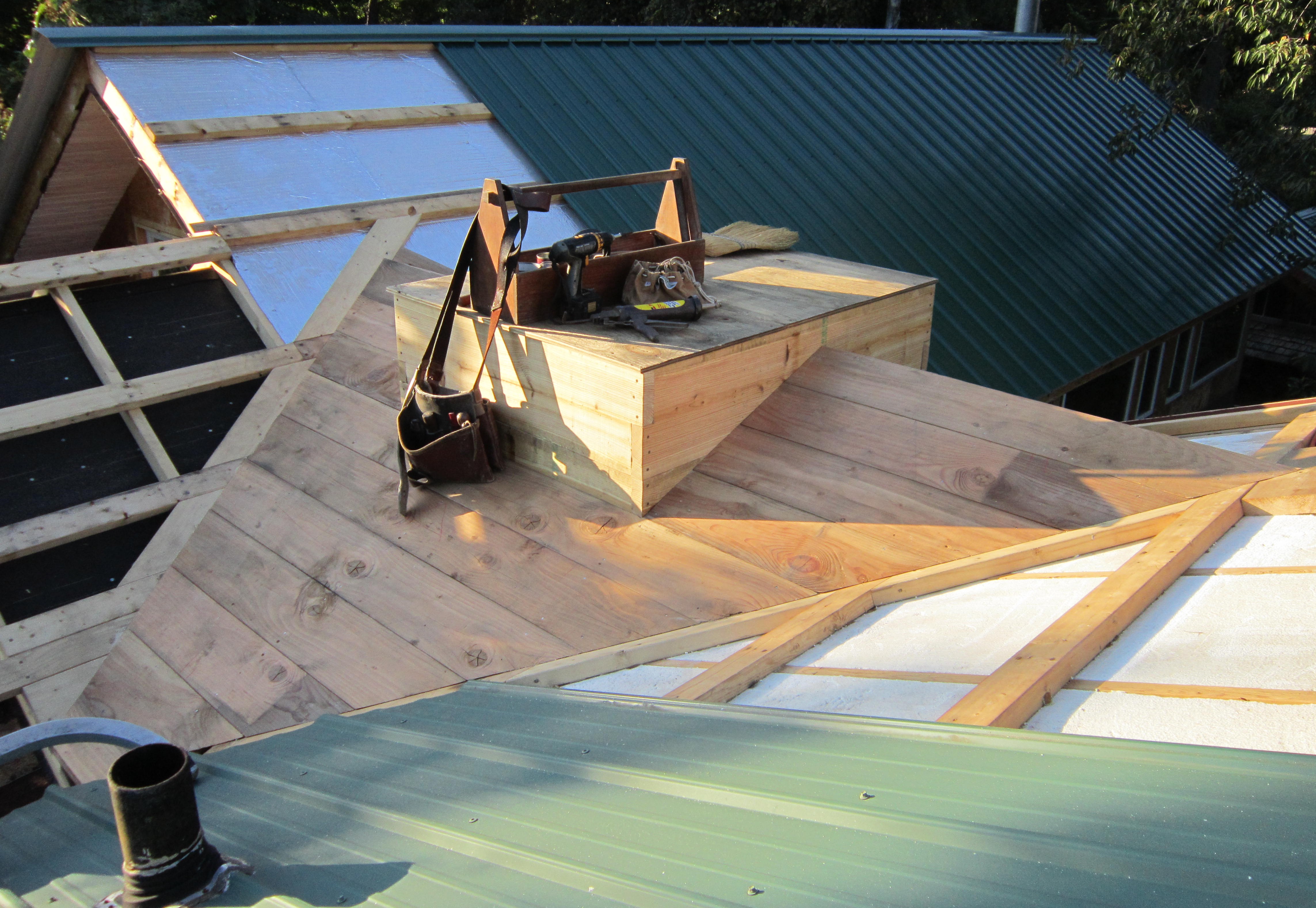
This is the intersection of an 8/12 roof and a 5/12 roof. The cricket has an 8/12 slope on one side, and a 5/12 on the other. Two of the valleys are regular, they are at an angle of 45º to plan. The other two valleys are irregular, one side is 5/12, the other 8/12, and the valleys lie at an angle other than 45º to plan. This requires a slightly more sophisticated approach than the conventional solutions.
Here’s a simple isometric of the basic idea, with the individual triangles lined out in colors. The trick is to determine a common…
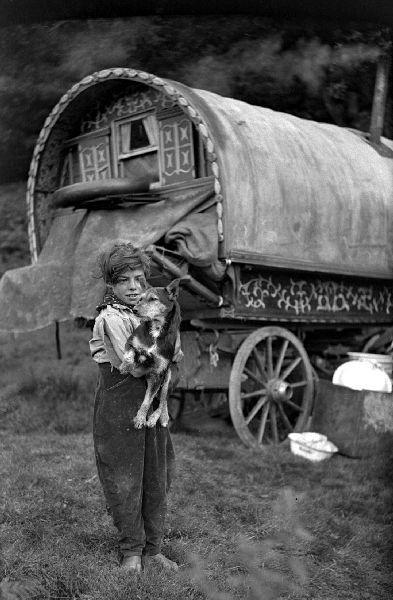
I have started a separate Blog Page to house the caravan, vardo, Rom, Gypsy, Traveller, and nomad art from my collections. Any contribution links are welcome as are comments.
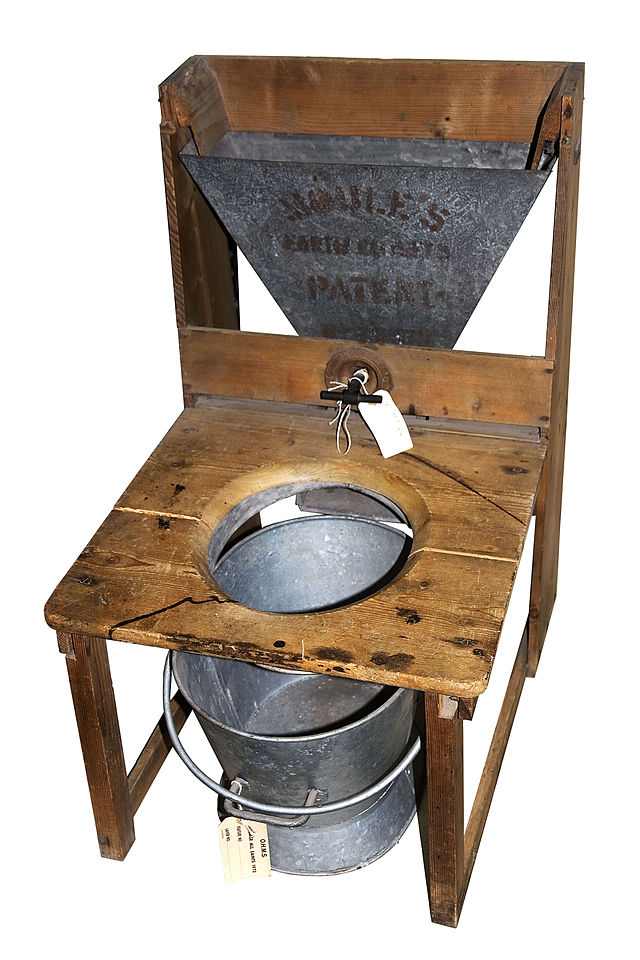
Presenting the MOULE’S PATENT EARTH CLOSET CO., Ld.
Humanure is not as new of an idea as we are often led to believe. With the genuine Moules, there are no, bad smells, typhoid OR diphtheria! That’s quite a bonus. Well, if it’s good enough for Windsor Castle and Sandringham then it’s good enough for me!
What I find truly fascinating is that we can’t discuss this subject openly. Certainly wouldn’t have been when and where I grew up. A close reading of the above handbill does not actually reveal what it is we are talking about here. Everyone does it, so everyone can figure it out. Imagine reading something like this as a non-native English speaker. The beat-around-the-bush lingo would be baffling. No picture, no real description, just talking about that which cannot be named in polite company; ewww.
If somehow you’re still not sure what we’re talking about here, this should help:
Again… eww.
But seriously, this sanitation unit was probably a huge lifesaver. Moule began developing the dry-earth system of sanitation after the summer of the “GREAT STINK” in London in 1858. Oddly enough, a culprit of this mass contamination was the introduction of the flush toilet shortly before. Overwhelming the ancient sewer systems of London and the surrounding areas.
Adding more water was not the solution to the problem so by 1860 Moule patented what became a widely accepted way to fight disease and water contamination. Due to it’s efficiency and ease of use the new “Earth Closets” were adopted by hospitals, the British military, affluent households (including the British monarchy) and throughout British India (a.k.a. the Raj).
Early work vans were designed to house manual laborers when on the job. Great for highway and railroad crews. These caravans were noted for poor ventilation and their spartan interior. Three to six workmen were often housed in these wagons.
All the necessities for living with none of the comforts of home. Cheaper than regular housing and mobile too. One can see how this evolved into the later caravan. These were expensive and not as well thought-out as later ‘vans.
At the end of the first decade of the twentieth century, the young artist Frances Jennings became a semi-invalid and was advised by her doctor to spend as much time as she could in the open air. Being a Victorian lady at loose ends, the obvious choice was to take to the open road. Her simple rig and a good spirit served her well. As described by J. Harris Stone:
She is extremely delicate, partially paralysed, and her doctor told her that she should practically live in the open air. Being of an active and practical mind she set to work to see how she could, within her means, carry out the drastic requirements of her medical adviser. She joined the Caravan Club, and all the assistance, in the way of pitches and introductions, was of course afforded her. Her desire was to take to the road and live altogether in the open air in rural parts of the country. Her cart—it can scarcely be called a caravan—she describes as “strange and happy-looking.” It is four-wheeled, rather like a trolley, and painted bright blue, with a yellow oilskin hood—something like a brewer’s dray in shape.
Beauty in a caravan is in the eye of the beholder.
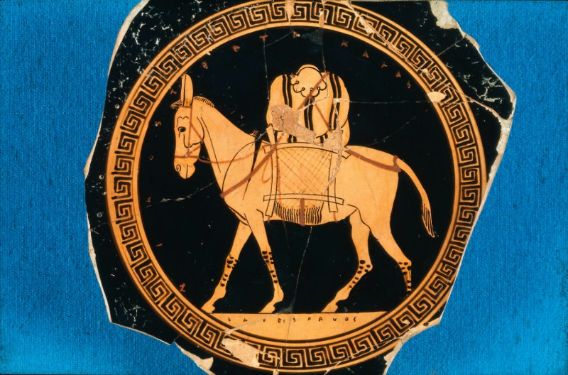
“I carry,” she tells me in one of her letters from a pitch in a most out-of-the-way spot in rural Gloucestershire, ”a hamper of food, and one of soap and brushes and tools, etc., and a box of books, a small faggot of wood for emergencies and a gallon can of water. I have a covering of sheepskins with the wool on them, and a sack of oats, bran, chaff, hay, or something to feed my little ass upon. Also I keep in a sack the donkey’s brush and comb and chain, etc., and the harness when not in use. I do not generally travel after dark, but if overtaken by dusk I hang out my candle lantern.”
Cooking over a campfire with the ubiquitous fire hook.
“…I build immense fires. That constitutes a great happiness to me. I have a kettle-hook and hanging pot, and I buy food in the villages. At the farms I find a plentiful supply of milk, fruit, honey, nuts and fresh vegetables. I build the fire just by the cart, with the donkey near at hand.”
Described in her first year on the road, she “sleeps in the covered cart, and she carries a few straight rods with her to drive into the ground on her pitch, on which she hangs squares of sacking across as a screen to keep off the gaze of curious watchers when she wants to sit by the fire ” and dream, and not be the object of their gaze.”
In her own Walden experience, things were not always easy or perfect. “I find great excitement, in the winter, in hearing the storms raving around me in the black of night… I feel my present outfit and way of getting along is very far short of perfection!… at present it is rather by the skin of my teeth that I manage to exist amid the elements of wind and rain and cold and space.”
Speaking of her time with the more traditional travellers, she says: “They have spoken like poets, worn silver rings on their copper hands and rosy beads around their necks; and their babies have round little twigs of hazel-nuts in their red hands. And perhaps the roof of their cart has been on the sea—the sail of a ship.”

 Improving the Primus Stove experience began early on. Putting the stove in a tin case, disassembled, made for easier packing and kept the parts together. And of course, a toaster rack that works while the tea kettle is heating on top would become indispensable.
 Unlike what was taught in the Boy Scouts, Primus highly encourage its use inside tents; going so far as to suggest drying clothing and bedding. I’m not sure my old Scoutmasters would approve but really, it’s nearly the twentieth century, right? Seriously though, some of the better information concerns the economy. One quart (0.95 litres) will burn for 5 hours, or as one prospectors testimony claims “A quart of kerosene lasts a week and cooks three meals a day for us.”





 Preindustrial Craftsmanship