From Cassell’s Carpentry and Joinery by Paul N. Hasluck, ed., 1907 edition, an excellent resource.
A selection of simple construction framing joints for building construction.
These are all really just mortises or forms of notching. These simple techniques can add a lot of value to your repertoire. The internet shows so much excitement when these things are seen in Japanese joinery but let’s not forget that this technology was world-wide common knowledge just a century ago.
Starting as a field scientist in the heady days when men were men and GPS was not available to common civilians, I learned my way around a compass pretty well. I thought I knew something coming out of Boy Scouts but putting those skills to the test mile after mile in order to locate a distant waypoint or build a map by hand honed those skills and etched them indelibly on my brain. Friendly competition arose amongst colleagues testing our pace and compass work over miles of rough ground in the eastern woodlands. The West is easy in comparison with open forests, plains, and grand vistas for taking long sightings. To this day, I generally prefer a pocket compass to a GPS and if I could choose only one, it would be one of these wireless beauties.A surveyor’s sighting compass can just about perform miracles in the right hands and my trusty Brunton Pocket Transit, after all these years, still finds it’s way into my field bag for big jobs. Get a compass, learn to really use it. Keep it handy, and you may never be truly lost.
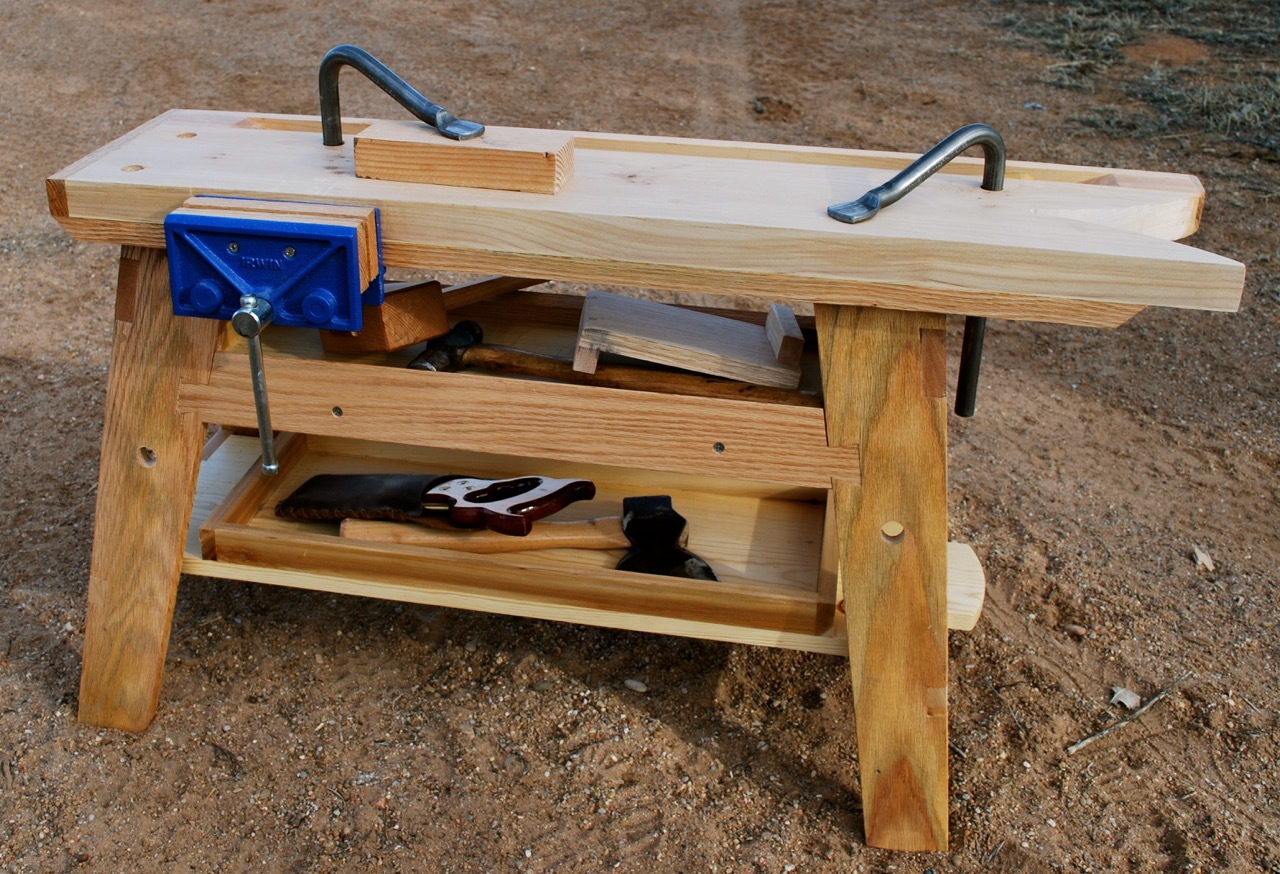
A little more done on the saw bench this weekend. It is clearly going to serve as my go-to portable workstation. I have several jigs in mind to add as regular features but, for now, I’ve started by making a brand new bench hook.
The bench’s small size will allow it to pack easily into the truck, even holding items in the tills.
I brought it out into the driveway this afternoon to get a few photographs before it’s all scuffed up and broken in.
The holdfasts are stored out-of-the-way by drilling a couple of holes in the legs. I placed them low enough that I can rotate them up to hold a board should the need ever arise.
I know this cannot replace a proper bench but I am very pleased right now. This will serve many functions, not the least of which is for bow and arrow making and as a leather work bench.
The holdfasts in place, holding nothing in particular.
This, in conjunction with the shave horse and folding x-leg table (below), will need to serve as my portable workshop for the foreseeable future I’m afraid.
Connection from leg assembly to the top.As for connecting the top, I used lag bolts with fender washers to provide a secure connection that could also be easily removed when the top is worn out.
This, in conjunction with the shave horse and folding x-leg table (below), will need to serve as my portable workshop for the foreseeable future I’m afraid.
The little table has many miles on it now and doesn’t look this pretty at all. I’m actually in the midst of refinishing it and will post pictures sometime soon.Bench hook on the bench.
This bench hook is oak, glued with Titebond 2, and pegged with Osage orange dowels for added strength. The dowels aren’t visible in the fence as they are half-blind and stop just short of the surface. A bench hook, shooting board, mitre box, and other small jigs make great use of scrap that might otherwise end up in the wood stove.
I’ve heard people say they have to put a piece of wood aside until the spirit hits them. That’s procrastination. Pick it up and work it – you’ll feel the spirit. No, I think it’s an advantage being self-taught.
The wheel barrow is an old device replacing the hand barrow which was more of a stretcher-like contraption. Simple as it is, it is one of those benchmark inventions and should not be overlooked in the realm of important technological innovations.
A good post by Wesley from Wesleyworkswithwood. I like lists. I enjoy seeing tool lists that people think of as essential. I used to like the packing lists for backpacking that the Boy Scouts printed. I like the lists that traveling Buddhist monks put out as part of their order. Lists pare us down to the bare bones and make us think about what we have, what we need, and what we want. Head over to Wesley’s and get in on the discussion. It should be a grand old time.
Stanley No. 5 Jack plane, or non-Stanley equivalent
One 3/4″ chisel
One 1/4″ mortise chisel
A Mallet
Two holdfasts
Two to four wooden handscrew clamps
Two to four 4 foot long bar clamps
One pint wood glue
Cut nails, 1″ long
Cut nails, 1 1/4″ long
Flat head screws, 1 1/4″
Sandpaper in grits 100, 160, 180, 220
Sharpening stones in rough, medium, and fine grits
Knock off of an eclipse sharpening jig
12″ Combination Square
Marking Gauge
Marking Knife
24″ Straightedge
Tape measure
16 oz claw hammer
Set of screwdrivers
Drill with common bits in common sizes
This post got away from me. Here’s what I hope to get out of it: a conversation. Do you think someone could get started with what I’ve listed above? Can something be removed from that list?
I wrote a little something about this a while back; see the post about the Bicimáquinas. Matt, from Makeshift sent me this link and asked me to share it. Have a look. It is pretty inspiring to see Makers of this caliber.
From their YouTube page:
“Power Hackers, a series made in collaboration with Autodesk, profiles unexpected makers and designers who are developing creative climate solutions.
This video profiles the inspiring work of Maya Pedal, a Guatemalan organization that produces “bicimaquinas,” or bicycle-powered machines. The income-generating devices range from blenders to milling machines. Along with clever engineering, director Mario Juarez has succeeded in fostering pride in the community’s work.
Makeshift is a field guide to hidden creativity. Subscribe to our YouTube channel to follow original series like Power Hackers.”
While you’re at it, have a look at their quarterly magazine at http://mkshft.org.






 Preindustrial Craftsmanship