The Crafting of Traditional Vegetable Tanned Huarache Footwear Leather

I have raved about the Huarache Blog before. Here’s a re-run of the excellent post about how real leather is still made by hand in Mexico.

huaracheblog's avatarHuarache Blog

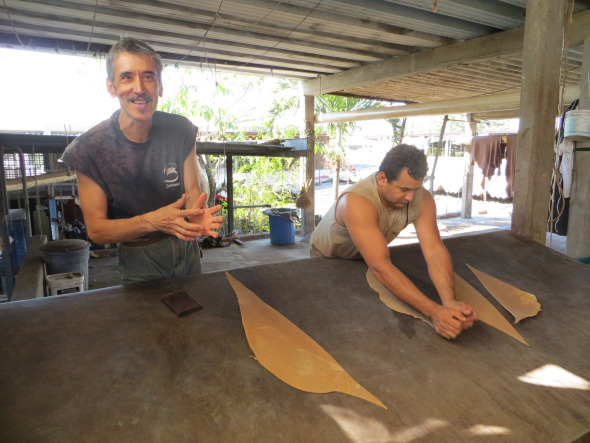
Unlike most mainstream footwear, Mexican Huarache footwear leather is still vegetable tanned using tree bark. Fewer tanneries in the world still offer vegetable tanned leathers because of the slower tanning process and higher costs of the natural raw materials used.

The natural benefits of vegetable tanned leather are:

1. The organic tanning process is non toxic and has a much lesser impact on the environment and the health of the tanners (chrome tannery workers have a 20%-50% higher chance of cancer risk).

2. The leather maintains some of its natural qualities to stretch and adapt to your foot shape.

________________________________________________________________________________________

A few months ago in a post titled “Taller De Curtiduria González – Vegetable Tanning the Best Huarache Leathers” I introduced Jesús and Antonio González the father and son tanners in Colima, Mexico who still practice this traditional and centuries old tanning method.
IMG_0084

The González tannery offers a variety…

View original post 1,275 more words

The Blind Fiddler

The Blind Fiddler 1806 Sir David Wilkie 1785-1841 Presented by Sir George Beaumont Bt 1826 http://www.tate.org.uk/art/work/N00099
The Blind Fiddler 1806 Sir David Wilkie 1785-1841, Tate Gallery Collection.

“An itinerant fiddler is playing for a humble country family. David Wilkie focuses on the listeners’ different expressions. Only two people seem to respond to the music: the baby and the boy on the right, who is imitating the fiddler by playing the bellows.When this picture was exhibited at the Royal Academy some critics thought the bust on the shelf represented a dissenting minister, and concluded that the family were nonconformists. The power of music to stir the passions of those supposedly suspicious of pleasure was thought to add to the painting’s subtlety.” From the Tate website 2007.

So many historic details in this painting: basket, copper work, cookware, walking stick, spinning wheel, stools, hats, dog, pipe, key, cup, and shovel.  A snapshot of late 18th – early 19th century rural life.

Early Style Camping Gear

Some of my camping gear mostly inspired by the period from 1745-1812, prior to major industrialization.
Some of my real-life camping gear mostly inspired by the period from 1745-1812, prior to major industrialization.

Starting in the upper left and moving more-or-less clockwise: small tomahawk, portmanteau, stoneware jug, braided buckskin cord, patch knife, buckskin bag for brass sundial compass, wool bonnet (tam o’shanter), trade bead necklace, small gourd for salt, pewter beer mug (could possibly hold water too), canteen gourd, Knife River flint blades, needle case and bone needles, strike-a-light and char-cloth box, wooden bowl and spoon, buckskin bag, bone handled eating knife, waterproofed leather bag, bark tanned belt pouch, buckskin neck bag containing spare fire kit, net shuttle holding hemp line, sewing kit in buckskin bag, wooden needle case with needles, argillite pipe with buckskin bag, fine hemp line, extra blanket pin, belt, pampooties (ghillie shoes), bamboo container containing larger bone awls and other bone tools, in the center, shoulder bag.

The Useful Man

Some thoughts on a “useful man” from 1852. Possibly the best thing I’ve read this year.

“The useful man would be the necessary link in the chain that ought connect the man of science and the daily workman, for he would lay one hand on the theory and the other on the practice, and would often take the place of the two.”

Five Years and 20,000 Miles Later…

The vardo known as the Snail turned five years old a few months ago and shortly after, crossed the 20,000 mile mark.  It’s just an arbitrary number, I know, but it feels like a milestone in our lifelong journey.  Changes have been made, details reconsidered, and minor additions have created a cozy little living space.  We now know how to use the space when traveling, eating, sleeping, or just hanging out.  The dog thinks of it as home and recognizes the signs when we’re preparing for a trip.

DSC_0082
Heading out.

This is a bit of a sentimental recapitulation of some high points so far.

There are many little wagons that are much more artistic than mine but I have been lucky and have received awards from both Popular Mechanics and the good people at Maker’s Faire.  While at the Faire, the wagon was staged for viewing, allowing visitors to walk through and ask questions.  Thousands of people came inside and checked it out.

The north woods of Idaho, 2014.

Life has slowed down for the Snail but we still take it out regularly and it makes a safe and comfortable home on the road.  In case you missed it, here’s a quick overview of the construction.

Heading out on the road.

Taking a break.
Taking a break.
Packed and ready to go.

I hope to show a few of the recent updates and changes to the living space in the next few days.  Thanks for following.

Comrades

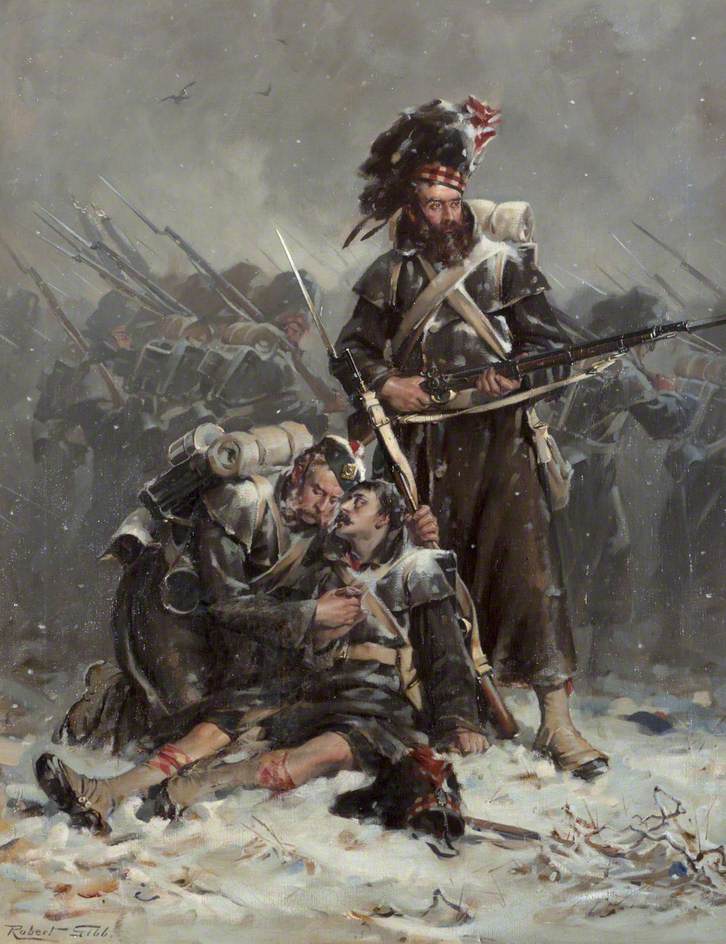
ComradeComrades, the 42nd Highlanders (copy of a lost earlier painting by the artist) 1894, by Robert Gibb.

This image is extremely moving and poignant.  The scene is of the 42nd Regiment of Foot (later called the Black Watch),  during the Crimean War winter campaign of 1854-1855.  The dying man on the ground is whispering his dying words to the man propping him up while the third stands over them.  The image is said to have been inspired by reading a book on Napoleon’s retreat from Moscow and adapted to a more familiar British theme.  This remarkable snapshot of 19th century history hangs in the Black Watch Museum, Balhousie Castle in Perth, Scotland .

HB Tansu #3-Progress 20-Complete

Wow! For calling this a “hillbilly” project this sure shows a high level of skill and craftsmanship. Maybe it’s graduated up to “hillwilliam” status now?

Greg Merritt's avatarHILLBILLY DAIKU

I’m calling it done!

Over the last several days I have been adding the finishing touches to Hillbilly Tansu #3.  Primarily, the actual finish.   I used several coats of Tried & True Original which is a mixture of polymerised linseed oil and beeswax.  I’ll add additional coats over the coarse of the next year or so.  I know that sounds like a lot of work, but I like the way the finish looks as well as the non-toxic nature of the finish in both the raw and the cured state.  How many finishes do you use that you would let a five year old help you to apply?  Once the finish had dried I buffed the entire tansu with synthetic steel wool and a soft cotton cloth.

This project had a few experiments/challenges involved in it.  Early on in the planning stages I knew that I wanted to incorporate walnut…

View original post 504 more words