For the past twenty or more years the technology of the spear-thrower has become more and more well-known as a sport. Popularly called an atlatl in the Americas as that was the name the Nahuatl-speaking Aztecs gave it. This is a world-wide technology and arguably one of the greatest technological leaps for early modern humans. I feel fortunate to have lived through this increasing popularity and to see the growth of the sport.
Have a look at some remarkable throwers recreating an ancient training game reported to be from South America.
For a more European take on the subject, check out speerschleuders at this fine German website. Finally, possibly the oldest image of a spear thrower in action from Lascaux Cave.
The bird on a stick in the lower left is believed to be an animal effigy spear thrower widely known in the region from the later Pleistocene.
Finding “handedness” in archaeology… using the fletching of arrows as an example. As a professional archaeologist AND primitive technologist I am very skeptical when someone claims they can determine which hand of a maker is dominant on an ancient tool or weapon. One reason for the distrust is that the archaeologist may not have experienced creating the object in the same way the original maker did. I think the Leatherworking Reverend has a valid point in the following article (and not just because it affirms my own experiences).
At most find-sites that have arrows there will be a non-equal mix of S- and Z-wrap on the bindings. The dig report will assert that left-handed fletchers were responsible for those that aren’t the majority direction arrow binding, probably without mentioning whether it’s the Z- or S- that they are talking about. I can’t find where it was written down the first time, but it has been repeated until it became lore. Consider the Ötze website:
According to technical archaeologist Harm Paulsen, the two arrows could not have been fashioned by the same person. The fletching shows that one was wound by a left-hander and the other by a right-hander.
and the Mary Rose Trust:
Hopkins (1998) studied 408 shafts from chest 81A2582 (O9) and recorded that, in every case, the binding thread had been wound in a clockwise direction from the tip end of the shaftment (ie, the portion of the arrow…
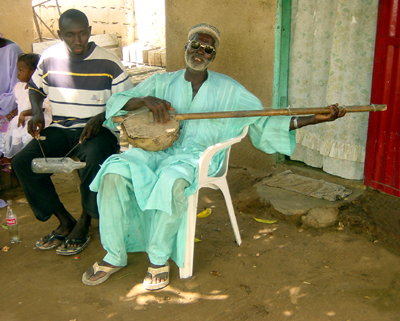
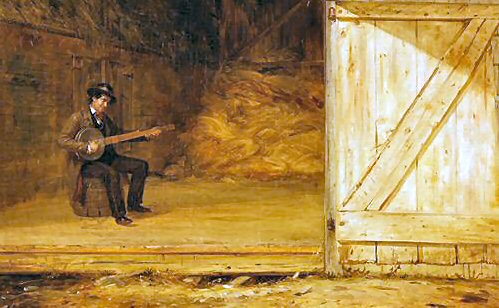
A little historical banjo for a musical Monday. Nothing comes from nothing. The banjo is truly American with roots in Africa, the mother of us all.
The Banjo Player by William Sydney Mount, 1856. Click the image for some info on early banjo sources.Manjak bunchundo master Francis Mendy. Banjul, Gambia, 2004 (Photo by Ulf Jägfors). Click the image for more information about this three string lute and other banjo cousins.An interesting article on NPR about the akonting: a three-stringed instrument with a long neck and a body made from a calabash gourd with a goat skin stretched over it.A lonely but beautiful image of a lone musician.
“I was born lost and
take no pleasure
in being found.”
John Steinbeck
That quote resonates with me. What did John Steinbeck feel?
He was a celebrity when he wrote this in “Travels with Charley”, a travelogue about him crossing America in a camper with his poodle Charley in the 60s. John was depressed, in bad health, feeling he had lost his touch with America. In order to reconnect, some say because he had a contract to write another best-seller, he got into a camper and drove across America. As a fiction writer he may have embellished or invented some conversations that made it into the book. Nevertheless his perception about the death of localism, the growing homogeneity of America, and the trashing of the environment was authentic.
A few weeks ago I visited Chilkoot Lake for the first time, a remarkable serene, and peaceful place in Southeast Alaska. Spring…
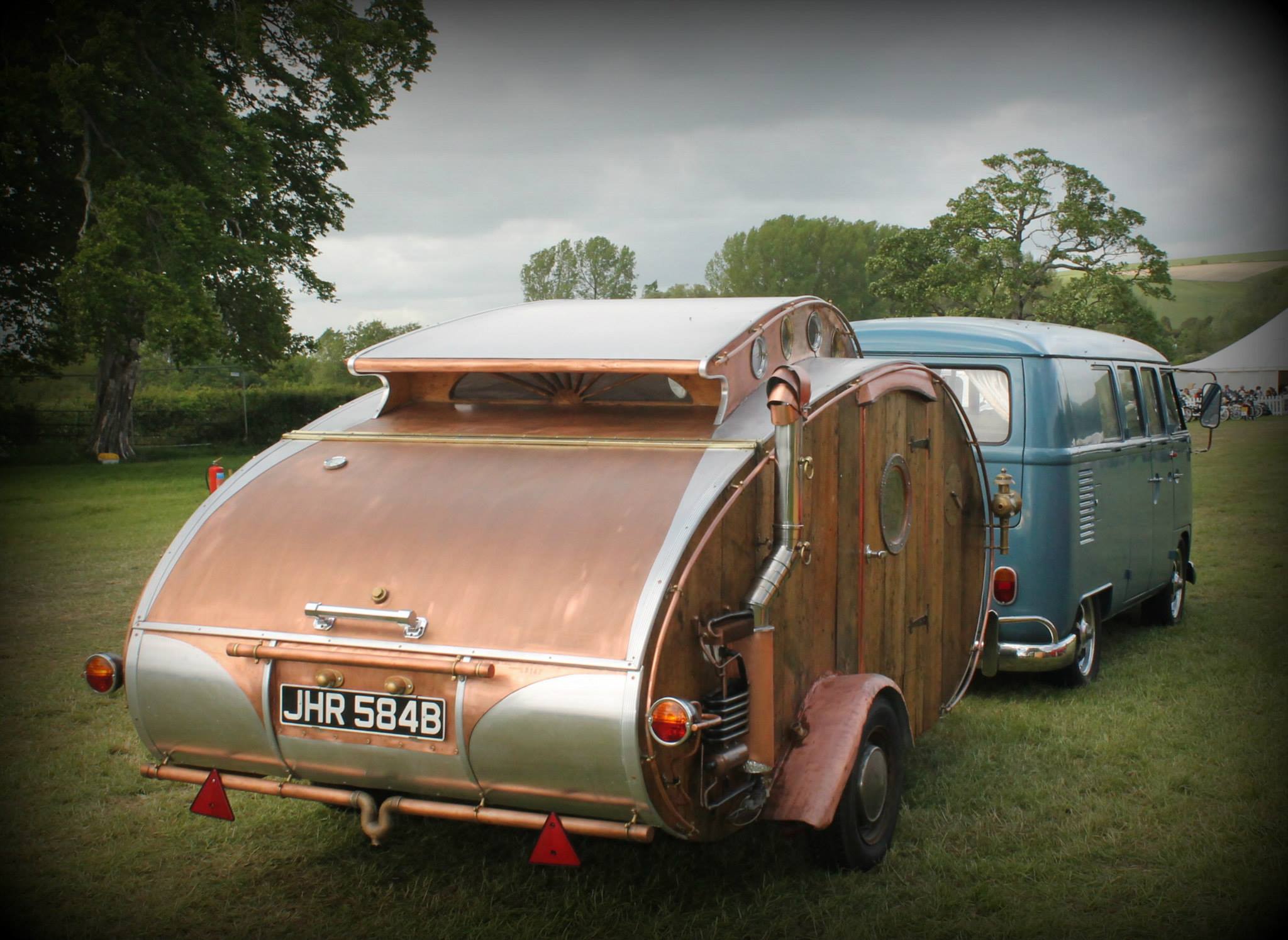
Some of you Teardrop aficionados out there have undoubtedly seen photos of Dave Moult’s spectacular build. The best write-up I’ve come across is from the Living in a Shoebox blog. This is not Mr. Moult’s first build and it clearly shows. This one has a retro-futuristic Steampunk theme and uses a lot of copper and recycled wood to create a real eye-catching look. The gizmos and do-dads are not merely for show and that’s something I can truly appreciate.
“Have nothing in your house that you do not know to be useful, or believe to be beautiful.”William Morris.
Mr. Moult has created something that is not only useful, but beautiful and interesting with this camper; and his tow-rig isn’t too shabby either. The trailer comes in at about 400 kilos loaded (just under a thousand pounds) so it will not be a chore to tow for most vehicles.
I think the genius here is in the details like the copper tubing for both water and conduit. Like most of the finer teardrops, he uses the outside of the trailer for many functions. (If you aren’t familiar with this design, I think the best way to describe them is a large outside kitchen area and a box to sleep in). Don’t worry, this nifty sink folds away for travel. The kitchen proper holds many amenities including running water, lots of storage and surfaces, and even a propane refrigerator (the mechanism and vent are exposed on the starboard side of the camper adding to the Steampunk look).
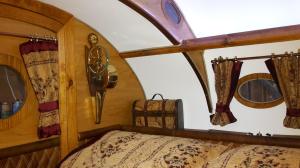
The interior is well lighted from the dormer-ended mollycroft and portholes on three sides. Supplemental lighting is in the form of well-placed LEDs; there’s even a small chandelier in the sleeping compartment. I think they travel in style; in the words of George Washington Sears, “not roughing it but smoothing it.”
Finally, a great and whimsical illusion adds to the interior ambiance with the use of library wallpaper.
View looking aft through the front porthole. The interior leather is salvaged from an old leather couch.Small enough to be pulled by a classic Mini? Now that’s cool.
More photos of Mr. Moult’s projects can be found on his Facebook page and HERE.
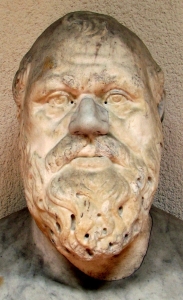
A bit of perspective on this Philosophical Friday morning. One of my favorite quotes from Socrates (Σωκράτης). Our experiences are more shared than unique.
“The unexamined life is not worth living.”Socrates
“The children now love luxury; they have bad manners, contempt for authority; they show disrespect for elders and love chatter in place of exercise. Children are now tyrants, not the servants of their households. They no longer rise when elders enter the room. They contradict their parents, chatter before company, gobble up dainties at the table, cross their legs, and tyrannize their teachers.”
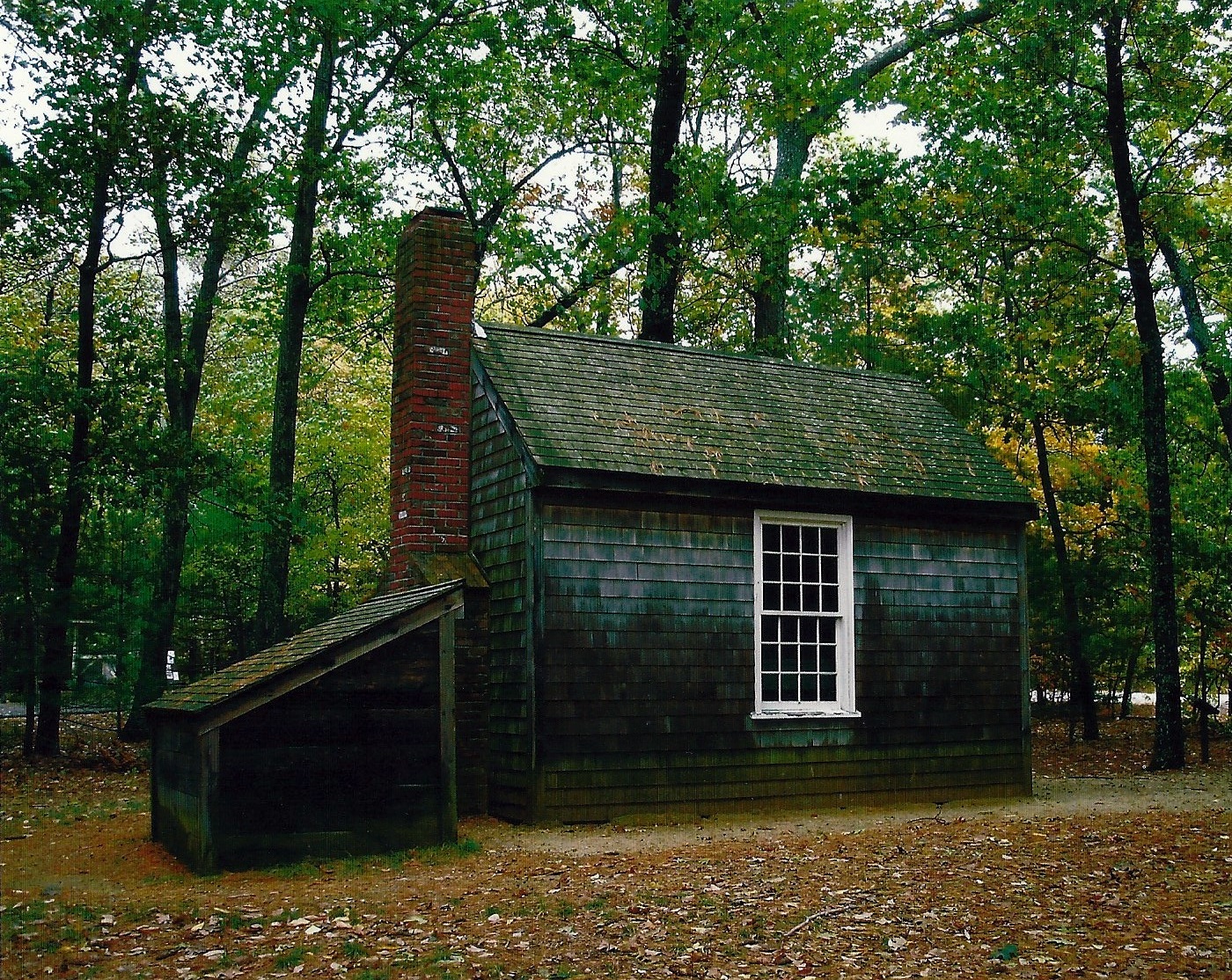
“However mean your life is, meet it and live it; do not shun it and call it hard names. It is not so bad as you are. It looks poorest when you are richest. The fault-finder will find faults even in paradise. Love your life, poor as it is. You may perhaps have some pleasant, thrilling, glorious hours, even in a poorhouse. The setting sun is reflected from the windows of the almshouse as brightly as from the rich man’s abode; the snow melts before its door as early in the spring. I do not see but a quiet mind may live as contentedly there, and have as cheering thoughts, as in a palace.”
A little something for Wagon Wednesday. A simple bow-top accommodation. Very little of the wagon is seen in the image but we can rest assured that it was painted green at one time. Hedley picked up some fine details here including bolts, boards, the tarp attachment, and a very nice little driving lamp.
Last in Market, Ralph Hedley 1885. Hedley really captured life in rural northern Britain.
A Traveller’s (sic) Tuesday. Just a glimpse into life in a bender tent. Despite the glamorous view of life on the road depicted by the romantic English Gypsy Caravans, this is how most Roma lived in 19th Century Britain.
Gypsies, Camped on the Beach, near South Shields, Ralph Hedley Charlton, painted 1876.












 Preindustrial Craftsmanship