After learning my flight was detained 4 hours, I heard the announcement: If anyone in the vicinity of gate 4-A understands any Arabic, please come to the gate immediately.
Well—one pauses these days. Gate 4-A was my own gate. I went there.
An older woman in full traditional Palestinian dress, just like my grandma wore, was crumpled to the floor, wailing loudly. Help, said the flight service person. Talk to her. What is her problem? We told her the flight was going to be four hours late and she did this.
I put my arm around her and spoke to her haltingly.
Shu dow-a, shu- biduck habibti, stani stani schway, min fadlick, sho bit se-wee?
If you know me at all you know that I am interested in pack baskets. Because of this, they catch my eye when I’m browsing historic images.
I could find no information whatsoever about this one. I suspect maybe Tibet in the early 20th century? Pack baskets have been underrated in the west. I’m glad to see more and more of them used in the primitive technology, bushcraft, and survival communities. I love the one I made but I know there are even better ones out there.
I was interested in the harness system here. It seems to sling around the entire basket for support. It took me some time and effort to come up with one I liked for mine but based on some historic examples, I was able to come up with one that worked.
Danger, geek stuff ahead as I share a little story from last week…
Recently, on my occasional foray into our local charity shop I saw something mysterious. I’m not much of a shopper but before I was even certain as to what this fellow was, I was pretty sure I needed to possess it. Knowing nothing about this entire class of antiquity, I also had no idea what a good price would be but I knew that the listed amount would be worth my entertainment. The tag asked for about the price of a decent dinner out in small town rural New Mexico. And they say it goes to a charity, right?
A black box ready to be explored. What could be inside?
I find about one thing per year in this store that actually piques my interest. This slightly battered black box was pushed back on a bottom shelf mixed in with some old-style slide projectors and video recorders. I thought maybe it was a film camera or possibly a projector. Whatever it was, the case appeared to be from a better era of construction, and judging by the battered handle and nicks in the covering, it was well-loved and was much carried around. The fact it had a key and functioning lock gave me hope.
So What Is It? A Clockwork Ipod? An Early Laptop?
Some of you savvy collector-types who know antiques probably spotted it for what it is immediately.
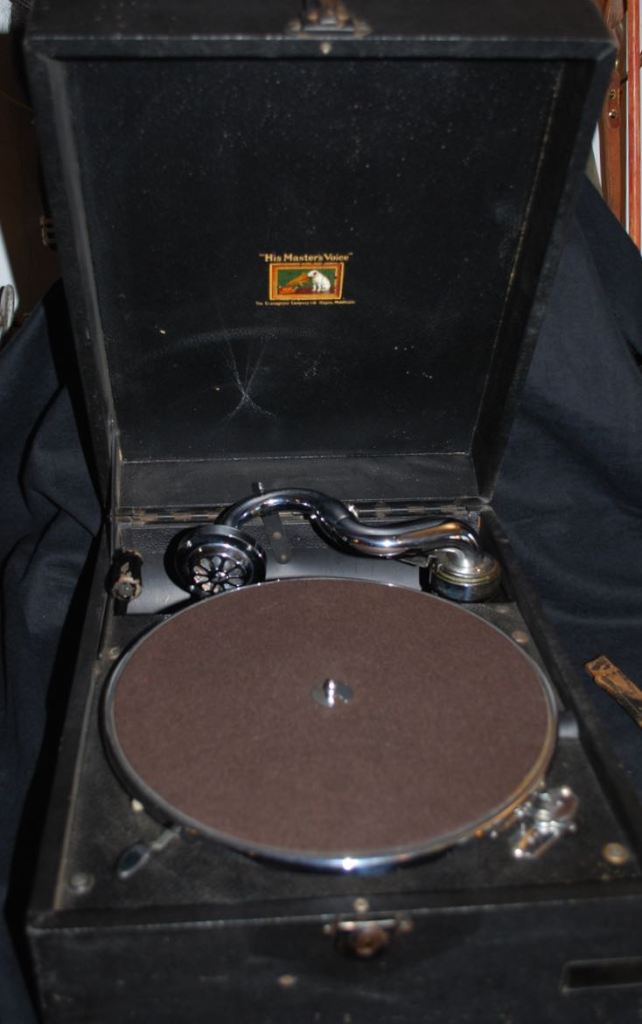
An inexcusably poor photo of this mechanical marvel. A 1939 mechanical gramophone.
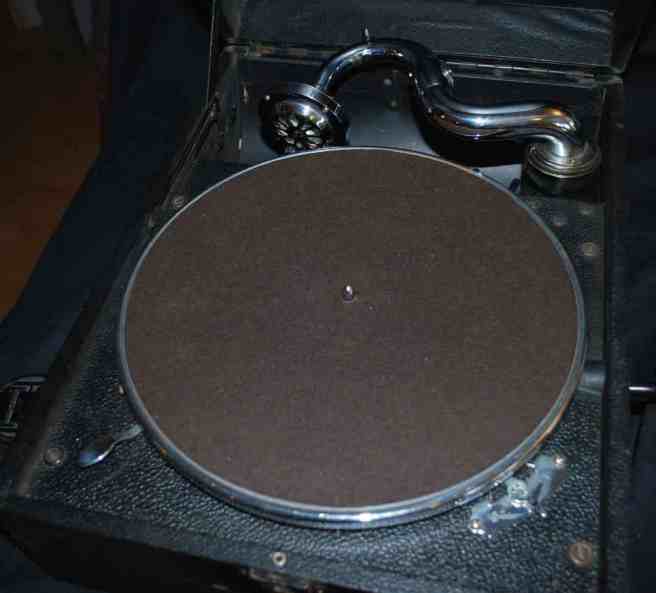
Opening it up, I was excited to see it was a 78 RPM gramophone. I honestly had very little hope that this thing would work or that all the parts would even be present much less in working order. My experience is that thrift store patrons are a rough lot whose goal it is to disassemble and loot as much of the merchandise as possible; merely for the entertainment. Nevertheless, I was intrigued.
I honestly had no experience with this sort of contraption but, lacking any sort of electrical motor or plug, and having a crank handle stowed inside, I quickly deduced that this was an escapement clockwork mechanism. The moving parts still moved. The solid bits remained solid. Better yet, there was a small, hand-written note inside reading: “We purchased this in England in the 1930s. Brought it over here in 1970.”
Only this, and nothing more.
Under the watchful glare of the shop attendant, I examined every part, figured out what moved where, felt out the spring by cranking it up, testing the stop and start mechanism, fondled the styluses, and generally examined this little beast like a dairy cow at a county fair. No part went untouched, if you know what I mean.
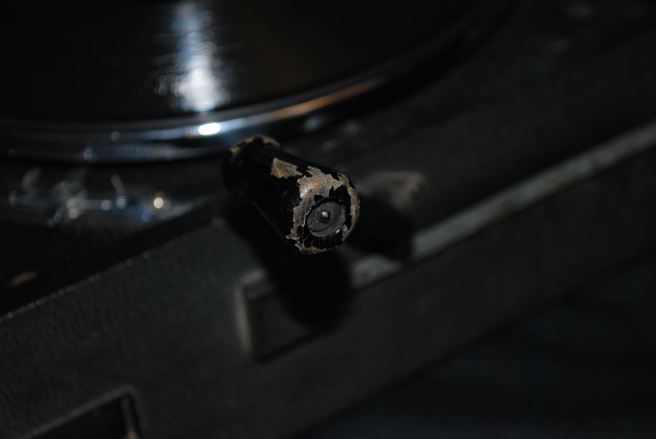
The hand crank in it’s storage cradle.Crank engaged with winding mechanism showing chipped enamel paint over hardwood (beech?).
Cranking it for the first time, I felt for any oddity in turning. It felt smooth and tightened slowly. I had no idea if it should turn five or one hundred times.
Diaphragm assembly; heart and soul of a gramophone.
I inserted a needle and brushing it with my finger I could tell it had plenty of sound. There’s some use for calloused skin I suppose.
If nothing else, this was a work of art.“Made in England.”
I think they used to make some good stuff in England.
Speed adjustment. 78 RPM, Slow to Fast.Although the outside showed signs of care-worn travel, the interior was immaculate.
Being, in the words of Shakespeare, one of those people known as the rude mechanicals, I was able to figure out the basic functions of the machine with just a little experimentation. They were spectacular. Appealing to my somewhat Luddite, but also slightly retro-futuristic aesthetic, I desired to possess this creature. It turned when cranked. The stop mechanism stopped. It had all the right parts (I thought). It was a beauty to behold.
However…
I decided, in accordance with my Minimalizing lifestyle, to close it up, put it back on the shelf, and walk away… I issued the nolle prosequi for the moment. I let that train sail from the station. If it was still there in two weeks, I would reconsider.
For the moment, I let this sleeping dog lie.
I thought long and hard about this. It was nearly perfect.
Not long ago, I would have snatched it up just because it was fun and cheap; even just as a novelty. Nowadays, I don’t make purchases without a lot of consideration. Do I need this? Not really. Do I think it will bring some pleasure? Hell yeah. Is it expensive? Not really. In fact, I partially justified it to myself that I could always re-sell it on Ebay, at more than ten times the asking price judging by others I found online. So, of course,
I bought it.
A little Internet research taught me a lot about this type of instrument. Here’s some model-specific information I came up with:
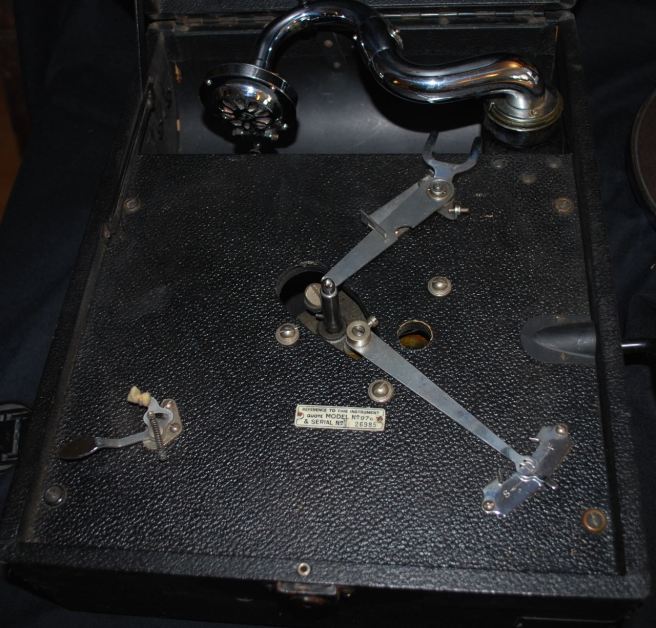
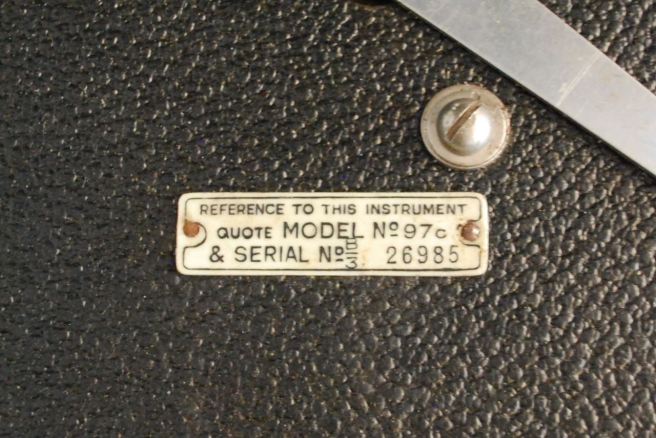
HMV Model 97c – The “c” is a year designation for the 1939 model although one collector site thought it might be a 1938 model. This makes little difference to me as it’s still 76 years old. The Model 97 was designed as a cheaper alternative to the ever popular HMV Model 102 costing £2-£3 in the mid 1930’s compared to the £5-£6 price-tag of the 102 (I’m told this is about £395.00 and £795.00 in today’s economy). It has a 10” turntable, HMV No.21 sound box, automatic and manual brakes, a pivoted front corner needle bin and it originally came with a record carrying tray (now sadly missing). It is finished in a black Rexine® (fabric comprised of cellulose nitrate, camphor oil, pigment, and alcohol, embossed to look like leather) cloth-covered case with a steel-reinforced leather handle.
Clarence “Pinetop” Smith’s groundbreaking music seemed an appropriate piece to test the little machine. A fellow Midwesterner.
Of course, I remember 78s being around in my elder’s record collections as a kid but I am definitely of the age of vinyl and now electrons in some sort of cloud. Fortunately, there are loads of reasonably priced 78 RPM records and replacement needles out there so providing some sustenance for the HMV was for me, but the work of a moment (and an exercise in PayPal). Here’s a rather dull video I made of the little box in action (my first YouTube upload) just to show how well it works.
Pulling the arm out to the right kick-starts the motor by unlocking the turntable, and it stops by triggering the lock again as the arm reaches the inner radius. Needles need to be replaced after every use so there is a small expense involved. The little box is remarkably loud and the old adage from the Victrola era “put a sock in it” rings true unless you happen to be hosting a dance. I understand that these were popular for picnics and outdoor soirées as they made plenty of noise and required no external power. A sort of boom box of their day. Anyone having unwanted 78s lying around feeling neglected can send them my way as I think this will be a novel little device for the long winter evenings in the Vardo.
Thanks for tolerating this journey into a geeky toy. I hope you enjoy it.
I have added a page to share some of my previous Minimalism posts. I hope to continue adding essays here as I progress toward the goal of the comfortable minimum.
When you take the plunge into restoring old tools, there are some days that you feel a bit like a historian and a conservator, and there are others when you feel like a surgeon in a field hospital.
It’s inevitable in the hunt for fine tools at flea markets, that you will sometimes run into tools that have lived a hard life. Tools that have suffered unmentionable and unfathomable indignities at the hands of previous owners. These tools will look up at you with their sad tool eyes and beg to be taken home with you.
Sometimes, despite your better judgement, you do, and then you have to figure out what in the world to do with them.
Such is the case with this guy:
It evidently started out life as a Disston no.4 mitre box saw, probably included with a small Millers Falls, Langon, or Stanley set. From there on…
Ardnamurchan (Àird nam Murchan: headland of the great seas), Lochaber, Highland, Scotland. This is a beautiful short film of the westernmost peninsula of the British mainland.
The Naked Woodworker video makes out like the bench build is a one day project. This may just be for effect or Mr. Siemsen may be able to pull this feat off. A well organised shop and an experienced builder might just be able to build this bench in a day. Since I come up a little bit short on both counts, my build will take a little more than a day. I did give it my best shot though.
Saturday I began by processing the 2x12s into usable parts. I first cut the 8ft seactions that will make up the aprons and tops. This left me with 4ft drops from each board. Then I did something that I haven’t done in a long time. I fired up my old portable table saw. I used it to rip the 4ft drop in half to yield eight pieces 5-1/2″ wide and…
Here’s another look at an image I posted quite a while ago. I really like this photo. These Scottish Travellers give a glimpse of some less-than-stereotypical living waggons (sic). Very few wanderers could afford the classic Dunton Reading wagon but made do with more affordable accommodations; possibly even owner-built.
Tyne & Wear Archives & Museums. Click HERE for the source.
All three of the caravans pictured have mollycrofts for light and air but are of a pretty simple variety. I am struck by the one on the right mostly by how plain it is (plank siding without exposed ribs) and it’s very small proportions. I suspect there were many more of this variety than the elite, custom-built wagons on the roads in Britain in the heyday.












 Preindustrial Craftsmanship