Wildlife Battle

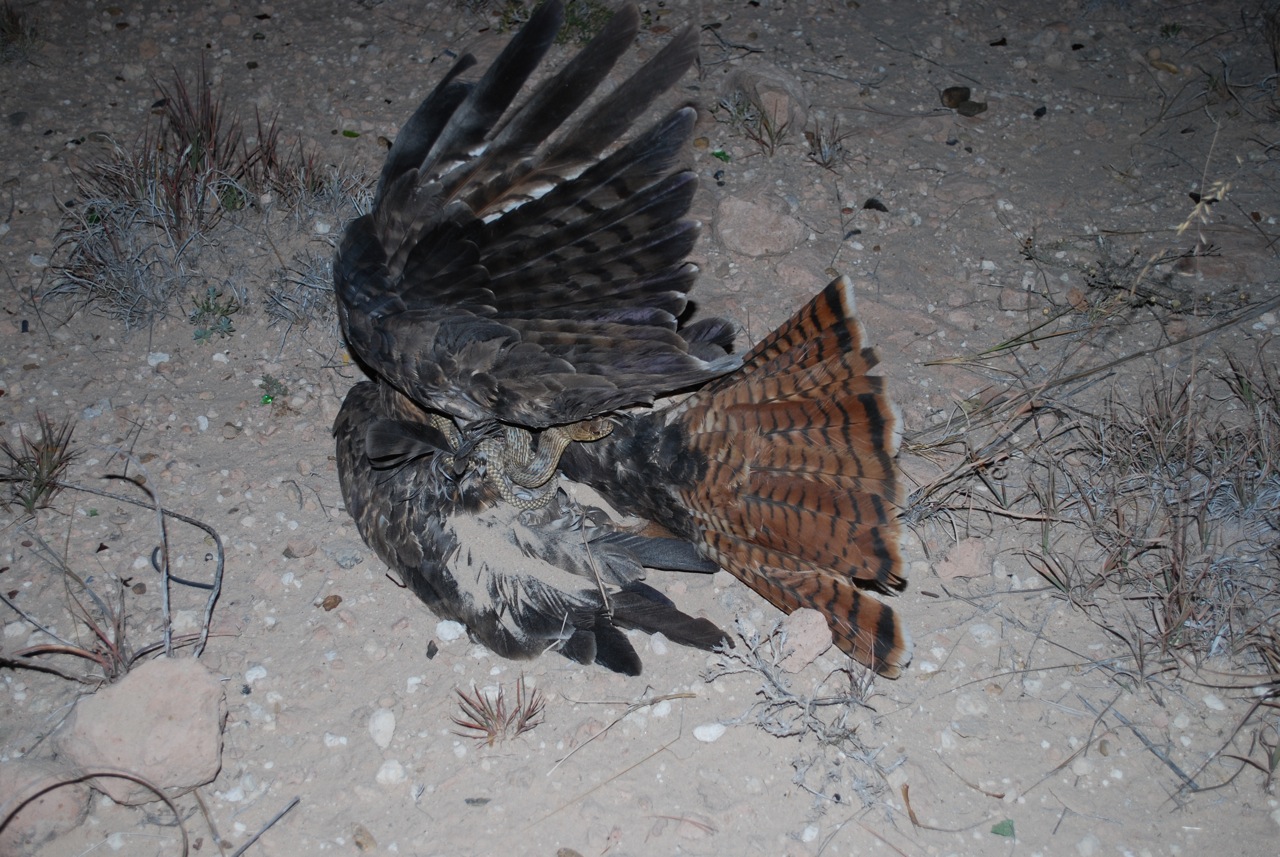
I was fortunate enough to see an amazing wildlife battle yesterday evening.  It was life at its rawest on the Llano Estacado.  I wanted to be an impartial observer but, being human, I stepped in and intervened.  I live in a rural area with a lot of wildlife including many raptors and snakes.  It is not uncommon to see a hawk swoop down and catch a rabbit, rat, mouse, or lizard.  I was heading home to eat so I wasn’t too concerned with watching when a large hawk landed hunched over some prey out in the scrub.  I went past to check our back gate and came back the same way a minute later.  I saw the hawk was hopping around and it looked like it was fighting something.  Due to the brush and growing darkness I couldn’t tell what it was fighting with but wanted to have a closer look.  There was a split second of frenzied activity and suddenly the hawk was flipped onto its back on the ground.  Luckily, I had a camera so I was able to snap off this shot.

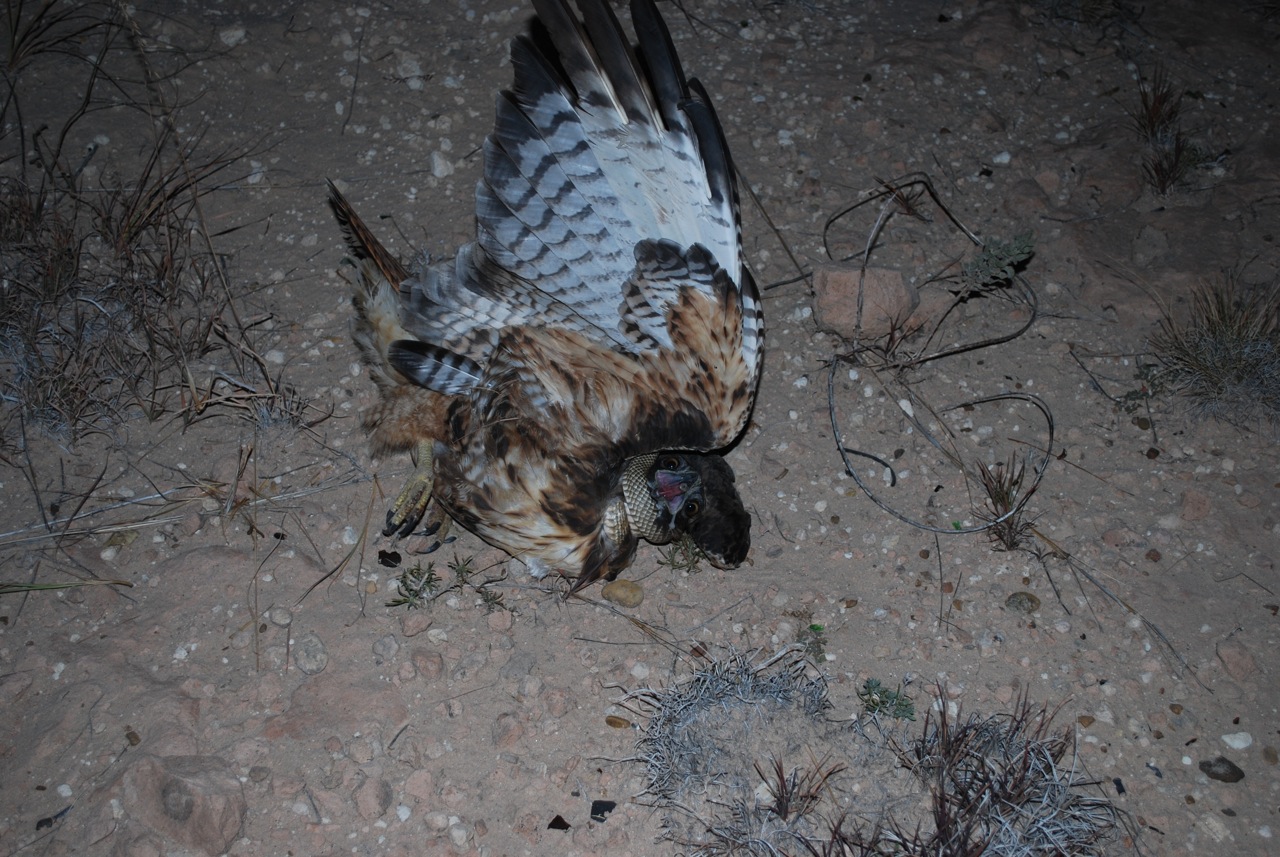
She looks shocked!  I would have had a hard time believing it had I not seen it.  A relatively small snake was all over the hawk and choking the life out of it.  It was dark and my initial thought was that it had been bit by a prairie rattler.  The hawk’s beak was open, eyes bulging and obviously gasping for air.  Closer inspection showed the snake to be a gopher snake, and net even a very big one.

My presence was obviously upsetting everybody and there was more thrashing.  The snake was able to hide under the feathers pretty effectively.  I wanted to just grab the snake and unwind it but images of being bitten or clawed by a frightened hawk kept me at a little distance.  Not sure what to do next I was able to call someone down to give me hand.

Can you see terror in her eyes?  At this point I was pretty sure the hawk was done for as the snake had three coils around its neck.  So, I could let it die and have one less chicken killer around or save her to help keep down the rodent population.

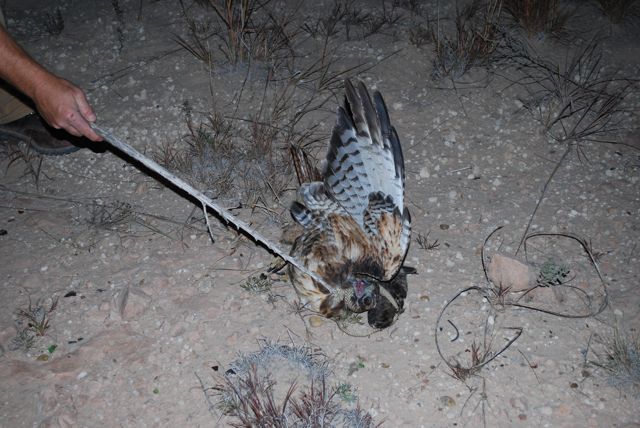
I grabbed a yucca stalk to help hold the hawk down while I grabbed for the snake and tried to avoid talons.  I doubt it would have done much but it was all I had.

Here I am awkwardly pulling snake out with one hand and holding the hawk away with the stick.

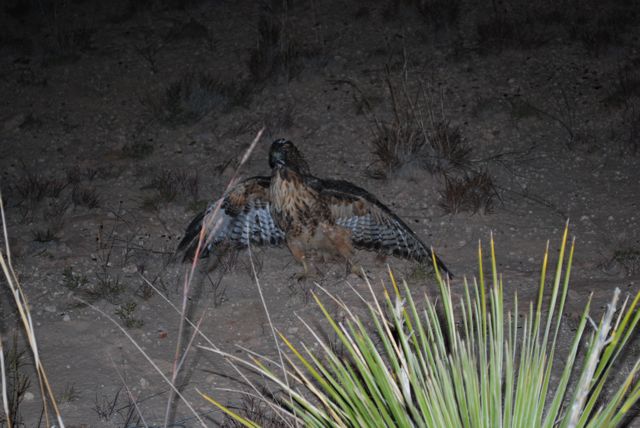
She got up, staggered around, shook herself out and flew up into a nearby tree.

This irritated snake actually pursued me, snapping at me until I left.  I can’t blame it.  That was a traumatic event.

Anyway, it was a wordy story.  I have spent a lot of time outdoors and seen many interesting animal behaviors but nothing like this before.

Shoemaker’s Toolbox W.I.P.

Lunch-time post:

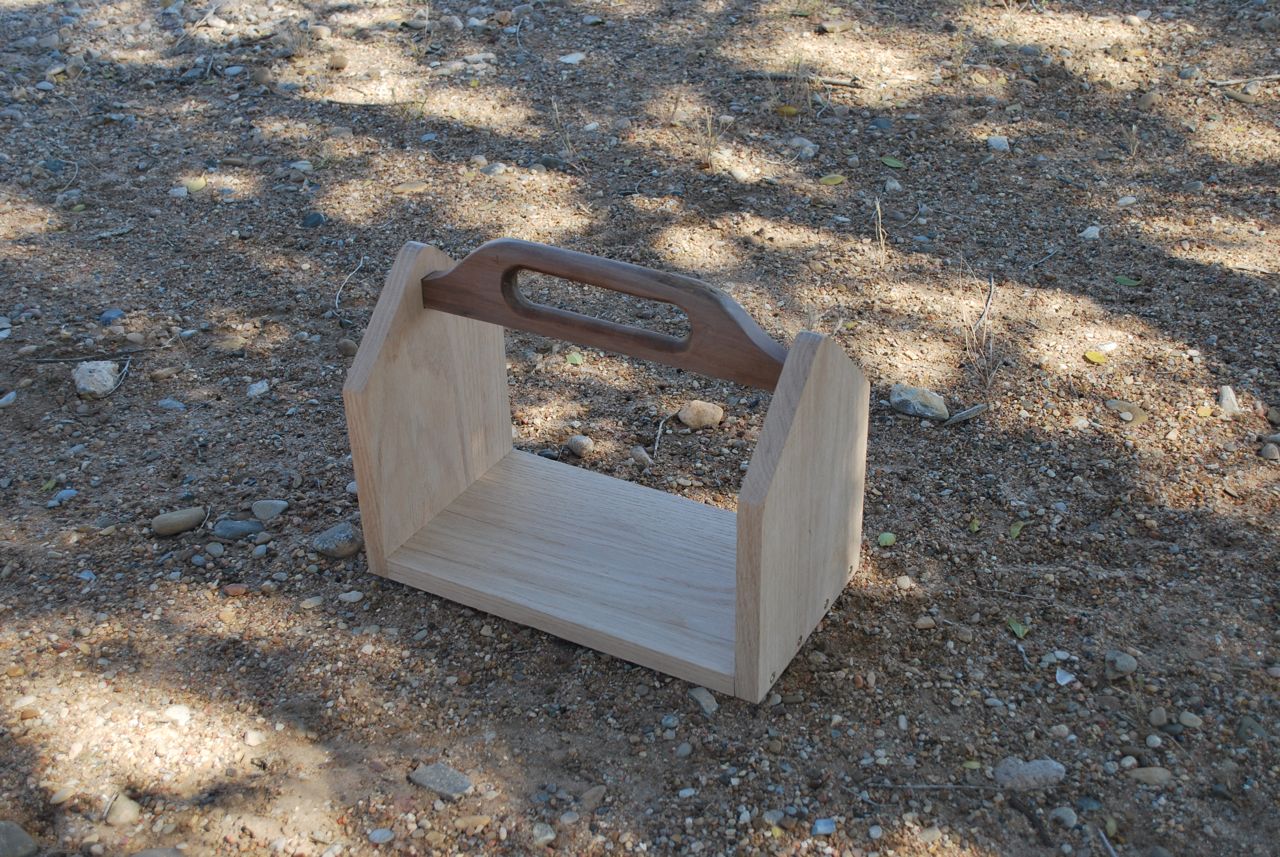
I began working on a shoemaker’s toolbox this weekend.  It’s based on an eighteenth century design but probably goes back further.  It will have leather “pockets” for the awls and some long tools.  The difference between this and a carpenter’s box is in the upright storage to keep the tools very handy.  The box I based it on can be found here: http://aands.org/raisedheels/Other/Toolbox/toolbox.php.

No complicated joinery other than the half mortises for the handle.  The sides are off still to tack in the leather pockets.  The original was nailed together but mine uses wood screws (brass).  Material is red oak with a walnut handle.  More to follow.

Tool Museum

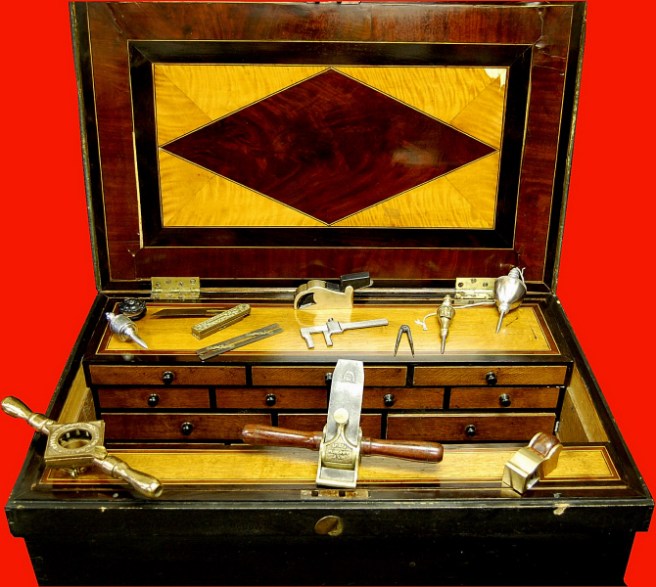
If you love beautiful tools (if you don’t, you should) there is a remarkable web page devoted to some remarkable historic tools.  I hope to see these in person someday.  I hope  I get to Michigan or find him on the road sometime.  He’s got a pretty amazing paint job on the trailer too.

Click the ship plane to open the museum in a new window.

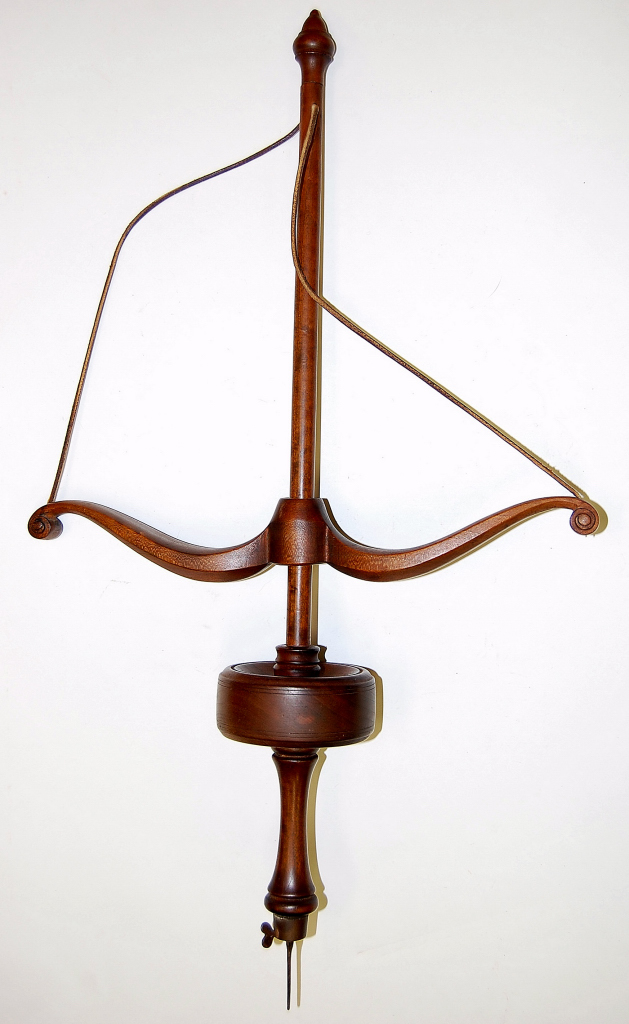
I really like this drill.  I think I need to make one.

Thank to the Village Carpenter (http://villagecarpenter.blogspot.com/) for having a link to the museum.

Close Call at 65 mph

I had to wait a while to publish this one but maybe I just need to get it out…

I like to think I’m a safe person.  At least to the point of looking out for others if not always myself.  I don’t drive aggressively, I maintain my vehicles, and don’t take big chances on the road.  That said, I probably stress my truck and the vardo more than most people would.  The truck has spent sixteen years as an archaeologist’s field vehicle and has gone into places I would have never thought I would take it.  I have crept into BLM campsites with the vardo that required it to be tipped up to 45 degrees and I was certain it was going to go over.  I’ve intentionally jack-knifed the whole thing just to push it into place between boulders.

These things are just the nature of travel in the remote western US and having worked in remote places for 20+ years I have become used to expecting the unexpected.  I regularly check my tires, wheels, and bolts for damage or looseness.  In fact, I recently discovered a sheered-off bolt on my hitch bumper and I can’t even imaging how that happened except possibly during the event I am going to describe here.

This is the driver’s side wheel from the vardo.  It is steel, not aluminum.

We were driving from San Diego to Portales, New Mexico and after a nice stay in Flagstaff with our friends, we were coming down into the desert on I-40.  Approaching Holbrook, I thought I could feel a slight shimmy in the wagon.  As it normally tracks well behind the old F-150, I thought it must just be an effect of the wind.  Suddenly, with a “whooping” noise the trailer gave a jerk (surprisingly minor feeling due to the heavy weight of the truck).  I thought I might have a blowout but then saw sparks out of the corner of my eye in the side view mirror.

The wheel had come off and passed us at 60 mph as I was able to slowing onto the shoulder, fortunately near an off-ramp.

I watched the wheel run for what seemed like miles while I was trying to Jedi mind-control it to not steer into the oncoming lanes.  Fortunately, there was little traffic on the Interstate that day.  Mind-control worked (actually the road camber worked) and took it into the right ditch about a quarter-mile down the highway.

After a moment of mental freakout, I had a look at the situation, and realized what must have happened.  I lost a whole wheel!  A couple of studs were broken from the hub, one was stripped clean as the nut was ripped off.  The remaining two were intact.  The hub was whittled down to almost nothing and we had coasted in on the ends of the leaf spring bolts.

Did I mention it was Sunday?  In rural eastern Arizona?

I’ll keep the story short.  Assessing the situation I knew I was fully prepared to camp.  We had water, food, and a place to sleep if need be but I wanted to be on the road.  I had a good spare but nothing to bolt it to.  I contemplated putting it on the two remaining bolts to limp into town but upon inspection determined that they were far too destroyed.  As the wheel tore off the lugs it sheered into the bolts and the nuts were stripped anyway by being pried sideways. This meant abandoning the vardo on a rural highway; not the most desirable choice.

I was limping into Holbrook, Arizona.

I went to town and after asking around, I found the only 7 day a week mechanic was on vacation at Lake Havasu.  I actually spoke to him on the phone and he wasn’t sure what to suggest.  I drove back to Winslow as I figured there would at least be a parts store and maybe it would even open.  If there was nothing there I could trek back to Flagstaff before the end of the business day.  I’d only end up being a day or two behind.  Wild plans came to mind.  I could rent a flatbed trailer, load it with a come-a-long, and haul the vardo home that way; expensive and difficult.

I went back to the vardo on the way to Winslow and pulled the hub (fortunately I had some basic tools).  I brought the hub to the parts store that was open but the nearest part that fit was about 90 miles away in Payson, Arizona and could probably be delivered tomorrow.  I though maybe I could get studs pressed into the remaining hub but again, nobody would be around until tomorrow.

And then, like a miracle, the ol’ boy Good Samaritan network kicked in. 

An older man buying parts at the store overheard the conversation and knew a guy who might be around who might be willing to fix it.  The parts store kid was pretty skeptical but I was willing to try just about anything at this point as the day was waning away.  We followed the man to the old part of Winslow to a junk and car filled ancient gas station and talked to a teenager working on a little import car. He said his uncle Jerry would be back after lunch but we could wait if we wanted.

Eventually the uncle (Jerry) came back and gave us the tour of his Model A Ford he happened to be working on that day.  That’s why he was in.  Anyway, in fairly short order he pressed in new lugs, put in new bearings and charged me way too little for the whole process.  Jerry was our savior.  I hauled the whole thing back to the vardo, reassembled the hub, put on the spare, and away we went into the night.  I don’t always depend on the kindness of strangers but it’s these small acts of kindness that give me some hope in this world.

Drive safe.  Check your equipment.  Carry tools.

New High Tops

Determined to get the pattern right once-and-for-all I have been slaving away on a new pair of shoes.  As a matter of fact, I think these shoes are completely slave-labor-free.  The leather upper and mid-sole are oak tanned leather (Hermann Oak), and the rubber soles were cut from SoleFlex sheeting.  The laces were made from brain-tanned elk hide I processed myself.

The gent’s shoe as worn.

Outside heel stiffener.

Trousers cuffed to show height of shoe.  I live where the plants are unfriendly to bare skin.

The pattern was created without a last based on previous turn-shoes and a mock-up done in heavy canvas.  The shoe has no heel or shank as I am very used to walking barefoot or in sandals and moccasins.  A little more on shoes I have made here at: Footwear.  And some other leather work here.

Archery Artisans

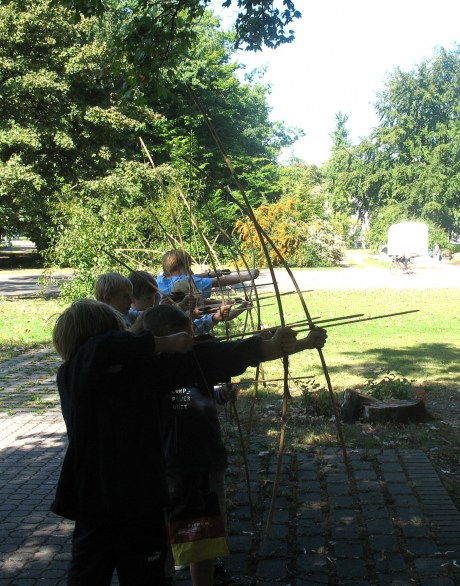
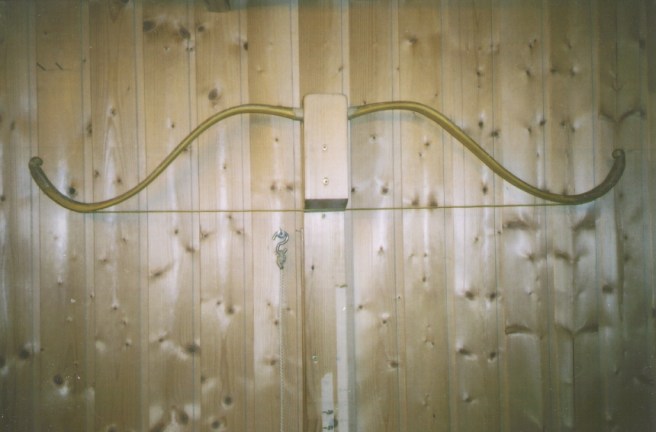
The arts and crafts of bow-making and arrow-making are alive and well.  If anything, they have grown in quality and quantity in the 30 years I have been involved in archery.  I, like most of the other bowyers I know, learned in relative isolation with very little printed information available.  After a few successful bows, I was lucky enough to find a copy of James Duff’s 1932 classic Bows and Arrows which explains the English Longbow in great detail.

After making a couple dozen bows of various styles, I began to make arrows and realized that this is where the real magic happens.  A bow is simply a leaf spring that stores energy applied slowly by the archer and (hopefully) returns that energy very quickly to launch an arrow.  On the other hand, an arrow is a work of art and craftsmanship that undergoes tremendous force during acceleration and should be able to survive the trauma of slamming into a target at speeds approaching 200 feet per second (135 mph or 220 km/hr).  On top of this, a good arrow must have some weather-proof qualities to handle massive temperature fluctuation, damp grass, heat, sun, and possibly rain.

I mention this because to many people I speak to just getting interested in archery, that to make a bow is the holy grail of primitive technology.  For me, it is that creation of a matched set of 12-24 arrows that work well for me and my bow and will hold up under hard use.  Yes, there is something cool in making a great bow, but building a good arrow is far more important.

On that ramble, here are a couple of good links I recently stumbled across on the internet.

Bow Explosion is a German website from a bowyer working in the Black Forest with and interest in flight shooting.

Ashbow has an excellent Picasa Web Album documenting some excellent archery and other primitive technology skills.

And I cannot say enough good about the ATARNnet.  The forum of the Asian Traditional Archery Network.  There is a load of great information there about Asiatic archery, from Scythia to Japan and everything in between.

Primitive Technology Gatherings

The culture of off-beat primitive technology gatherings has grown and morphed into many forms around the continent and I suspect, around the world.  Certainly, when I was a school kid, I didn’t know of anything approaching the types of gatherings we enjoy today.  I guess the closest thing we had were Larry Dean Olsen’s practical book on outdoor survival and some near-mystical writings by Tom Brown.  A little later I found Bradford Angier’s How to Stay Alive in the Woods which made survival in the far reaches seem completely possible with just a little skill and knowledge.

There was actually about a decade where I thought that a few of my friends and I were about the only people practicing “survival” skills, foraging, friction fire building, making bows and spear-throwers, and eating wild foods.  There  were rumors of things out west.  There were re-enactors living primitive if only for a weekend. Rumors of some big meeting in Idaho, but no one seemed to know how to find out more (this was before the INTERNET!).

In the mean time I read more ethnographies, more archaeology and technology papers.  I combed 100 year old issues of Nature, Proceedings of the Royal Society, Antiquity, and other views of people from different times and places.  My personal research took me into archery, boomerangs, spear-throwers, fire making, blowguns, music, shelter, and hide working, to only name a few.  It wasn’t until I was lucky enough to find the Society of Primitive Technology, then in about its fifth year, that I felt things really coming together in a community situation.  People are social animals and real survival only works in a community.

The generation growing up now has much more information to draw upon from experimental archaeologists, outdoor survival schools, adventure programs, and people who have actively pursued a life outside the norm of consumerism as a way of life.

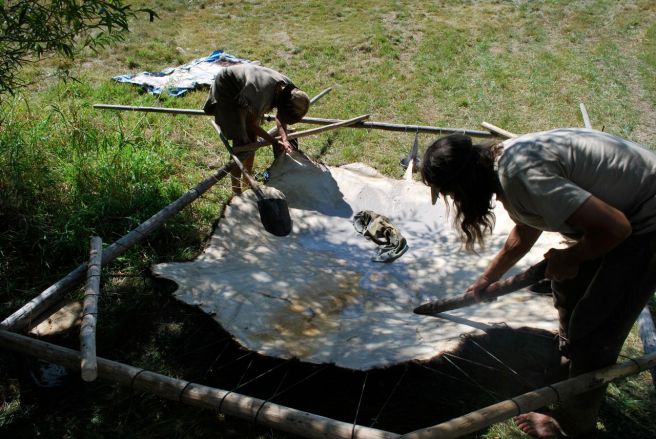
Hide scraping is a community effort. Rabbitstick 2009.

The two big gatherings associated with the Society are Rabbitstick near Rexburg, Idaho and Winter Count near Maricopa, Arizona.  Each are week-long instructional gatherings that teach various survival, primitive, and other off-grid skills.  Participants and instructors are probably the most diverse cross-section of people one could ever find assembled in one place.

A pottery class firing at Winter Count 2011

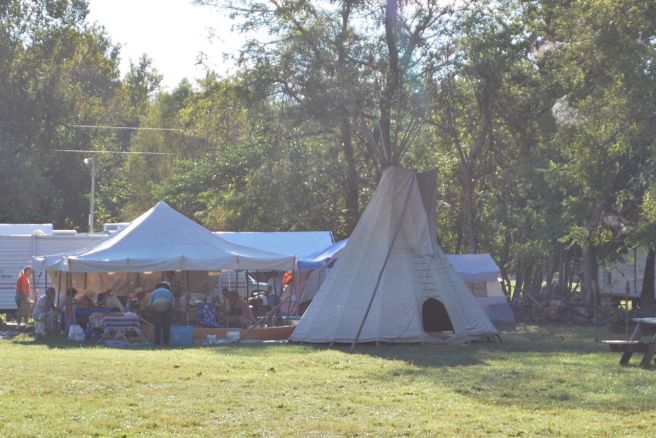
A small but interesting primitive skills gathering is the Bois d’Arc Rendezvous in southwest Missouri.  While working on some archaeological projects in the region, I was lucky enough to meet up with Bo Brown and Don Brink, who really made this event happen over the years.  This event has a slightly different feel than other gatherings as it is partnered with a knap-in*.

Bois d'Arc Rendezvous

The Echoes in Time gathering is held for five days in July near Salem, Oregon.  This is a fairly structured workshop/class-type event with a daily schedule.  I think some people respond better to this than other events where classes come and go and have an amorphous schedule.  Although I know many of the participants, I cannot speak firsthand about Echoes as I have not made it to this event (yet).  Meals are not provided but there is a communal kitchen area and cooking may be done in camp on a portable stove.

Tools from Winter Count 2011. Click the image to go to Jeff Damm's excellent photo collection of past events.

The Buckeye Gathering is a newcomer to the scene but seems to be heading for greatness out in California.  One of its unique qualities is its close tie to the Native community.  It is held at the YaKaAma Indian Education and Development center about 90 minutes north of the San Francisco Bay area.

The central arbor at Buckeye.

Firefly Gathering:  This is another relatively new one and luckily for many, it is near the east coast.  I have not been to this one either but it is on my short list of things to do in the near future.  Its in a beautiful part of the world and I wish them well.

Earthskills’ Rivercane and Falling Leaves Rendezvous.  These folks put on two major events each year in spring and fall out in northern Georgia.  It is pretty huge and even offers hot showers for participants.  The instructor list is extensive and impressive.  Check them out if you live in the area or can get to the eastern seaboard for a great vacation.

If you are interested in “primitive” skills, homesteading, wilderness survival, or just crafting things to make your life better, consider an immersion in one of these events.  Then, if something really catches your fancy, there are many instructors and schools out there that will take you farther in a direction you may want to go.

*For some odd reason, knap-in folks don’t tend to mix with the other “primitives” although most of us primitive types are at least fair-to-middling knappers ourselves.  I think that the deep-seated reason is about process versus product.  Many knappers I know are mostly interested in the product as a object d’art whereas the archaeologists and primitive technologists are more concerned with the process and functionality.  A secondary reason may have to do with image.  The primitive technologists and survival-types are often a little rough around the edges for polite society and may even fall so far as to be considered an all-out bush hippie**.

**Bush hippie – def.  “Hippie” person who lives rough on the margins of consumer society.  Often sporting re-purposed or handmade clothing possibly made from buckskin.  Hair is plentiful and the cranial portion often in the form of dreadlocks.