
I have been re-studying joinery, amongst other things, recently and am currently deep in Moxon’s The Art of Joinery. I have built many structures in my life and documented quite a few for historic preservation. Last night, I made it through another oldie from the 1920s Woodwork Joints by William Fairham which really set my stagnant mind in motion.
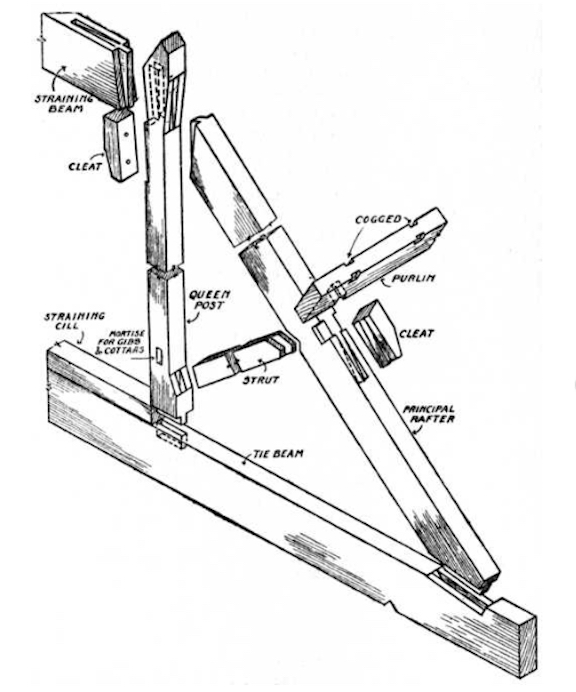
I know the image isn’t the sharpest but this, to me, shows the level of quality and craftsmanship we have lost in our pursuit of speed, simplicity, and the dumbing down of our trades. Nothing in this truss is complex in-and-of-itself but requires some layout skills with straight-edge and dividers, not to mention hand skills with saw and chisel. Few fasteners are required in this type of construction as it depends on the joinery locking the system together.
I have read several misguided web sites on woodworking recently lauding Japanese and other Asian-style building techniques for their use of joinery and lack of metal fasteners. Yes, they are remarkable, just not unique to Asia. This type of construction is the reason many centuries-old buildings still stand today.

Very little under the sun is new technology. The above joint is a locking corner known as a Japanese corner tenon. I have no idea if this really filtered into western construction from Japan but it is a pretty neat looking joint.


All the complicated joints are a lot of fun and interest, but in reality, learning the basic mortise and tenon (with the myriad variations) will allow for the creation of most building structures.

Even simple half-lap joints are structurally sound with some thought towards design. The above pinned and half-lapped joint can be found in historic structures tying the top rails of simple buildings together and is also seen in a straight wall run, not just on corners. This simple timber joint is perfect for small outbuildings, sheds, and chicken coups.


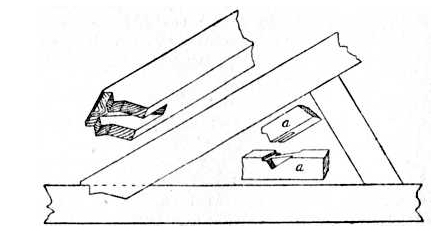
Finally, a few simple joints you may still see used are simple notching, cogging, and bird-mouth joints.
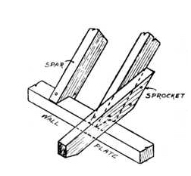
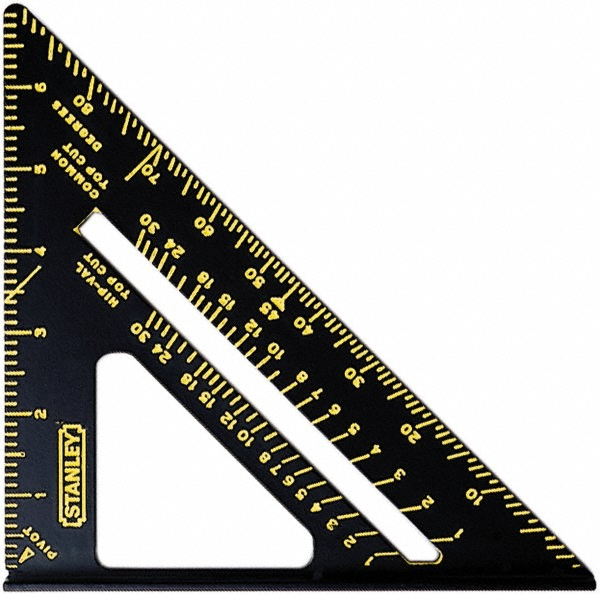
 When I was a young laborer in high school and beyond, laying out and cutting accurate bird-mouths and rafter angles were the tests that separated “the men from the boys” as it were. Some people could never really get their heads around the angles, even with the ingenious, and simple layout square; many a builder’s best friend.
 This post took a bit of a rambling turn but more on this subject will certainly follow for good or bad. I’m always learning, so bear with me as I work through the process on my keyboard and in my head.








 Preindustrial Craftsmanship