“About going where he likes, for instance? Are there not certain laws of the road that forbid the tarrying by the way of caravan folks, for a longer period than that necessary to water and feed a horse or look at his feet? By night, again, he may spy a delightfully retired common, with nothing thereon, perhaps, except a flock of gabbling geese and a superannuated cart-horse, and be tempted to draw up and on it, but may not some duty-bound police man stroll quietly up, and order him to put-to and “move on?”
Gordon Stables 1886.
The RV and traveling community owes a debt of gratitude to this fine rolling home. The Wanderer was the first true luxury Land Yacht, having been given that moniker by it’s owner, Dr W. Gordan Stables. There were some Romany-style and showman’s wagons in use on the roads, and the Salvation Army “barrows” (see Caravans for Christ) but Stables’ design expanded upon the basic plan as a luxurious moving home that well-to-do Victorians could understand.
A retired Royal Navy doctor, Stables commissioned the Wanderer to be built and began a 1300 mile tour in 1885. Prior to this, living wagons were mostly pragmatic affairs with few creature comforts, primarily employed for housing work crews. The base specifications for the Wanderer are 30 feet long (9.15 meters) and she weighed approximately 4000 pounds (1815 kilos). Two years on the road led Stables to conclude that “one about twelve feet long would serve every purpose, and be easily moved with one good horse. It would also be more easily drawn into meadows at night.”
The Wanderer. Image after Nerissa Wilson, Gypsies and Gentlemen 1986, pg 53.
Fortunately, the Wanderer was owned and loved by an avid writer so there is a lot of information about life in this beast. Dr Stables described in his writings several important amenities which we can benefit from today:
“Under the rear door the broad steps are shipped, and at each side is a little mahogany flap table to let down. These the valet finds very handy when washing up. Beneath each of these flaps and under the carriage is a drawer to contain tools, dusters, blacking-brushes, and many a little article, without which comfort on the road could hardly be secured.
Under the caravan are fastened by chain and padlock a light long ladder, a framework used in holding out our after-awning or tent, a spade, and the buckets. But there is also space enough here in which to hang a hammock.”
Gordon Stables. “The Cruise of the Land-Yacht “Wanderer”; or, Thirteen Hundred Miles in my Caravan.”
If I could only employ a valet to do the washing up!
Line drawing of the Wanderer’s floor plan.
As a career Naval officer, Dr Stables was clearly familiar with living in small spaces and understood that neatness and a place for everything was key to comfort. To explain the layout, Stables continues with a more detailed description of his little home:
“Entering from behind you may pass through A, the pantry or kitchen, into B, the saloon. Folding doors with nice curtains divide the caravan at pleasure into two compartments. C is the sofa, upholstered in strong blue railway repp. It is a sofa only by day. At night it forms the owner’s bed. There are lockers under, which contain the bedclothes, etc, when not in use, as well as my wardrobe. D is the table, over which is a dainty little bookcase, with at each side a beautiful lamp on brackets. E is the cupboard, or rather the cheffonière, both elegant and ornamental, with large looking-glass over and behind it. It will be noticed that it juts out and on to the coupé, and thus not only takes up no room in the saloon, but gives me an additional recess on top for glove-boxes, hanging baskets for handkerchiefs, and nicknacks.”
Illustration from Stable’s book about his 1300 mile journey in the Wanderer.
In this era of slow-moving traffic, regular furniture was used with few “built-in” units used, more like a normal Victorian parlour. I love the fact that music seems to have been very important to the good Doctor. He describes his “furniture” as:
“a piano-stool and tiny camp-chair, music-rack, footstool, dressing-case, a few artful cushions, pretty mirrors on the walls, with gilt brackets for coloured candles, a corner bracket with a clock, a guitar, a small harmonium, a violin, a navy sword, and a good revolver.”
The list seems very sound and familiar to me and shows preparedness for most contingencies on the road, from raucous music parties to a quiet evening in the saloon, with the ability to hold off highwaymen and marauders as necessary. I think he is definitely a kindred spirit. I guess I need to add a sword to my traveling accessories now.
Artist’s rendering of the Wanderer’s interior.
Above we see the valet hard at work, after Wilson 1986. Note the under seat/bed storage visible here. I became very curious about the tricycle and found that the good Doctor not only loved caravanning but promoted the new past time of cycling as an excellent and healthy way to tour Europe. Thinking like a Navy man, he thought of the bike as a “tender” to the caravan; a land dinghy of sorts.
The Wanderer’s flooring choice was a practical one. Linoleum was a relatively new product but had shown itself to wear well under difficult conditions and remain flexible (perfect for a rolling home). To further beautify the main room, Stables chose a Persian rug to overlay the Linoleum.
A filter much like that described in the Wanderer may be seen in the lower right of this advertisement.
On a practical note, the Wanderer was fitted with a carbon-silicated water filter as the general supply was still very poor in much of Britain. Hygene was attended to in the after cabin at the marble washstand with a small gravity-fed water system. The after cabin (really the domain of the valet) also contained a Rippingille cooking-range, a truly modern convenience in portable stoves of the time.
The Rippingille cook stove.Rippingilles Stoves Magazine Advert ca. 1910. Don’t they look happy?
“The Rippingille cooking-range is a great comfort. On cool days it can be used in the pantry, on hot days—or, at pleasure, on any day—it can be placed under our after-tent, and the chef’s work got through expeditiously with cleanliness and nicety. ” Stables 1886.
-Note to self: get a chef.
A brief stop for a meal. As with most caravans, the Wanderer carried tentage and awnings to extend the living space. The little Rippingille cooking-range can be seen next to the cook in the A-frame tent.
Dr Stables traveled in style, apparently employing a cook, coachman, and valet (it’s not clear to me if they are one-and-the-same) and had little monetary concern along the way between his pension and some success as a writer. He did, however, pave the way for the “gentleman caravanner” and helped start a trend that many of us are still emulating in our own way today. This style of off-beat living eschews the tin-can clones of the RV park and brings a level of style and class to living on the road, whether it be for a week or a year.
A couple of well-dressed Scotsmen; Stables (right) and unknown man (possibly his valet) stand in front of the Wanderer. That’s Bob the dog lying next to his master. You get a real sense of the scale of this caravan in this image.
Finally, what became of the Wanderer? A few years ago, she was safely ensconced in the Caravan Club’s site in the Costwolds, England. It seems that she never left safe hands and therefore didn’t suffer the rot and destruction that was the fate of most of the early caravans. She is still a sight to see and many are thrilled that the decision was made to display this piece of history instead of storing it in a less accessible facility.
Colin Elliott from the Caravan Club with The Wanderer. Click the image for a short article about the preservation.The Wanderer still looks immaculate inside with beautiful woodwork and attention to detail.
About the book, The Cruise of the Land Yacht Wanderer, Thirteen Hundred Miles in my Caravan. After the descriptions of the Wanderer itself, much of his book is simply a travelogue of late 19th Century Britain with encounters and minor adventures along the way. However, there are some great morsels of information hidden throughout and a delightful chapter about “Caravanning for Health” with his opinions as a career Medical Doctor. Also, he wraps up with some good advice for the traveling gentle-person about living in a small space on the road. It’s a great little read and I highly recommend it to the caravan set. If it cannot be found any other way you can read his book by downloading it from Project Gutenberg; The Cruise of the Land-Yacht “Wanderer”.
Every traveler has a campfire has the center of daily life. The hearth has been our home for 1.5 – 2 million years now. No wonder it fascinates us and brings so much comfort.
Nomads in a stationary culture are often tolerated at best and left only marginal space to congregate. This will probably never change.
These high-end vardos with fancy covers are probably “gentlemen travelers,” the antecedents to modern RVers.
Yes, I know that Traveller has two Ls in our title but since we’re looking at Britain and the Continent that’s how we’re spelling it.
Scenes of life on the road and around the campsites.
October 1951: Mrs Robert Matthew, an MP’s wife, campaigning at a gypsy encampment.Kids at the campsite.A classic image of Traveller children.Modern gypsies (Romany) in their simple accommodation.I really love these little bender tents.A fine caravan for a successful traveller.
This is part of a series of images, mostly Romany, Irish, and Scottish Travellers collected from around the internet. Many of these historic images found on the web are without citation. When a clear link to a source is found, I try to include it. If a source is known, please pass it on and I will gladly include it or remove it if necessary.
A tiny accommodation, side entry single horse style. It is documented that the adults with this style wagon generally slept outdoors except in very bad weather. It was a good way to confine the children and the valuables.
This is part of a series of images, mostly Romany, Irish and Scottish Travellers collected from around the internet. Many of these historic images found on the web are without citation. When a clear link to a source is found, I try to include it. If a source is known, please pass it on and I will gladly include it or remove it if necessary.
Wonderful rolling home.
This is part of a series of images, mostly Romany, Irish and Scottish Travellers collected from around the internet. Many of these historic images found on the web are without citation. When a clear link to a source is found, I try to include it. If a source is known, please pass it on and I will gladly include it or remove it if necessary.
A painting by the Scottish artist John Burr (1831-1893). Tinkers were originally tinsmiths or “tinners”. One of many itinerant jobs pursued by a class of casual laborers. These were mostly skilled and specialized crafts like basket making, shoe repair, leather work, and metal work but many poorer workers were migrant farm labor picking hops and tending the market gardens during the peak harvest. The fellow in the image above appears to be a fairly well-off repairman mending a seam in a pot. This from a time when new items were a rare purchase.
I love deciphering images like this for the details of domestic life. Unlike most photos, there is real intention in what the artist chose to include or not in the painting. The house is clearly a poor one but a freshly killed chicken hangs from a nail on the wall by some dry roots. A handmade broom leans against the wall next to a basket that has the tradesman’s coat lying across it. The oldest daughter tends the infant while the mother stands by the laundry basin with a toddler behind. All the children look on while the novel worker plies his trade in a waistcoat and hobnail walking shoes.
I really love these family photos generally taken in front of the wagon.
Scottish Travellers is a loose term that covers many diverse peoples in Scotland and even beyond. Here, I’m primarily looking at the indigenous folk who seem to be descend from an in situ population of itinerant craftsmen and laborers.
Scottish Travellers, or the people termed loosely Gypsies and Tinkers in Scotland, consist of a number of diverse, unrelated communities, with groups speaking a variety of different languages and holding to distinct customs, histories, and traditions. There are three distinct communities that identify themselves as Gypsies or Travellers in Scotland: Indigenous Highland Travellers; Funfair Travellers, or Showmen; Romanichals (a subgroup of the Romani people) and Lowland Gypsies.
Indigenous Highland Travellers –In Scottish Gaelic they are known as the “Ceàrdannan” (the Craftsmen), or less controversially, “luchd siubhail” (people of travel) for travellers in general. Poetically known as the “Summer Walkers”, Highland Travellers are a distinct ethnic group and may be referred to as “traivellers”, “traivellin fowk'”, in Scots, “tinkers”, originating from the Gaelic “tinceard” or (tinsmith) or “Black Tinkers”. Mistakenly, the settled Scottish population may call all travelling and Romani groups tinkers, which is usually regarded as pejorative, and contemptuously as “tinks” or “tinkies”.Highland Travellers are closely tied to the native Highlands, and many traveller families carry clan names like Macfie, Stewart, MacDonald, Cameron, Williamson, and Macmillan. They follow a nomadic or settled lifestyle; passing from village to village and are more strongly identified with the native Gaelic speaking population. Continuing their nomadic life, they would pitch their bow-tents on rough ground on the edge of the village and earn money there as tinsmiths, hawkers, horse dealers or pearl–fishermen. Many found seasonal employment on farms, e.g. at the berry picking or during harvest. Since the 1950s, however, the majority of Highland Travellers have settled down into organized campsites or regular houses.
Origins and customs
The Highland Traveller community has a long history in Scotland going back, at least in record, to the 12th century as a form of employment and one of the first records of that name states a “James the Tinker” held land in the town of Perth from 1165-1214 and share a similar heritage, although are distinct from the Irish Travellers. As with their Irish counterparts, there are several theories regarding the origin of Scottish Highland travellers, one being they are descended from the Picts, excommunicated clergy, or exiles from the pre-Norman-Invasion. Highland travellers are distinct both culturally and linguistically from other Gypsy groups like the Romani, including the Romanichal, Lowland Scottish Travellers, Eastern European Romani, and Welsh Kale groups. Several other Continental European groups are related to the Scottish Highland Travellers, and share similarities to other non-Romany groups across Europe, namely the Yeniches, Woonwagenbewoners in Holland, and Landfahrer in Germany. As with Norwegian and Swedish Travellers, Highland travellers origins may be more complex and difficult to ascertain and left no written records of their own. As an indigenous group Highland Travellers have played an essential role in the preservation of traditional Gaelic culture. Travellers’ outstanding contribution to Highland life has been as custodians of an ancient and vital singing, storytelling and folklore tradition of great importance. It is estimated that only 2,000 Scottish travellers continue to lead their traditional lifestyle on the roads.
In Britain and Ireland, the Romany Gypsys and the Traveller community are often associated with low-skilled work such as scrap dealers, horse traders, musical entertainers, or more nefarious activities outside the societal norms. However, there were plenty of skilled craftsmen and craftswomen providing goods and services to people around the country.
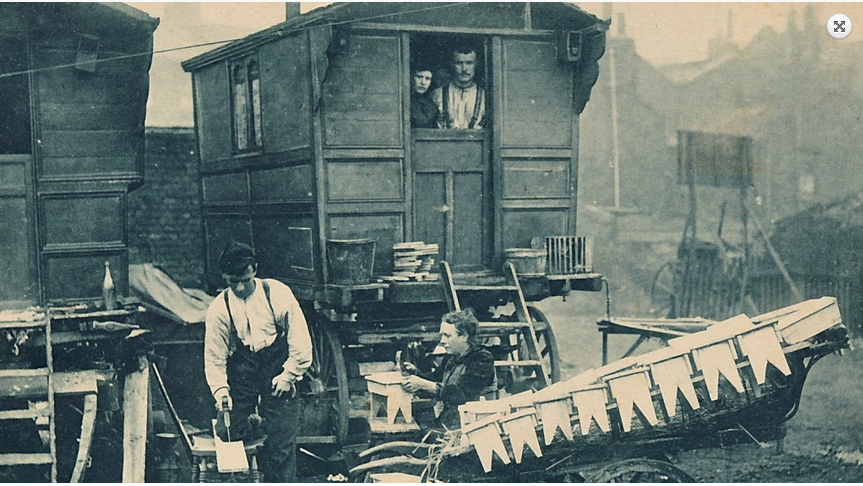
Below is an image of a couple, working together making footstools outside their vardo while another couple looks on from the comfort of their wagon.
Gypsy carpenters making small and large stools for market. From an early 20th century postcard. Source: Romany and Traveller Family History Society.
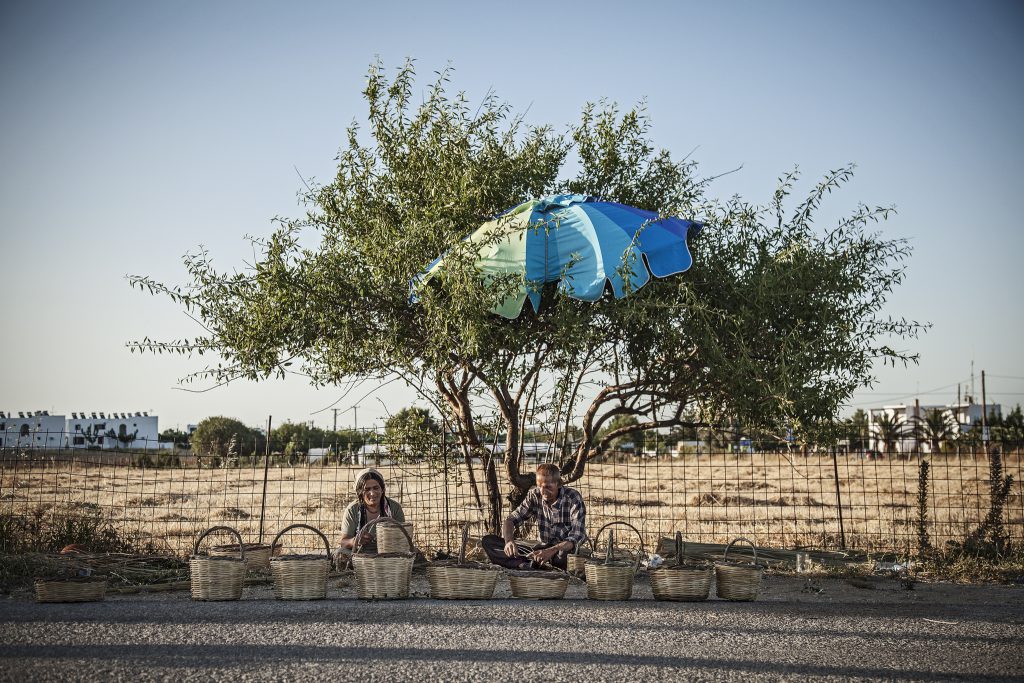
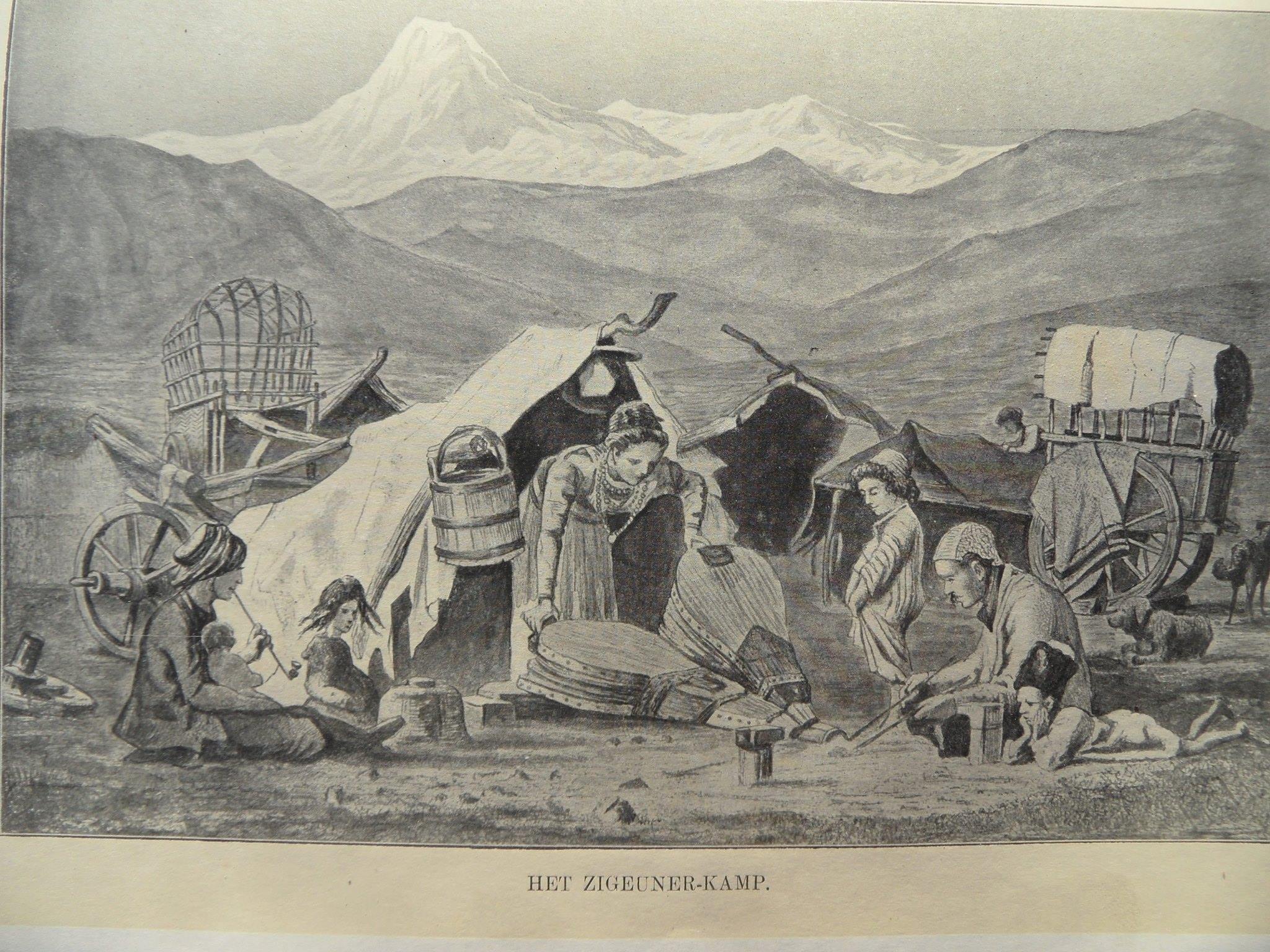
Other Gypsy families were blacksmiths, basket weavers, or similar occupations that could be taken on the road, required little stock or overhead, and could be performed independently or with a minimum of family help.
Nomads are not loners. In fact, humans do not do well alone in any setting. We have always been communal people, depending upon one another for help and support. Many hands make light work and it is essential to be near others you can depend on.
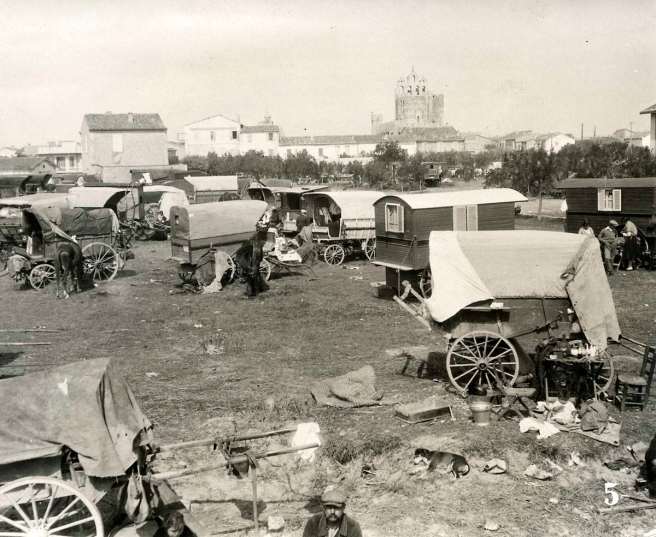
I have been collecting images of Traveller communities for many years and I really enjoy the gritty, homespun feel of the old encampments with peeling paint and makeshift tarpaulin shelters. I’m sure this image was not welcome in settled communities around Europe and the shiftless nature of these wanderers led to many suspicions, both unfounded and real.
These are not the rolling home of the wealthy showmen of idle rich but the best compromise for families destined to live on the road.
The vardos bear many differences but within fairly tight physical contraints of size, weight, needs, and technology. It’s important to remember as well that historic travellers of most varieties didn’t design or build their own accommodations but often modified or improved that which they acquired.
Even though they show few relevant details of the caravans themselves these are some of my favorite images; they give us a glimpse of the people who called them home.
Although Traveller families lived (and live) on the margins of “normal” society they were (are) more like their neighbors than not.
I hope you enjoy the photos as we head into the season of Thanksgiving here in North America and give thanks for what we have.
We are at our best and worst in groups, whether that is family or friends. Humans are social animals.
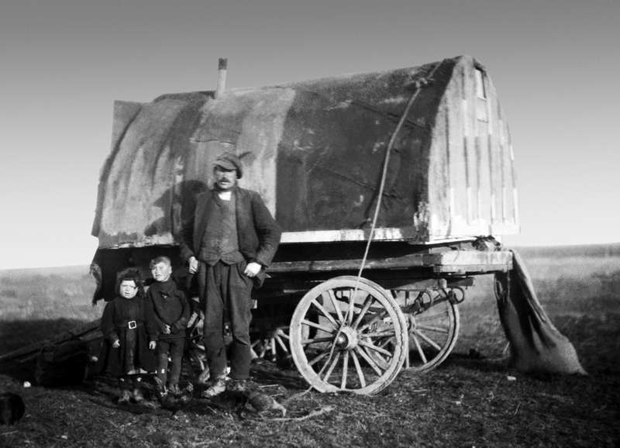
Here’s a wonderful old photograph of a “Tinker Family in Scotland.” It is believed to be taken sometime in the 1920s but the location was not identified. The wagon could just about pass for a western American sheep camp. Even thought they had the wealth to own a wagon it was still a pretty tough life, often unwanted in non-traveller (sic) communities, these people have been marginalized for centuries.
I found this one while perusing the Johnston Collection on the Document Scotland webpage. Have a look if you are interested in great images of a beautiful country.




 Preindustrial Craftsmanship