As usual, an interesting old find posted on the Lost Arts Press. It’s worth a read.
“It is doubtless the timidity of woman which restrains her mending instincts. She dreads the saw and the chisel as treacherous tools that inevitably inflict wounds on the user… Moreover, she can never grasp the difference between a nail and a screw, and regards the latter as an absurd variety of nail which can not be driven with a hammer unless the wielder of the hammer has the muscles of a man.”
Thank you Paul Sellers for stating an obvious but nearly lost truth. There are far too many needless and complicated gizmos, devices, and “new technologies” for a 2,500 year old task. Clever marketers have figured out that we can blame our laziness and impatience on our tools and not ourselves.
Maybe I am speaking out of turn as my tools are always for from perfect.
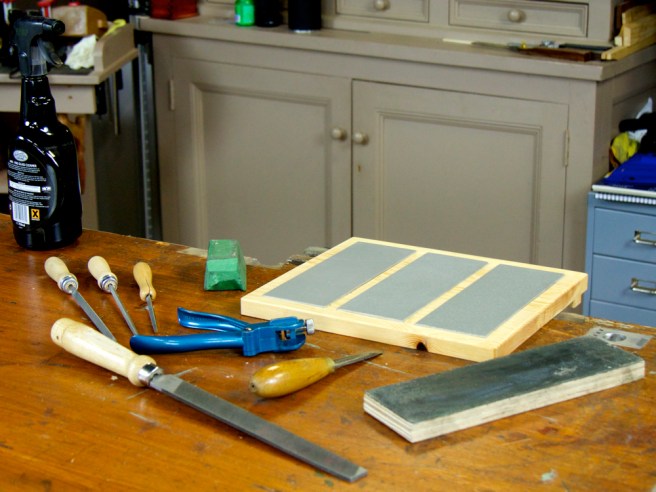
Catalogs are full of overpriced specialty devices designed to do the seemingly impossible; polish a sharp edge onto a piece of steel. I realize now that I was very fortunate. I learned to use a file and whetstone as a very young child. I even learned about setting saw teeth and how to use the hard straight razor stone. Before there were special stones to resurface a stone, we simpletons used a hard, sandy, and flat concrete surface before graduating on to sandpaper stuck to a sheet of glass.
Some of the best sharpeners I know still do virtually everything with Arkansas whetstones and some very-fine emery paper. One thing to remember though; you have to actually do it. If you don’t regularly keep things sharp, it only becomes more of a chore and takes more time. I think the old idea of spending a few minutes before you begin work of sharpening and stropping is a wise idea.
If you use tools, consider a real pair of Arkansas whetstones. Here’s a couple of sources to try:
In the mean time, head over to Paul Sellers’ excellent as usual blog for his take on sharpening as well. Notice his very simple set-up.
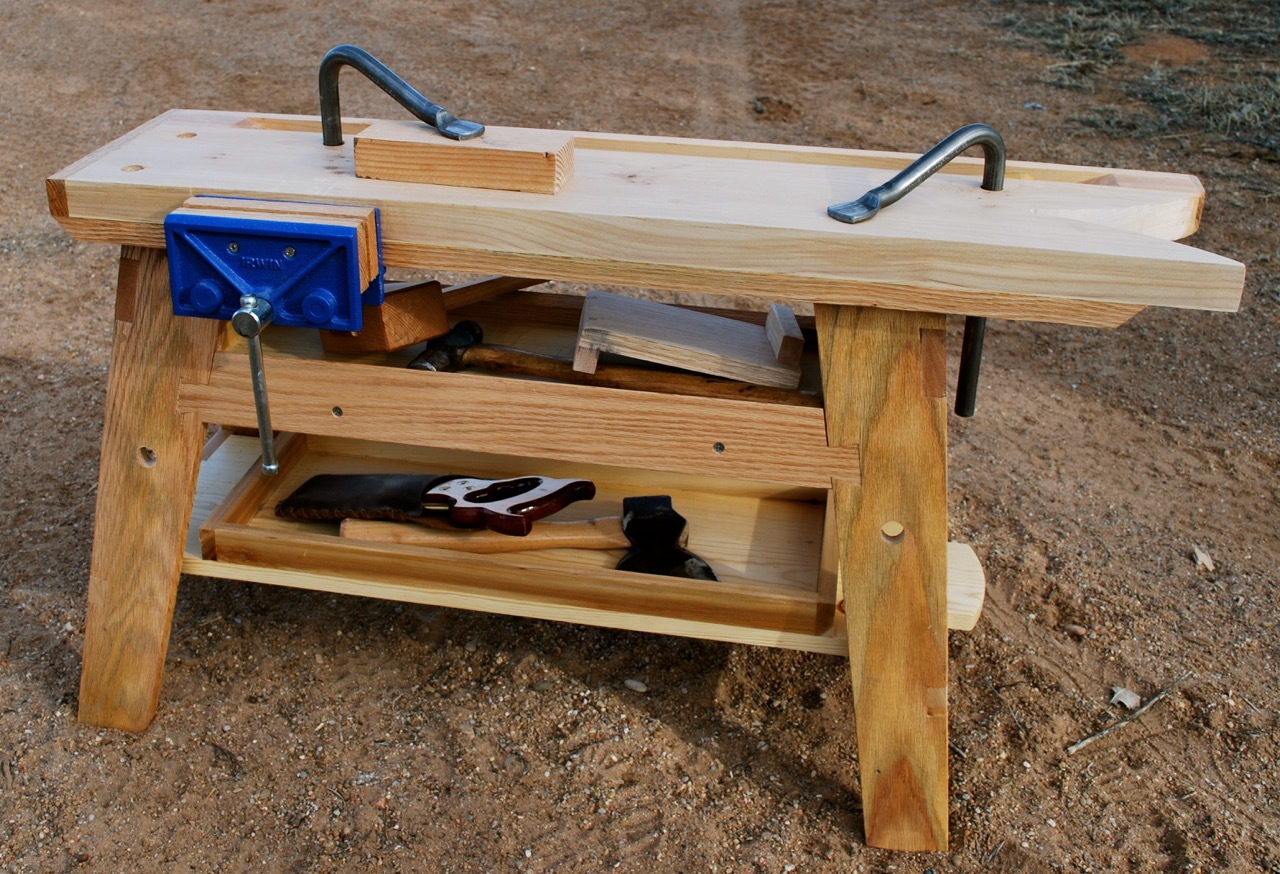
A little more done on the saw bench this weekend. It is clearly going to serve as my go-to portable workstation. I have several jigs in mind to add as regular features but, for now, I’ve started by making a brand new bench hook.
The bench’s small size will allow it to pack easily into the truck, even holding items in the tills.
I brought it out into the driveway this afternoon to get a few photographs before it’s all scuffed up and broken in.
The holdfasts are stored out-of-the-way by drilling a couple of holes in the legs. I placed them low enough that I can rotate them up to hold a board should the need ever arise.
I know this cannot replace a proper bench but I am very pleased right now. This will serve many functions, not the least of which is for bow and arrow making and as a leather work bench.
The holdfasts in place, holding nothing in particular.
This, in conjunction with the shave horse and folding x-leg table (below), will need to serve as my portable workshop for the foreseeable future I’m afraid.
Connection from leg assembly to the top.As for connecting the top, I used lag bolts with fender washers to provide a secure connection that could also be easily removed when the top is worn out.
This, in conjunction with the shave horse and folding x-leg table (below), will need to serve as my portable workshop for the foreseeable future I’m afraid.
The little table has many miles on it now and doesn’t look this pretty at all. I’m actually in the midst of refinishing it and will post pictures sometime soon.Bench hook on the bench.
This bench hook is oak, glued with Titebond 2, and pegged with Osage orange dowels for added strength. The dowels aren’t visible in the fence as they are half-blind and stop just short of the surface. A bench hook, shooting board, mitre box, and other small jigs make great use of scrap that might otherwise end up in the wood stove.
The wheel barrow is an old device replacing the hand barrow which was more of a stretcher-like contraption. Simple as it is, it is one of those benchmark inventions and should not be overlooked in the realm of important technological innovations.
A good post by Wesley from Wesleyworkswithwood. I like lists. I enjoy seeing tool lists that people think of as essential. I used to like the packing lists for backpacking that the Boy Scouts printed. I like the lists that traveling Buddhist monks put out as part of their order. Lists pare us down to the bare bones and make us think about what we have, what we need, and what we want. Head over to Wesley’s and get in on the discussion. It should be a grand old time.
Stanley No. 5 Jack plane, or non-Stanley equivalent
One 3/4″ chisel
One 1/4″ mortise chisel
A Mallet
Two holdfasts
Two to four wooden handscrew clamps
Two to four 4 foot long bar clamps
One pint wood glue
Cut nails, 1″ long
Cut nails, 1 1/4″ long
Flat head screws, 1 1/4″
Sandpaper in grits 100, 160, 180, 220
Sharpening stones in rough, medium, and fine grits
Knock off of an eclipse sharpening jig
12″ Combination Square
Marking Gauge
Marking Knife
24″ Straightedge
Tape measure
16 oz claw hammer
Set of screwdrivers
Drill with common bits in common sizes
This post got away from me. Here’s what I hope to get out of it: a conversation. Do you think someone could get started with what I’ve listed above? Can something be removed from that list?
One of my favorite tools and one I have seen misused by too may people over the years. Often these are snatched up at auctions by antiquey people who want a wall hanging but quality ones can be found on places like Ebay. I have several styles and they each have their virtues.
My carriage maker model gets all the heavy work where the carpenter’s razor gets the other 80%. And let’s not forget the humble but beautiful cabinet scraper.
The common spokeshave has not changed much in over a century. The main types can be subdivided several ways but they are essentially, high or low angle with various shapes to the foot plate. I find this tool a great help when making bows, handles, or other spindle-shaped things. A flat shave will take you a long way but I get great use out of a rockered-style (convex front-to-back) for creating the complex shape of a bow handle.
These examples are from the very early 20th century and are all probably still in use from that era. I still have a boxwood low angle shave from my great-grandfather. The steel is remarkable.






 Preindustrial Craftsmanship