Building Your Own Vardo

I began version one of my Vardo Caravan eleven years ago this month.  As I published updates and details along the way people have for a detailed “how to” for building a vardo.  Since everyone’s needs, skills, and resources are different, I will leave the task to others.  My suggestions are this.  Decide on your basic design wants.  Traditional or modern construction?  Consider size and weight (I went for the minimum of both).  Consider materials.  This will determine construction technique.  As for traditional or modern?  Go look at some used RVs for sale and see how flimsy they are built; not to mention probable issues from toxins in the plywood, pressboard, adhesives, plastic veneers, etc.

Drink in as many details as possible about other wagons.  Are they for show or can they take the hammering of bad roads?  How do you think they will hold together in a wreck?  What kind of long-term maintenance are you prepared to perform?  This is why modern RVs are covered in sheet metal or plastic.  If you convince yourself that you want to use materials others don’t, then ask yourself why.  Are you building an RV that looks “old fashioned” or are you deciding to build with traditional techniques?  (Neither is bad, but it may not be practical to mix and match).

Final sketch that built the Vardo.

Above is the written plan I used to create the Vardo.  This is obviously not exactly how it turned out as changes were made based upon availability of materials and constant reconsidering of different options.  The essentials didn’t change.  This is how the arc of the roof was calculated and overall dimensions worked out.  I chose to use traditional techniques and plywood only in the ceiling (for ease of building and stiffening the structure).  Although glue is used in some areas, the structure depends upon screws and bolts in all critical areas.  I decided I was willing to maintain my wagon so the exterior finish is simple oil paint over wood.

Sketch, sheet 2.

The second sheet of the plan was mostly used as a way to gauge sizes, raw materials, and habitable space.  I didn’t really build from the sheet.

Figuring it all out.

This is just one of many sketches used to figure out space and arrangements.  I looked at Irish Open Lots, Vardos, Bow Tops, and Sheepherder wagons.  With so much experience out there, the best arrangements have been worked out many times over.  Here’s the link to the rest of the photos from the build: https://paleotool.wordpress.com/plans-projects-and-patterns/the-vardo/

Study and read as much as you can about what you want to build.  Make many sketches and plans.  Cut out little scale paper dolls to measure out spaces if it helps. 

Make a model.

Take a deep breath. 

Dive in.

ProtoStoga

I want to re-share this camper I posted about back in 2010.  I would still like to know more about it but love what I’ve seen so far.

I see some definite similarities to my own concept of a vardo but I really like to metal sheathing as a modern, low maintenance exterior.  Also, the rounded front was a long consideration in my plans but in the end I chose a more “old-timey” look.

You can just about see the evolution of the Airstream design in this construction.  They also have a nice Tiny House that’s worth checking out here: http://www.protohaus.moonfruit.com/

For those who don’t follow the Tiny House Blog, check out the ProtoStoga here:

http://tinyhouseblog.com/tiny-house-concept/protostoga/#more-12243

Dugald Semple and a Simple Life

I would like to re-share this older post I wrote about a caravaner, scholar, and philosopher I am quite intrigued by – Dugald Semple

Dugald Semple was a Scottish philosopher of the early 20th Century and an advocate for simple living.  After becoming and engineer he took to the woods and, for a period, a life on the road, living in a tent and in various caravans in order to write and travel and avoid the enslavement of increasingly urban society.

Semple on the beach.

His major question was always “How ought we to live?” an ancient subject for thinkers the world-over and a very important topic in Asian philosophy as well.  His teachings are interesting and he still has a serious following of vegans, fruitarians, and Christian Phlosophers around the world.  He apparently never ate meat, eggs, or cheese, and subsisted on a mostly fruit diet.  It clearly worked well-enough, as he died at the age of 79 in 1964.  Not bad, but think of all the bacon he missed!

DugaldSemple

Of course, my interest in Dugald lies primarily in his simple lifestyle and his fondness for caravans and living in the open.  He married well.  Cathie, his wife was a widow who was independently wealthy, owning a large house and grounds.  This certainly contributed to the success of the life-long experiment in simple living.  Even as he settled down, he still philosophized and associated with his old friends who roamed the countryside and set up guilds of craftsmen (Nerrissa Wilson, Gypsies and Gentlemen).  He envisioned a new generation of skilled travelers who could pack up their trades and families and move to where the work was, thus alleviating some of the new stress of urban life.

Semple
Semple in his summer camp.

I love this camp.  This wagon seems perfectly suited for summertime use with the fully opening sides.  Too bad his dream didn’t catch on, but he admitted that life on road could be stressful and difficult.  At least we can give it a try; even if in a limited capacity.

Joy-in-Living

As an end note, here’s a quote he is well known for on his philosophy of a vegan lifestyle:

Personally, I began rather drastically over 50 years ago by cutting out not only all meat or flesh foods, but milk, eggs, butter, tea and coffee. Cheese I have never eaten; indeed I hate the very smell of this decayed milk. Next, I adopted a diet of nuts, fruit, cereals and vegetables. On this Edenic fare I lived for some ten years, and found that my health and strength were greatly improved. Probably this was also because I lived more in the fresh air and closer to Nature. (Emphasis added by the ed.).

I just don’t know if I can fully trust a man who won’t eat cheese…

A Fine Old Sheepherder Wagon

I love these the old sheepherder camps.  I’ve seen quite a few parked on ranches from Colorado to Idaho and even a few in Arizona.  I know they aren’t highway capable but it seems they could provide a real housing alternative for low-income minimalists who have access to land.  Far better than a housing complex or apartment for sure if you can deal with a small footprint.

Originally designed on a narrow wagon box, the builders took advantage of every square inch of space.  Since weight wasn’t really an issue, many have large stoves like the one above for heating and cooking.  As most of these wagons were homes for ranch workers in the western U.S., they needed to be prepared for extreme cold and windy environments.  When I was building my vardo, I took a fair amount of design inspiration from these wagons, adding their vibe to the more European designs I was ingesting.  My stove is small and I envy this one above; at least the cook top.

Off-the-shelf or build it yourself?  It’s the details of hand-built structures that make them stand out and this chimney cap is no exception.  This looks far more interesting to me than the local hardware store option.

The photos are from Ken Griswold’s Tiny House Blog.  If you haven’t figured it out yet, I’ve been a fan of his site for a long time now and recommend it for anyone with an interest in Tiny Homes.  Here’s a link to the full article about Lorna’s wagon.

Save

Novel Camping Trailer from 1929

From the ingenuity of the Roaring 20s.  Pack up with your favorite Flapper and head to the wide-open spaces!

camping_trailer

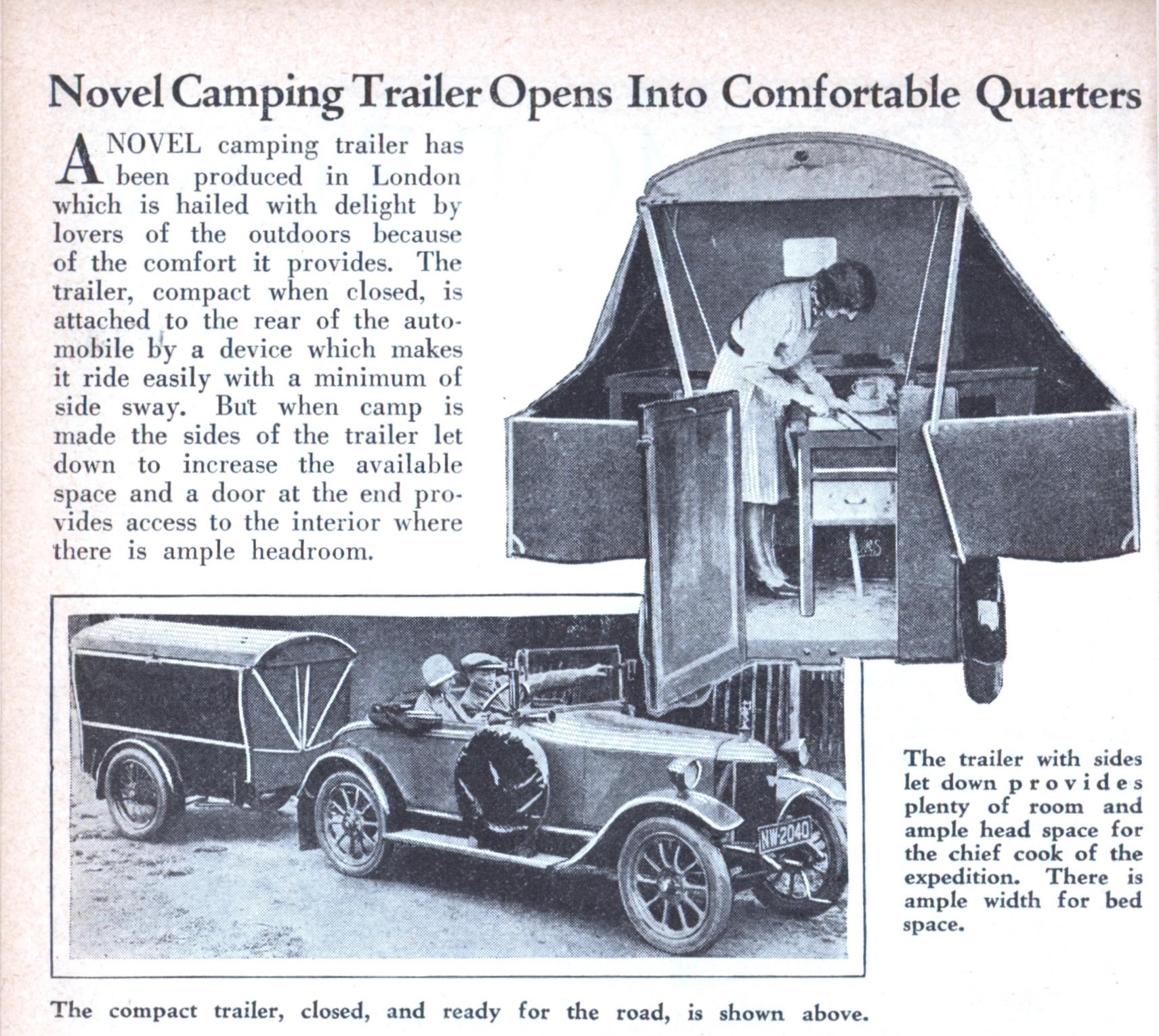
Novel Camping Trailer Opens Into Comfortable Quarters
A NOVEL camping trailer has been produced in London which is hailed with delight by lovers of the outdoors because of the comfort it provides. The trailer, compact when closed, is attached to the rear of the automobile by a device which makes it ride easily with a minimum of side sway. But when camp is made the sides of the trailer let down to increase the available space and a door at the end provides access to the interior where there is ample headroom.

From Modern Mechanics and Inventions, December 1929.

Yet Another Sheepherder…

(from the Paleotool vault)

I love these things.  I saw quite a few parked on ranches from Colorado to Idaho last week.  I know they aren’t highway capable but it seems they could provide a real housing alternative for low-income minimalists.  Way better than a housing complex or apartment for sure.  The photos link to Ken Griswold’s Tiny House Blog.  If you haven’t figured it out yet, I’m a fan of his site.

I took a fair amount of design inspiration from these wagons but added a bit of class along the way.  I wouldn’t mind having a cook stove like this one though.

Off-the-shelf or build it yourself?  I love these details in hand-built structures.  This looks way better to me than the local hardware store option.

Have a look at Lorna’s old wagon here.

Save

Save

Growing Up on the Range…

(from the Paleotool vault)

Here’s a great story I read years ago about being raised in a family of six in a sheep camp measuring about 7 x 8′! (I think that’s the floor space).  I recently relocated the article in Mother Earth News.

Nice layout sketch of a sheep camp.

Here’s an excerpt:

“The canvas-covered sheep wagon was roughly about seven feet wide by eight feet long. On the front end a door opened out of the middle and you stepped down onto the wagon tongue and thence to the ground. From the inside looking out, the stove was on the left of the door. On the right was a small wash stand with several wooden drawers for storage of linens, towels and socks. A bucket of water and washbasin were on the oil cloth covered top and a small mirror hung above the basin for shaving. Soap, toothbrush, razor and essentials rested on top of the stand when in location or were stowed in a drawer when moving.”

Read more here: http://www.motherearthnews.com/nature-community/sheepherders-wagon-zmaz70mjzkin.aspx

Save

Wyoming Sheepherders Again

 (from the Paleotool vault)

Sheep camps from Wyoming from the Wyoming Tales and Trails webpage.  Great photos and some good information concerning everything “western.”

I could spend much of my life like this!

A self-contained base camp in a sheep wagon provides a cozy home on the prairie.

A beautiful culmination of cultures a innovations created this iconic American living arrangement.  We can learn a lot from these designs today.

The Wyoming Tails and Trails website contains a lot of other information about western history along with more than 100 photos.  Have a look around and get a feel for the old west.

http://www.wyomingtalesandtrails.com/

Save

Sheepherders’ Camps

Here are a few classic Sheep Camps from the Wyoming Tales and Trails webpage. There are some great photos and some good information on their web page.  I personally took a lot of inspiration from these resourceful and low-cost housing solutions.

Fiddling on the prairie.  I could spend much of my life like this!

Out on the range. Looking at my Vardo, you can see my inspiration for the offset door and stove.

Again, the offset door. I get asked about this a lot. It gives a large amount of room on one side.

There’s a lot of other information and photos of western history here too.  Have a look around.

http://www.wyomingtalesandtrails.com/

Update from the vault: Vardo and Sheepherder Links

After several requests for information, here is my short list of inspirational sites found on the web.  Culling the web for Vardo style so you don’t have to.  I will try to morph this into it’s own page soon as a place to add more links as they become available.

Romany and Traditional Style

GypsyWaggons
Great Historical Resource

Roth
Gypsy Vans by Roth. Beautiful traditional waggons with loads of information about types and styles. Amazing stuff here.

Nice, garden variety caravans.  These make wonderful retreats and getaway spaces.
Nice, garden variety caravans. These make wonderful retreats and getaway spaces.

Solid, permanent and towable vardos from Windy Smithy.

Ingham & Fallon, restoration, new and used.  The images alone make this one worthwhile.
Ingham & Fallon, restoration, new and used. The images alone make this page worthwhile.

Sheepherder Wagons

Plan to spend some time on this website.  Anvil Wagon Works in Livingston, Montana makes all types of traditional Chuckwagons, Sheepwagons, and Buggys.  Lot's of great photos.
Plan to spend some time on this website. Anvil Wagon Works in Livingston, Montana makes all types of traditional Chuckwagons, Sheepwagons, and Buggies. Lot’s of great photos inside and out.


This image links to their Sheepwagon page but there is so much more here.  Serious craftsmen of all things traditional Wagon and Wheel related.
This image links to their Sheep wagon page but there is so much more here. Serious craftsmen of all things traditional Wagon and Wheel related.

The Lazy AA Guest Ranch and Builders of towable Woolywagons.

Idaho Sheep Camp.  You can't be more authentic than this.  I want one!  Pages of images to inspire the builder of tiny homes.
Idaho Sheep Camp. This is the interior of just one of their many featured wagons.  You can’t be more authentic than this. I want one! Pages of images to inspire the builder of tiny homes.

Old Western Wagons are builders of Sheep Wagons, Vardos, Freight Wagons, and other horse drawn vehicles.  Located in Seattle, Washington.
Old Western Wagons are builders of Sheep Wagons, Vardos, Freight Wagons, and other horse-drawn vehicles. Located in Seattle, Washington.

Engel's Coach Shop  Joliet, Montana.  Master Wheelwright and makers of horse drawn vehicles.
Engel’s Coach Shop Joliet, Montana. Master Wheelwright and makers of horse-drawn vehicles.

Plankbridge Shepherd Huts from Dorset, England.  Traditional huts, not for long distance travel but fine for short moves.  Nice designs.
Plankbridge Shepherd Huts from Dorset, England. Traditional huts, not for long distance travel but fine for short moves. Nice designs.

bshtrippictransnoshadow850
Blackdown Shepherd Huts. Handcrafted in Somerset, England. Posh and spiffy little cabins with lots of style.

Shepherd
Everything you need to know about historic Shepherd Huts.

Ranch Willow Wagon Co. builds and restores wagons to the highest quality standards. Company owner Lynn Sedar has been in the wagon business for over 20 years and is also an acclaimed artist, design consultant and furniture designer. Wagons designed by Ranch Willow Wagon Co. are the ultimate blend of history and art.

French Style

ImageTitreIndex

In French. The website contains some good old images as well as information about various types of travelers’ wagons (a.k.a. Roulottes).

An Interesting mix of Hippie vehicles from Britain and Europe:

travellerhomes-head

MORE TO COME