Building Your Own Vardo

I began version one of my Vardo Caravan eleven years ago this month.  As I published updates and details along the way people have for a detailed “how to” for building a vardo.  Since everyone’s needs, skills, and resources are different, I will leave the task to others.  My suggestions are this.  Decide on your basic design wants.  Traditional or modern construction?  Consider size and weight (I went for the minimum of both).  Consider materials.  This will determine construction technique.  As for traditional or modern?  Go look at some used RVs for sale and see how flimsy they are built; not to mention probable issues from toxins in the plywood, pressboard, adhesives, plastic veneers, etc.

Drink in as many details as possible about other wagons.  Are they for show or can they take the hammering of bad roads?  How do you think they will hold together in a wreck?  What kind of long-term maintenance are you prepared to perform?  This is why modern RVs are covered in sheet metal or plastic.  If you convince yourself that you want to use materials others don’t, then ask yourself why.  Are you building an RV that looks “old fashioned” or are you deciding to build with traditional techniques?  (Neither is bad, but it may not be practical to mix and match).

Final sketch that built the Vardo.

Above is the written plan I used to create the Vardo.  This is obviously not exactly how it turned out as changes were made based upon availability of materials and constant reconsidering of different options.  The essentials didn’t change.  This is how the arc of the roof was calculated and overall dimensions worked out.  I chose to use traditional techniques and plywood only in the ceiling (for ease of building and stiffening the structure).  Although glue is used in some areas, the structure depends upon screws and bolts in all critical areas.  I decided I was willing to maintain my wagon so the exterior finish is simple oil paint over wood.

Sketch, sheet 2.

The second sheet of the plan was mostly used as a way to gauge sizes, raw materials, and habitable space.  I didn’t really build from the sheet.

Figuring it all out.

This is just one of many sketches used to figure out space and arrangements.  I looked at Irish Open Lots, Vardos, Bow Tops, and Sheepherder wagons.  With so much experience out there, the best arrangements have been worked out many times over.  Here’s the link to the rest of the photos from the build: https://paleotool.wordpress.com/plans-projects-and-patterns/the-vardo/

Study and read as much as you can about what you want to build.  Make many sketches and plans.  Cut out little scale paper dolls to measure out spaces if it helps. 

Make a model.

Take a deep breath. 

Dive in.

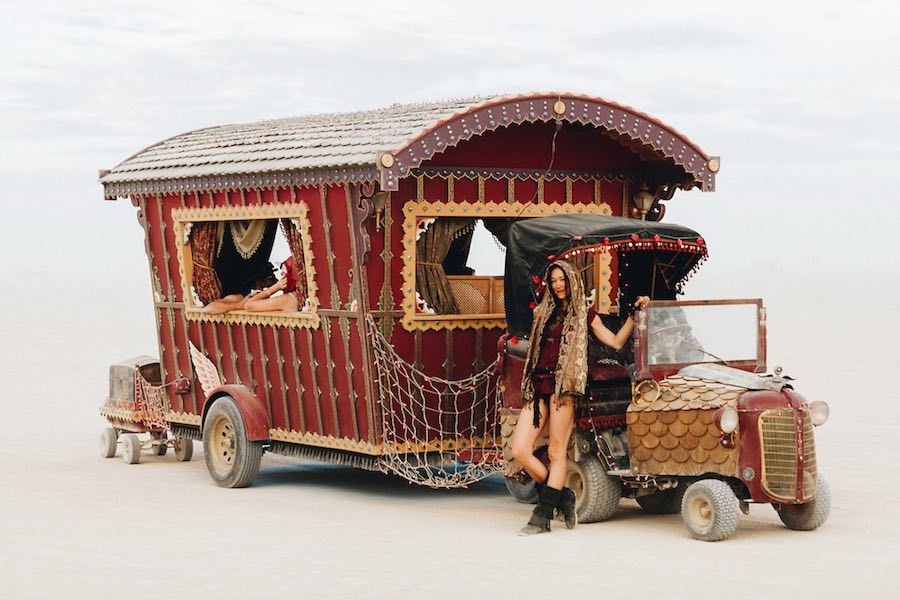
A Slow Moving Beauty

Reported from Burning Man 2016.

I don’t really know anything about this beautiful rig but I like what I see.  A converted mower in front as a tow vehicle and it’s pulling a little trailer of it’s own behind.  If anyone knows any more about this one please let me know!  I found it on Tumblr but was able to image search it back to this source:

http://www.archipanic.com/burning-man-exploring-black-rock-city/

Save

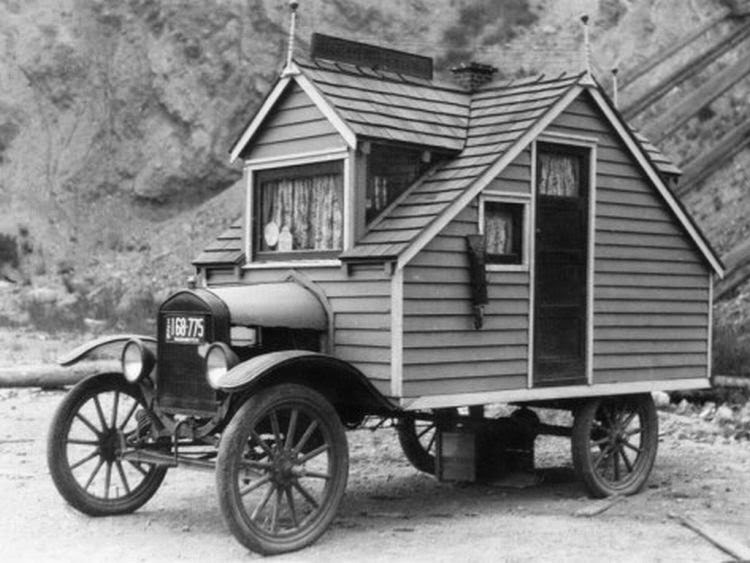
A 1926 Home Built Camper Truck

An early tiny house on wheels… and a family selfie.

W.M. O'Donnell & family of Detroit in bungalow auto, 2/1/26.
W.M. O’Donnell & family of Detroit in bungalow auto, 2/1/26.

The Library of Congress has some pretty amazing stuff.  I rarely find what I came for but I always find something pretty spectacular.  This house (click to enlarge) is quite a piece of woodworking.  Shingle siding all glass door, sturdy balcony, beautiful windows, under storage, and what I think is a pull out pan box on the back.  The O’Donnell’s were certainly traveling in style.

The amount of joinery that went into the door and windows is probably more than found in most houses today.
W.M. O’Donnell & family of Detroit in bungalow auto, 2/1/26

The amount of joinery that went into the door and windows is probably more than is found in most houses today.  I really like the old basement windows used as storage access underneath.  As usual, I could find no interior photos but I suspect it was well appointed.

Original files can be found: http://www.loc.gov/pictures/item/npc2008007978/and http://www.loc.gov/pictures/item/npc2008007936/

If this isn’t inspiring, I don’t know what is.

Oh, and nearby photo caught my eye in the Library:

Mlle. Rae with garter flask, 1/26/26.

I’ve never known a woman with a garter flask before…

Finally…

A perfect rolling home.

And a place for everything!

Bundesarchiv. Bild 183-1987-1002-510 Foto 1 November 1922.

The details here are remarkable including the decorative framing around the windows and planter boxes … with plants!  I believe this sits on solid rubber teeth-rattling tires.  You can probably tell from the caption but this is apparently from Germany in 1922.  I wish I knew what the function of the trailer was; workshop, spare bedroom, animals, kitchen?

Camper Bicycle

I would love a human-powered world with creatures like this filling our highways, quietly and without belching exhaust into the air.  Maybe we wouldn’t need to expend all our resources and youth expanding the empire to secure our ever-growing need for oil overseas.

bikecamperAs things stand today, there are few roads you could safely travel with this beast. But I’m just a dreamer.  Is that window a subtle Oregon “O”?

Found here: http://mooiefietsennicebikes.tumblr.com/post/87924151197/camperbike