Presenting the traveling requisites; a caravan case and road-grade book.
Advertisement for a lightweight but implicitly tough (it is sole leather after all) suitcase or light trunk for the traveler. Road grade books were very handy in the days of principally human and animal power. If you are cycling cross-country or pulling and immense showman’s van you may choose to avoid some of the worst grades. Britain was notorious for poor roads for centuries so you don’t want to be stuck in ruts on an eight percent grade at nightfall. These books were lifesavers.
Saves Gas Bills, Saves Trouble, Saves Patience, Saves Time! And it burns any kind of oil. I think we would market this as multi-fuel off-grid survival stove these days.
It seems that minimalism is the word du jour around the internet these days. Tiny houses, the 100 Thing Challenge, Non-Conformist work strategies, and urban homesteaders are filling blog-space with ideas and adventures outside the old consumerist norm. Many people are looking for something more in their lives and realizing that Stuff is not the answer. There is often an epiphany in someone’s life when they come to the realization that humans are not just professional consumers or targets for marketing strategies. Shopping is not a valid pastime. Hopefully there is more to our short existence than reality TV. Having lived without regular television for quite a few years I feel very lucky to miss out on political soundbites, sit-coms, and mass marketing of sports-watching. Unfortunately, even with my relative isolation, I know about these things from reading the news on the Internet almost daily.
Choosing to not buy into most popular-culture lightens my mental load a lot and (hopefully) allows time for deeper and more elevated thinking as well as crafting a better life. Daily walks, exercise, building things, cooking good food, and reading make for a calmer mind and a lower stress level. These are intentional activities not the imposed sedation of consumer culture.
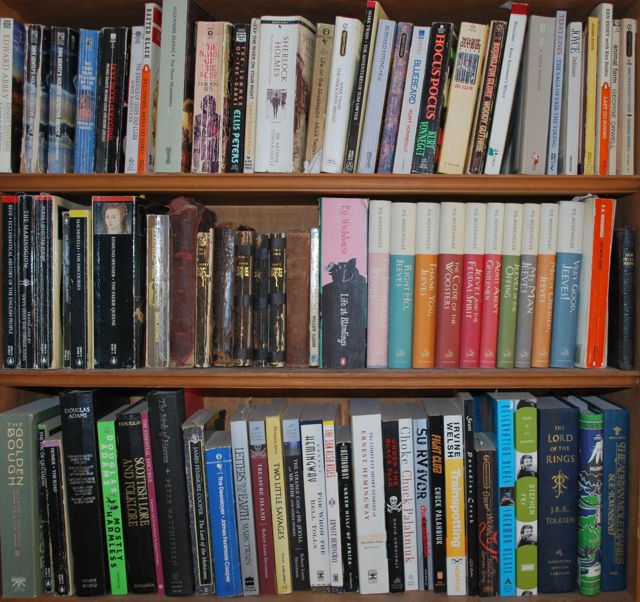
When I had to leave Flagstaff about eight years ago, I began uncluttering my belongings. I don’t think of myself as a collector, but I had amassed an enormous library of books. This is what people on an academic path do … right? Who did I think I was? Some nineteenth-century English aristocrat? Why would I possibly need a personal library? It hit me one day that this was crazy. I have hauled books around since I was a teenager until it became truckloads to move while nearly always living within twenty minutes of a large, academic library.
Sure, as a person who researches writes for work there are certain references and sources I need to have on hand and could not adequately perform my job without, but I had fallen into the trap of keeping books around “just in case” I wanted them again. That’s not to say that there aren’t recreational books I would never want to be without and I hope to read or reference many more times before I die.
I was able to sell a fair number of books and make a few dollars from them but, in the end, found that there isn’t a high monetary value on most books. These I gave away. I gave away even more to the local library and to the Goodwill store. I still have far too many books, but now its really just the one’s I love or have a need for. The ones I may not need but can’t quite part with are: a few rare antiques, first editions, special editions, and expensive academic tomes.
I’m still giving away books but I’m still buying them as well. Being far from a real bookstore actually makes it easier, not harder, to shop, read reviews, preview and purchase books. Without getting up I can order a book and expect it in my post office box in a week. Such is the Amazon.com culture.
I still read voraciously, but now, when considering a book, I really try to consider how much I want to own it and do I want to lug it around? Another anchor holding me down. Can my local library get it? This has been a difficult addiction to overcome. I’ve bought books since I was fourteen and, on some level, prided myself on having such an extensive collection at my fingertips. It felt good to put another dozen or so hardbacks in my Goodwill box this morning. Just a few hundred more to let go (but a few more are on their way to my post office).
Did you know that labor unions made the following 36 things possible?
1.Weekends without work
2.All breaks at work, including your lunch breaks
3.Paid vacation
4.Family & Medical Leave Act (FMLA)
5.Sick leave
6.Social Security
7.Minimum wage
8.Civil Rights Act/Title VII – prohibits employer discrimination
9.8-hour work day
10.Overtime pay
11.Child labor laws
12.Occupational Safety & Health Act (OSHA)
13.40-hour work week
14.Workers’ compensation (workers’ comp)
15.Unemployment insurance
16.Pensions
17.Workplace safety standards and regulations
18.Employer health care insurance
19.Collective bargaining rights for employees
20.Wrongful termination laws
21.Age Discrimination in Employment Act of 1967 (ADEA)
22.Whistleblower protection laws
23.Employee Polygraph Protection Act (EPPA) – prohibits employers from using a lie detector test on an employee
24.Veteran’s Employment and Training Services (VETS)
25.Compensation increases and evaluations (i.e. raises)
26.Sexual harassment laws
27.Americans With Disabilities Act (ADA)
28.Holiday pay
29.Employer dental, life, and vision insurance
30.Privacy rights
31.Pregnancy and parental leave
32.Military leave
33.The right to strike
34.Public education for children
35.Equal Pay Acts of 1963 & 2011 – requires employers pay men and women equally for the same amount of work
36.Laws ending sweatshops in the United States
THANK A UNION !!!
“Anyone who believes in indefinite growth in anything physical, on a physically finite planet, is either mad or and economist ,” Kenneth Boulding, environmental advisor to President Kennedy.
A realism to ponder when listening to bankers and politicians.

 Advertisement for a lightweight but implicitly tough (it is sole leather after all) suitcase or light trunk for the traveler. Road grade books were very handy in the days of principally human and animal power. If you are cycling cross-country or pulling and immense showman’s van you may choose to avoid some of the worst grades. Britain was notorious for poor roads for centuries so you don’t want to be stuck in ruts on an eight percent grade at nightfall. These books were lifesavers.




 Preindustrial Craftsmanship