The Blind Fiddler

The Blind Fiddler 1806 Sir David Wilkie 1785-1841 Presented by Sir George Beaumont Bt 1826 http://www.tate.org.uk/art/work/N00099
The Blind Fiddler 1806 Sir David Wilkie 1785-1841, Tate Gallery Collection.

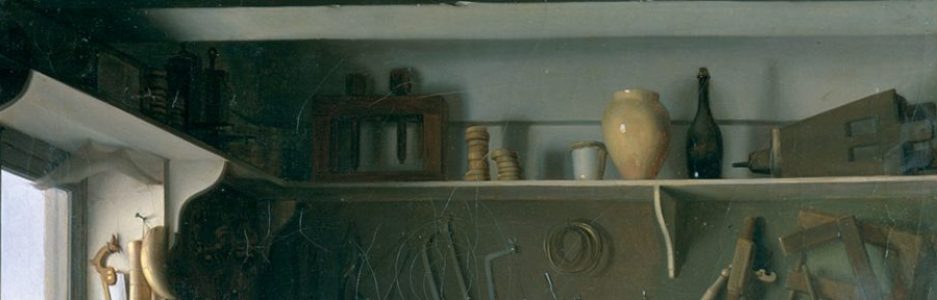
“An itinerant fiddler is playing for a humble country family. David Wilkie focuses on the listeners’ different expressions. Only two people seem to respond to the music: the baby and the boy on the right, who is imitating the fiddler by playing the bellows.When this picture was exhibited at the Royal Academy some critics thought the bust on the shelf represented a dissenting minister, and concluded that the family were nonconformists. The power of music to stir the passions of those supposedly suspicious of pleasure was thought to add to the painting’s subtlety.” From the Tate website 2007.

So many historic details in this painting: basket, copper work, cookware, walking stick, spinning wheel, stools, hats, dog, pipe, key, cup, and shovel.  A snapshot of late 18th – early 19th century rural life.
Comrades

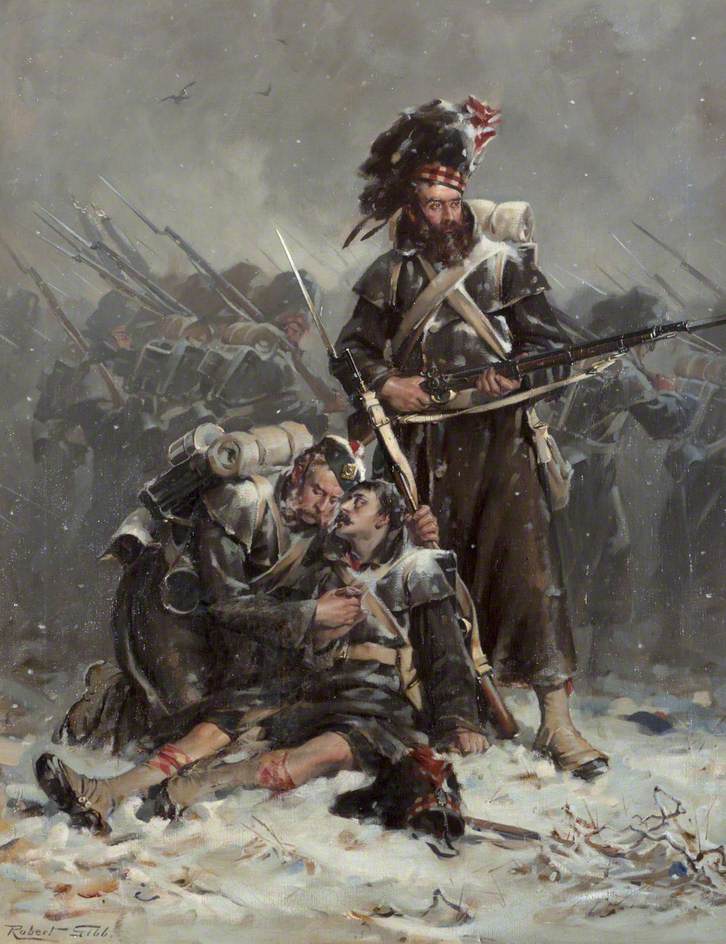
ComradeComrades, the 42nd Highlanders (copy of a lost earlier painting by the artist) 1894, by Robert Gibb.

This image is extremely moving and poignant.  The scene is of the 42nd Regiment of Foot (later called the Black Watch),  during the Crimean War winter campaign of 1854-1855.  The dying man on the ground is whispering his dying words to the man propping him up while the third stands over them.  The image is said to have been inspired by reading a book on Napoleon’s retreat from Moscow and adapted to a more familiar British theme.  This remarkable snapshot of 19th century history hangs in the Black Watch Museum, Balhousie Castle in Perth, Scotland .

Seek Solutide

Eugene_delacroix“Nourish yourself with grand and austere ideas of beauty that feed the soul… Seek solitude.”

“I must work alone. I think that going into society from time to time, or just going out and seeing people, does not do much harm to one’s work and spiritual progress, in spite of what many so-called artists say to the contrary. Associating with people of that kind is far more dangerous; their conversation is always commonplace. I must go back to being alone. Moreover, I must try to live austerely, as Plato did. How can one keep one’s enthusiasm concentrated on a subject when one is always at the mercy of other people and in constant need of their society? … The things we experience for ourselves when we are alone are much stronger and much fresher. However pleasant it may be to communicate one’s emotions to a friend there are too many fine shades of feeling to be explained, and although each probably perceives them, he does so in his own way and thus the impression is weakened for both.”

Eugène Delacroix – 1798–1863.

Pop over to Maria Popova‘s blog “Brain Pickings” and read more about Delacroix and his thoughts on solitude.  While you are there, check out the many other fine and philosophical musings of her’s.